
Topic
This article explains how to configure single sign-on (SSO) in NinjaOne for a new identity provider (IdP).
Environment
- NinjaOne Platform
- NinjaOne Integrations
Description
You can use SSO to configure SAML (Security Assertion Markup Language) to access NinjaOne directly from your preferred provider portal. Use unique entity IDs to implement the same identity provider for SAML and SCIM (System for Cross-domain Identity Management).
Select a category to learn more:
- Important Considerations About Generic SSO Implementation
- Set Up SSO in NinjaOne
- Enable SSO for NinjaOne Technicians and End Users
- Additional Resources
Important Considerations About Generic SSO Implementation
Technicians can use SAML to access the NinjaOne application via SSO with their preferred IdP. You can use SAML with both the standard and branded NinjaOne site, which supports multiple IdPs.
You may use any IdP that supports SAML 2.0, and we provide user guides for configuring specific IdPs such as Duo, Okta, and Microsoft Azure, to name a few. You can access these guides from Security Assertion Markup Language (SAML).
For a generic SSO implementation, you will need the Unique User Identifier (UUID) attribute for each user. The UUID attribute must match the NinjaOne username, which is an email address. The SAML response or assertion must include necessary information, such as whether the session is valid, how long it remains valid, and other security specifications.
By default, NinjaOne uses the UUID attribute to match a NinjaOne user to their IdP account. If the UUID attribute value does not match the NinjaOne username, consider updating the UUID or Name ID to user.mail, user.othermail, or any attribute that will match an account’s NinjaOne username.
Set Up SSO in NinjaOne
You can add multiple SSOs and IDPs to a single instance of NinjaOne.
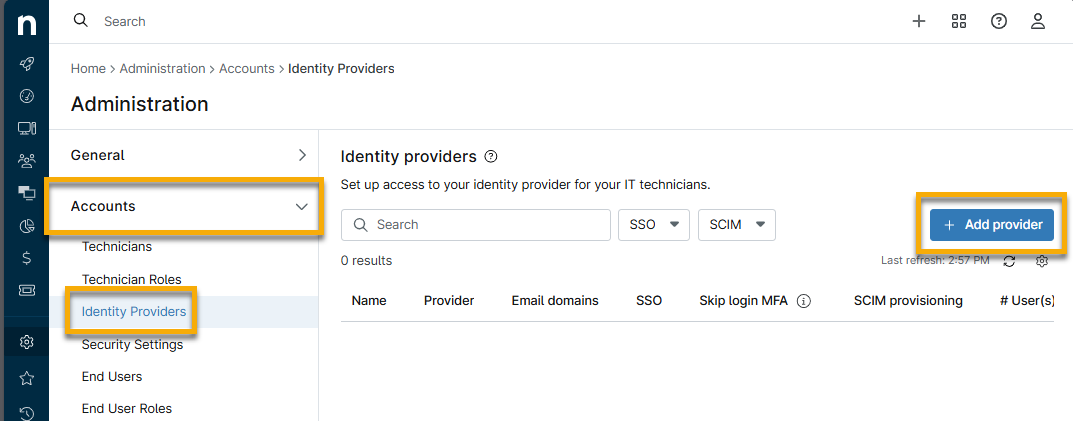
- Navigate to Administration → Accounts → Identity Provider. Select Add Provider.
- Enter a unique identifier for the Display name. This can be the email domain that uses this integration.
- For Authorized email domains*, determine whether you will use SSO or specific domains. If you select Specific domains, enter all characters after the @ in the target email addresses into the Specific domains* text field.

- Copy the Reply URL and identifier data from NinjaOne, and paste it in the appropriate field in the SSO provider's settings. You can find examples for specific providers in the Additional Resources section of this article.

- Copy the metadata from your IdP and paste it into the Import metadata from field. You can use a URL, file, or XML data; select the applicable option from the drop-down menu. For more information about the Enable conditional NinjaOne MFA bypass option, refer to NinjaOne Platform: Enable Conditional NinjaOne Multifactor Authentication Bypass.

- Determine whether you want to use IdP-initiated login or enforce strict SAML validation. To learn about the IdP-initiated login, refer to NinjaOne Identity Access Management (IAM): About IDP-Initiated Security Assertion Markup Language (SAML).

- Test and establish the connection.
- After testing the connection, you may be prompted to log in. When the test succeeds, click Save, and on the resulting page, click Enable. Single sign-on will now be active.
Enable SSO for NinjaOne Technicians and End Users
To use SSO in NinjaOne, select Single sign-on as the Authentication Type value for each technician in NinjaOne for whom it should be active. You can find more information at NinjaOne Endpoint Management: End User Sharing for Device Access.
- Navigate to Administration → Accounts → Technicians or End Users. Find the technician or end user for whom you wish to enable SSO and open the account configuration page.
- In the General section, open the Security tab.
- Select Single Sign On from the Authentication Type drop-down menu.

- To apply this change, click Save. Repeat this process for each technician for whom you would like to enable SSO.
Deactivate SSO
To deactivate SSO as a provider, perform the following steps.
- Navigate to Administration → Accounts → Identity Provider.
- Move your cursor over the IdP and click the actions menu button.
- Select Disable SSO.

To deactivate SSO for a single end user or technician:
- Open the account configuration page. In the General section, open the Security tab.
- Select a new option from the Authentication Type drop-down menu.
Additional Resources
Refer to Identity Authentication and Management: Resource Catalog to learn more about NinjaOne's identity services.