
Topic
This article explains how to enable conditional Bypass for NinjaOne multi-factor authentication (MFA).
Environment
NinjaOne Platform
Description
Enable conditional NinjaOne MFA bypass so it is performed only once during an SSO login, either at the Identity Provider or at NinjaOne, but not both. This still ensures a high level of security while providing the added usability benefit of requesting only a single MFA.
Index
Select a category to learn more:
- What is the MFA workflow?
- How does NinjaOne use MFA?
- Which Identity Providers Does NinjaOne Support?
- For which attributes does NinjaOne search?
- Why is "Enable conditional NinjaOne MFA bypass" hidden after the Identity Provider test?
- Why do users still get the Ninja MFA during login even though I have this feature activated?
- Does this affect NinjaOne MFA for security-sensitive operations in NinjaOne after login?
- Why do I still receive a prompt for MFA during login, even though I have activated Bypass?
FAQ
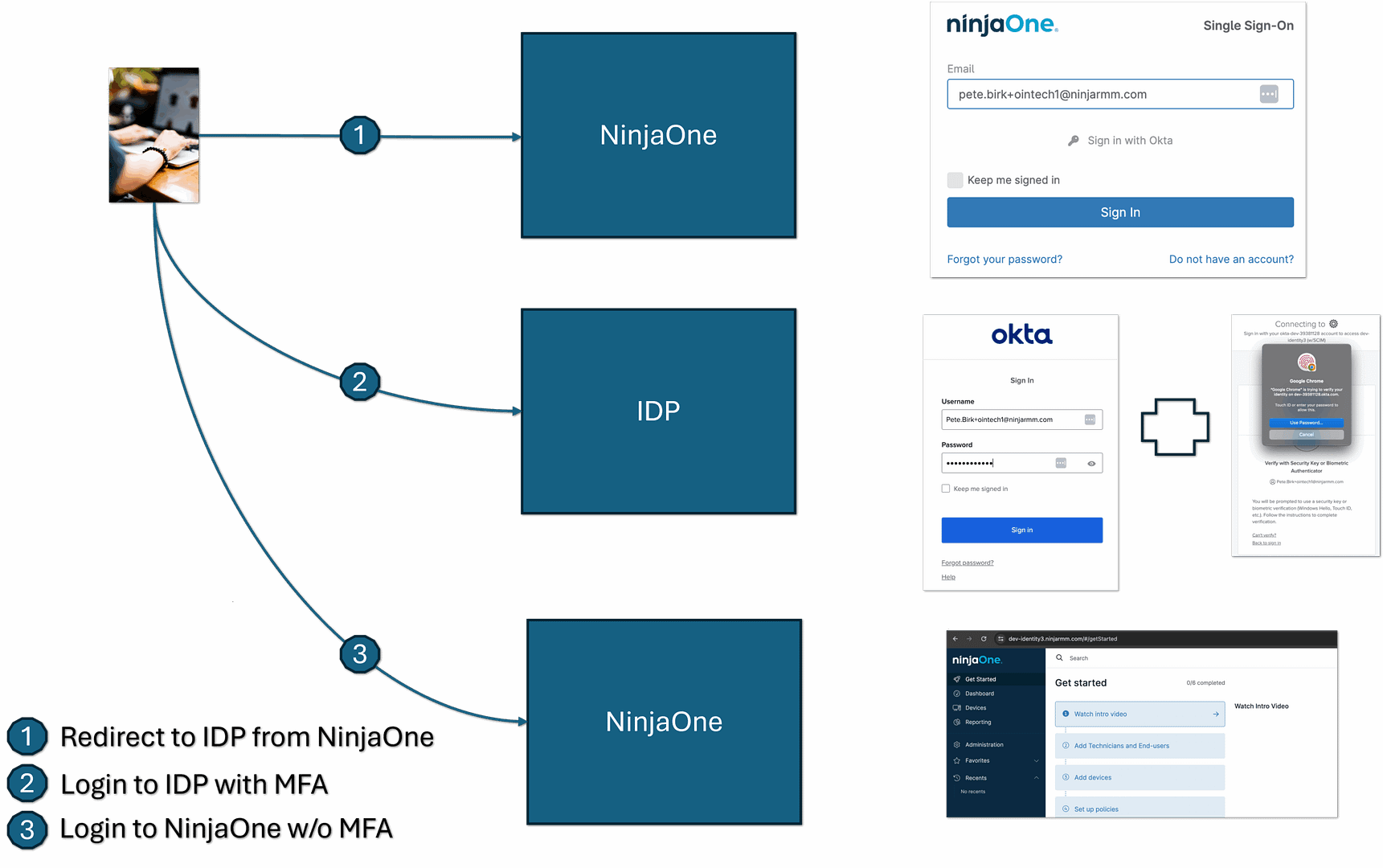
What is the MFA workflow?
The following figure shows MFA used only as an Identity Provider (IdP):
The following figure shows how NinjaOne uses MFA:
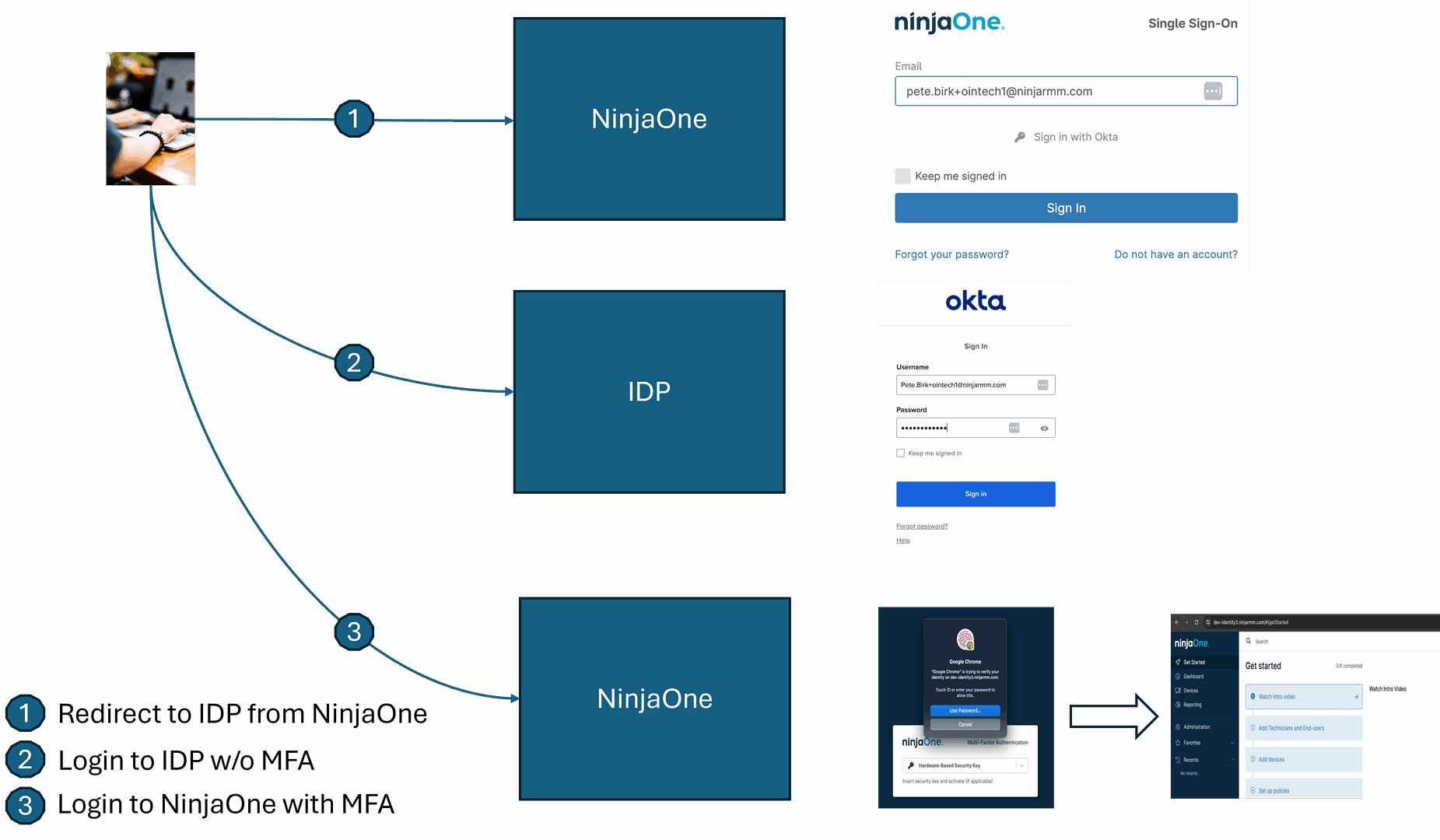
How does NinjaOne use MFA?
Some IdPs, including Okta and Azure, add a SAML attribute to the user login response that indicates whether MFA was performed during the login session. We look for this attribute when the SAML response is received to determine whether to skip the NinjaOne MFA.
The SAML response is a cryptographically signed document that establishes trust between NinjaOne and the IdP. It cannot be modified between the IdP and NinjaOne without detection. If we do not find this specific MFA attribute in the SAML response, we will not bypass the NinjaOne MFA for the user login.
Which Identity Providers Does NinjaOne Support?
NinjaOne supports all IdPs for MFA bypass. If you are using a branded site, you have to add both the native and branded URLs to your IdP's affiliated URL (Uniform Resource Locator) list.
For example: https://<branding_hostname→/ws/account/saml-login.
For which attributes does NinjaOne search?
NinjaOne will look for the following attributes in the SAML response for Okta and Azure. If found, NinjaOne will bypass MFA for that request. If not found, NinjaOne will perform MFA for the login request.
Okta attributes:
<saml2:Attribute Name=“amr” NameFormat=“urn:oasis:names:tc:SAML:2.0:attrname-format:unspecified”>
<saml2:AttributeValue xmlns:xs=“http://www.w3.org/2001/XMLSchema” xmlns:xsi=“http://www.w3.org/2001/XMLSchema-instance” xsi:type=“xs:string”>swk</saml2:AttributeValue>
<saml2:AttributeValue xmlns:xs=“http://www.w3.org/2001/XMLSchema” xmlns:xsi=“http://www.w3.org/2001/XMLSchema-instance” xsi:type=“xs:string”>mfa</saml2:AttributeValue>
<saml2:AttributeValue xmlns:xs=“http://www.w3.org/2001/XMLSchema” xmlns:xsi=“http://www.w3.org/2001/XMLSchema-instance” xsi:type=“xs:string”>pwd</saml2:AttributeValue>
</saml2:Attribute>
Azure attributes:
<Attribute Name="http://schemas.microsoft.com/claims/authnmethodsreferences">
<AttributeValue>http://schemas.microsoft.com/ws/2008/06/identity/authenticationmethod/password</AttributeValue>
<AttributeValue>http://schemas.microsoft.com/claims/multipleauthn</AttributeValue>
</Attribute>Why is Enable conditional NinjaOne MFA bypass hidden after the IdP test?
Because this release only supports Azure and Okta, we are currently looking for an IdP URL that contains .okta.com (Okta) or .microsoftonline.com (Azure). If your identity provider has a branded URL, it is currently not supported, but this is likely to change in the future. For now, all other IdPs will have this option hidden after the IdP test connection is complete.
Why do users still get the NinjaOne MFA during login even though I have this feature activated?
This can occur for several reasons:
- The feature is not activated in the NinjaOne IdP configuration.
- The attribute set in the SAML response by the IdP may be either missing or not the one we’re looking for. Ensure the attribute is coming through in the SAML response received by NinjaOne.
- The user may not have performed MFA at the IdP. Ensure the IdP policy enforces MFA for the NinjaOne application.
- If the IdP is configured with a third-party for MFA (such as using Duo with Azure IdP), it’s possible that the IdP is not adding the MFA attribute for which we are looking.
The user may have only a single authentication method configured for their account (such as an account password, an authenticator app, Okta Verify, or another). Therefore, the account does not meet the MFA requirement in NinjaOne and will receive the prompt. Add a secondary authentication option and try again.
Does this feature affect NinjaOne MFA for security-sensitive operations in NinjaOne after login?
No, this feature does not affect post-login MFA requirements. Even if NinjaOne MFA is bypassed during login, all NinjaOne technicians and end users should still have a NinjaOne MFA configured. They will still be required to perform MFA for security-sensitive operations after logging in.
Why do I still receive a prompt for MFA during login, even though I have activated Bypass?
You may only have a single authentication method configured for your account (for example, an account password, authenticator app, Okta Verify, or similar). Therefore, the account does not meet the MFA requirement and will receive the NinjaOne MFA prompt. Add a secondary authentication option and try again.
Additional Resources
For more information related to MFA Bypass, refer to NinjaOne Platform: Enable Conditional NinjaOne Multifactor Authentication Bypass.