
Topic
This article describes the data contained in the Devices dashboard → Details tab in NinjaOne.
Environment
NinjaOne Endpoint Management
Description
The Details tab on the Devices dashboard displays device identification information and hardware specifications on a single page.
Select a topic to learn more:
- Navigating to Device Details
- Viewing Device Details
- Device Information Categories
- Mobile Devices
- Additional Resources
Navigating to Device Details
You can access device details in NinjaOne at the organizational or device level.
From the Organizational Level
- In NinjaOne, navigate to Dashboard → Organizations.
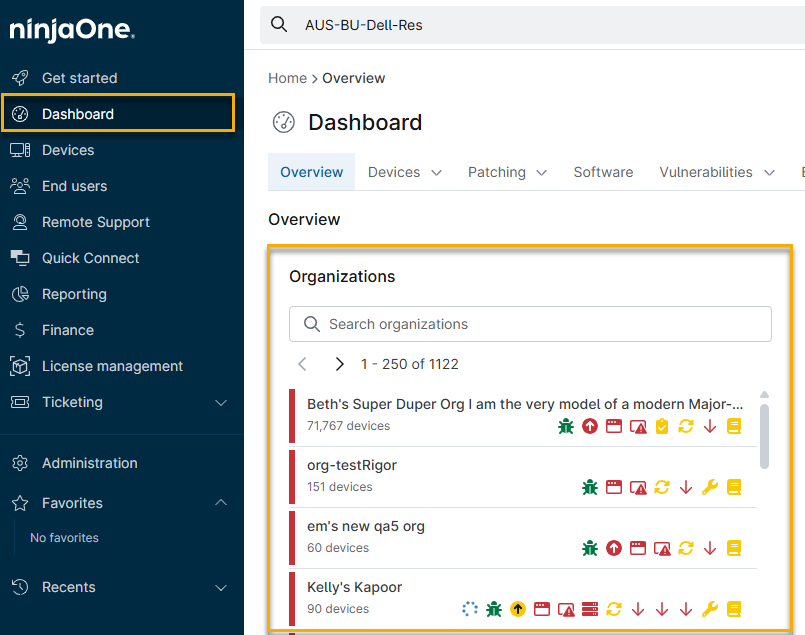
- The organization's Overview tab opens. Click a device from the Devices card to open its Overview page.
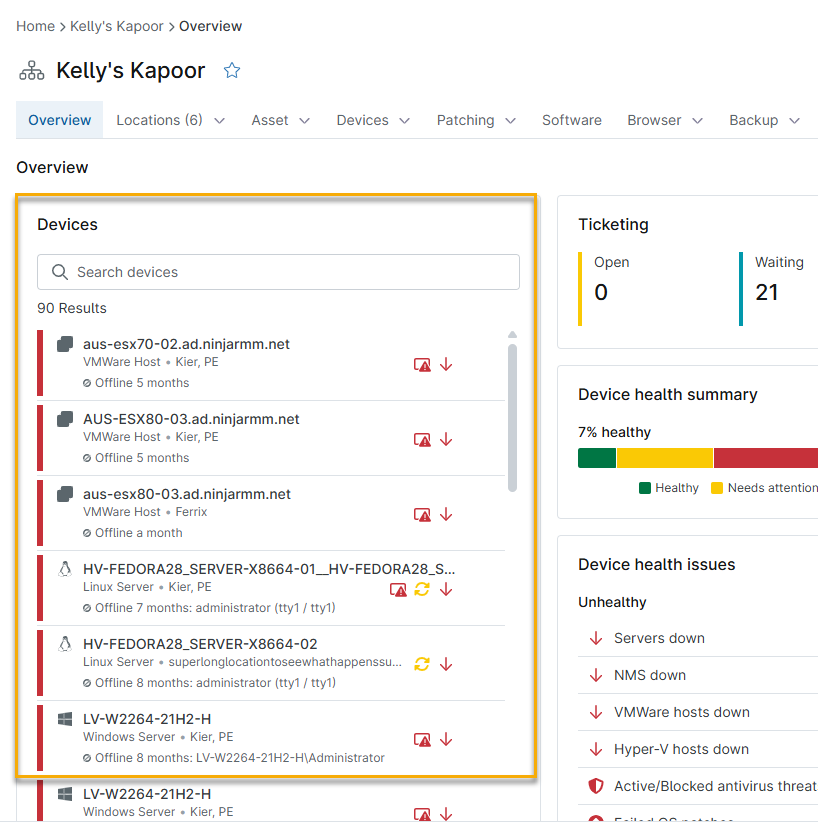
- Click the Details tab to open device details.
From the Device Level
In NinjaOne, click Devices, then use the search and filter options to locate the device, or select it directly from the device list. The device's Overview page opens.

Viewing Device Details
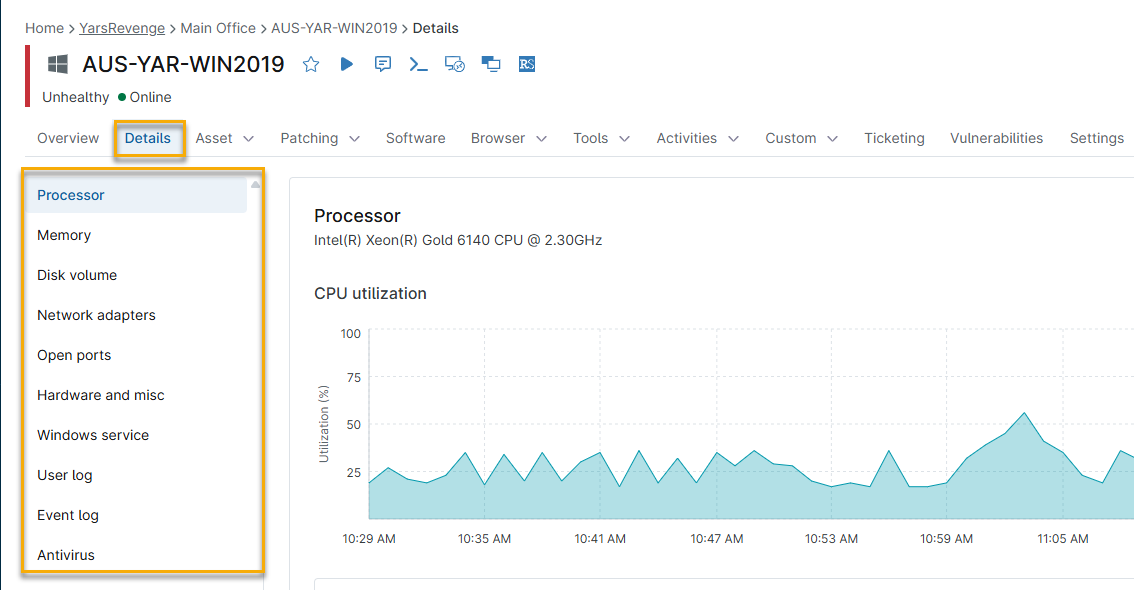
On the device's Overview page, click the Details tab. The tab shows a list of information categories, with the Processor category open by default. Select a category from the Device Information Categories list to view a description of the information and its availability by device type.
Device Information Categories
Choose a device category for information about that specific aspect of the device's specifications and performance. Your device type (for example, a server, a laptop, or a virtual machine) determines the categories of information displayed.
Processor
Available for: Desktops, laptops, servers, Hyper-V hosts, and VMware.
This section provides a graph of CPU utilization and a table of running processes, which includes the process ID (PID), process name, number of threads, and CPU percentage for each process using the device's CPU. The details below the graph include the latest submission data. This data does not reflect the graph's retention period.

Memory
Available for: Desktops, laptops, servers, Hyper-V hosts, VMware, and mobile devices.
This section provides a graph of memory usage over a specified time period, and a table listing the process ID (PID), process name, commit, working set, shared memory, and total memory usage for each process using memory on the device.
The details below the graph include the latest submission data. This data does not reflect the graph's retention period.
- Apple iOS and MDM-enrolled Apple macOS details will only include the amount of storage currently used, expressed as a percentage of the total storage in GB.
- Android mobile details include RAM, internal storage, and external storage used, all in GB.

Datastore
Available for: Hyper-V hosts.
This section provides information about the device's virtual disk space and usage, read and write speed, available free space, and capacity.
Disk Volume
Available for: Desktops, laptops, and servers.
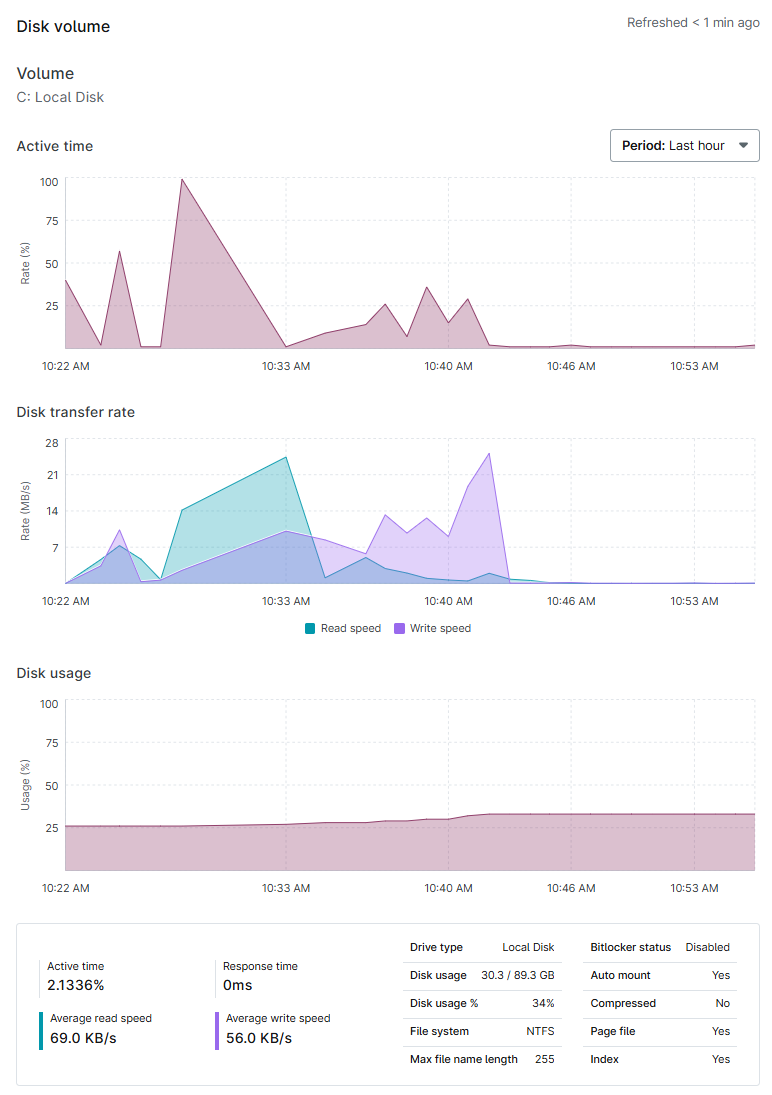
This section displays graphs for each disk volume on the device, showing active time, disk transfer rate, disk usage, and BitLocker status. For more information, refer to NinjaOne Endpoint Management: BitLocker and FileVault Encryption Key Management.
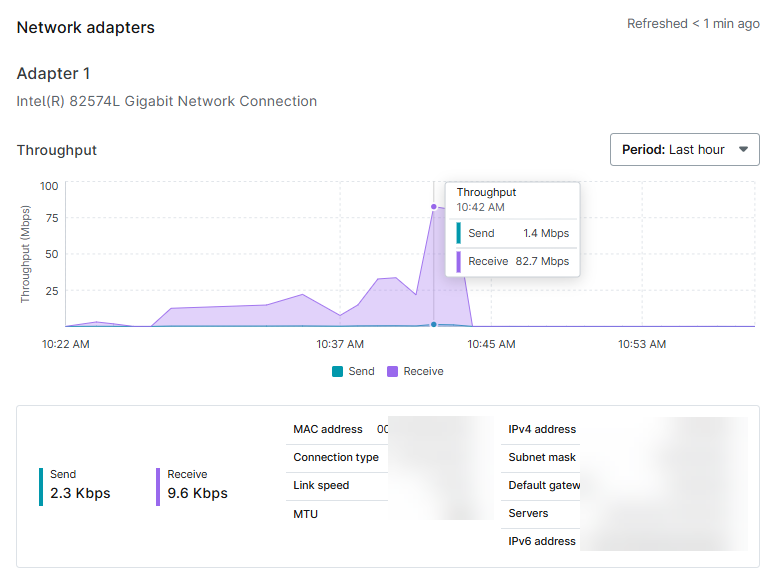
Network Adapters
Available for: Desktops, laptops, servers, and VMware.
This section provides graphs that show the throughput for each network adapter on the device.
Open Ports
Available for: Desktops, laptops, and servers.
This section provides a table showing the port, protocol, status, and service for each entry.

Hardware and Miscellaneous
Available for: Desktops, laptops, and servers.
This section lists information about the device's hard drive, disk partitions, sound card, video card, disk drive, page file, and motherboard.

RAID Monitoring
Available for: Windows servers.
This section includes tables for controller, virtual drive, and physical drive details.
- NinjaOne can pull RAID monitoring data.
- For HP RAID controllers, you must install the relevant HP utilities on the machine for NinjaOne to monitor the controller's details.
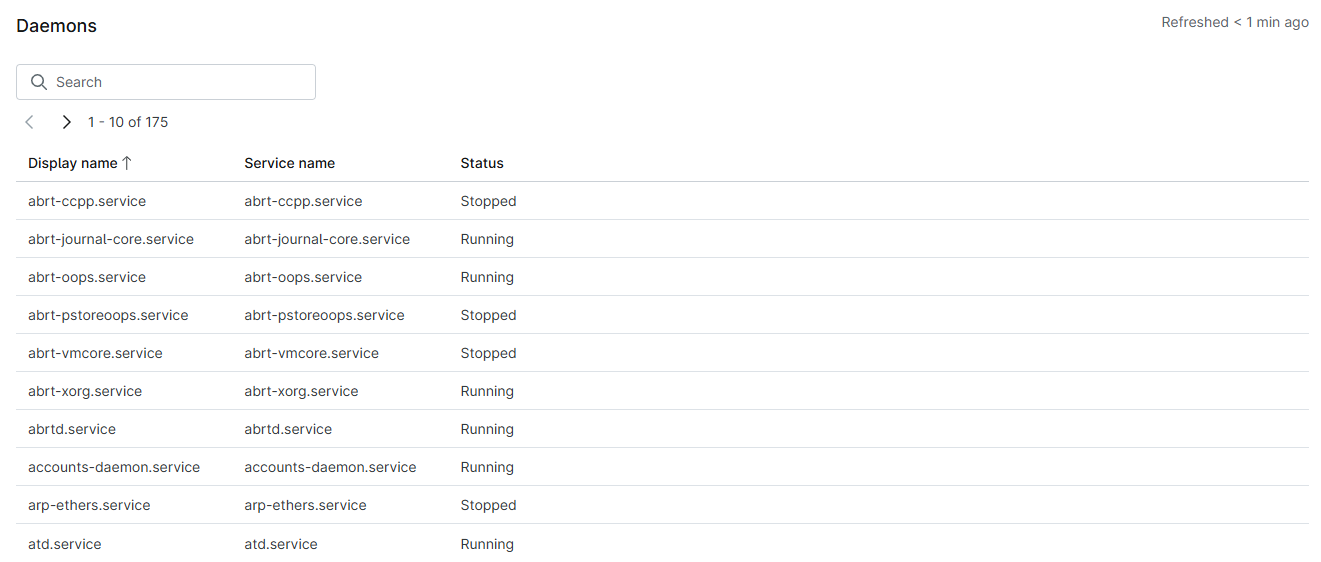
Windows Services and Daemons
Available for: Windows, macOS, and Linux devices.
Windows devices: This section is called Windows service, and includes a table with the display name, service name, status, start type, and log-on-as information for each Microsoft Windows service on the device.

macOS and Linux devices: This section is called Daemons, and includes a table with the display name, daemon name, and status information for each background process on Apple macOS and Linux devices.
User Log
Available for: Windows and macOS desktops and laptops.
This section includes the username and the last login date and time on the device by a user.

Event Log
Available for: All Windows devices.
This section includes tables with critical and non-critical events that have occurred on the device. NinjaOne includes the event ID, source, type, message, and occurrences in the data tables.
- The Critical section lists any event classified as Critical or Error.
- The Non-Critical section lists the remaining event status types: Information, Success Audit, Failure Audit, Warning, and Verbose.
NinjaOne automatically displays all events classified as Critical, Error, Warning, or Failure Audit. Other event types appear only if you have a condition set up to monitor for their occurrence. Refer to NinjaOne Policies: Windows Event Condition for more information.

Antivirus
Available for: Windows and macOS devices.
This section includes an antivirus (AV) overview, followed by a scan summary and details on the antivirus software installed. The antivirus summary includes:
- A description.
- The number of files scanned.
- The number of files cleaned.
- The scan duration.
The section also includes a table with the name, definition status, and product state for each antivirus application installed on the device.
NinjaOne aggregates antivirus data from Windows Security Center. For more information, refer to Reporting: Why does my Antivirus report show no information?
For information about how to feed antivirus information for servers into a custom file, refer to NinjaOne Agent Troubleshooting: Add an Override for Antivirus.

Port Status
Available for: Network monitoring agents.
This section includes the device's port location and its current state (connected, not responding, or other).

Mobile Devices
Compliance
Available for: Android devices.
This section contains details about the device's compliance state. If the device is not compliant, expand the section to learn the reason for the violation.
Security
The following details are available for each platform.
Available for: Apple iOS and Android mobile devices.
- iOS
- Encryption status (encrypted, not encrypted): This option includes both block-level and file-level encryption.
- Is passcode compliant (yes/no): NinjaOne retrieves this information from the policy's configuration page.
- Has passcode (yes/no): NinjaOne retrieves this information from the policy's configuration page.
- Android
- Device posture (secure, not secure)
- Is PIN or password set (yes, no)
- Encryption status(encrypted, not encrypted): Both block-level and file-level encryption.
- Install apps from unknown sources enabled (yes, no)
Network
Available for: Apple iOS and Android mobile devices.
Apple mobile devices provide the International Mobile Equipment Identity (IMEI) number and the WiFi MAC address.
Cloud
This section displays cloud backup information for the device, including:
- Backup enabled (yes, no)
- Last backup date
Additional Resources
Refer to the following resources to learn more about device management in NinjaOne:
- NinjaOne Endpoint Management: Device Roles
- NinjaOne Endpoint Management: Change a Device Display Name
- NinjaOne Endpoint Management: Customize Device Health Statuses
- NinjaOne Documentation: Device Notes and Related Items
- NinjaOne Endpoint Management: Save and Load Search Groups
- NinjaOne Endpoint Management: Manage Devices and Run Actions