NinjaOne vs Syncro

NinjaOne and Syncro are both endpoint management platforms: NinjaOne is a unified IT operations platform serving IT teams and MSPs at scale, while Syncro is an integrated RMM and PSA tool built for small and growing MSPs and IT teams. 

NinjaOne

VS
Information as per product capabilities from G2 This comparison represents our assessment of publicly available product capabilities from G2 as of June 2026. If you believe any information here is inaccurate or incomplete, please contact us and we will evaluate and address it as appropriate.

NinjaOne is designed for

Syncro is designed for

MSP teams and internal IT departments ranging from small teams to large enterprise IT operations 

Small to mid-sized MSPs that manage both technical operations and client-facing business workflows from a single platform  

Organizations that need centralized endpoint visibility and control across multi-client or multi-site environments 

Organizations that need RMM and PSA capabilities together, including ticketing, invoicing, and help desk management  

IT teams and organizations managing distributed employee endpoints at scale, including hybrid workforces, multi-site environments, and heterogenous OS mixes (Windows, Mac, Linux) 

Environments where a single technician or small team handles both endpoint management and service delivery administration  

Teams that prioritize automation-first workflows, fast deployment, and reduced manual overhead in day-to-day IT operations 

Teams with limited tooling budgets that prioritize operational consolidation over depth of feature specialization in any category 

Key differences between NinjaOne and Syncro 

The main differences between NinjaOne and Syncro are

Dimension NinjaOne Syncro
Scope of platform NinjaOne is purpose-built for endpoint management, centralizing monitoring, patching, and remediation across large, distributed environments. Syncro combines RMM with PSA functions like ticketing and invoicing, prioritizing operational consolidation for MSPs managing both technical operations and business workflows.
Automation depth NinjaOne provides policy-based automation and scripting across Windows, macOS, and Linux, as well as 6,000+ third-party applications, designed to handle repetitive tasks at scale with minimal manual intervention. Syncro includes a scripting engine and an automated policy module, supporting scheduled maintenance and software deployments within its integrated RMM and PSA workflow.
Operational overhead NinjaOne is designed for fast deployment and a low-friction onboarding experience, with a cloud-native architecture that reduces setup and maintenance burden. Syncro’s dashboard offers a consolidated view of RMM and PSA functions, though its customization options are more limited than dedicated endpoint management platforms.
Support model NinjaOne provides 24/7 support with dedicated onboarding and training included at no additional cost. Syncro provides support through its standard support channels, with onboarding tailored to its combined RMM and PSA platform.
Remote access flexibility NinjaOne integrates with multiple third-party remote-control tools alongside NinjaOne Remote, giving teams flexibility in how they access endpoints. Syncro includes built-in remote access as part of its subscription, eliminating the need for separate licensing.

When NinjaOne is the better choice

Choose NinjaOne when

Your team needs a single, consistent view of device health, patch status, and alerts without switching between tools. 

Your team requires around-the-clock technical support and structured onboarding, particularly during platform migration or rapid headcount growth. 

Your organization is under pressure to consolidate endpoint monitoring, patching, and remediation into one platform. 

Your technicians need flexible remote access options rather than relying on a single built-in tool. 

Policy-based automation is operationally critical, such as enforcing patch compliance across heterogeneous OS environments. 

Your team needs PSA capabilities (such as ticketing, billing, and workflow management) integrated with the same platform handling endpoint monitoring, patching, and remote access. 

Why IT teams choose NinjaOne over Syncro

Cut through dashboard friction 

NinjaOne’s interface is designed for fast navigation and clear endpoint visibility, allowing technicians to identify and act on issues without issue. Meanwhile, Syncro’s dashboard has limited customization options, which users report makes it harder to find the information most relevant to their workflows. For teams managing multiple clients, that navigational overhead compounds quickly and affects how efficiently issues are resolved. 

NinjaOne provides policy-based automation and reliable scripting across a broad set of OS environments and third-party applications, reducing the manual effort required to maintain patch compliance at scale. While Syncro offers scripting and automation capabilities, some users have reported inconsistencies with scheduled task execution, which introduces risk for workflows that depend on consistent operation.  

NinjaOne includes 24/7 support and structured onboarding at no additional cost, which reduces the time teams spend waiting on resolution. On the other hand, Syncro’s support model has drawn criticism from users who report slow ticket resolution, sometimes spanning days or weeks, which can stall troubleshooting during active incidents.  

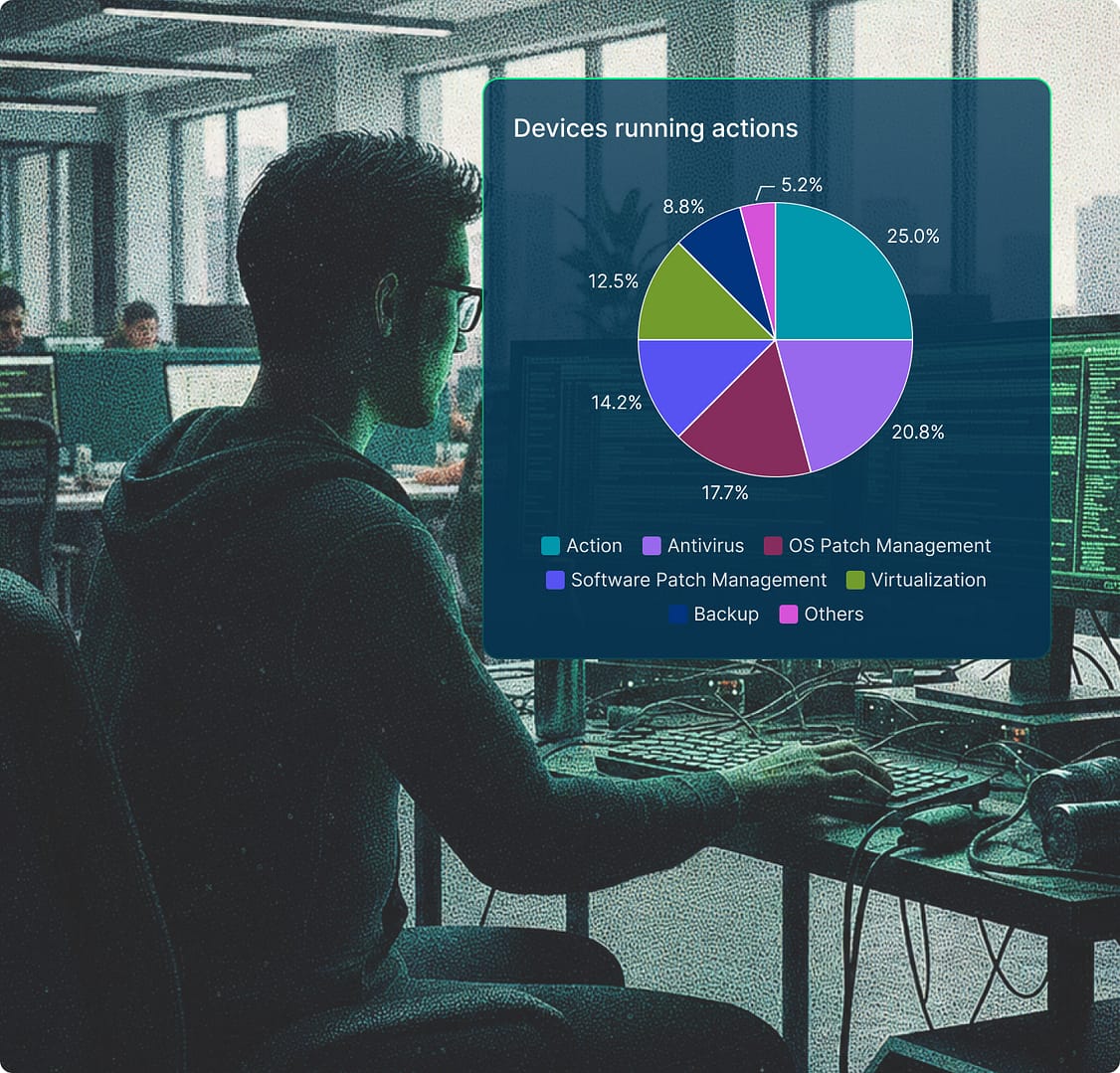
IT technician with image of NinjaOne dashboard

User reviews and ratings: NinjaOne vs. Syncro

NinjaOne

4.7

Overall G2 rating (4,308

Syncro

4.5

Overall G2 rating (502)

Information as per product capabilities from G2 This comparison represents our assessment of publicly available product capabilities from G2 as of June 2026. If you believe any information here is inaccurate or incomplete, please contact us and we will evaluate and address it as appropriate.

Discover value in 5 minutes.

NinjaOne integrations for IT environments 

NinjaOne integrates with tools commonly used in Syncro environments, including PSA and ticketing platforms, endpoint security solutions, and remote access tools.

How to evaluate the decision between NinjaOne vs. Syncro

When evaluating NinjaOne vs. Syncro, consider the following criteria: 

  • The scale and distribution of your endpoint environment, including the number of devices, OS diversity, and whether endpoints span multiple clients or sites
  • The level of automation reliability that your workflows require, particularly for scheduled patching, scripting, and compliance enforcement
  • The depth and availability of vendor support that your team depends on, especially during onboarding or active incident response
  • The remote access flexibility your technicians need in the field, including whether a single built-in tool is sufficient

NinjaOne vs. Syncro FAQs

NinjaOne is a unified IT operations platform with deep capabilities in endpoint monitoring, patch management, automation, and remote access across distributed environments. Syncro combines RMM with PSA functions, such as ticketing and invoicing, targeting small to mid-sized MSPs that manage both technical operations and client-facing business workflows.  

The sharpest difference is automation reliability. NinjaOne provides policy-based automation and scripting across Windows, macOS, and Linux with support for more than 6,000 third-party applications. Syncro includes scripting and an automated policy module, but some users have reported inconsistencies with scheduled task execution that introduce risk for compliance-dependent workflows.   

NinjaOne is a relevant alternative for teams that need deeper endpoint management capabilities, more reliable automation, or broader remote access flexibility than Syncro provides. It’s particularly applicable for environments managing high endpoint volumes across multiple clients or sites where patch compliance, scripting reliability, and 24/7 support availability are operational priorities. 

NinjaOne is structured for teams that need scalable RMM across high endpoint volumes, with policy-based automation, multi-OS patch management, and flexible remote access options built into a single console. Syncro’s RMM capabilities are paired with PSA functions, making it a better fit for smaller MSPs that prioritize managing both technical and client-facing business workflows. 

NinjaOne provides the core endpoint management capabilities Syncro users rely on. For teams that also need PSA and ticketing functions, NinjaOne includes these as native platform features and integrates with dedicated PSA platforms, including ConnectWise Manage and HaloPSA. 

Ready to simplify work with unified IT?

Snapshot Report Citation: IDC Business Value Snapshot sponsored by NinjaOne, The Business Value of NinjaOne for IT Operations, Doc #US54520326-BVS, May 2026.


GARTNER is a registered trademark and service mark of Gartner, Inc. and/or its affiliates in the U.S. and internationally and is used herein with permission. All rights reserved. Magic Quadrant is a registered trademark of Gartner, Inc. and/or its affiliates and is used herein with permission. All rights reserved. Gartner does not endorse any company, vendor, product or service depicted in its publications, and does not advise technology users to select only those vendors with the highest ratings or other designation. Gartner publications consist of the opinions of Gartner’s business and technology insights organization and should not be construed as statements of fact. Gartner disclaims all warranties, expressed or implied, with respect to this publication, including any warranties of merchantability or fitness for a particular purpose.
This comparison represents our assessment of publicly available product capabilities as of January 2025. Our evaluation draws on vendor-provided materials, including product documentation and release notes, as well as publicly available pricing information, customer feedback, and analyst insights. Where applicable, details were reviewed against the vendor’s then-current generally available (GA) release as of the date indicated.
Enterprise IT leaders evaluating endpoint management platforms don’t just compare features: they also assess the time it takes to deliver value, the number of people needed to operate the system, and the actual cost after deployment, training, and ongoing operation. NinjaOne delivers measurable results. On average, deployment is completed in less than 30 days; operators become proficient in less than 10 days. There is no infrastructure to provision, no phased rollout, and no deployment project scope to define: cloud-native SaaS means your team becomes productive in days, not months. Your team configures, operates, and scales the system without dedicated administrators, proprietary query languages, or ongoing vendor support. And all of this on a unified platform, with no mandatory professional services, no premium support tiers, no hidden renewal costs, and rich features that don’t compromise the digital employee experience your organization is striving for.