NinjaOne vs. Tanium

NinjaOne and Tanium are both enterprise endpoint management platforms: NinjaOne is a unified IT operations platform using lightweight agents, while Tanium uses a peer-to-peer architecture for real-time querying at scale.

NinjaOne

VS
Information as per product capabilities from G2 This comparison represents our assessment of publicly available product capabilities from G2 as of July 2026. If you believe any information here is inaccurate or incomplete, please contact us and we will evaluate and address it as appropriate.

NinjaOne is designed for

Tanium is designed for

MSPs that manage a diverse range of client environments that rely on several device types and operating systems

Massive enterprises with hundreds of thousands of endpoints for regulated industries

Enterprise IT teams managing thousands of endpoints

IT teams that prioritize real-time queries to manage sprawling enterprise environments

Teams that prioritize fast and stable platform performance to free up IT administrators to focus on more strategic tasks

Environments with more extensive requirements for on-premises deployment

Organizations that need granular customization options, such as automations, scripting, and per-device overrides

Organizations that need robust endpoint security and threat response features for regulatory compliance

Key differences between NinjaOne and Tanium

The main differences between NinjaOne and Tanium are

DimensionNinjaOneTanium
InfrastructureAs a cloud-native solution, NinjaOne relies on agents on managed devices to communicate directly with its cloud infrastructure, eliminating the need for infrastructure in distributed, cloud-first environments.Tanium uses a patented linear-chain, peer-to-peer architecture to support real-time querying at scale without increasing the number of servers required in large environments. Endpoints connect to their neighbors in a chain, and data aggregates up the chain to reach the Tanium server.
Performance speedThe lightweight NinjaOne agent is not taxing on system resources, ensuring smooth and fast performance.Due to Tanium’s heavy CPU and memory utilization, users find that performance can slow down.
Custom scripting and automationNinjaOne offers granular customization options for creating scripts and automating workflows.Tanium offers granular customization for its on-premises solution, but its cloud version lacks customization for scripts, alerts, and automations.
Low-friction setupSetting up NinjaOne for the first time is quick and seamless. On average, customers are fully deployed within 30 days, with 91% onboarding technicians in 5 hours. NinjaOne also offers unlimited onboarding support.Due to the complexity of Tanium’s interface and features, new users need to invest more time and resources into configuring and learning, according to reviews. In addition, onboarding and support depend on the product tier customers are on.
Centralizes managementNinjaOne provides full visibility into all managed devices, along with tools for alerting, patching, automation, and backups, from a single pane of glass.Tanium organizes data by modules separately, so reporting across models requires more time for cross-referencing.

When NinjaOne is the better choice

Choose NinjaOne when

You employ a remote or hybrid workforce that benefits from a scalable and flexible cloud-first platform.

Your team requires a lightweight agent that ensures priority is fast and stable platform performance for MSP and enterprise fleets.

Your IT team wants to reduce its tech stack to boost efficiency with an all-in-one tool, instead of switching between tools and modules.

Your end users rely on applications that require consistent patching to keep endpoints secure and compliant.

Your IT teams and technicians manage and support a large number of devices that benefit from complex workflow or alerting automations.

Why IT teams choose NinjaOne over Tanium

Efficient resource usage

Tanium users report struggling with the platform’s high CPU and memory consumption. In addition, Tanium requires installing a separate agent for each module. On the other hand, NinjaOne only needs IT teams to install a single low-resource agent for remote monitoring, patching, automation, backup, and remote control. The NinjaOne lightweight RMM agent also minimizes resource consumption, so technicians can monitor and manage devices without competing with the very workloads they’re trying to support. Running NinjaOne doesn’t impact the performance of end-user devices.

While Tanium organizes data by module rather than in one console, IT administrators need to cross-reference data across systems, which takes extra time during reporting and incident response. That fragmentation slows technicians down and creates information silos, which can complicate troubleshooting alerts or pulling together a compliance report. NinjaOne consolidates alerting, patching, automation, and backup into a single pane of glass, so technicians manage every device without switching context.

Many IT and MSP teams need automation and scripting that reflect the specific policies and exceptions of their own environment, not a one-size-fits-all workflow. Tanium offers granular customization for its on-premises deployment, but when using its cloud-based platform for scripts, alerts, and automations, Tanium’s customization features are limited. That’s a difficult trade-off for teams already moving to the cloud, specifically to reduce infrastructure overhead. As a cloud-native platform, NinjaOne delivers granular customization for scripting, policy-based automation, and per-device overrides, without requiring the costly maintenance and management of on-premises infrastructure.

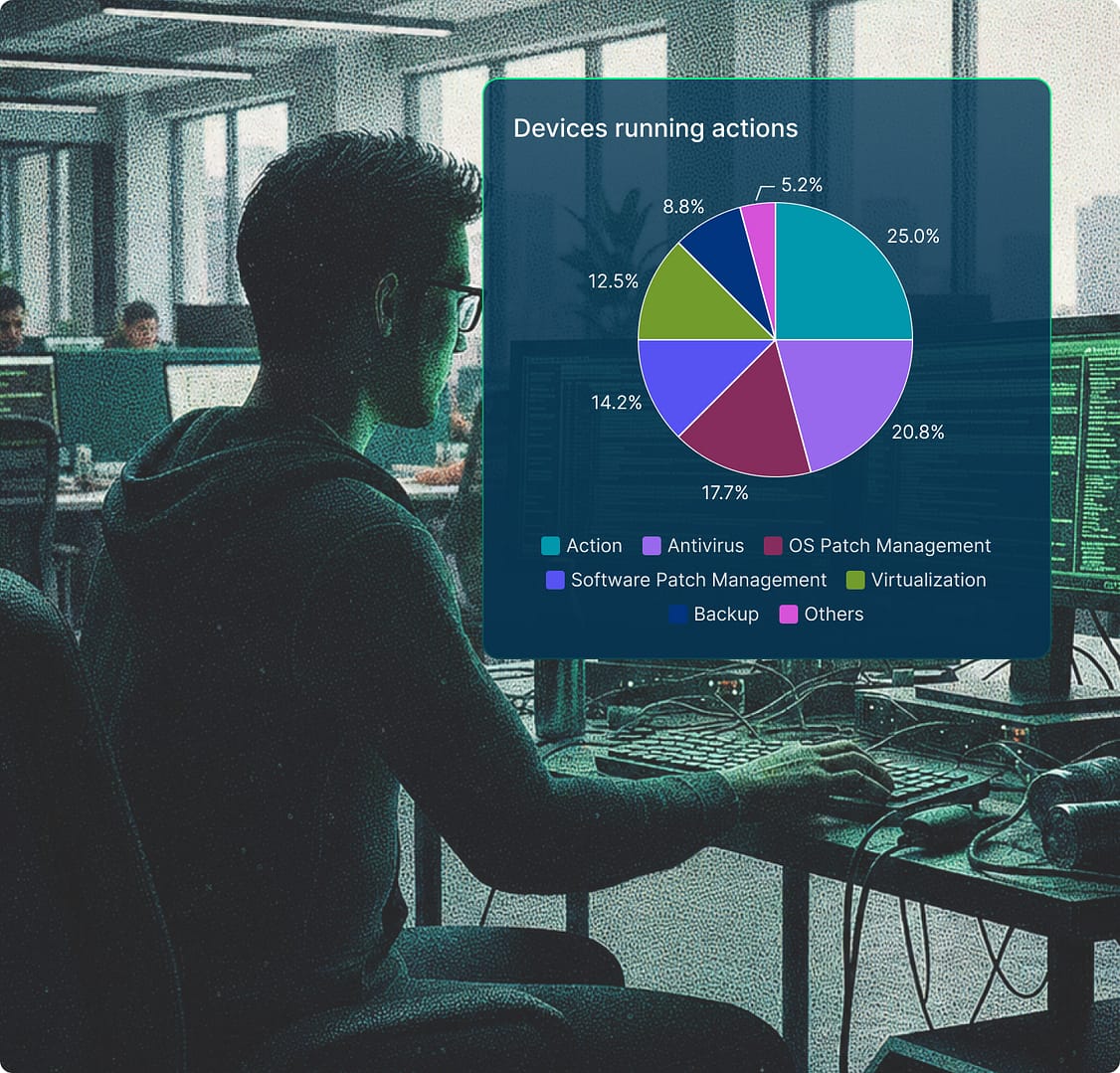
IT technician with image of NinjaOne dashboard

User reviews and ratings: NinjaOne vs. Tanium

NinjaOne

4.7

Overall G2 rating (4,392)

Tanium

4.5

Overall G2 rating (67)

Information as per product capabilities from G2 This comparison represents our assessment of publicly available product capabilities from G2 as of July 2026. If you believe any information here is inaccurate or incomplete, please contact us and we will evaluate and address it as appropriate.

Discover value in 5 minutes.

NinjaOne integrations for IT environments 

NinjaOne integrates with tools commonly used in Tanium environments, including workflow automation, Windows endpoint management, and notification channels.

How to evaluate the decision between NinjaOne vs. Tanium

When evaluating NinjaOne vs. Tanium, consider the following criteria: 

  • The resource overhead your environment can tolerate so that you can minimize the impact of resource consumption on end-user device performance
  • Whether you need a single console to consolidate visibility and control across devices for easier management and reporting.
  • How much you value continuous technical support and user-friendliness when it comes to the platform’s interface and learning curve
  • The level of granular customization, such as whether you need per-device overrides, deep automation, and custom scripting.

NinjaOne vs. Tanium FAQs

NinjaOne is a cloud-first unified IT operations platform built for MSPs and enterprise IT teams managing diverse device fleets, while Tanium is an endpoint management and security platform built for massive enterprises with hundreds of thousands of endpoints. The core difference is platform architecture, which affects performance and features. NinjaOne uses a single lightweight agent that centralizes a breadth of features, including monitoring, patching, automation, backup, and remote control, in a single dashboard. In contrast, Tanium relies on a linear-chain, peer-to-peer architecture designed primarily for real-time querying across large endpoint fleets, which can require more system resources.

NinjaOne centralizes monitoring, patching, automation, and backups in a single console via a single agent, whereas Tanium organizes data across separate modules, requiring more cross-referencing for reporting across systems. The NinjaOne agent is also lightweight and does not consume a lot of system resources, while Tanium’s higher CPU and memory usage can result in slower response times.

NinjaOne is a strong option for organizations with remote or hybrid workforces that need a scalable, cloud-first platform with deep automation for cloud deployments. It’s a better fit than Tanium for teams prioritizing fast, low-resource performance over massive-scale, on-premises-heavy deployments.

NinjaOne is designed for fast response times, low resource consumption, and stable performance across thousands of endpoints, with granular customization and centralized management from a single console. Tanium works better for IT teams managing hundreds of thousands of endpoints that need real-time querying or extensive on-premises deployment.

For organizations that primarily need unified endpoint monitoring, patching, and automation, the NinjaOne platform covers that core functionality with a cloud-first architecture and a lightweight agent. Tanium remains the stronger fit for real-time querying and deep security operations at massive scale.

Ready to simplify work with unified IT?

Snapshot Report Citation: IDC Business Value Snapshot sponsored by NinjaOne, The Business Value of NinjaOne for IT Operations, Doc #US54520326-BVS, May 2026.


GARTNER is a registered trademark and service mark of Gartner, Inc. and/or its affiliates in the U.S. and internationally and is used herein with permission. All rights reserved. Magic Quadrant is a registered trademark of Gartner, Inc. and/or its affiliates and is used herein with permission. All rights reserved.

Gartner does not endorse any company, vendor, product or service depicted in its publications, and does not advise technology users to select only those vendors with the highest ratings or other designation. Gartner publications consist of the opinions of Gartner’s business and technology insights organization and should not be construed as statements of fact. Gartner disclaims all warranties, expressed or implied, with respect to this publication, including any warranties of merchantability or fitness for a particular purpose.


This comparison represents our assessment of publicly available product capabilities as of July 2026. Our evaluation draws on vendor-provided materials, including product documentation and release notes, as well as publicly available pricing information, customer feedback, and analyst insights. Where applicable, details were reviewed against the vendor’s then-current generally available (GA) release as of the date indicated.


Enterprise IT leaders evaluating endpoint management platforms don’t just compare features: they also assess the time it takes to deliver value, the number of people needed to operate the system, and the actual cost after deployment, training, and ongoing operation.

NinjaOne delivers measurable results. On average, deployment is completed in less than 30 days; operators become proficient in less than 10 days. There is no infrastructure to provision, no phased rollout, and no deployment project scope to define: cloud-native SaaS means your team becomes productive in days, not months.

Your team configures, operates, and scales the system without dedicated administrators, proprietary query languages, or ongoing vendor support. And all of this on a unified platform, with no mandatory professional services, no premium support tiers, no hidden renewal costs, and rich features that don’t compromise the digital employee experience your organization is striving for.