NinjaOne vs. ManageEngine

NinjaOne and ManageEngine are both endpoint management and IT operations platforms: NinjaOne is a unified IT operations platform, while ManageEngine offers a modular suite of separate IT management products. 

NinjaOne

VS
Information as per product capabilities from G2 This comparison represents our assessment of publicly available product capabilities from G2 as of June 2026. If you believe any information here is inaccurate or incomplete, please contact us and we will evaluate and address it as appropriate.
NinjaOne is designed for

ManageEngine is designed for

MSPs and enterprise IT teams managing distributed endpoints across multiple client environments or locations

Enterprise IT departments managing endpoints within a defined organizational boundary  

Organizations that need endpoint monitoring, patching, remote access, backup, and ticketing in a single platform

Organizations already using ManageEngine or Zoho products that want endpoint management within that ecosystem

Environments with distributed or hybrid workforces where automated remediation and endpoint visibility are priorities  

Environments where IT operations span multiple functions and a modular, product-suite approach is acceptable  

Teams managing a large endpoint-to-staff ratio that depend on automation to maintain operational efficiency 

Teams with the administrative capacity to configure and maintain a more complex, module-based platform 

Key differences between NinjaOne and ManageEngine 

The main differences between NinjaOne and ManageEngine are

DimensionNinjaOneManageEngine
Deployment modelNinjaOne adopts a cloud-native architecture designed for modern, distributed IT environments.ManageEngine supports cloud and on-premises deployment, though on-premises installations introduce additional infrastructure management responsibilities.
Platform architectureEndpoint management, patch management, remote access, backup, and ticketing are built into a single platform, eliminating the need to connect separate tools.Functionality is spread across separate products—such as Endpoint Central and RMM Central—that require integration to work together.
Implementation complexityNinjaOne is designed for fast time-to-value, with minimal configuration required before the platform is operationally useful.Reaching full operational capability across modules requires upfront configuration, which can extend implementation timelines.
Ecosystem fitNinjaOne integrates with a broad range of third-party tools, making it adaptable to existing IT stacks regardless of vendor.ManageEngine integrates most deeply within the ManageEngine and Zoho product ecosystem, which may limit flexibility for organizations using tools outside that stack.
Operational overheadAutonomous patch management and automations for alerting and remediation are built into core workflows, reducing the burden on IT staff.Automation capabilities require administrative configuration before they reduce manual workload at scale.

When NinjaOne is the better choice

Choose NinjaOne when

Your team manages endpoints across multiple client environments or locations and needs a single console for monitoring, patching, and remediation. 

IT staff headcount is small relative to endpoint volume and automated workflows need to be operational without extensive upfront configuration.

Your environment is entirely cloud-based or remote-first and an on-premises deployment model introduces unnecessary infrastructure overhead. 

Your organization runs several separate IT tools and the overhead of maintaining those integrations is affecting team efficiency. 

Your existing IT stack includes tools from multiple vendors and you need an endpoint management platform that integrates across that mix without being anchored to a single software ecosystem.

Your organization has gone through acquisition or merger activity and needs to standardize endpoint management across newly combined IT environments without rebuilding the tool stack. 

Why IT teams choose NinjaOne over ManageEngine 

Consolidate your IT tool stack

NinjaOne consolidates endpoint monitoring, autonomous patch management, remote access, backup, and ticketing into a single platform, eliminating the need to manage dependencies between separate tools. For teams managing distributed or multi-client environments, ManageEngine’s suite-based architecture adds administrative burden that compounds as environments scale. 

NinjaOne’s automation is built into core workflows, allowing teams to manage large endpoint volumes without extensive upfront configuration or proportionally large staff. ManageEngine’s module-based approach requires significant setup before automation meaningfully reduces manual workload, which can be a difficult ask in lean IT environments where time and headcount are already constrained. 

Because NinjaOne operates as a unified platform, every support query has a single owner. There is no cross-product triage, no module-specific handoffs, and no ambiguity about where an issue originates. The result is a consistent resolution speed regardless of environment complexity.   

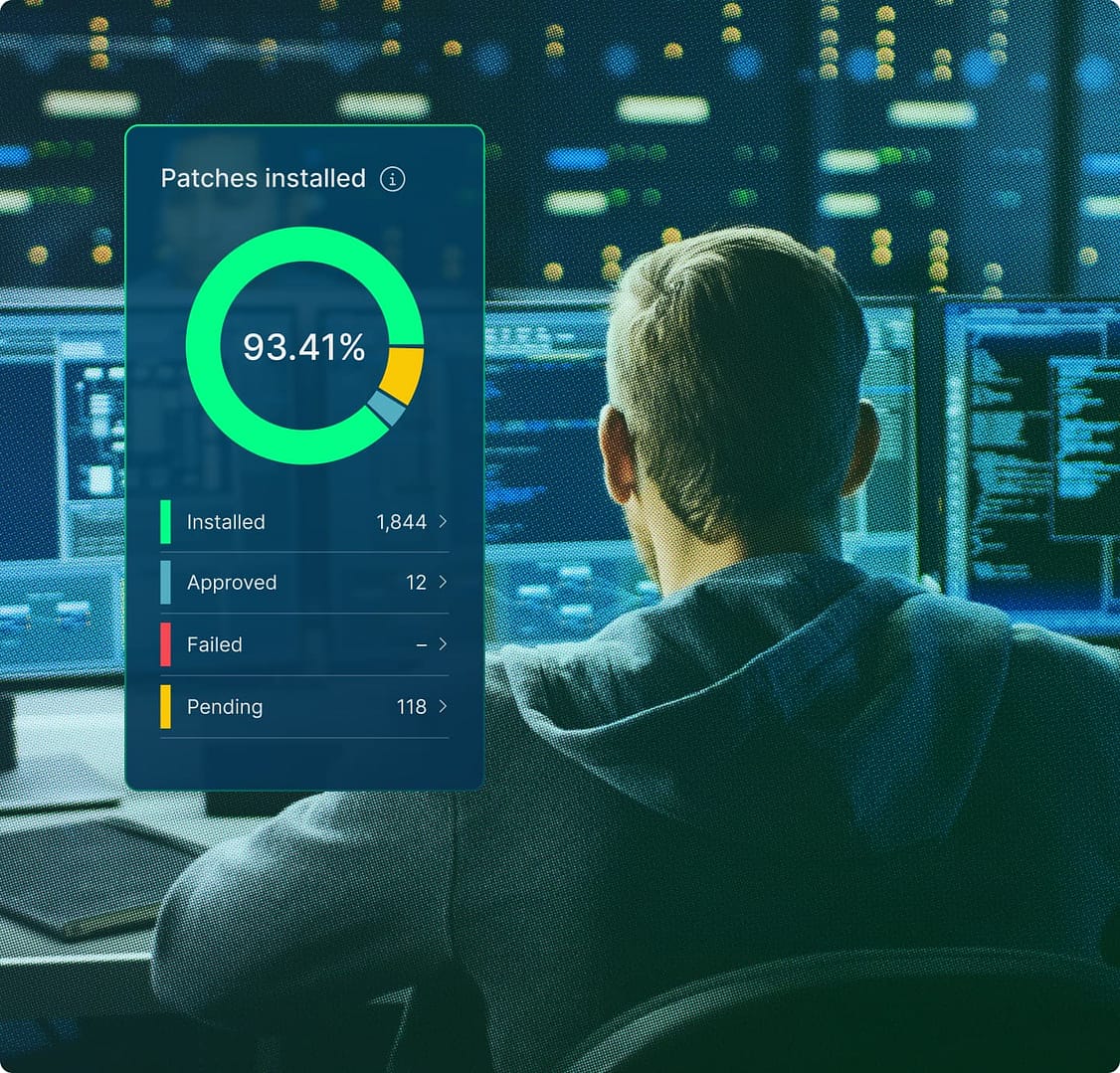
IT technician with image of NinjaOne dashboard

User reviews and ratings: NinjaOne vs. ManageEngine 

NinjaOne

4.7

Overall G2 rating (4,308

ManageEngine

4.5

Overall G2 rating (1,103)

Information as per product capabilities from G2 This comparison represents our assessment of publicly available product capabilities from G2 as of June 2026. If you believe any information here is inaccurate or incomplete, please contact us and we will evaluate and address it as appropriate.

Discover value in 5 minutes.

NinjaOne integrations for IT environments 

NinjaOne integrates with tools commonly used in ManageEngine environments and across broader MSP and enterprise IT stacks, including Microsoft ecosystem tools, IT service management platforms, and endpoint security solutions. 

How to evaluate the decision between NinjaOne vs. ManageEngine

When evaluating NinjaOne vs. ManageEngine, consider the following criteria: 

  • Whether your team requires a single, unified platform for endpoint management or can operationally support a modular suite of integrated products 
  • The configuration overhead your IT staff can realistically absorb during deployment and ongoing maintenance, relative to team size and endpoint volume 
  • Whether your organization operates primarily in the cloud or requires on-premises infrastructure control over where endpoint data and management tooling reside 
  • How deeply your existing IT stack is tied to third-party tools outside a single vendor ecosystem and how much integration flexibility your environment requires
  • The level of support responsiveness and accountability your team depends on when resolving complex platform issues at scale 

NinjaOne vs. ManageEngine FAQs 

NinjaOne is a unified IT operations platform; ManageEngine is a modular product suite that includes Endpoint Central and RMM Central among other products. NinjaOne consolidates endpoint management, patch management, automation, remote access, backup, and ticketing in one console, while ManageEngine requires those functions to be connected across separate products. 

NinjaOne is cloud-native with all core functions built into a single console. ManageEngine supports cloud and on-premises deployment across separate products.  NinjaOne also integrates more broadly with third-party tools beyond a single vendor ecosystem. 

Yes, particularly for MSPs and IT teams managing distributed endpoints who need monitoring, patching, remote access, backup, and ticketing in a single platform without extensive configuration. NinjaOne is well suited to cloud-first environments and teams managing a high endpoint-to-staff ratio. 

NinjaOne is better suited for organizations that need a single platform covering the full endpoint management workflow. ManageEngine may be a stronger fit for teams already invested in its broader product ecosystem. For lean IT teams or MSPs managing distributed endpoints at scale, NinjaOne’s built-in automation and unified architecture reduce the operational overhead that a modular suite approach introduces. 

NinjaOne covers the core functions of ManageEngine Endpoint Central—endpoint monitoring, patch management, remote access, and automation—within a single platform. Organizations moving from ManageEngine typically do so to consolidate those functions and reduce the configuration overhead of managing a modular product suite. 

Ready to simplify work with unified IT?
This comparison represents our assessment of publicly available product capabilities as of June 2026. Our evaluation draws on vendor-provided materials, including product documentation and release notes, as well as publicly available pricing information, customer feedback, and analyst insights. Where applicable, details were reviewed against the vendor’s then-current generally available (GA) release as of the date indicated.