NinjaOne vs. N-able N-sight

NinjaOne and N-able N-sight are both provide RMM software: NinjaOne is a unified IT operations platform for monitoring, patching, remote access, and backup, while N-sight bundles RMM, ticketing, and billing.

Information as per product capabilities from G2 This comparison represents our assessment of publicly available product capabilities from G2 as of July 2026. If you believe any information here is inaccurate or incomplete, please contact us and we will evaluate and address it as appropriate.

NinjaOne is designed for

N-able N-sight is designed for

IT teams and MSPs of every size, from lean SMB and mid-market IT to large enterprise and enterprise MSP environments managing 100,000+ endpoints.

SMB and mid-market MSPs and IT departments looking for a bundled RMM, remote access, ticketing, and billing platform.

Organizations that need to confirm automation and patch results quickly instead of waiting to find out whether a task succeeded.

Organizations that want monitoring, endpoint detection and response (EDR), and billing packaged together.

Environments spanning Windows, Mac, Linux, mobile devices, and network hardware in a single console, including Apple MDM for Mac, iOS, and iPadOS.

Environments built primarily around Windows endpoints, with narrower Linux and third-party application patching coverage.

Teams that want vulnerability visibility, backup recovery, and network monitoring built into the core platform rather than assembled from a wider add-on family.

Teams already working within N-able’s drag-and-drop automation builder and its broader product family.

Teams that want fast deployment, low ongoing management overhead, and configuration ease from their RMM.

Key differences between NinjaOne and N-able N-sight

The main differences between NinjaOne and N-able N-sight are automation feedback speed, patch management coverage, remote access depth, platform breadth, and console performance at scale.

DimensionNinjaOneN-able N-sight
Automation feedbackAutomations and scripts report status in near real time, so technicians can confirm success or failure without delay.Automation runs through a drag-and-drop builder, which means that status reporting is less immediate. As such, confirming an outcome can take longer.
Patch management coveragePolicy-based patching covers Windows, Mac, and Linux, plus thousands of third-party applications.Patching covers Windows endpoints, with third-party application coverage of around 100 applications.
Remote access depthTechnicians can reach files, the registry, services, and a terminal directly from the device view without opening a full remote session. Remote access and remote support are both part of the core platform rather than a separate limited tier.Take Control, N-able’s remote control software, offers solid attended and unattended sessions, with file transfer, process management, and diagnostics built around a full remote session.
Security and device management scopeNinjaOne provides Apple MDM and Android MDM, continuous scan-free vulnerability visibility mapped to CVEs, EDR integrations with enterprise-grade vendors, image-level backup with automated recovery verification, and SNMP-based network discovery as native parts of the core platform.N-sight includes native Apple MDM, EDR powered by SentinelOne, and vulnerability management within the platform; backup runs through Cove Data Protection, a separate product sold as an add-on.
Console performance at scaleThe web-native console is built to stay fast and responsive as device counts grow.N-sight's interface has been undergoing modernization as part of ongoing product updates.

When NinjaOne is the better choice

Choose NinjaOne when

Your technicians need real-time confirmation that a script or patch succeeded, rather than troubleshooting after the fact.

Your environment includes Linux endpoints or a broad third-party software catalog that needs policy-based patching.

Your growing device counts make console speed and centralized policy management a priority.

Your team wants documentation, ticketing, and backup unified with RMM in the same console instead of managed separately.

Your team wants structured onboarding, learning paths, and certification through NinjaOne, backed by top-rated support.

Why IT teams choose NinjaOne over N-able N-sight

Broader patch management coverage

NinjaOne offers policy-driven patching that spans Windows, Mac, and Linux alongside thousands of third-party applications from a single policy, which matters most for teams managing a broader software catalog or a mixed-OS environment. Patch management is also one of the more frequently raised categories in N-sight’s G2 reviews (Source), so it’s often one of the first things teams look at closely when comparing the two platforms.

NinjaOne reports status in near real time, so technicians spend less time waiting to confirm an outcome before moving to the next ticket. For teams evaluating a switch, this is worth weighing carefully, since it directly affects how much manual follow-up a technician needs to do before closing out a task.

Teams also cite the NinjaOne console itself as an advantage: It is built to execute automations quickly, stay responsive as device counts scale, and keep documentation, ticketing, and backup in the same place as RMM data, rather than split across separate tools and a support site that can be hard to search. Console performance and interface modernization come up often enough in N-sight’s G2 reviews (Source) that they’re a reasonable line item to check firsthand during a trial.

Platform breadth is another reason teams standardize on NinjaOne. The capabilities in the table above all live in the same console and licensing agreement, so adding a new device type or use case doesn’t mean evaluating, buying, and maintaining another vendor. For teams comparing platforms, that consolidation is worth factoring into total cost of ownership: fewer add-on products to license, fewer integrations to maintain, and one place to train technicians instead of several.

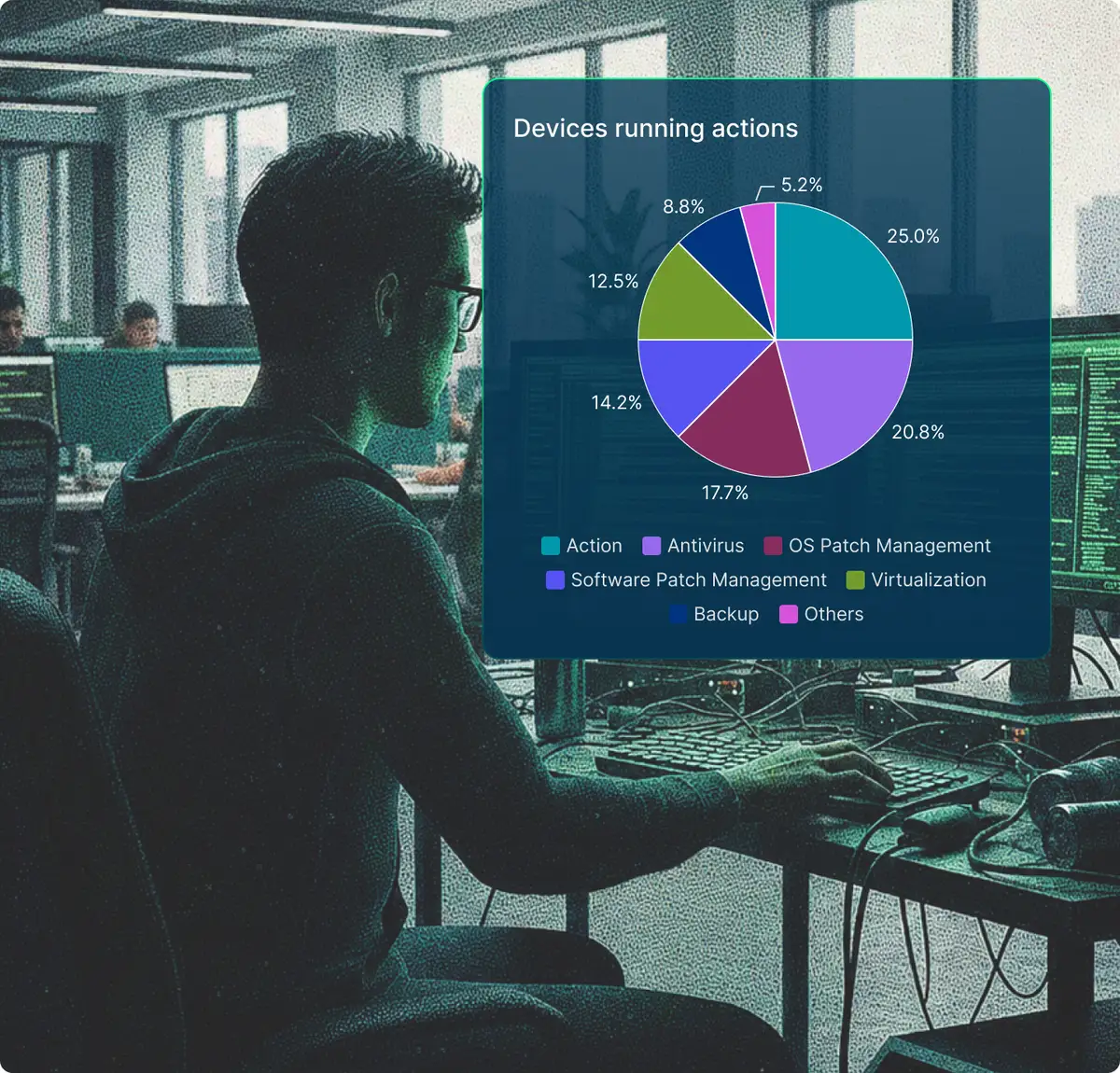
IT technician with image of NinjaOne dashboard

User reviews and ratings: NinjaOne vs. N-able N-sight

NinjaOne

4.7

Overall G2 rating (4,407)

N-able N-sight

4.5

Overall G2 rating (349)

Information as per product capabilities from G2 This comparison represents our assessment of publicly available product capabilities from G2 as of July 2026. If you believe any information here is inaccurate or incomplete, please contact us and we will evaluate and address it as appropriate.

Discover value in 5 minutes.

NinjaOne integrations for IT environments 

NinjaOne integrates with tools commonly found in N-able N-sight environments, including endpoint security and EDR platforms, PSA and ticketing systems, and IT documentation tools.

How to evaluate the decision between NinjaOne vs. N-able N-sight

When evaluating NinjaOne vs. N-able N-sight, consider the following criteria: 

  • Whether Linux endpoints or broad third-party software patching are part of the environment.
  • How much value real-time automation and patch feedback has for your technician team’s daily workflow.
  • Whether documentation, ticketing, and backup should live in the same console as RMM or be managed as separate tools.
  • How console performance needs to hold up as device count grows.
  • What onboarding, training, and support costs are included versus billed separately.

NinjaOne vs. N-able N-sight FAQs

NinjaOne fits teams managing Windows, Mac, Linux, and mobile devices from one console, while N-able N-sight fits teams already standardized on its automation tooling and looking for RMM bundled with billing in the same platform.

The clearest differences are automation feedback speed and patch coverage: NinjaOne automations report status in near real time and its policy-based patching spans Windows, Mac, and Linux, while N-able N-sight’s automation and patch deployments can be slower to confirm and do not include Linux.

Yes, for MSPs and IT teams that need faster visibility into automation and patch outcomes, broader OS and third-party patching coverage, or a console that stays fast as device counts grow.

Choose NinjaOne when real-time automation feedback, cross-platform patching that includes Linux, and console speed at scale matter most. Choose N-able N-sight when a bundled RMM, remote access, ticketing, and billing platform already fits an existing workflow.

Yes. NinjaOne covers the same core RMM functions as N-able N-sight, including monitoring, patch management, remote access, and automation, in a single unified platform.

Ready to simplify work with unified IT?

Snapshot Report Citation: IDC Business Value Snapshot sponsored by NinjaOne, The Business Value of NinjaOne for IT Operations, Doc #US54520326-BVS, May 2026.


GARTNER is a registered trademark and service mark of Gartner, Inc. and/or its affiliates in the U.S. and internationally and is used herein with permission. All rights reserved. Magic Quadrant is a registered trademark of Gartner, Inc. and/or its affiliates and is used herein with permission. All rights reserved.

Gartner does not endorse any company, vendor, product or service depicted in its publications, and does not advise technology users to select only those vendors with the highest ratings or other designation. Gartner publications consist of the opinions of Gartner’s business and technology insights organization and should not be construed as statements of fact. Gartner disclaims all warranties, expressed or implied, with respect to this publication, including any warranties of merchantability or fitness for a particular purpose.


This comparison represents our assessment of publicly available product capabilities as of July 2026. Our evaluation draws on vendor-provided materials, including product documentation and release notes, as well as publicly available pricing information, customer feedback, and analyst insights. Where applicable, details were reviewed against the vendor’s then-current generally available (GA) release as of the date indicated.


Enterprise IT leaders evaluating endpoint management platforms don’t just compare features: they also assess the time it takes to deliver value, the number of people needed to operate the system, and the actual cost after deployment, training, and ongoing operation.

NinjaOne delivers measurable results. On average, deployment is completed in less than 30 days; operators become proficient in less than 10 days. There is no infrastructure to provision, no phased rollout, and no deployment project scope to define: cloud-native SaaS means your team becomes productive in days, not months.

Your team configures, operates, and scales the system without dedicated administrators, proprietary query languages, or ongoing vendor support. And all of this on a unified platform, with no mandatory professional services, no premium support tiers, no hidden renewal costs, and rich features that don’t compromise the digital employee experience your organization is striving for.