Ratings
N-able N-sight
SuperOps

Overall
4.8
Meets Requirements
9.2
905 responses
Ease of Use
9.3
912 responses
Ease of Setup
9.4
804 responses
Ease of Admin
9.5
80 responses
Quality of Support
9.4
876 responses
Ease of Doing Business with
9.6
808 responses
Product Direction (% positive)
Based on G2 Winter 2026
Competitors
N-able N-sight
Product Summary
N-able N-sight™ RMM is a unified IT management platform that combines remote monitoring, endpoint management, and secure remote access (powered by Take Control) with integrated ticketing and billing, enabling MSPs and IT teams to automate workflows and manage devices across physical, hybrid, and cloud environments from a single console.
Use Cases
- Automation Manager: N-Sight includes a visual, drag-and-drop automation builder that allows technicians to construct PowerShell-based workflows without writing code directly. For less technical teams, this lowers the barrier to building automations.
- Take Control: N-Sight’s remote access solution offers solid attended and unattended connectivity with background management tools including file transfer, process management, and device diagnostics. For MSPs that prioritize remote support as a core workflow, it’s a capable option.
- MSP Institute: N-able offers an extensive library of training content through MSP Institute, including product courses, business development resources, bootcamps, and masterclasses. For teams looking to build technical and business skills.
Shortcomings
- Delayed automation feedback: N-Sight script and automation deployments can be slow to execute. Without real-time status reporting, technicians have limited visibility into whether an action succeeded or failed, making it difficult to troubleshoot quickly or confirm outcomes with confidence.
- Limited patching coverage: N-Sight patching does not include Linux support, and third-party application coverage is limited to roughly 100 applications. For organizations managing diverse environments or a broad software catalog, that gap requires additional tooling to compensate.
- Documentation that’s hard to navigate: N-Sight’s product documentation can be difficult to search, making it harder for technicians to find answers quickly. In fast-moving IT environments, time spent hunting through docs is time not spent resolving issues.
SuperOps
Product Summary
SuperOps is a unified, AI-powered platform that merges PSA, RMM, automation, and documentation for MSPs and internal IT teams — delivering operational efficiency, scalability, and simplified tool consolidation.
Use Cases
- Unified PSA and RMM: SuperOps builds its PSA and RMM on a shared database, meaning alerts, tickets, assets, and client records live in one place without requiring a separate sync between tools.
- Modern interface: SuperOps offers a clean, fast UI that is consistently noted by users as intuitive and easy to navigate, reducing onboarding time for new technicians.
- AI-assisted ticketing: SuperOps includes Monica AI, which assists with ticket summarization, triage, and basic workflow automation for service desk teams.
Shortcomings
- No native remote access: SuperOps does not include its own remote access technology. Remote desktop access is delivered through third-party integrations such as ISL Online and Splashtop, each requiring separate configuration and licensing.
- No native backup: SuperOps does not include built-in endpoint backup. Backup and recovery workflows require third-party integrations, adding separate setup, billing, and vendor management to the IT environment.
- No background remote sessions: SuperOps does not support background remote sessions, meaning technicians cannot open an independent session on an endpoint without affecting the user’s active session. Remediation and troubleshooting work requires interrupting the end user, adding friction and disruption to routine fixes.
NinjaOne
Why your peers choose us over N-able N-sight and SuperOps
For enterprise IT organizations managing complex, distributed environments, NinjaOne delivers where others fall short. Recognized as a Leader in the 2026 Gartner® Magic Quadrant™ for Endpoint Management Tools, NinjaOne is purpose-built to meet the demands of large-scale operations, combining deep visibility, governance-grade control, and the industry’s highest customer satisfaction scores.Enterprise teams choose NinjaOne for its ability to scale without compromise. Whether managing thousands of endpoints across global locations or enforcing consistent security and compliance policies across heterogeneous infrastructure, NinjaOne provides the reliability and operational consistency that enterprise environments require. Unlike many competing solutions that carry steep learning curves and high system resource overhead, NinjaOne delivers enterprise-grade power without the implementation burden.
NinjaOne’s integration ecosystem is built for enterprise breadth, offering pre-built compatibility with leading security and ITSM platforms, enabling organizations to consolidate their toolset rather than work around it. Advanced, role-based reporting and audit-ready dashboards give IT leadership the real-time intelligence needed to drive strategic decisions and demonstrate compliance. For enterprises seeking a proven, scalable endpoint management platform backed by best-in-class support, NinjaOne is the clear choice.
What they're saying



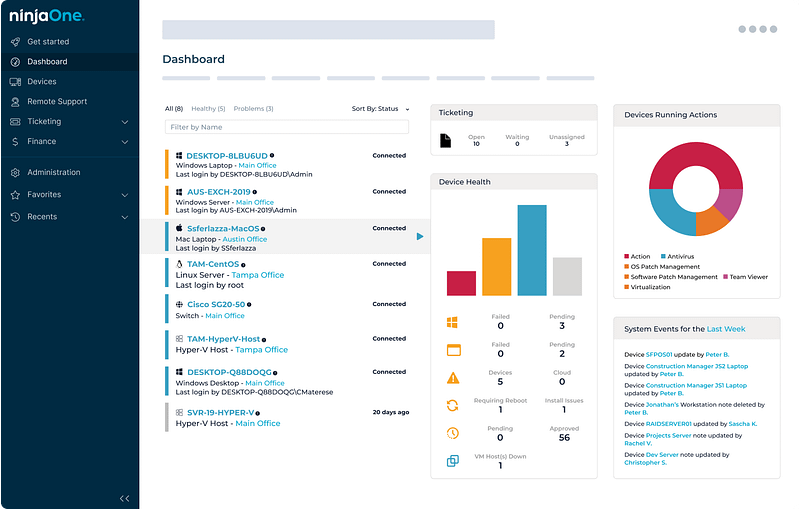
Watch a Demo of the #1 IT Management Software on G2
Related resources
N-able N-sight
JumpCloud vs N-able N-sight
Miradore vs N-able N-sight
Jamf vs N-able N-sight
Moki Total Control vs N-able N-sight
N-able N-sight vs SureMDM
GFI Languard vs N-able N-sight
Mosyle vs N-able N-sight
Esper vs N-able N-sight
Addigy vs N-able N-sight
Kandji vs N-able N-sight
N-able N-sight vs Sophos Mobile
Cisco Meraki vs N-able N-sight
BMC Helix Client Management vs N-able N-sight
N-able N-sight vs SOTI MobiControl
IBM Security MaaS360 vs N-able N-sight
N-able N-sight vs Pandora FMS
N-able N-sight vs Scalefusion
N-able N-sight vs SysAid
N-able N-sight vs VMware Workspace One
Kace vs N-able N-sight
Action1 vs N-able N-sight
N-able N-sight vs Syxsense
N-able N-sight vs SuperOps
Matrix42 vs N-able N-sight
GoTo Resolve vs N-able N-sight
Level vs N-able N-sight
Bacon Unlimited vs N-able N-sight
ITarian vs N-able N-sight
Hexnode vs N-able N-sight
Baramundi vs N-able N-sight
LogicMonitor vs N-able N-sight
Goverlan vs N-able N-sight
Auvik vs N-able N-sight
Atera vs N-able N-sight
N-able N-sight vs SyncroMSP
Kaseya VSA vs N-able N-sight
Connectwise Automate vs N-able N-sight
N-able N-sight vs PRTG Network Monitor
ManageEngine Endpoint Central vs N-able N-sight
LogMeIn vs N-able N-sight
N-able N-sight vs Veeam
N-able N-sight vs Panorama9
N-able N-sight vs SolarWinds Dameware
Bravura OptiTune vs N-able N-sight
Microsoft Intune vs N-able N-sight
Datto vs N-able N-sight
Automox vs N-able N-sight
Datto vs N-able N-sight
N-able N-central vs N-able N-sight
N-able N-sight vs Naverisk
Acronis vs N-able N-sight
IT Glue vs N-able N-sight
Ivanti vs N-able N-sight
N-able N-sight vs Pulseway
Arcserve vs N-able N-sight
BigFix vs N-able N-sight
N-able N-sight vs Tanium
Lansweeper vs N-able N-sight
SuperOps
JumpCloud vs SuperOps
Miradore vs SuperOps
Jamf vs SuperOps
Moki Total Control vs SuperOps
SuperOps vs SureMDM
Esper vs SuperOps
Kandji vs SuperOps
Sophos Mobile vs SuperOps
GFI Languard vs SuperOps
Mosyle vs SuperOps
Addigy vs SuperOps
Cisco Meraki vs SuperOps
BMC Helix Client Management vs SuperOps
SOTI MobiControl vs SuperOps
IBM Security MaaS360 vs SuperOps
Pandora FMS vs SuperOps
LogicMonitor vs SuperOps
Goverlan vs SuperOps
Auvik vs SuperOps
Automox vs SuperOps
Atera vs SuperOps
SuperOps vs SyncroMSP
Kaseya VSA vs SuperOps
Connecwise Automate vs SuperOps
PRTG Network vs SuperOps
Bravura Optitune vs SuperOps
Microsoft Intune vs SuperOps
ManageEngine Endpoint Central vs SuperOps
LogMeIn vs SuperOps
N-able N-central vs SuperOps
N-able N-sight vs SuperOps
Datto vs SuperOps
SuperOps vs Veeam
Panorama9 vs SuperOps
Naverisk vs SuperOps
SolarWinds Dameware vs SuperOps
SuperOps vs Tanium
Lansweeper vs SuperOps
BigFix vs SuperOps
Arcserve vs SuperOps
Pulseway vs SuperOps
Ivanti vs SuperOps
IT Glue vs SuperOps
Acronis vs SuperOps
GoTo Resolve vs SuperOps
Level vs SuperOps
Bacon Unlimited vs SuperOps
ITarian vs SuperOps
Hexnode vs SuperOps
Baramundi vs SuperOps
Action1 vs SuperOps
SuperOps vs Syxsense
SuperOps vs VMware Workspace One
SuperOps vs SysAid
Scalefusion vs SuperOps
Kace vs SuperOps
Matrix42 vs SuperOps
