NinjaOne vs. Take Control

NinjaOne and Take Control both deliver remote support: NinjaOne brings remote access into a unified IT operations platform, while Take Control fits teams that want a dedicated remote tool.

NinjaOne

VS
This comparison reflects our assessment as of November 2026 This comparison represents our assessment of publicly available product capabilities from G2 as of November 2026. If you believe any information here is inaccurate or incomplete, please contact us and we will evaluate and address it as appropriate.

Where NinjaOne fits

Where Take Control fits

IT teams and MSPs that want the remote features they rely on built into the same platform they use for monitoring, patching, and automation.
Support teams that want post-session surveys and technician performance reporting built into their remote tool.
Teams that want remote tools like the file browser, task manager, and registry editor available in the console without opening a session.
Teams that hand sessions between technicians and want session transfer built in.
Teams already on NinjaOne that want to retire a second remote tool without giving up ad-hoc sessions or session recording.
MSPs using Passportal that want credentials injected directly into remote sessions.

Feature comparison between NinjaOne and Take Control

The main differences between NinjaOne and N-able Take Control are
NinjaOneTake Control
Background sessionsBackground Mode opens a dedicated desktop session without interrupting the end user.Take Control desktop sessions run on the end user’s screen.
Remote toolsFile browser, task manager, service manager, registry editor, and terminal run directly in the NinjaOne console, without opening a session.Take Control’s background tools include a system shell, registry editor, file transfer, and system information for processes, services, and applications.
Ad-hoc supportQuickConnect starts on-demand sessions with users on unmanaged devices.End users join on-demand sessions through a website button, a link, or startcontrol.com.
Session recording and loggingSession logs show who connected to which device and when, while recordings show what happened during the session.Sessions can be recorded, and session history reports track activity, including System Shell use.
Platform scopeBuilt into the same platform that runs monitoring, patching, automation, endpoint backup, and PSA.A standalone remote support tool, also integrated into N-able’s N-central and N-sight RMMs.

When NinjaOne is the better choice

Choose NinjaOne when

Your team already manages endpoints in NinjaOne and wants remote control within the same console instead of a separate tool.
Your technicians want to work on a device without interrupting the end user, with Background Mode for dedicated desktop sessions and remote tools that don’t need a session at all.
Your technicians want to start a remote session, reboot a device, or run a script directly from a ticket.
Your team wants common issues resolved automatically before they turn into a remote support request.

Why IT teams choose NinjaOne over Take Control

Run remote support from the same platform as everything else

Running a separate remote tool alongside an RMM means two agents on every endpoint, two consoles, and two places to check for device data. NinjaOne Remote is built into the same platform as monitoring, patching, and automation, so a technician can go from an alert or a device record straight into a session. The device’s patch status, monitoring history, and open tickets are right there in the same console. Remote support becomes one step in the workflow instead of a separate tool.
Many issues only need a quick look at a process, a service, or a registry key. NinjaOne puts the file browser, task manager, service manager, registry editor, and terminal directly in the console, so a technician can restart a service or check a registry value from the device page and open a session only when the issue calls for one. Small fixes stay small.
Some fixes need a full desktop, but not an audience. Background Mode gives technicians a dedicated desktop session that runs without interrupting the person using the device, so the fix happens while the end user keeps working. The user’s day carries on, and the technician isn’t racing to finish before someone needs their screen back.
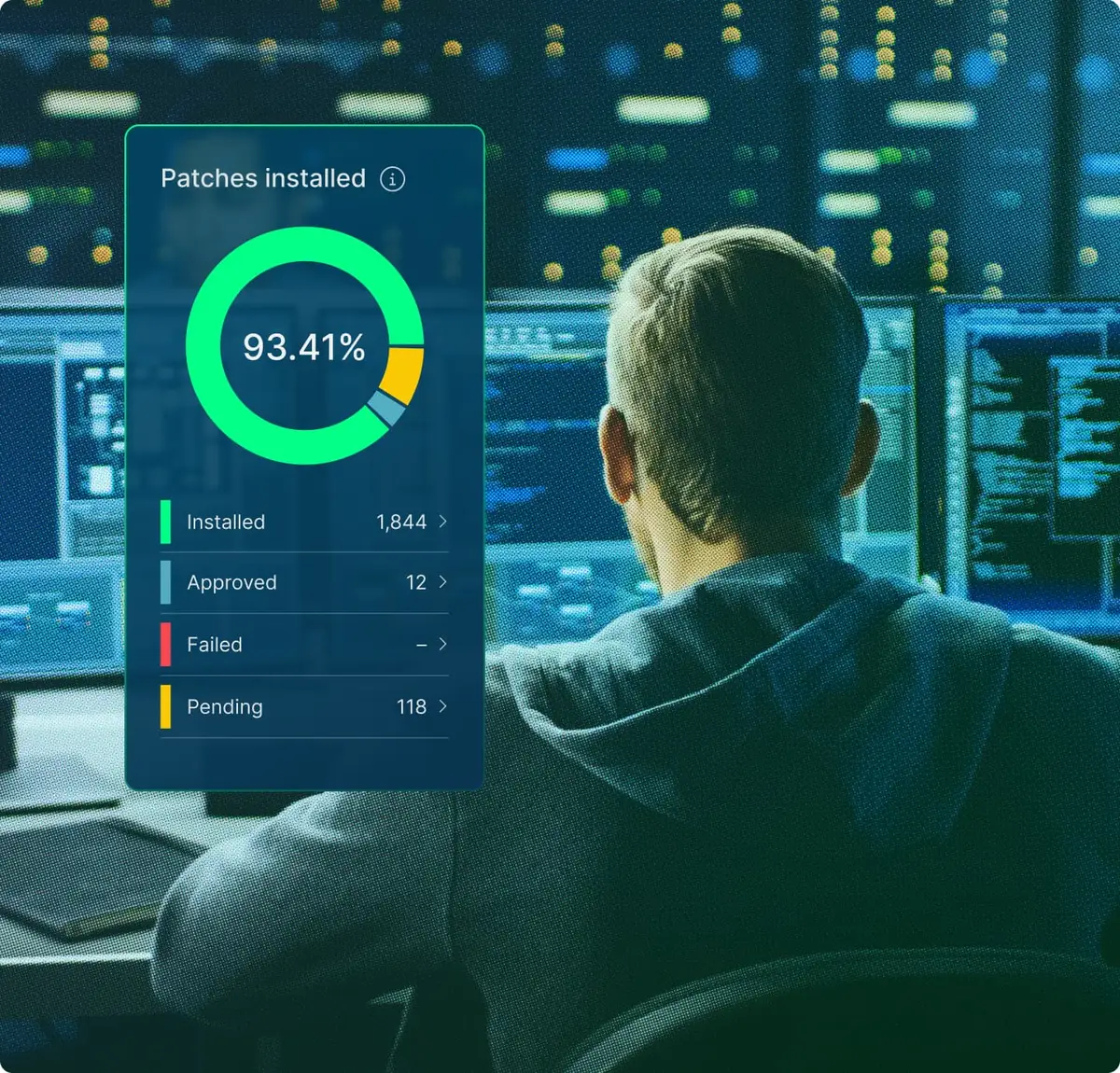
IT technician with image of NinjaOne dashboard

User reviews and ratings: NinjaOne vs. N-able Take Control

NinjaOne

4.7

Overall G2 rating (5,819)

N-able Take Control

4.5

Overall G2 rating (150)

Information as per product capabilities from G2 This comparison represents our assessment of publicly available product capabilities from G2 as of November 2026. If you believe any information here is inaccurate or incomplete, please contact us and we will evaluate and address it as appropriate.

Discover value in 5 minutes.

NinjaOne integrations for MSPs

NinjaOne integrates with tools commonly used alongside remote access in MSP and enterprise IT stacks, including PSA, documentation, and ITSM platforms.

How to evaluate the decision between NinjaOne vs. Take Control

When evaluating NinjaOne vs. Take Control, consider the following criteria:
  • How many separate agents and consoles your technicians use today for monitoring, patching, and remote access.
  • How often technicians need to work on a device while the end user is still using it.
  • Which session workflows your team relies on, such as post-session surveys, session transfers, and credential injection.
  • How much time your team spends moving from an alert or ticket to a remote session.

NinjaOne vs. Take Control FAQs

Take Control is a dedicated remote support tool, while NinjaOne is a cloud-native IT operations platform with remote control built in alongside monitoring, patching, scripting and automation, endpoint backup, and ticketing. With NinjaOne, technicians get remote access in the same console they use for the rest of their endpoint work.
The main difference is where remote support lives. Compared with Take Control, NinjaOne adds Background Mode for dedicated desktop sessions that don’t interrupt the end user, and runs remote tools from the device page in the same console as monitoring, patching, and tickets.
NinjaOne is a strong alternative to Take Control for teams that want remote control in the same platform as their RMM. NinjaOne Remote includes QuickConnect for ad-hoc sessions, multi-monitor support, file transfer, chat, remote printing, session recording, and safe-mode reboot, plus Background Mode.
For the remote support features technicians use every day, no. NinjaOne Remote covers ad-hoc sessions with QuickConnect, multi-monitor support, file transfer, chat, remote printing, session recording, and safe-mode reboot, and it adds Background Mode. Teams that rely on Take Control extras like post-session surveys, session transfer, or Passportal credential injection should plan for those differences.
Yes. NinjaOne Remote can replace Take Control for the remote support work technicians do every day, including ad-hoc sessions, multi-monitor support, file transfer, session recording, and safe-mode reboot. Teams also gain Background Mode, monitoring, patching, automation, endpoint backup, and PSA in the same platform.
Ready to simplify work with unified IT?

Snapshot Report Citation: IDC Business Value Snapshot sponsored by NinjaOne, The Business Value of NinjaOne for IT Operations, Doc #US54520326-BVS, May 2026.


GARTNER is a registered trademark and service mark of Gartner, Inc. and/or its affiliates in the U.S. and internationally and is used herein with permission. All rights reserved. Magic Quadrant is a registered trademark of Gartner, Inc. and/or its affiliates and is used herein with permission. All rights reserved.

Gartner does not endorse any company, vendor, product or service depicted in its publications, and does not advise technology users to select only those vendors with the highest ratings or other designation. Gartner publications consist of the opinions of Gartner’s business and technology insights organization and should not be construed as statements of fact. Gartner disclaims all warranties, expressed or implied, with respect to this publication, including any warranties of merchantability or fitness for a particular purpose.


This comparison represents our assessment of publicly available product capabilities as of November 2026. Our evaluation draws on vendor-provided materials, including product documentation and release notes, as well as publicly available pricing information, customer feedback, and analyst insights. Where applicable, details were reviewed against the vendor’s then-current generally available (GA) release as of the date indicated.


Enterprise IT leaders evaluating endpoint management platforms don’t just compare features: they also assess the time it takes to deliver value, the number of people needed to operate the system, and the actual cost after deployment, training, and ongoing operation.

NinjaOne delivers measurable results. On average, deployment is completed in less than 30 days; operators become proficient in less than 10 days. There is no infrastructure to provision, no phased rollout, and no deployment project scope to define: cloud-native SaaS means your team becomes productive in days, not months.

Your team configures, operates, and scales the system without dedicated administrators, proprietary query languages, or ongoing vendor support. And all of this on a unified platform, with no mandatory professional services, no premium support tiers, no hidden renewal costs, and rich features that don’t compromise the digital employee experience your organization is striving for.