Ratings
Atera
Microsoft Intune

Overall
4.8
Meets Requirements
9.2
905 responses
Ease of Use
9.3
912 responses
Ease of Setup
9.4
804 responses
Ease of Admin
9.5
80 responses
Quality of Support
9.4
876 responses
Ease of Doing Business with
9.6
808 responses
Product Direction (% positive)
Based on G2 Winter 2026
Competitors
Atera
Product Summary
Atera is a cloud-based IT management platform that combines native RMM, helpdesk and ticketing, patch management, and network discovery. The platform supports Windows, macOS, and Linux device management for IT departments and managed service providers.
Use Cases
- RMM: Atera provides remote monitoring and management for endpoint devices, with alert-based monitoring and scripted automation for routine IT tasks.
- Helpdesk & Ticketing: Atera includes a built-in ticketing system for managing end-user support requests, with SLA tracking and technician assignment.
- Patch Management: Atera supports patching for Windows and macOS devices. Linux patching is available through Atera’s Package Manager.
Shortcomings
- Inconsistent patch management: Users on G2 and TrustRadius report that Atera’s patch management can be unreliable, particularly for third-party applications. Scheduling and managing patches across OS platforms has also been cited as unintuitive.
- Limited reporting and customization: Users on G2 and Capterra report that Atera’s built-in reporting is basic and difficult to customize. Generating reports for specific needs, such as executive summaries or compliance documentation, requires workarounds, including exporting data to external tools. Multiple reviewers have noted that advanced analytics and custom report building are not available on lower-tier plans.
- No native backup solution: Atera does not include a built-in backup capability. Organizations requiring backup must rely on third-party integrations, adding complexity and additional vendor management to their IT environment.
- No native remote access: Atera does not offer a native remote access tool. Remote connectivity is provided through third-party integrations with Splashtop and AnyDesk.
Microsoft Intune
Product Summary
Microsoft Intune offers cloud-based endpoint management with comprehensive support for Microsoft product integration. Intune allows managed service providers (MSPs) and IT teams to set up laptops and mobile devices, manage corporate and BYOD devices, and enforce security policies. It offers features such as app management, data protection, device configuration, and software updates, all from a single cloud-based platform. With Intune, customers can remotely secure their data and ensure device compliance with company security policies.
Use Cases
- Centralized device management:
Streamlines device onboarding, configuration, and administration for highly homogenous environments and device configurations. - Application management:
Intune is commonly used to deploy applications, push updates, and manage user permission for multiple device types. - Easy integration with Microsoft products:
Built for seamless integration with Azure Active Directory and other Microsoft products such as Office and Microsoft Endpoint Configuration Manager.
Shortcomings
- Performance:
Several user reviews have stated that Intune can slow down when performing multiple tasks simultaneously, such as deploying and assigning configuration profiles or showing the status of items. - Universal compatibility:
Users have reported that configuring macOS and Apple mobile devices may be challenging, and fewer functionalities are available for non-Windows devices. - Learning curve:
According to G2 reviews, InTune’s interface can be complex, requiring new users to expend more time and resources to learn and understand how to use the platform fully.
NinjaOne
Why your peers choose NinjaOne + Intune over Atera
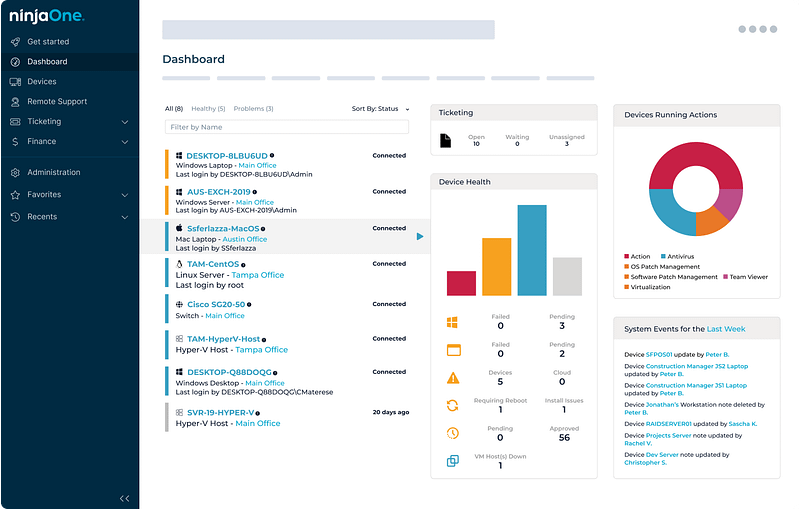
NinjaOne and Microsoft Intune work seamlessly together to unify device visibility and control across every endpoint. By connecting Intune-managed devices with NinjaOne, IT teams gain a single-pane, intelligent view for real-time health monitoring and compliance. This means that IT pros can seamlessly perform various actions, from deploying patches to enforcing policies and configurations, from one dashboard. Together, they create a streamlined, secure endpoint management experience that saves time and reduces complexity.
Compared to other similar tools, NinjaOne delivers unmatched agility and efficiency. It stands out for its extensive compatibility with a wide range of third-party applications (an area where other RMM solutions often have limitations), making it a more adaptable choice for diverse IT environments. Combined with advanced, customizable reporting and a customer-first approach, NinjaOne remains the leading choice for IT professionals who need a dependable, efficient, and future-ready RMM platform.
What they're saying



Watch a Demo of the #1 IT Management Software on G2
Related resources
Atera
Atera vs JumpCloud
Atera vs Miradore
Atera vs Jamf
Atera vs Moki Total Control
Atera vs SureMDM
Atera vs Mosyle
Atera vs Esper
Addigy vs Atera
Atera vs Bravura Optitune
Atera vs Cisco Meraki MDM
Atera vs Sophos Mobile
Atera vs GFI Languard
Atera vs Kandji
Atera vs BMC Helix Client Management
Atera vs SOTI MobiControl
Atera vs IBM Security MaaS360
Atera vs Pandora FMS
Atera vs Scalefusion
Atera vs SysAid
Atera vs VMware Workspace One
Atera vs Kace
Action1 vs Atera
Atera vs Syxsense
Atera vs SuperOps
Atera vs Matrix42
Atera vs GoTo Resolve
Atera vs Level
Atera vs Bacon Unlimited
Atera vs ITarian
Atera vs Hexnode
Atera vs Baramundi
Atera vs N-able N-sight
Atera vs SolarWinds Dameware
Atera vs Panorama9
Atera vs Veeam
Atera vs Datto
Atera vs N-able N-central
Atera vs Naverisk
Acronis vs Atera
Atera vs IT Glue
Atera vs Ivanti
Atera vs Pulseway
Arcserve vs Atera
Atera vs Lansweeper
Atera vs Tanium
Atera vs BigFix
Atera vs SyncroMSP
Atera vs Kaseya VSA
Atera vs Connectwise Automate
Atera vs PRTG Network Monitor
Atera vs Microsoft Intune
Atera vs ManageEngine Endpoint Central
Atera vs LogMeIn
Atera vs LogicMonitor
Atera vs Goverlan
Atera vs Automox
Atera vs Auvik
Microsoft Intune
JumpCloud vs Microsoft Intune
Microsoft Intune vs Miradore
Jamf vs Microsoft Intune
Microsoft Intune vs Moki Total Control
Microsoft Intune vs SureMDM
Microsoft Intune vs Sophos Mobile
GFI Languard vs Microsoft Intune
Microsoft Intune vs Mosyle
Esper vs Microsoft Intune
Addigy vs Microsoft Intune
Kandji vs Microsoft Intune
Cisco Meraki vs Microsoft Intune
BMC Helix Client Management vs Microsoft Intune
Microsoft Intune vs SOTI MobiControl
IBM Security MaaS360 vs Microsoft Intune
Microsoft Intune vs Pandora FMS
Microsoft Intune vs Scalefusion
Microsoft Intune vs SysAid
Microsoft Intune vs VMware Workspace One
Kace vs Microsoft Intune
Action1 vs Microsoft Intune
Microsoft Intune vs Syxsense
Microsoft Intune vs SuperOps
GoTo Resolve vs Microsoft Intune
Level vs Microsoft Intune
Bacon Unlimited vs Microsoft Intune
ITarian vs Microsoft Intune
Hexnode vs Microsoft Intune
Baramundi vs Microsoft Intune
Microsoft Intune vs N-able N-sight
Microsoft Intune vs SolarWinds Dameware
Microsoft Intune vs Panorama9
Microsoft Intune vs Veeam
Datto vs Microsoft Intune
Microsoft Intune vs N-able N-central
Microsoft Intune vs Naverisk
Acronis vs Microsoft Intune
IT Glue vs Microsoft Intune
Ivanti vs Microsoft Intune
Microsoft Intune vs Pulseway
Arcserve vs Microsoft Intune
Lansweeper vs Microsoft Intune
Microsoft Intune vs Tanium
BigFix vs Microsoft Intune
LogicMonitor vs Microsoft Intune
Goverlan vs Microsoft Intune
Auvik vs Microsoft Intune
Automox vs Microsoft Intune
Microsoft Intune vs SyncroMSP
Kaseya VSA vs Microsoft Intune
Connectwise Automate vs Microsoft Intune
Microsoft Intune vs PRTG Network Monitor
Bravura Optitune vs Microsoft Intune
ManageEngine Endpoint Central vs Microsoft Intune
LogMeIn vs Microsoft Intune
Atera vs Microsoft Intune
