Key Points
- The top alternatives to Atera are: 1) NinjaOne, 2) ConnectWise RMM, 3) Datto RMM, 4) Kaseya VSA, 5) N-able N-central, 6) Syncro, 7) ManageEngine Endpoint Central, 8) Pulseway, 9) OptiTune, 10) Ivanti, 11) Automox, and 12) Action 1
- NinjaOne is the strongest all-around alternative for teams prioritizing patch reliability, fast deployment, and tool consolidation.
- Patch reliability, automation depth, and support quality are the features MSPs and IT teams most commonly prioritize when evaluating Atera alternatives.
- Atera works well at a smaller scale, but teams often begin evaluating alternatives when recurring patch failures, limited reporting customization, and remote control gaps start consuming more technician time than the platform saves.
This guide covers the top 12 Atera alternatives for this year. We evaluated each tool on its core capabilities, real-world strengths, and shortcomings based on genuine user feedback from G2 and Capterra.
Many readers using this guide are most likely already using Atera and wondering whether transitioning is worth their time and effort. In this article, we intend to answer this question while also offering insights into which platforms offer the smoothest migration paths and which are best positioned for long-term growth.
TL;DR: If you’re evaluating whether to switch from Atera, the decision largely comes down to where your current friction is coming from. Teams running into patch reliability issues, scaling limitations, reporting gaps, or a lack of customization will find stronger alternatives available today. This guide breaks down the top 12 options to help you find the right fit for your team’s size, workflows, and long-term growth plans, with NinjaOne as our top recommendation for teams that need reliable patch management, fast deployment, and a single platform that consolidates their toolset.
See NinjaOne in action.
Start your 14-day free trial.
Atera alternatives quick comparison table
| Tool | G2 Rating | Reviews | Best for | Pricing model | Deployment | Migration difficulty |
| NinjaOne | 4.7/5 | 4,308 | MSPs and IT teams of all sizes | Per device | Cloud | Low |
| ConnectWise RMM | 4.2/5 | 66 | Larger enterprises, SMBs with NOC | Per device | Cloud | Medium |
| Datto RMM | 4.5/5 | 760 | SMBs and MSPs in Kaseya ecosystem | Per device | Cloud | Medium |
| Kaseya VSA | 4.5/5 | 326 | MSPs scaling IT operation | Per device | Cloud / on-premises | Medium |
| N-able N-central | 4.4/5 | 556 | MSPs and IT teams | Per device | Cloud / on-premises | Medium |
| Syncro | 4.5/5 | 502 | Small to medium sized MSPs | Per technician | Cloud | Low |
| ManageEngine Endpoint Central | 4.5/5 | 1,104 | Mid-market to enterprise IT teams | Per device/ bundle | Cloud / on-premises | Medium |
| Pulseway | 4.6/5 | 123 | Mobile-first IT admins and MSPs | Per device | Cloud | Low |
| OptiTune | 4.3/5 | 5 | Small IT teams and lean MSPs | Per device | Cloud / on-premises | Low |
| Ivanti Neurons | 4.2/5 | 107 | Enterprise IT, ITAM-focused teams | Custom | Cloud / on-premises | High |
| Automox | 4.5/5 | 291 | Security-first IT and patch management | Per device | Cloud | Low |
| Action1 | 4.9/5 | 1,047 | Cloud-first teams, remote workforces | Per device | Cloud | Low |
How we evaluated these tools
The alternatives listed in this guide were selected based on market presence, G2 and Capterra review volume, relevance to MSP and IT team workflows, and direct comparability with Atera’s core feature set.
Our methodology followed these criteria:
- Third-party review data: Ratings, themes, and friction points were drawn from G2 and Capterra, prioritizing reviews from the past 12 months where available.
- Feature relevance: Tools were assessed on patch management, remote monitoring, automation, reporting, integration depth, and scalability, the functional areas where Atera users most commonly report limitations.
- Deployment and migration: Each tool was assessed on deployment model (cloud, on-premises, hybrid) and the practical effort of migrating from Atera.
- NinjaOne internal research: Where applicable, validated NinjaOne benchmarks and customer outcome data were used to support the NinjaOne section.
12 best alternatives to Atera
All G2/Capterra data as of June 2026.
1. NinjaOne
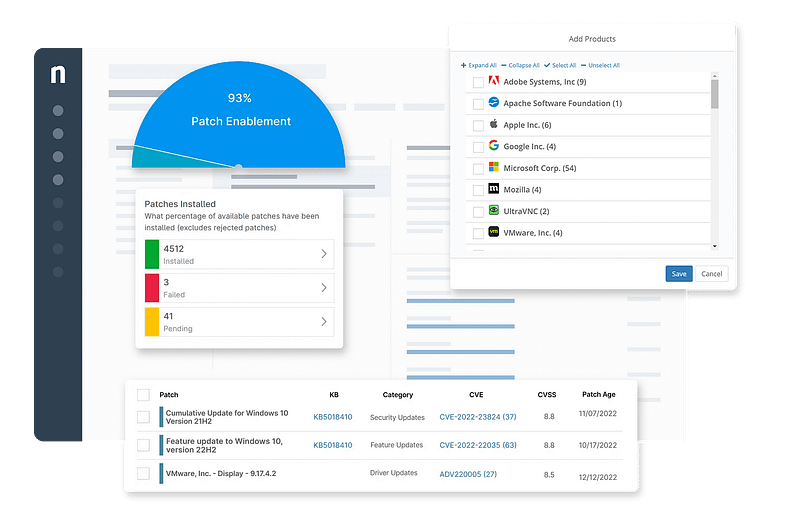
NinjaOne, an enterprise-ready unified IT management platform trusted by over 40,000 customers worldwide, is our top choice in this list of alternatives to Atera, due to its superior integration capabilities and customization options. The NinjaOne Platform empowers IT teams to be more proactive in their decision-making by providing them with the data and tools they need in a single pane of glass, resulting in more productive and satisfied end users. Its platform is designed to reduce tool sprawl and improve technician efficiency across Windows, macOS, Linux, and hundreds of third-party applications.
Key features
- Autonomous patch management: NinjaOne supports patching across Windows, macOS, Linux, and third-party applications from a single interface.
- Extensive integrations: NinjaOne integrates with dozens of apps. This allows you to use all the tools you need on one dashboard rather than working with several different third-party vendors.
- Unlimited scalability: NinjaOne is suitable for everyone, whether you’re a startup business or an established one. Its cloud-based infrastructure can manage any number of endpoints across all operating systems.
- Reliable network services: NinjaOne helps you maintain high network service levels, tight security, and constant visibility into your IT infrastructure. This allows you to make more efficient use of your IT resources.
- Easy to use and set up: NinjaOne ranks high consistently for its ease of setup, admin, and use. Its endpoint management solution is designed to be intuitive so you can focus on the tasks that matter.
NinjaOne consolidates the most essential endpoint management functionalities in one centralized platform.
→ See NinjaOne in action
Customer Story
Mark Andres, the Director of IT Services at GSDSolutions, says that migrating from Atera to NinjaOne was a no-brainer choice for him. He explains that NinjaOne provided him and his team the flexibility and customization they needed to optimize their internal processes and deliver more efficient services to their customers.
“Our biggest challenge with Atera was their remote-control integration – we ended up purchasing Splashtop directly, rolling it out with scripts, and managing it outside the platform,” says Andres. “NinjaOne gives us all the tools and functionality we need, it’s fast and easy to onboard new clients, the platform saves me time, and it helps us keep clients compliant.”
You can read more customer stories or check out NinjaOne reviews.
Pricing information
NinjaOne uses a per-device pricing model that is customized to the specific modules you need, such as backup, patch management, and remote access. There are no hidden fees, and includes unlimited onboarding, training, and support at no extra cost.
You can request a free quote, schedule a 14-day free trial, or watch a demo.
Reviews
- 4,308 reviews (at the time of update)
- 4.7 / 5 stars
- 292 reviews (at the time of update)
- 4.7 / 5 stars
2. ConnectWise RMM
ConnectWise RMM is an endpoint management platform meant for MSPs and larger enterprises that want both do-it-yourself (DIY) and do-it-for-you (DFY) services in a single interface. It is intended for smaller-sized businesses looking specifically for an outsourced network operations center (NOC).
It is part of the broader ConnectWise ecosystem, which includes PSA, documentation, and security tooling.
See how ConnectWise compares to NinjaOne.
Read a more in-depth comparison of ConnectWise competitors or learn more about ConnectWise vs. Atera
Best for
Mid-to-large MSPs and enterprises that are already using other ConnectWise products (such as ScreenConnect) and want a tightly integrated ecosystem.
Features
- Policy-based automation: ConnectWise allows IT teams to remotely manage their endpoints and implement patch management policies.
- Desktop alerting: ConnectWise offers a feature that allows its users to receive notifications on their desktops, especially for more urgent cases.
- AI scripting: ConnectWise leverages AI technology to make scripts more efficient.
Shortcomings
- User-friendliness: Some G2 users have stated that the platform may not be as intuitive as expected. (Verified G2 review)
- Integrations beyond the ConnectWise ecosystem: The platform could improve its integration capabilities with other business apps outside its current ecosystem. (Verified G2 review)
- Reporting: According to a G2 review, the reporting functionality is available on a separate platform. (Verified G2 review)
ConnectWise G2 Reviews
- 66 reviews (at the time of update)
- 4.2 / 5 stars
ConnectWise Capterra Reviews
- 72 reviews (at the time of update)
- 4.2 / 5 stars
3. Datto RMM (now part of Kaseya)
Datto RMM is a cloud-hosted remote monitoring and management platform that has been part of the Kaseya family since its acquisition in June 2022. The product retains its Datto branding and continues to be developed within Kaseya’s portfolio, with Autotask PSA as its recommended PSA integration.
Datto RMM features tools such as networking management and business management, helping smaller enterprises improve their business efficiency through automation and integrations.
See how Datto compares to NinjaOne.
Read a more in-depth comparison of Datto competitors or learn more about Datto vs. Atera.
Best for
Small-to-mid MSPs that are already using Autotask PSA or other Kaseya products, or those that prioritized Datto’s ecosystem before the acquisition.
Features
- Modern UI: Datto is known for its easy-to-use and easy-to-understand user interface.
- Remote control: Datto allows IT groups and MSPs to remotely monitor and manage their network quite easily.
- Scripting management: Datto allows users to upload their own scripts, allowing for more tailored automation and management.
Shortcomings
- Policy organization and navigation: Several G2 reviews show users expressing their desire for more intuitive navigation, especially as their organizations scale. (Verified G2 review)
- Alert tuning: It may take some time to properly configure the alert function. (Verified G2 review)
- Web console timeout: G2 users state that connecting to a device remotely can take some time, which may reduce customer satisfaction. (Verified G2 review)
Datto RMM G2 Reviews
- 760 reviews (at the time of update)
- 4.5 / 5 stars
Datto RMM Capterra Reviews
- 42 reviews (at the time of update)
- 4.3 / 5 stars
4. Kaseya VSA
Kaseya VSA (Virtual System Administration) is Kaseya’s flagship RMM product, offering centralized endpoint management for MSPs and IT departments managing distributed environments.
VSA supports patching, automation, remote troubleshooting, and monitoring across Windows, macOS, and third-party applications. It is positioned as a solution for IT teams looking to unify operations across multiple platforms within the Kaseya IT Complete stack.
See how Kaseya compares to NinjaOne.
Read a more in-depth comparison of Kaseya competitors or learn more about Kaseya vs. Atera.
Best for
MSPs and IT teams that are already invested in the Kaseya product ecosystem, or organizations that require a feature-rich RMM with a broad range of integrations across Kaseya’s IT Complete suite.
Features
- Monitoring and alerting: Kaseya offers comprehensive monitoring and alerting capabilities, allowing IT administrators to identify potential issues before they affect the whole system.
- Auto-remediation: The platform also has functionalities that allow IT administrators to automate issue fixes and fundamental troubleshooting tasks to help speed up resolution.
- Patch management: Kaseya VSA provides centralized patch management for Windows, macOS, and third-party applications.
Shortcomings
- Navigation: Some Kaseya users expressed challenges when navigating the platform, saying it takes time to get to features buried deep within the user interface. (Verified G2 review)
- Support: Multiple G2 reviews state that Kaseya could improve its customer support. (Verified G2 review)
- Integration with related products: Some users found integrating Kaseya effectively with other products within the Kaseya ecosystem challenging. (Verified G2 review)
Kaseya VSA G2 Reviews
- 326 reviews (at the time of update)
- 4.5 / 5 stars
Kaseya VSA Capterra Reviews
- 207 reviews (at the time of update)
- 4.1 / 5 stars
5. N-able N-central
N-able N-central is a unified endpoint management SaaS solution focusing on remote monitoring and management functionalities. The platform offers endpoint management, security, backup, and automation capabilities that cater to on-premises, cloud, or hybrid IT environments.
N-able N-central is suited for both managed service providers and internal IT teams for organizations of all sizes, making it an ideal choice for businesses seeking an endpoint management solution that provides RMM features with dedication to endpoint security.
See how N-able N-central compares to NinjaOne.
Read a more in-depth comparison of N-able N-central competitors or learn more about N-able N-central vs. Atera.
Best for
MSPs and IT teams of all sizes that prioritize endpoint security alongside remote monitoring.
Features
- Integrations: N-able N-central offers integrations for IT operations such as PSA, backup, reporting, security, and other third-party services.
- Multi-platform support: N-able N-central lets IT administrators manage endpoints running on different operating systems and platforms in one centralized console.
- Automation: N-able N-central provides a library of over 650 pre-built scripts, enabling automation across various skill levels – from no-code to pro-code development.
Shortcomings
- Flexibility: Several G2 reviewers said that the platform could be more flexible and intuitive. (Verified G2 review)
- Set up: According to G2 reports, there is a steep learning curve associated with using N-able N-central. (Verified G2 review)
- Customer support: Other users have mentioned that getting support may be challenging. (Verified G2 review)
N-able N-central G2 Reviews
- 556 reviews (at the time of update)
- 4.4 / 5 stars
N-able N-central Capterra Reviews
- 253 reviews (at the time of update)
- 4.2 / 5 stars
6. Syncro
Syncro is a platform designed primarily for MSPs, but it is also flexible enough for IT teams in businesses and organizations that want to centralize their endpoint management.
It combines RMM, PSA, and remote access in one solution, allowing IT pros to manage operations, customer interactions, and service delivery more efficiently.
Because of this, Syncro is often regarded as one of the top Atera alternatives for MSPs seeking a balance of affordability and functionality.
See how Syncro compares to NinjaOne.
Read a more in-depth comparison of Syncro alternatives or learn more about Syncro vs. Atera.
Best for
Small-to-mid MSPs that want an integrated RMM and PSA without managing separate vendor relationships or paying per-device fees.
Features
- Mobile app: Syncro has a dedicated mobile app with essential endpoint management features that IT administrators can use on the go.
- PSA features: Syncro delivers ticketing, billing, customer management, and endpoint monitoring in one platform, eliminating the need for a separate PSA subscription.
- Remote access: Syncro allows IT administrators to perform troubleshooting through remote access, reducing the need for physical intervention.
Shortcomings
- Ticket transparency: One G2 review said that it is difficult to determine if other team members are working on the same ticket, which can create delays. (Verified G2 review)
- Vague alerts: Multiple reviews state that they receive basic reports about different issues, which can slow down the resolution process. (Verified G2 review)
- Reporting: The reporting function could be improved to be more comprehensive and intuitive. (Verified G2 review)
Syncro G2 Reviews
- 502 reviews (at the time of update)
- 4.5 / 5 stars
Syncro Capterra Reviews
- 148 reviews (at the time of update)
- 4.6 / 5 stars
7. ManageEngine Endpoint Central
ManageEngine Endpoint Central is a unified endpoint manager that helps organizations centralize IT operations like patching, software deployment, device control, and security management. It provides IT teams with a single console to manage desktops, servers, mobile devices, and virtual machines, making it a strong option for MSPs and internal IT departments.
For businesses comparing Atera alternatives, ManageEngine Endpoint Central stands out with its broad device coverage and built-in security capabilities.
See how ManageEngine compares to NinjaOne.
Read a more in-depth comparison of ManageEngine Endpoint Central alternatives or see how ManageEngine Endpoint Central compares to Atera.
Best for
Mid-market to enterprise internal IT departments that need broad device coverage across desktops, servers, and mobile endpoints, with built-in security and compliance management.
Features
- Device support: ManageEngine Endpoint Central supports various endpoints, from smartphones and tablets to computers and rugged devices.
- Security: The platform also offers security features such as malware protection, browser security, application control, and more.
- Software management: ManageEngine Endpoint Central has software management capabilities such as application templates, software repositories, metering, etc.
Shortcomings
- Remote sessions: Occasionally, users receive error messages during a remote session, though they spontaneously resolve on their own after a few minutes. (Verified G2 review)
- Learning curve: According to some ManageEngine Endpoint Central users, learning and becoming familiar with the platform can be a challenge. (Verified G2 review)
- Patch pushing: Multiple users have expressed difficulty in pushing patches. (Verified G2 review)
ManageEngine Endpoint Central G2 Reviews
- 1,104 reviews (at the time of update)
- 4.5 / 5 stars
ManageEngine Endpoint Central Capterra Reviews
- 83 reviews (at the time of update)
- 4.7 / 5 stars
8. Pulseway
Pulseway is a cloud-based platform that gives IT teams and MSPs the ability to monitor and manage endpoints from anywhere. Its design emphasizes mobility, with a strong mobile app and cloud-first approach that makes it easy for administrators to stay connected on the go. The core platform covers essential RMM capabilities, with add-ons allowing organizations to expand into areas like security, patching, and automation.
Because of its mobile-first design, Pulseway is often reviewed as one of the best Atera alternatives.
See how Pulseway compares to NinjaOne.
Read a more in-depth comparison of Pulseway competitors or learn more about Pulseway vs. Atera.
Best for
IT administrators and small-to-mid MSPs that prioritize mobile access and the ability to manage their environment remotely from a smartphone or tablet.
Features
- Auto-remediation: Pulseway enables IT administrators to set up remediation workflows for streamlined and quicker IT issue resolutions.
- Mobile-first management: Pulseway’s mobile app supports alerting, remote actions, script execution, and endpoint access.
- Server monitoring: Pulseway provides server monitoring and management capabilities that help IT administrators keep track of performance and uptime status.
Shortcomings
- User-interface: Some G2 users have said that Pulseway’s UI could improve so that it’s more user-friendly. (Verified G2 review)
- Desktop limitations: While the mobile app version of Pulseway is robust, G2 users have said that it could improve its desktop counterpart. (Verified G2 review)
- Reporting: Some users note that the reporting features could be improved, especially when compared to other Atera alternatives on this list. (Verified G2 review)
Pulseway G2 Reviews
- 123 reviews (at the time of update)
- 4.6 / 5 stars
Pulseway Capterra Reviews
- 310 reviews (at the time of update)
- 4.7 / 5 stars
9. OptiTune
OptiTune, developed by Bravura Software, is an endpoint management solution tailored for IT departments and MSPs. It delivers essential endpoint management capabilities such as RMM, monitoring and alerting, patch management, and more.
OptiTune promotes its broad accessibility capability, which enables IT administrators to manage devices and IT infrastructure remotely from any location with internet connectivity. It’s an ideal choice for organizations and MSPs that require flexibility and the ability to manage their IT environment from anywhere.
See how OptiTune compares to NinjaOne.
Read a more in-depth comparison of OptiTune competitors.
Best for
Small IT teams and lean MSPs that need straightforward endpoint monitoring and patch management without the complexity of enterprise-grade platforms.
Features
- Monitoring and alerting: OptiTune immediately alerts IT administrators when a potential issue arises.
- Update status: The platform presents users with a dashboard that shows detailed graphs and breakdowns of the patching status and progress.
- Endpoint security: OptiTune integrates with IT security services that can provide endpoint protection from disruptive threats.
Shortcomings
- Integrations: While OptiTune handles core endpoint management well, it offers fewer out-of-the-box integrations with PSA, security, or automation tools, which may require additional workarounds for MSPs with broader software stacks. (Verified G2 review)
- Mobile-friendliness: A G2 review claims the product is not as mobile-friendly as expected. (Verified G2 review)
- Support for Linux: According to some users, OptiTune’s functionalities are Windows/macOS oriented, posing challenges for IT administrators managing Linux endpoints. (Verified G2 review)
OptiTune G2 Reviews
- 5 reviews (at the time of update)
- 4.3 / 5 stars
OptiTune Capterra Reviews
- 14 reviews (at the time of update)
- 4.3 / 5 stars
10. Ivanti
Ivanti is an endpoint manager solution that consolidates the management of both end-user computers and mobile devices into a single, unified platform. This comprehensive solution provides core endpoint management services and primarily targets enterprises and IT departments aiming to streamline device management and optimize their overall IT operations.
For those exploring the best Atera alternatives, Ivanti stands out as a robust alternative to Atera, particularly for businesses focused on consolidating infrastructure and security.
See how Ivanti compares to NinjaOne.
Read a more in-depth comparison of Ivanti competitors or learn more about Ivanti vs. Atera.
Best for
Ivanti is best suited to teams with dedicated IT resources and the capacity to manage a complex, full-featured platform.
Features
- IT asset management: Ivanti offers ITAM capabilities through its cloud-based platform, Ivanti Neurons, providing organizations with comprehensive observability of hardware and software.
- Digital experience management: Ivanti Neurons for Digital Experience helps IT professionals proactively identify and resolve user device and application issues to enhance employee experience and productivity.
- Voice integration: Under the platform’s service management capabilities, Ivanti integrates existing phone systems with IT service desks to enhance customer experience through call routing and voice self-service.
Shortcomings
- User experience: Multiple G2 reviews state that the platform could be challenging to use, especially for beginner IT professionals. (Verified G2 review)
- Setup and navigation: Others pointed out that setting up Ivanti is complex, and post-setup navigation can be challenging. (Verified G2 review)
- Documentation: Some users suggest that documentation should be maintained and updated to facilitate accurate troubleshooting and faster resolution. (Verified G2 review)
Ivanti G2 Reviews
- 115 reviews (at the time of update)
- 4.2 / 5 stars
Ivanti Capterra Reviews
- 1 review (at the time of update)
- 3.0 / 5 stars
11. Automox
Automox is a cloud-native endpoint management platform that places automation and patch management at the center of its feature set. In addition to automation, it offers essential endpoint management features such as patch management, remote troubleshooting, analytics, and more.
It’s a contender for IT teams and MSPs prioritizing security and efficiency and often appears among the best Atera alternatives due to its centralized control and streamlined workflows.
See how Automox compares to NinjaOne.
Read a more in-depth comparison of Automox competitors or learn more about Automox vs. Atera.
Best for
Security-conscious IT teams and MSPs that want strong, automated cross-platform patch management without the overhead of a traditional on-premises RMM.
Features
- Cross-platform patch automation: Automox automates patching across Windows, macOS, and Linux endpoints from a single policy engine, enforcing consistent compliance without OS-specific silos.
- Remote control: Automox enables remote troubleshooting of endpoints directly within its console, eliminating the need for separate tools or processes.
- Lightweight agent: The Automox agent is designed to have minimal system resource impact, reducing the risk of endpoint performance degradation after deployment.
Shortcomings
- Reporting: While Automox includes reporting features, some users note they would benefit from more detailed and customizable reporting options to gain clearer insights into patch and policy outcomes. (Verified G2 review)
- Real-time visibility: A few users mention that policy or device status updates can sometimes slow down, which may affect real-time monitoring in fast-moving environments. (Verified G2 review)
- Initial setup: Users have stated that setting up Automox could be challenging. (Verified G2 review)
Automox G2 Reviews
- 291 reviews (at the time of update)
- 4.5 / 5 stars
Automox Capterra Reviews
- 153 reviews (at the time of update)
- 4.7 / 5 stars
12. Action1
Action1 is a cloud-based endpoint management platform that supports organizations managing both office-based and remote devices. It offers tools to monitor and oversee endpoints remotely, streamline IT operations, and maintain compliance with industry requirements.
The solution is designed to provide centralized control over devices, accommodating both on-premises and cloud environments. It also offers a free vulnerability assessment for unlimited endpoints, which is an entry point for teams evaluating their security posture.
See how Action1 compares to NinjaOne.
Read a more in-depth comparison of Action1 competitors or learn more about Action1 vs. Atera.
Best for
Action1 stands out as a lightweight yet powerful option, particularly for teams wanting fast deployment and real-time visibility without traditional VPN dependencies.
Features
- Patch management: Action1 offers a cloud-native patch management solution designed for MSPs to handle cross-OS and third-party patching and software deployment.
- Software deployment: Action1 has a cloud-native solution for automating software deployment, patching, and inventory across in-office and remote devices without a VPN.
- Initial vulnerability assessment: Action1 offers a free one-time vulnerability assessment for unlimited endpoints for organizations to gauge the platform’s vulnerability management functionality.
Shortcomings
- Pre-packaged software: Some G2 users requested for a more extensive software selection. (Verified G2 review)
- Specific metrics: A G2 user requested for more detailed endpoint performance metrics. (Verified G2 review)
- Documentation: Other Action1 users said its documentation could benefit from more in-depth explanations for users with less technical expertise. (Verified G2 review)
Action1 G2 Reviews
- 1,047 reviews (at the time of update)
- 4.9 / 5 stars
Action1 Capterra Reviews
- 237 reviews (at the time of update)
- 4.9 / 5 stars
What is Atera?
Atera is a cloud-based IT management platform designed for MSPs and internal IT teams. Its core offering includes RMM, patch management, PSA, network discovery, reporting, and ticketing, all accessible from a single interface. Atera also features its own autonomous agents that assist with proactive management, ensuring some issues are mitigated even before technicians need to intervene.
Why choose NinjaOne over Atera?
1. More reliable patch management
Reviews of Atera flag inconsistent patch deployment and occasional slowdowns as a recurring frustration. NinjaOne’s patch management covers Windows, macOS, Linux, and hundreds of third-party applications from a single interface, with separate scheduling for scanning and deployment and flexible reboot controls. According to NinjaOne customer outcome data, 95% of customers improved patch compliance after switching, and 70% reduced vulnerabilities in their environment by up to 75%.
2. More flexible ticketing and helpdesk experience
Reviews and user feedback point to several friction points in Atera’s ticketing system, especially with inconsistent and cluttered ticket categories. NinjaOne’s ticketing is built for flexibility, with more customizable templates, consistent categorization, and a cleaner workflow that keeps technicians focused without the noise.
3. Faster deployment and onboarding
Atera users have noted performance slowdowns as their environments scale, which can compound the productivity dip that comes with platform transitions. NinjaOne’s average enterprise deployment is completed in under 30 days, and 90% of customers reporting becoming proficient just hours. This significantly reduces the productivity dip typically associated with switching RMM platforms.
4. Stronger tool consolidation
While Atera positions itself as an all-in-one platform, reviews note that its capabilities become more limited as operational needs grow, particularly around reporting, patching, and mobile functionality. NinjaOne consolidates endpoint monitoring and management, remote access, backup, and patch management under a single agent, reducing tool sprawl. According to NinjaOne’s own research, 71% of customers replaced more than four tools after switching to NinjaOne.
5. Deeper reporting visibility
Reporting is one of the most frequently cited limitations in Atera reviews, with users noting that the function lacks comprehensiveness and flexibility for their needs. NinjaOne offers customizable reporting across endpoints, patches, and performance metrics, giving IT teams and MSPs the depth and visibility they need to make informed decisions and demonstrate value to stakeholders.
Experience NinjaOne in action.
Book your free demo.
Strengths of Atera
Atera has genuine strengths that explain its adoption among MSPs and IT teams, particularly at smaller scale. The following are drawn from verified third-party reviews:
- Ease of use: Multiple reviewers on G2 note that Atera’s interface is relatively easy to navigate. (Verified G2 Review)
- All-in-one platform: Atera’s combination of RMM, ticketing, and automation tools in a single platform reduces the need to manage multiple vendor relationships. (Verified G2 Review)
- Per-technician pricing: Atera’s pricing model, which charges per technician rather than per device, can be cost-effective for lean MSPs. However, as team size grows or device counts shift, this model may not always offer the best value compared to per-device pricing alternatives. (Verified Capterra Review)
- AI-assisted features: Atera reviewers praise Atera’s AI agents that assist with proactive endpoint management. (Verified G2 Review)
- Value at entry level: Atera offers a reasonable baseline feature set at an accessible price point (Verified G2 Review)
Limitations of Atera
The following recurring friction points reflect the operational impact most commonly experienced by Atera users:
- Customization options: Users have expressed their desire for the platform to be more customizable and flexible. (Verified G2 review)
- Patch reliability: Atera users state that the platform can occasionally slow down or deploy patches inconsistently. (Verified G2 review)
- Scaling issues: While robust for smaller enterprises, some G2 users have said that the platform begins to slow down or experience issues as monitoring needs scale. (Verified G2 review)
- Reporting: Atera could also improve its reporting function to be more comprehensive. (Verified G2 review)
- Mobile app: Multiple G2 reviews state that while the mobile app is functional, it could still be improved to be as intuitive as its desktop version. (Verified G2 review)
Atera pros and cons
| Pros | Cons |
| Easy to use and navigate for new users | Limited customization and flexibility options |
| All-in-one RMM, PSA, and helpdesk in one platform | Patch deployment can be inconsistent or slow |
| Per-technician pricing model (cost-effective for smaller teams with high endpoint counts, but may not scale as favorably for larger ones) | Performance and scaling issues as monitoring needs grow |
| AI-assisted proactive management features | Reporting functionality lacks comprehensiveness |
| Accessible pricing for smaller teams and MSPs | Mobile app is functional but less intuitive than the desktop version |
Why IT teams look for alternatives to Atera
For many teams, Atera works well at lower scale. Its unified interface and per-technician pricing model remove the need to manage multiple vendor relationships, and it covers the baseline feature set most MSPs need to get started. However, as teams grow or their operational needs mature, certain limitations begin to create friction. Inconsistent patch deployment, limited reporting customization, accuracy issues with network discovery, and variable support response times are the most common themes in user feedback from review platforms like G2 and Capterra.
Teams that reach these friction points often begin evaluating alternatives not because Atera fails entirely, but because the cost of working around its limitations starts to outweigh the benefits of staying on the platform. Common pain points include the need for deeper reporting customization and more reliable patch deployment at scale, among others.
Using this guide of the best Atera alternatives
Evaluating alternatives to Atera does not have to be difficult. We recommend using this guide to determine a platform that most adequately fits your workflows, needs, and long-term growth plans.
Keep in mind that each of Atera competitors outlined in this article offers its own strengths, making it easier to identify the right alternative to Atera for your environment. It would also be wise to conduct a vendor assessment and evaluate which software provider can help you achieve your business goals more efficiently.
Simplify and take control of your IT infrastructure with NinjaOne’s complete endpoint management solution.