Key points
- ConnectWise Automate is an RMM software that provides centralized monitoring and control of endpoints across networks, enabling IT teams to automate routine maintenance tasks, deploy patches, run scripts, and remotely control devices.
- The top Atera alternatives: 1. NinjaOne, 2. Datto, 3. Atera, 3. N-able N-central, 4. Kaseya VSA, 5. Syncro, 6. Pulseway, 7. LogMeIn Resolve, 9. Ivanti Neurons, 10. ManageEngine Endpoint Central, 11. Naverisk, 12. Action1
- NinjaOne is the best ConnectWise alternative due to its reliable automated patch management, user-friendly interface, fast setup and learning period, transparent product roadmap, and world-class support.
- This guide should help readers in choosing a ConnectWise alternative by providing information to help IT leaders determine which RMM software most adequately fits their workflows, needs, and long-term growth plans.
Looking for ConnectWise alternatives for your IT management needs? We’ve got you covered.
We’ve looked at the leading review sites, evaluated dozens of competitors, analyzed genuine user reviews, and written this list of our top choices for ConnectWise Automate alternatives.
Top 12 ConnectWise competitors at a glance
| ConnectWise Alternative | G2 score | Best for | Pricing model | Migration difficulty |
| NinjaOne | 4.7/5 (4,313) | MSPs and large enterprises looking that require a secure, reliable, and user-friendly centralized platform | Per device (custom quote) | Low |
| Datto | 4.5/5 (760) | Small to mid-sized MSPs that prioritize ease of use and quick deployment over deep scripting capabilities. | Per device (custom quote) | Medium |
| Atera | 4.6 /5 (1,176) | IT teams of small to mid-sized businesses and MSPs that want an all-in-one RMM solution. | Per technician (unlimited endpoints) | Low |
| N-able N-central | 4.4/5 (556) | MSPs managing larger environments that require a highly scalable solution with cross-platform support. | Per device (custom quote) | High |
| Kaseya | 4/5 (326) | MSPs managing complex networks, especially in environments that primarily use Windows devices. | Per device (custom quote) | High |
| Syncro | 4.5/5 (502) | Smaller internal IT teams and MSPs that are looking for customizable automation. | Per technician (unlimited endpoints) | Low |
| Pulseway | 4.6/5 (123) | Smaller IT teams that need to manage endpoints on the go, as Pulseway focuses on its mobile app. | Per device (calculator-based) | Low |
| LogMeIn Resolve | 4.3/5 (468) | Small to medium businesses and internal IT teams that are looking for an RMM with tools for remote IT support. | Per technician / tiered plans | Low |
| Ivanti Neurons | 3.9/5 (242) | Medium businesses and enterprises looking for a security-focused RMM platform. | Custom quote | High |
| ManageEngine Endpoint Central | 4.5/5 (1,104) | MSPs and internal IT teams managing large-scale environments with diverse device types. | Per device / per technician tiers | Medium |
| Naverisk | 4.7/5 (72) | Small to mid-sized organizations looking for a cost-effective solution that combines RMM with helpdesk tools. | Flat monthly subscription | Low |
| Action1 | 4.9/5 (1,054) | Smaller businesses or cost-conscious MSPs managing multiple smaller clients. | Free up to 200 endpoints; per device beyond that | Low |
🥷 Simplify operations for radical efficiency with NinjaOne.
How we evaluated these tools
To build this list, we reviewed verified user feedback across G2, Capterra, and Gartner Peer Insights, cross-referencing recurring themes around ease of use, patch management reliability, onboarding experience, and support quality. We also consulted MSP community discussions on Reddit and NinjaOne’s own MSP research. Our goal was to produce an accurate, useful resource for MSPs actively evaluating their options
The 12 Best ConnectWise alternatives
1. NinjaOne
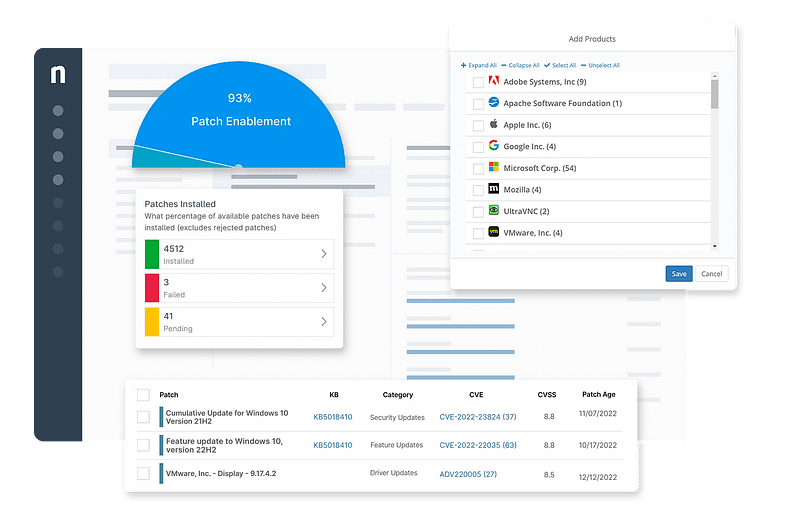
NinjaOne has been consistently rated as the #1 rated RMM on G2 for years. Built especially for IT teams, its solution delivers market-leading technician efficiency across all endpoints running on Windows, macOS, and Linux. Its powerful RMM software allows business leaders to work more effectively and efficiently as they monitor and manage all their servers, workstations, devices, and virtual machines in a single pane of glass.
5 reasons to choose NinjaOne over ConnectWise
1. Seamless implementation
ConnectWise offers a feature-rich platform that could be challenging to implement and integrate into your current IT system. Unless you are a larger business with many tier 3 technicians, you may find it challenging and time-consuming to use ConnectWise’s RMM. NinjaOne, on the other hand, drives efficiency from the start and is easy to implement.
2. Clean, simple, and intuitive interface
Your RMM platform needs to be both powerful and easy to learn so that you can focus on your core business without worrying about which tool does what task. Some users may feel that ConnectWise has a steep learning curve compared to NinjaOne, which is simple to use and understand. From the get-go, you have access to a robust system that helps you deliver more efficient and profitable IT services.
3. Ahead of the curve
NinjaOne is built on innovation and always prioritizes its clients. To help you better understand its products and how your organization can benefit from them, the company provides a transparent public road map that is regularly updated. ConnectWise offers webinars you must sign up for to find out what they have planned for the product. In contrast, NinjaOne ensures you are continuously aware of the company’s trajectory and new features through its roadmap, which can be accessed at any time.
4. Fast RMM agent
The RMM agent is the unobtrusive software you install on the devices you wish to monitor. Because it automates tedious processes, it needs to be fast and “lean” so that you can execute actions in real time. ConnectWise user reviews often complained about the slowness of the ConnectWise agent. NinjaOne offers top-rated RMM software that never lags, regardless of the number of devices it needs to manage.
5. Consistent and reliable patching
ConnectWise is marketed mostly for Windows devices. While it does offer patch management solutions for macOS, it is not its main focus. NinjaOne is suitable for MSPs of all sizes and industries working with Windows, macOS, and Linux. NinjaOne’s RMM solution allows you to patch your entire fleet of endpoint devices consistently, regularly, and reliably.
Strengths of NinjaOne
- Receive the support you need. Having been rated as the #1 in customer support, NinjaOne takes pride in helping its customers receive the assistance they need when they need it. The company also offers free and unlimited training for all its solutions.
- Experience live monitoring. NinjaOne’s RMM allows you to manage and monitor your entire IT infrastructure from a single, actionable interface. This real-time approach allows you to proactively address threats before they become an issue.
- Become more efficient. NinjaOne designs custom solutions for every client, whether they’re in the education or financial industry. NinjaOne aims to make technicians more efficient with an intuitive interface that is easy to learn and quick to navigate.
- Integrate with ease. NinjaOne offers best-in-class integration capabilities. The team behind NinjaOne understands the difficulties that can arise with managing several applications from different providers and has designed its RMM to provide a service that is as seamless as possible.
- Automates repetitive tasks. NinjaOne centralizes the decision-making process into policies that act as “air traffic control” for management. Optimizing these policies allows you to automate tedious, repetitive tasks and reduces the need for manual intervention.
Built for modern IT management
With NinjaOne’s RMM solution, you can gain a significant advantage in the management of your IT environment while benefiting from a massive ROI.
Customer Story
Lorenzo Kopari, Service Manager at CTS, said that he exhaled a sigh of relief when he switched from ConnectWise Automate to NinjaOne. Managing a small team of 15, he found that ConnectWise was simply too complex for his team to manage unless he wanted to hire a dedicated RMM manager, which wouldn’t be cost-effective. After moving forward with NinjaOne, he and his team were able to become more efficient with their IT operations.
“Honestly, it took us 30 minutes to an hour with Ninja’s support team to get us fully up and running. Everything we were having a problem within ConnectWise was resolved when we moved those devices over to Ninja, ” Lorenzo said.
You can read more customer stories or check out more NinjaOne reviews.
Pricing information
NinjaOne’s IT management software has no forced commitments and no hidden fees. You can request a free quote, schedule a 14-day free trial, or watch a demo.
New IDC Business Value White Paper found that NinjaOne customers achieve $197,700 in annual benefits per 1,000 endpoints managed.* 2
Read the IDC Business Value White Paper.
Reviews
NinjaOne G2 Reviews
- 4,313 reviews (at the time of update)
- 4.7 / 5 stars
NinjaOne Capterra Reviews
- 293 reviews (at the time of update)
- 4.8 / 5 stars
2. Datto
Datto RMM offers a cloud-managed remote monitoring and management platform marketed for MSPs of all sizes. Its solution includes automated monitoring, alerts, patch management, and endpoint remote control, among other things. Datto RMM provides a multi-tenant view so users can easily find and manage several organizations simultaneously.
Best for: Small to mid-sized MSPs that prioritize ease of use and quick deployment over deep scripting capabilities.
Pros:
- Monitoring. Datto’s RMM allows you to monitor your IT network easily in a fast and modern UI.
- Remote control. Datto users have stated that its solution offers a simple RMM that allows them to manage all endpoints 100% online.
- Scripting management. Datto offers both templated scripts and manual scripting options so that you can customize your RMM to your specific business requirements.
Cons:
- Performance in large environments. Reviewers say that Datto’s alerting and policy management suffer when running in larger environments. (Verified G2 review) (Verified G2 review)
- Limited patch management. Many former Datto users are most concerned about its limited options for third-party patching. (Verified G2 review)
- Lack of support. Some Datto users have claimed that they don’t feel they’re offered enough timely support. (Verified G2 review)
Ratings & reviews (as of June 10, 2026)
- G2: 4.5/5 (760 reviews)
- Capterra: 4.3/5 (42 reviews)
See how Datto compares to NinjaOne.
Read a more in-depth comparison of Datto competitors and learn more about Datto vs. ConnectWise.
3. Atera
Atera is an all-in-one MSP solution that allows IT professionals to manage all their IT operations and automation from anywhere. Currently, it offers patch management, IT automation, advanced reporting, automated alerts, help desk, ticketing, and some integrations. Compared to other vendors, Atera offers a pay-per-technician pricing model.
Best for: IT teams of small to mid-sized businesses and MSPs that want an all-in-one RMM solution.
Pros:
- Service automation. Atera allows MSPs to automate several tasks to accomplish them faster, easier, and more efficiently.
- Mobile app. Atera has taken particular care to improve its mobile management app so that users can manage their devices and remediate issues even on their phones.
- Remote monitoring. One of the main reasons users choose Atera is its ease of use and remote monitoring functions. Users say that Atera’s RMM makes it simple to find certain features.
Cons:
- Customer support. Reports on G2 and Capterra have said that Atera is not as efficient in its customer support as it should be. (Verified G2 Review)
- Reporting. Atera’s reports are functional but lack the automated scheduling and customization options that make data easier to understand for executives or MSP clients. (Verified G2 review) (Verified G2 review)
- Patch management. Atera provides a respectable patch management tool for smaller MSPs. However, their patching may become more challenging as a business grows. (Verified G2 review)
Ratings & reviews (as of June 10, 2026)
- G2: 4.6/5 (1,176 reviews)
- Capterra: 4.5/5 (449 reviews)
See how Atera compares to NinjaOne.
Read a more in-depth comparison of Atera alternatives and learn more about Atera vs. ConnectWise.
4. N-able N-central
N-able N-central is a robust RMM platform that enables IT experts to remotely monitor and manage devices and complex networks in a single pane of glass. Built with security in mind, N-able automatically discovers and manages connected Windows, macOS, and Linux devices and features a multi-tenant Microsoft 365 management platform.
Best for: MSPs managing larger environments that require a highly scalable solution with cross-platform support.
Pros:
- Centralized dashboard. The platform offers end-to-end visibility into your entire IT network in a single console.
- Automatic discovery and deployment. Users can map client networks, deploy service templates, and use automation policies for repetitive tasks.
- Patch management. N-able allows you to patch any network environment, on schedule or on demand.
Cons:
- Navigation. The platform can be overwhelming and challenging to navigate. (Verified G2 review) (Verified G2 review)
- macOS support. Some G2 users have said that N-central is not as reliable with its macOS agents as with Windows. (Verified G2 review) (Verified G2 review)
- Complexity. N-able N-central may be better suited for more experienced IT professionals. (Verified G2 review) (Verified G2 review) (Verified G2 review)
Ratings & reviews (as of June 10, 2026)
- G2: 4.4/5 (556 reviews)
- Capterra: 4.2/5 (253 reviews)
See how N-able N-central compares to NinjaOne.
Read a more in-depth comparison of N-able alternatives and learn more about N-able vs ConnectWise.
5. Kaseya VSA
Kaseya VSA is an integrated IT systems management platform that can be leveraged across IT disciplines. As an alternative to ConnectWise, Kaseya is a well-known RMM tool that manages all endpoints, including mobile, IoT, and VMs, and offers easy-to-use features designed for agile IT environments.
Best for: MSPs managing complex networks, especially in environments that primarily use Windows devices.
Pros:
- IT automation. Kaseya automates routine IT processes from patch management to auto-remediation.
- Endpoint management. Kaseya users maintain complete visibility and command of all their endpoints.
- Proactive IT. The platform helps users prevent issues before they have any organizational impact.
Cons:
- Integrations. Some G2 users have expressed their desire for more out-of-box integrations. (Verified G2 review) (Verified G2 review)
- Steep learning curve. The platform may be more suitable for larger organizations with more experienced IT professionals. (Verified G2 review)
- macOS support. According to some users, Kaseya can further improve its support for Apple devices. (Verified G2 review) (Verified G2 review)
Ratings & reviews (as of June 10, 2026)
- G2: 4/5 (326 reviews)
- Capterra: 4/5 (207 reviews)
See how Kaseya compares to NinjaOne.
Read a more in-depth comparison of Kaseya alternatives and learn more about Kaseya vs ConnectWise.
6. Syncro
Syncro is a fully integrated MSP and IT management platform that features an RMM and PSA in a single console. It is designed to help IT teams proactively address security vulnerabilities and simplify workloads. Additionally, Syncro’s platform offers multiple functions to streamline processes, ensure compliance, and control the entire environment.
Best for: Smaller internal IT teams and MSPs that are looking for customizable automation.
Pros:
- Unified dashboard. Syncro allows you to manage your endpoints from a single platform.
- Flexibility. You can customize alerts and tickets based on your specific needs.
- Monitoring and alerting. Syncro helps you proactively manage your endpoints, monitor systems, and automate routine tasks.
Cons:
- Alerting. Syncro’s RMM alerts lack details that could speed up remediation. (Verified G2 review
- Mobile app. Syncro’s mobile app could benefit from additional features. (Verified G2 review)
- Ticketing. Some G2 users have reported that Syncro could improve its first-response time. (Verified G2 review)
Ratings & reviews (as of June 10, 2026)
- G2: 4.5/5 (502 reviews)
- Capterra: 4.6/5 (148 reviews)
See how Syncro compares to NinjaOne.
Read a more in-depth comparison of Syncro alternatives and learn more about Syncro vs ConnectWise.
7. Pulseway
Pulseway is an all-in-one RMM software that positions itself as a “mobile-first solution” for MSPs and IT teams reduce downtime and set new standards for efficiency through automation. The platform offers monitoring and alerting for Windows, Mac, and Linux network devices and IoT, remote control, patch management, and scripting and automation.
Best for: Smaller IT teams that need to manage endpoints on the go, as Pulseway focuses on its mobile app.
Pros:
- Discovery and deployment. Pulseway features an easy-to-use network discovery and deployment engine right out of the box.
- Monitoring and management. The platform provides real-time, actionable, detailed information on servers, workstations, and network devices.
- Automation and auto-remediation. Pulseway RMM combines workflow technology so users can set smart triggers to auto-remediate IT issues.
Cons:
- Performance and interface. According to some G2 users, some users report that certain features don’t always perform as expected and its user interface can be unintuitive. (Verified G2 review)
- Scripting. Pulseway could improve scripting for all its customers. (Verified G2 review)
- Support for macOS and Linux. G2 reviews state that Pulseway could improve its support for macOS and Linux endpoints. (Verified G2 review) (Verified G2 review)
Ratings & reviews (as of June 10, 2026)
- G2: 4.6/5 (123 reviews)
- Capterra: 4.7/5 (310 reviews)
See how Pulseway compares to NinjaOne.
Read a more in-depth comparison of Pulseway alternatives and learn more about Pulseway vs ConnectWise.
8. LogMeIn Resolve
LogMeIn Resolve (formerly GoTo Resolve) is an IT management and support solution designed to help organizations take control of their IT infrastructure. Its cloud-based platform offers various features, including remote monitoring and endpoint management, remote access and support, ticketing, and automation, among others
Best for: Small to medium businesses and internal IT teams that are looking for an RMM with tools for remote IT support.
Pros:
- IT automation. Users can run the most common automated tasks using pre-developed workflows.
- Troubleshooting. The platform offers one-click, background access to critical system information.
- Patch management. Proactively detects needed patches across an organization’s servers and workstations.
Cons:
- Performance issues. The platform may slow down when several actions are run on multiple devices simultaneously. (Verified G2 review)
- MDM. According to some G2 users, LogMeIn Resolve lacks features and support for managing mobile devices. (Verified G2 review) (Verified G2 review)
- Customer service. Users report that LogMeIn’s customer support team can take time to respond and frequently do not provide updates on ticket status. (Verified G2 review)
Ratings & reviews (as of June 10, 2026)
- G2: 4.3/5 (468 reviews)
- Capterra: 4.4/5 (214 reviews)
See how LogMeIn Resolve compares to NinjaOne.
Read a more in-depth comparison of LogMeIn Resolve alternatives and learn more about LogMeIn Resolve vs ConnectWise.
9. Ivanti Neurons
Ivanti Neurons is an endpoint management and automation platform designed to help IT teams proactively reduce risk, improve productivity, and reduce operational costs from a unified platform. It joins our list of ConnectWise alternatives because its cloud platform automates most manual IT processes so your team can focus on more strategic projects.
Best for: Medium businesses and enterprises looking for a security-focused RMM platform.
Pros:
- Common login experience. Ivanti Neurons provides a unified login feature so users can conveniently switch between systems without needing to re-authenticate.
- Machine learning. The platform leverages new technologies to sense, predict, interpret, and automate remediation actions.
- Unified agent management. Users can easily register and configure devices.
Cons:
- Customer support. G2 users say that it can take days to receive responses for complex technical issues. (Verified G2 review)
- User-friendliness. Ivanti Neurons has a steep learning curve and may be complex to master, especially for beginner IT professionals. (Verified G2 review)
- Customization. Some G2 users say some customizations are more time-consuming than anticipated. (Verified G2 review)
Ratings & reviews (as of June 10, 2026)
- G2: 3.9/5 (243 reviews)
- Capterra: 3.9/5 (15 reviews)
See how Ivanti compares to NinjaOne.
Read a more in-depth comparison of Ivanti alternatives and learn more about Ivanti vs ConnectWise.
10. ManageEngine Endpoint Central
ManageEngine Endpoint Central is a complete endpoint manager that helps users easily manage their servers, desktops, laptops, smartphones, tablets, and POS devices from a central location. Its platform automates repetitive tasks, such as installing patches, distributing software, imaging and deploying OS, managing IT assets, managing software licenses, and monitoring software usage statistics.
Best for: MSPs and internal IT teams managing large-scale environments with diverse device types.
Pros:
- Visibility and control. Users gain end-to-end visibility into your IT infrastructure.
- Insight-driven defense. ManageEngine reduces your attack surface with data hardening and multi-layered endpoint protection.
- Threat detection and remediation. Detect and remediate vulnerabilities 24/7.
Cons:
- Learning curve. There is a steep learning curve at the beginning due to its complex interface and features. (Verified G2 review)
- Customer support. Endpoint Central could improve its customer help desk. (Verified G2 review)
- Patch management. G2 users say Endpoint Central suffers from slow performance when patching devices, especially in larger envrionments. (Verified G2 review) (Verified G2 review)
Ratings & reviews (as of June 10, 2026)
- G2: 4.5/5 (1,104 reviews)
- Capterra: 4.6/5 (1,708 reviews)
See how ManageEngine compares to NinjaOne.
Read a more in-depth comparison of ManageEngine alternatives and learn more about ManageEngine vs ConnectWise.
11. Naverisk
Naverisk is an RMM and service desk platform that’s designed for MSPs and IT professionals. It features remote monitoring, patch management, and automation with built-in PSA software and a ticketing system. The platform’s cross-platform compatibility allows users to manage Windows, Linux, macOS, and SNMP devices from one console.
Best for: Small to mid-sized organizations looking for a cost-effective solution that combines RMM with helpdesk tools.
Pros:
- Automation. Users can automate routine tasks and deploy custom scripts across managed devices with Naverisk.
- Helpdesk features. The platform features built-in ticketing that enables technicians to track, manage, and report on helpdesk activity from within the platform.
- Remote monitoring. Naverisk monitors device health, network activity, and system performance in real time with automated alerting.
Cons:
- User interface. The design of Naverisk’s user interface can feel dated compared to competitors. (Verified G2 review)
- Ticketing. Naverisk’s ticketing system could use improvement and more customization options.(Verified G2 review) (Verified G2 review)
- Learning curve. Users say it can take some time to fully learn how to use the platform. (Verified G2 review)
Ratings & reviews (as of June 10, 2026)
- G2: 4.7/5 (72 reviews)
- Capterra: 4.8/5 (97 reviews)
See how Naverisk compares to NinjaOne.
Read a more in-depth comparison of Naverisk alternatives and learn more about Naverisk vs ConnectWise.
12. Action1
Action1 is a cloud-based RMM platform with a strong focus on patch management and vulnerability remediation for MSPs and IT teams. It covers patch deployment, software distribution, IT asset visibility, and remote desktop capabilities from a single cloud-based console, with support for Windows, macOS, and Linux environments. Users with 200 endpoints can use Action1 with full platform functionality and no feature restrictions.
Best for: Smaller businesses or cost-conscious MSPs managing multiple smaller clients.
Pros:
- Patch management. Users can schedule and deploy OS and third-party application patches across Windows, macOS, and Linux devices.
- Vulnerability assessment. Action1 gives users real-time visibility into missing patches and security gaps for faster resolution.
- Lightweight. Action1 uses a cloud-based agent that keeps it easy to deploy and manage.
Cons:
- OS support. Action1’s support and features for macOS and Linux are not as extensive as users hoped for. (Verified G2 review)
- Lacks device metrics. Reviews say that Action1’s dashboards could provide more details and customization options when displaying endpoints. (Verified G2 review) (Verified G2 review)
- Limited RMM features. Since Action1’s primary focus is patch management and vulnerability scanning, its RMM features, such as automation and custom reporting, can be lacking compared to competitors. (Verified G2 review)
Ratings & reviews (as of June 10, 2026)
- G2: 4.9/5 (1,054 reviews)
- Capterra: 4.9/5 (237 reviews)
See how Action1 compares to NinjaOne.
Read a more in-depth comparison of Action1 alternatives and learn more about Action1 vs ConnectWise.
What is ConnectWise?
ConnectWise is a software company that builds tools for managed service providers and IT teams. One of its core products, ConnectWise Automate (formerly LabTech), is an RMM platform focused on automation, remote monitoring, and scripting. It’s aimed at MSPs managing complex IT environments that require granular automation and custom script deployment at scale.
Why choose NinjaOne over ConnectWise
Initial setup
The initial implementation of ConnectWise is complex and time-consuming, and users often need outside consultants to help them implement and configure the solution. On the other hand, NinjaOne offers immediate value with an average enterprise deployment that’s less than thirty days. Its quick setup and intuitive interface that allows technicians to start managing endpoints from day one, without sacrificing the automation capabilities that MSPs actually need. In fact, 90% of NinjaOne’s customers have reported that their IT teams become familiar with the platform in under 9 hours.
Patch management
Users find that ConnectWise Automate struggles with deploying patches. As one reviewer on G2 points out, “[ConnectWise’s] patching configuration is also complex and easy to misconfigure, which can lead to gaps in coverage.” Where ConnectWise Automate users report patching issues that can often require manual intervention to resolve, NinjaOne’s automated patch management works reliably and consistently. In fact, according to NinjaOne MSP Business Impact Survey, 89% of customers have reported that they save up to 10 hours per week on patching alone after switching.
Customer support
ConnectWise generally has customer support, but some users find it can be difficult to get in contact with a technical expert. According to one user on G2, “Support is ok, but can be tricky to get in touch with at times”. In contrast, NinjaOne NinjaOne stands apart for its quality of support among RMM platforms. NinjaOne’s customer support team is easy to reach and offers fast, helpful responses, leading to a 98 CSAT score.
Strengths of ConnectWise
- IT automation. ConnectWise offers automation capabilities for large-scale MSP environments.
- Customizable. Users of ConnectWise Automate have control over how monitoring thresholds, alerts, and policies are defined.
- Integrations. ConnectWise Automate integrates tightly with the rest of the ConnectWise ecosystem and also major third-party AV, EDR, and backup applications.
Limitations of ConnectWise
- Complex interface. ConnectWise’s user interface can make navigating and using the platform’s features challenging. (Verified G2 review)
- Patching issues. Deploying patches via ConnectWise can be a complex process, with misconfigurations causing issues. (Verified G2 review)
- Customer support. Users have experienced some difficulty getting in touch with the ConnectWise support team. (Verified G2 review)
ConnectWise pros and cons
| ConnectWise Pros | ConnectWise Cons |
| Powerful automation and scripting capabilities built for large-scale MSP environments. | Navigating the platform’s features can be challenging, particularly for new users. |
| Granular control over monitoring thresholds, alerts, and policies. | Patch deployment can be complex, with misconfigurations causing security gaps |
| Integrates with the ConnectWise ecosystem and major third-party AV, EDR, and backup tools. | Users report difficulty getting help from the support team in a timely manner |
Why MSPs look for alternatives to ConnectWise
ConnectWise Automate’s powerful scripting and automation tools make it a strong choice for enterprise and MSPs, but it asks a lot of the teams that use it due to the complexity of its setup and user interface. The most common reasons MSPs begin evaluating ConnectWise alternatives are its complex interface and steep learning curve, making it harder for users to fully utilize the platform. In addition, patch management issues and support reliability lead users to look for alternatives to ConnectWise.
When MSPs begin evaluating the best ConnectWise alternatives, the most common priorities that come up include ease of use, reliable patch management, and support they can count on when something goes wrong. According to NinjaOne MSP Business Impact Survey, 90% of MSPs reported faster mean time to resolution after switching, and 89% save up to 10 hours per week on patching alone, time that previously went to managing platform overhead rather than serving clients. For MSPs that require a more agile and streamlined user experience compared to ConnectWise, exploring alternatives is well-supported by both the data and the experience of peers who’ve already made the move.
Built for modern IT management
With NinjaOne’s RMM solution, you can gain a significant advantage in the management of your IT environment while benefiting from a massive ROI.
Review ConnectWise competitors to choose the best RMM tool
An RMM tool allows your IT department to monitor various endpoints proactively and resolve any possible issues. Leveraging the right RMM frees your IT technicians to focus on higher-level tasks and reduces the risk of human error.
One of the best ways to make the most informed decision is to research various vendors and conduct a vendor risk assessment. Always communicate with RMM vendors about your specific needs and budget so that you can receive the most appropriate tool.
*IDC Business Value White Paper sponsored by NinjaOne, The Business Value of NinjaOne for IT Operations, Doc #US54520326, June 2026.