

Key Points
- Top RMM competitors to Kaseya include: NinjaOne, 2. ManageEngine, 3. N-able N-central, 4. Atera, 5. Pulseway, 6. Datto, 7. ConnectWise Automate, 8. Action1, 9. LogMeIn Resolve, 10. Naverisk, 11. SuperOps, and 12. Automox.
- NinjaOne stands out as the top Kaseya alternative, offering a fast, intuitive UI, out-of-the-box features, world-class support, and a cost-effective, scalable RMM platform designed specifically for MSPs and IT teams.
- What to look for in an RMM solution: Easy onboarding, continuous monitoring, patch management, support for all network devices, and access to unlimited training and support.
The right RMM software can significantly improve and optimize your business. Ideally, your remote monitoring and management (RMM) tool should allow your IT technicians to manage the network infrastructure from anywhere there is an internet connection and support them as they proactively identify, report, and remediate IT issues.
While Kaseya offers many products that improve RMM operations for IT pros, some may still look for alternatives, perhaps a platform that can fully support their IT environment. In this article, we will dive into Kaseya alternatives that IT professionals may consider to better understand their options.
We’ve done the research to outline several alternatives, along with their potential advantages and limitations, to help you evaluate which solution may align best with your operational needs and priorities.
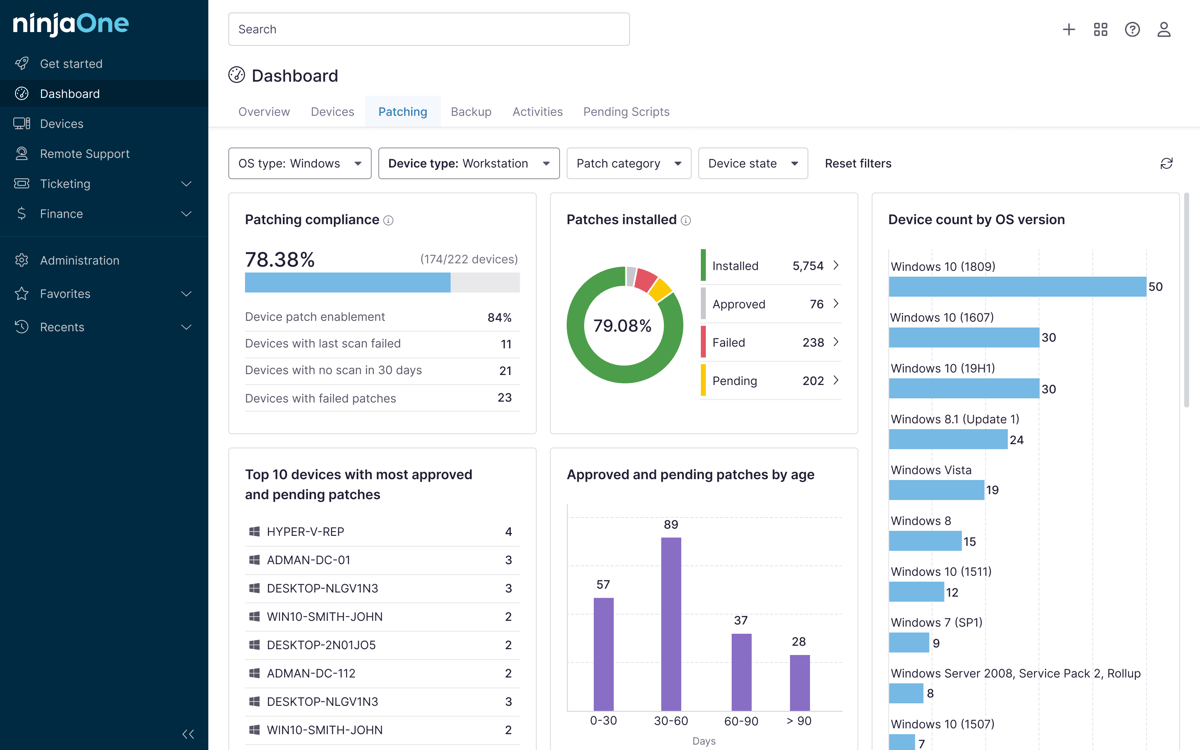
NinjaOne uses automation to reduce the need for manual intervention so you can focus on more strategic projects.
Kaseya alternatives quick comparison table
|
Vendor |
G2 rating | Review count | Best for | Pricing model | Deployment mode |
Migration difficulty |
| NinjaOne | 4.7 | 4,307 | Enterprise-grade endpoint management for MSPs and IT teams of all sizes | Per device; billed monthly or annually | Cloud-only | Low |
| ManageEngine | 4.5 | 1,101 | Large enterprises managing complex, mixed IT environments | Per device or per technician (varies by product); billed monthly or annually | Cloud or on-premise | Medium |
| N-able N-central | 4.4 | 555 | Technically mature MSPs needing deep automation and scripting | Custom quote (typically per endpoint/device); billing terms vary | Cloud or on-premise | Medium |
| Atera | 4.6 | 1,154 | MSPs managing high endpoint-to-technician ratios | Per technician (unlimited endpoints); billed monthly or annually | Cloud-only | Low |
| Pulseway | 4.6 | 123 | IT teams needing mobile-first remote monitoring | Per endpoint; billed monthly | Cloud-only | Medium |
| Datto | 4.5 | 759 | MSPs already using Datto or Kaseya ecosystem tools | Per device; custom quote | Cloud-only | Medium |
| ConnectWise Automate | 4.1 | 140 | Large MSPs requiring advanced scripting and workflow customization | Per endpoint; custom quote | Cloud or on-premise | High |
| Action1 | 4.9 | 140 | SMBs and internal IT teams focused on patch management and compliance | Per endpoint; free up to 200 endpoints; custom quote beyond that | Cloud-only | Low |
| LogMeIn Resolve | 4.3 | 468 | Small-to-medium businesses needing lightweight remote support | Per user/subscription tier; billed monthly or annually | Cloud-only | Low |
| Naverisk | 4.7 | 72 | Small-to-mid MSPs wanting integrated RMM, PSA, and service desk | Custom quote; pricing varies by endpoint and licensing model | Cloud or on-premise | Medium |
| SuperOps | 4.5 | 133 | Small-to-mid MSPs wanting a unified RMM and PSA platform | Per technician with endpoint-based components/add-ons depending on plan | Cloud-only | Medium |
| Automox | 4.5 | 290 | Distributed IT teams needing cross-platform patch management | Per endpoint; billed annually | Cloud-only | Low |
How we evaluated these tools
To build a strong comparative analysis, we drew on a combination of verified user feedback from review aggregator platforms such as G2, Capterra, and Gartner. We also pulled insights from community discussions on Reddit and direct customer feedback collected by NinjaOne. Any limitations presented reflect patterns in real user reviews from the mentioned sources. The goal of this guide is to provide research-supported resources to IT professionals and MSPs so they can make an informed decision.
12 best alternatives to Kaseya
All G2 and Capterra data as of June 2026.
1. NinjaOne
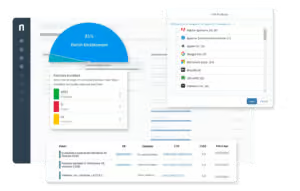
NinjaOne is a powerful, easy-to-use RMM platform that provides a single-pane-of-glass view into all endpoints within an organization. Built specifically for IT teams, the solution operates on proactive endpoint management so your business can run more efficiently and effectively. NinjaOne’s RMM software is founded on innovation; it regularly updates its features based on the comments and suggestions of its users and ensures that its system works well on all devices on Windows, macOS, and Linux.
Key features of NinjaOne
1. Fast, intuitive UI
One reason why some users may be searching for Kaseya competitors is its interface. For an RMM platform to be effective, it needs to handle all types of data and actions so that you can proactively address threats before they evolve into much larger issues. NinjaOne is one of the best alternatives to Kaseya since its RMM is known for having an easy-to-use interface. The NinjaOne platform is both quick to implement and intuitive to use. This is one of the reasons why it has been rated as the #1 RMM on G2 for 19 consecutive quarters.
2. Out-of-the-box features
NinjaOne is always transparent about what its solution can offer and the features that are included in it. NinjaOne immediately provides out-of-the-box features and integrations so that you can start using its solution right away. The goal of any NinjaOne solution is to help your IT technicians manage endpoints more easily and with much more efficiency.
3. World-class support
NinjaOne is rated as #1 in customer support for its personalized, competent, and proactive assistance. Rather than providing “cookie-cutter” responses that may take days to receive, NinjaOne believes in resolving any issue as quickly and as accurately as possible. Driven by excellence, NinjaOne’s support team lets customers know they care about them and their IT problems.
4. Cost-effective solution
NinjaOne believes that every customer deserves an RMM solution tailored to their needs. Each custom package is carefully designed to ensure that you have all the features and integrations you need from the get-go. Compared to Kaseya, which may charge for add-ons, NinjaOne’s solution follows a pay-per-device subscription model that allows you to pay monthly only for what you need.
5. Ease of set up, admin, and use
Some users have said that Kaseya requires hours to learn and master. NinjaOne, on the other hand, is designed exactly for how MSPs do business. Its solution has been created to be as easy to use as possible. Having a minimal learning curve makes NinjaOne an ideal Kaseya VSA alernative since you can start driving efficiency from day one.
Customer story
Rudy Shaw, the IT Director of St. Francis Winery was looking for an RMM solution that allowed him to be more proactive in his endpoint management. He initially relied on N-able’s platform but found himself resolving issues only after they turned serious. He began looking for N-able competitors to find a vendor that suited his business requirements.
“What made NinjaOne stand out from other endpoint managers was how simple and easy it is to use. I can knock out ten tasks in NinjaOne in the same amount of time it takes me to do one task in Kaseya or ManageEngine– alternative solutions we scoped,” said Shaw. “After implementing NinjaOne, we cut down our MSP billable hours, which saves us over $72,000 per year while improving our service rate by 90%.”
You can read more customer stories or check out more NinjaOne reviews.
Pricing
NinjaOne’s IT management software has no forced commitments and no hidden fees. You can request a free quote, schedule a 14-day free trial, or watch a demo.
Reviews
- 4,307 reviews (at the time of writing)
- 4.7 / 5 stars
- 292 reviews (at the time of writing)
- 4.7 / 5 stars
→ See how Kaseya compares with NinjaOne
→ Read G2’s comparison of NinjaOne and Kaseya
Automate repetitive management tasks and reduce manual intervention so you can focus more on strategic projects.
Start free trial or watch a demo of NinjaOne
2. ManageEngine
ManageEngine, the enterprise IT management division of Zoho Corp., offers an RMM platform intended for more senior-level IT executives. Since 2002, ManageEngine has focused its efforts on building a complex unified IT management solution that helps technicians secure their digital network in a single dashboard.
→ Read G2’s comparison of ManageEngine and Kaseya
Best for
ManageEngine can be used by various-sized IT organizations across most industries. However, due to the complexity of its system, it is generally recommended for larger enterprises with tier 3 technicians.
Features:
- Network discovery. ManageEngine allows you to scan and detect all endpoints and virtual machines in your IT network.
- Patch management system. MSPs may benefit from ManageEngine’s patch management system to ensure the health of their IT infrastructure.
- Network analytics and reporting. ManageEngine allows you to gain insight into how your network is performing and how it can be further improved.
Shortcomings:
- Limited mobile management. ManageEngine is better suited for MSPs that manage their IT networks on desktop computers. (Verified G2 source)
- IT reporting capabilities. ManageEngine offers a fairly decent reporting system. However, it may become a little confusing for more detailed reports. (Verified G2 review) (Verified G2 review)
- Customer support. Some reviews on G2 and Capterra have stated that users want ManageEngine to improve customer support response time. (Verified G2 review) (Verified Capterra review)
Ratings and reviews:
- G2: 4.5 (1,101 reviews)
- Capterra: 6 (1,678 reviews)
See how ManageEngine compares with NinjaOne or learn more about ManageEngine vs. Kaseya.
3. N-able N-central
N-able N-central is an RMM solution designed to monitor and manage devices in a single SaaS platform. The company claims to be beneficial for MSPs looking for a comprehensive RMM tool.
Best for
N-able is generally used by larger enterprises that prefer manual scripting and reporting. While it is marketed to be used by enterprises across all industries, most users say that N-able is much more manageable for more tech-oriented companies.
→ Read G2’s comparison of N-able N-central and Kaseya
Features:
- Remote management. N-able allows you to manage and monitor all your endpoints remotely from anywhere there is an internet connection.
- Patch management. The company provides a patch management tool that regularly scans software providers and updates them at predetermined schedules.
- macOS management. N-able recently released its N-central macOS agent which allows MSPs to manage Mac devices remotely.
Shortcomings:
- May have a steep learning curve. N-able N-central is a complex system that may be more suitable for larger enterprises with a seasoned IT team. (Verified G2 review)
- Costs may add up quickly. N-able may charge extra for add-ons and features. Some features and integrations are not immediately offered out of the box. (Verified G2 review) (Verified G2 review) (Verified G2 review)
- Reporting. Some reviews have stated that N-central’s reporting should be more customizable. (Verified G2 review)
Ratings and reviews:
- G2: 4 (555 reviews)
- Capterra: 2 (253 reviews)
See how N-able compares with NinjaOne or learn more about N-able N-central vs. Kaseya.
4. Atera
Atera is a cloud-based RMM software designed primarily for managed service providers (MSPs) and IT professionals. Atera’s automation tools allow users to utilize out-of-the-box scripts or custom configurations to streamline IT operations such as reporting and alerting.
Best for
Atera is ideal for IT teams and mature MSPs to monitor devices, automate repetitive tasks, and manage helpdesk tickets.
→ Read G2’s comparison of Atera and Kaseya
Features:
- RMM: Atera provides full visibility and control over an organization’s endpoint devices.
- Patch management: Automated patching makes it more efficient for users to distribute updates and security patches.
- Ticketing: Atera’s ticketing system leverages automation to make managing tickets more efficient.
Shortcomings:
- macOS support: According to reviews, Atera’s monitoring, scripting, patching, and device management for macOS may feel not as efficient as with Windows. (Verified G2 review)
- Reporting: Users have said that customizing reports can be challenging. (Verified G2 review)
- Performance: Some users noted that the interface could experience slowdowns when managing large number of devices. (Verified G2 review)
Ratings and reviews:
- G2: 6 (1,154 reviews)
- Capterra: 5 (448 reviews)
See how Atera compares with NinjaOne or learn more about Atera vs. Kaseya.
5. Pulseway
Pulseway is an RMM platform that provides MSPs and IT teams with remote monitoring tools that keep track of several metrics in real-time for servers, endpoints, virtual machines, and networks. It offers remote control, patch management, network monitoring, and automation that can be accessed through a single dashboard.
Best for
Pulseway best fits IT teams needing a mobile-first RMM platform.
→ Read G2’s comparison of Pulseway and Kaseya
Features:
- Real-time monitoring: Pulseway provides IT teams with live updates and complete visibility of devices, servers, and networking devices.
- Alerting: Pulseway offers highly configurable notifications that can be triggered by specific events or thresholds.
- IT automation: Users can automate repetitive tasks, reducing the time spent on manual interventions.
Shortcomings:
- Remote access: According to reviews, Pulseway remote access experience may feel less intuitive and flexible, with limitations in multi-monitor support and managing multiple full-screen remote sessions. (Verified Capterra review)
- Linux remote desktop support: According to reviews, Pulseway lacks graphical remote desktop control for Linux devices, which may limit remote management capabilities in mixed operating system environments. (Verified Capterra review)
- Analytics: Users find Pulseway’s analytics may improve its customizability. (Verified G2 review)
Ratings and reviews:
- G2: 6 (123 reviews)
- Capterra: 7 (310 reviews)
See how Pulseway compares with NinjaOne or learn more about Pulseway vs. Kaseya.
6. Datto RMM
Datto is an RMM platform owned by Kaseya that includes essential IT management tools such as automated patching, network monitoring, and a ticketing system. This centralized approach makes it a good choice for MSPs managing multiple client environments. Datto also focuses on security with ransomware recovery and backup capabilities built into its RMM platform.
Best for
Datto RMM is an ideal solution for MSPs already using other products within the Datto or Kaseya ecosystem.
→ Read G2’s comparison of Datto RMM and Kaseya
Features:
- IT security: Datto helps secure data with backup capabilities and EDR.
- Ticketing: With Datto, technicians can use a ticketing system to manage IT support tickets.
- RMM: Datto consolidates network management, remote access, and other endpoint management tools.
Shortcomings:
- Remote access reliability: According to reviews, Datto RMM’s remote access tools may experience latency, inconsistent connections, or usability issues that can affect troubleshooting efficiency. (Verified Capterra review) (Verified G2 review)
- User interface: Users have complained that Datto RMM’s interface may feel cluttered or require excessive navigation, particularly after the introduction of the newer UI. (Verified G2 review) (Verified Capterra review)
- Alerting customizability: Some reviews mentioned that Datto RMM’s configuration of policies, alerts, and advanced workflows may require significant tuning and can be difficult to manage at scale. (Verified G2 review) (Verified Capterra review)
Ratings and reviews:
- G2: 5 (759 reviews)
- Capterra: 3 (42 reviews)
See how Datto compares with NinjaOne or learn more about Datto vs. Kaseya.
7. ConnectWise Automate
ConnectWise Automate, formerly known as LabTech, is RMM software that offers extensive customization and automation tools to streamline IT teams’ endpoint management processes. It offers scripting that can be leveraged to automate the monitoring and management of endpoints.
Best for
ConnectWise Automate is best for large MSPs that seek a platform with advanced scripting and workflow customization.
→ Read G2’s comparison of ConnectWise Automate and Kaseya
Features:
- RMM: ConnectWise centralizes a full view of all the devices in an IT environment, allowing IT professionals to keep track of their endpoints and remediate any issues.
- Automated patching: Automation tools ensure consistent updates and deployment of security patches.
- Software deployment: With ConnectWise, users can configure and distribute applications to their managed devices.
Shortcomings:
- Reporting: Users find that the reporting function is limited and challenging to customize. (Verified Capterra review)
- Complex interface: According to reviews, ConnectWise Automate can feel clunky, outdated, and difficult to navigate, especially for new users. (Verified G2 review) (Verified Capterra review)
- Web and desktop disparity: According to reviews, ConnectWise Automate’s web version may lack feature parity with the desktop application, forcing users to switch between both interfaces. (Verified G2 review) (Verified G2 review)
Ratings and reviews:
- G2: 1 (140 reviews)
- Capterra: 41 (141 reviews)
See how ConnectWise compares with NinjaOne or learn more about ConnectWise vs. Kaseya.
8. Action1
Action1 is a cloud-based RMM platform that’s geared towards small to medium-sized businesses that specialize in patch management. Users can ensure patch compliance across their servers and devices.
Best for
Action1 is best for SMBs and internal IT teams that want to deploy a solution focusing on patch management and compliance.
→ Read G2’s comparison of Action1 and Kaseya
Features:
- Patch management: Action1 allows users to automate patch deployment for operating software and third-party applications.
- Automation: Users can leverage Action1’s automation tools to reduce the need for manual intervention.
- Vulnerability management: Real-time vulnerability discovery allows technicians to detect missing patches.
Shortcomings:
- Reporting: Users find that the reporting function needs improvement, such as offering more detailed statistics. (Verified G2 review) (Verified G2 review)
- Remote access performance: According to reviews, Action1’s remote access tools may experience lag, slow connections, or issues when managing multiple displays. (Verified Capterra review) (Verified G2 review)
- Software repository: According to reviews, managing custom software packages and repositories may require additional effort and manual configuration. (Verified G2 review) (Verified Capterra review)
Ratings and reviews:
- G2: 9 (140 reviews)
- Capterra: 9 (237 reviews)
See how Action1 compares with NinjaOne or learn more about Action1 vs. Kaseya.
9. LogMeIn Resolve
LogMeIn Resolve is a cloud-based remote IT support and RMM software that is built for small to medium businesses. This platform enables technicians to monitor managed devices and quickly respond to issues. It also offers remote control and helpdesk tools.
Best for
LogMeIn Resolve is an ideal platform for small to medium businesses that need a lightweight remote support for their end users.
→ Read G2’s comparison of LogMeIn Resolve and Kaseya
Features:
- Remote access: Technicians can provide remote troubleshooting and provide remote support with this platform.
- Automation: LogMeIn Resolve out-of-the-box scripts that allow users to automate repetitive tasks.
- RMM: Users can monitor the health and status of the software and hardware in their IT environment.
Shortcomings:
- Remote connection: LogMeIn Resolve’s remote access can get unstable and unreliable in some occasions. (Verified G2 review)
- Performance: According to reviews, the platform performs slowly, and there are delays when transferring remote files. (Verified G2 review) (Verified G2 review)
- Large-scale onboarding and deployment: According to reviews, LogMeIn Resolve may be less efficient when onboarding or deploying devices at scale. (Verified G2 review)
Ratings and reviews:
- G2: 3 (468 reviews)
- Capterra: 4 (214 reviews)
See how LogMeIn Resolve compares with NinjaOne or learn more about LogMeIn Resolve vs. Kaseya.
10. Naverisk
Naverisk is an RMM platform that integrates with Professional Services Automation (PSA), and service desk features that offer a unified solution for IT teams and MSPs. Its centralized dashboard offers full visibility into all managed devices, allowing IT professionals to respond swiftly to system issues.
Best for
Naverisk is good for SMBs and MSPs looking for a solution that integrates RMM, PSA, and service desk.
→ Read G2’s comparison of Naverisk and Kaseya
Features:
- Remote monitoring: With Naverisk, IT teams get real-time updates on servers and endpoints, allowing them to intervene and resolve any issues quickly.
- IT automation: Open-source scripts and custom policies allow users to automate routine tasks for better IT efficiency.
- Centralized endpoint management: IT administrators can monitor and manage their Windows, Linux, macOS, and SNMP devices from a single dashboard.
Shortcomings:
- Ticketing and search: According to reviews, Naverisk’s ticketing system and search function can feel clunky, making it harder to find older tickets or archived information. (Verified Capterra review)
- Update and upgrade process: Some users said that Naverisk’s installation and upgrade process can require manual work. (Verified G2 review) (Verified Capterra review)
- User interface: Users pointed out that Naverisk’s interface can feel dated or difficult to get used to in some areas. (Verified Capterra review) (Verified Capterra review) (Verified G2 review)
Ratings and reviews:
- G2: 7 (72 reviews)
- Capterra: 8 (97 reviews)
See how Naverisk compares with NinjaOne or learn more about Naverisk vs. Kaseya.
11. SuperOps
SuperOps is a cloud-based IT management platform designed for managed service providers (MSPs), combining RMM and PSA capabilities into a single system. It focuses on helping IT teams manage endpoints, automate workflows, and handle service delivery within a unified interface.
Best for
SuperOps is for small to mid-sized MSPs that want a solution that consolidates RMM and PSA.
→ Read G2’s comparison of SuperOps and Kaseya
Features:
- Unified RMM and PSA: SuperOps combines endpoint management and service desk capabilities in one platform.
- Automation features: The IT solution supports workflow automation, helping with the reduction of manual IT tasks and human errors.
- Time tracking: SuperOps includes time tracking features that allow users to log billable and non-billable hours within tickets for billing and reporting purposes.
Shortcomings:
- Feature maturity and polish: According to reviews, some SuperOps features may still feel unfinished or lack expected functionality as the platform continues to evolve. (Verified G2 review)
- Mobile experience: Some features available in the web interface may be unavailable or less convenient in SuperOps’ mobile applications, according to some users. (Verified G2 review) (Verified Capterra review)
- Asset management: Some users report limitations in asset management, including challenges with search and filtering, as well as interface layout concerns that may increase the risk of accidental actions. (Verified G2 review) (Verified Capterra review)
Ratings and reviews:
- G2: 5 (133 reviews)
- Capterra: 6 (65 reviews)
See how SuperOps compares with NinjaOne or learn more about SuperOps vs. Kaseya.
12. Automox
Automox is a cloud-native endpoint management platform that focuses on patch management, configuration, and policy enforcement across distributed environments. It is used by IT teams to maintain system compliance and manage endpoints without relying on on-premises infrastructure.
Best for
Automox is designed for IT teams looking for a patch management solution that can be deployed across distributed environments.
→ Read G2’s comparison of Automox and Kaseya
Features:
- Cloud-native platform: Automox is a cloud-native IT management platform that does not require on-prem infrastructure for deployment or management.
- Patch automation: The IT solution helps teams with automated patching across operating systems and third-party applications.
- Policy-based management: Automox also enables IT teams to enforce configurations and compliance policies across endpoints.
Shortcomings:
- Integrations: According to reviews, Automox may have limited integrations with some commonly used IT tools, which can add workflow complexity. (Verified G2 review) (Verified G2 review)
- Reporting: Some users noted that Automox’s reporting and analytics may lack depth, real-time clarity, or advanced filtering for larger environments. (Verified G2 review) (Verified G2 review)
- Remote control: Some reviews mentioned that Automox’s remote control capabilities may feel limited or less mature for some support use cases. (Verified G2 review) (Verified Capterra review)
Ratings and reviews:
- G2: 5 (290 reviews)
- Capterra: 7 (153 reviews)
See how Automox compares with NinjaOne or learn more about Automox Kaseya.
What is Kaseya and why look for an alternative
Kaseya is an IT company that offers solutions designed to support managed service providers (MSPs) and internal IT teams in managing and maintaining IT environments. The company offers tools to help IT teams and MSPs oversee managed IT infrastructure efficiently through centralized platforms and integrated systems. Kaseya operates as a provider of IT management solutions aimed at simplifying how businesses handle their technology environments at scale.
Why choose NinjaOne over Kaseya
Consumers replace Kaseya with NinjaOne for the following reasons:
Reporting and analytics
Many IT teams report that Kaseya’s reporting and analytics can require additional effort to configure and may be complex to generate. NinjaOne users frequently highlight the platform’s visibility into endpoints and easy access to device information, helping teams monitor and manage environments without spending as much time building reports. (Verified Capterra review) (Verified Capterra review)
Remote access
Some Kaseya users mention that remote access performance can vary depending on the environment and that customization options may be limited. NinjaOne users frequently cite fast, reliable remote access that helps technicians troubleshoot devices efficiently from a centralized platform. (Verified G2 review) (Verified Capterra review)
Patch management
There are Kaseya users who report that patch management may require additional licensing beyond the base subscription. NinjaOne includes patch management as a core endpoint management capability, and users frequently praise its ease of configuration and reliability. (Verified G2 review) (Verified G2 review) (Verified Capterra review)
Support and service
Some Kaseya users report that support response times and documentation accessibility can affect how quickly issues are resolved. NinjaOne users often highlight responsive support teams, accessible documentation, and helpful onboarding resources. (Verified G2 review) (Verified Capterra review)
Automate repetitive management tasks and reduce manual intervention so you can focus more on strategic projects.
Start free trial or watch a demo of NinjaOne
Strengths of Kaseya
- Centralized console
The platform helps teams manage endpoints from a centralized system, making it useful for remote monitoring and day-to-day IT administration. (Verified Capterra review) (Verified Capterra review)
- Automation and scripting
Kaseya offers automation and scripting capabilities to help reduce manual work across endpoints and IT environments. (Verified G2 review) (Verified G2 review) (Verified Capterra review)
- Integration
Kaseya can connect with other Kaseya products or related tools, especially for teams already using the broader ecosystem. (Verified Capterra review) (Verified G2 review)
- Ideal for lean IT teams
Kaseya is useful for MSPs or lean IT teams because it helps them manage many sites, devices, or clients with limited resources. (Verified G2 review) (Verified Capterra review)
Limitations of Kaseya
- Reporting and analytics
Kaseya’s reporting and analytics may require additional effort to configure, with some complexity in creating and generating reports. (Verified G2 review) (Verified G2 review)
- Remote access
The platform’s remote access may have limited customization options and can vary in performance depending on the environment. (Verified G2 review)
- Patch management
Kaseya’s patch management may not be included in all base subscription tiers and could require additional licensing. (Verified G2 review) (Verified G2 review)
- Support and service
Support response times and documentation accessibility may differ, which can affect how quickly issues are resolved. (Verified G2 review) (Verified G2 review) (Verified G2 review) (Verified G2 review)
Kaseya’s pros and cons
Reviews for Kaseya are mixed, with some having positive experiences with the platform, allowing users to access tools and integrations in a centralized console, its automation and scripting capabilities, and it being an ideal fit for lean IT teams. Meanwhile, drawbacks include reporting, analytics, remote access tools, patch management, and the support it offers for users.
Why IT teams look for alternatives to Kaseya
IT teams and MSPs often start comparing Kaseya alternatives when they need a platform that is easier to adopt, faster to deploy, and simpler to manage over time. While Kaseya offers broad RMM functionality, user feedback points to challenges around reporting, remote access consistency, patch management licensing, and support responsiveness.
These pain points can make buyers prioritize tools with clearer pricing, more intuitive workflows, stronger support, and faster time to value. For example, NinjaOne reports that 90% of customers become proficient in under 9 hours, and enterprise deployments average in 30 days. These are compelling reasons why Kaseya users may jump from their existing solution to a more efficient one.
Find out why NinjaOne is G2’s no.1 RMM software and experience efficient and effective IT management.
Finding the best Kaseya competitors for your IT needs
Choosing the right remote monitoring and management system is crucial to your consistent success. Finding the ideal RMM platform involves knowing what your organization’s specific requirements are and then evaluating Kaseya VSA competitors. Among the leading Kaseya alternatives, NinjaOne stands out for its ease of use, fast deployment, comprehensive endpoint management capabilities, and consistently high customer satisfaction ratings.
Meanwhile, it is good to remember that no two RMMs are the same, so take the time to conduct your market research and find a vendor that checks all the boxes of what you need. Evaluate your current business needs and determine the RMM features you require to become more efficient and effective.