

Key Points
- The top alternatives to Datto are: 1) NinjaOne, 2) Atera, 3) ConnectWise RMM, 4) Syncro, 5) LogMeIn Resolve, 6) N-sight RMM, 7) N-able N-central, 8) Kaseya VSA, 9) SuperOps, 10) Pulseway, 11) ManageEngine Endpoint Central, and 12) Ivanti Neurons for ITSM
- Choose an RMM that scales with your growth, reduces technician workload through automation, and supports distributed or hybrid workforces.
- Evaluate Datto alternatives across monitoring, patch management, remote access, and automation to ensure the platform fits your operational needs.
- The strongest Datto alternatives offer one-click remediation, secure remote access, cross-OS patching, and broad integrations that reduce tool sprawl.
If you’re currently using Datto RMM and wondering whether it still fits your organization’s needs, you’re not alone. Since Kaseya acquired Datto in 2022, many MSPs and IT teams have been re-evaluating their RMM stack, weighing the features and shortcomings of Datto and determining if a switch is necessary for their specific use case and IT budget.
This guide is written to help you make that decision with confidence. We’ve evaluated the top 12 Datto alternatives for this year across metrics that matter most to MSPs: ease of use, deployment speed, patch management, automation depth, integrations, and support quality.
| TL;DR: If you’re evaluating Datto alternatives, prioritize platforms that offer transparent pricing, fast onboarding, strong patch management, and reliable support. MSPs managing multiple clients will benefit most from cloud-native tools with robust automation and PSA integration, while internal IT teams should weigh endpoint visibility and ITSM alignment. The tools in this guide cover both audiences across a range of team sizes and budgets, with NinjaOne ranking as our top recommendation based on G2 ratings, customer support, and overall ease of use. |
See NinjaOne in action.
Start your 14-day free trial.
Datto alternatives quick comparison table
| Tool | G2 Rating | Reviews | Best for | Pricing model | Deployment | Migration difficulty |
| NinjaOne | 4.7/5 | 4,308 | MSPs and IT teams of all sizes | Per device | Cloud | Low |
| Atera | 4.6/5 | 1,164 | Small MSPs & IT teams | Per technician | Cloud | Low |
| ConnectWise RMM | 4.2/5 | 66 | Mid-to-large MSPs needing deep customization | Per agent | Cloud/ on-premises | High |
| Syncro | 4.5/5 | 502 | Small-to-mid MSPs combining RMM + PSA | Per technician | Cloud | Medium |
| LogMeIn Resolve | 4.3/5 | 468 | SMBs & remote/hybrid IT teams | Per agent | Cloud | Low |
| N-sight RMM | 4.3/5 | 348 | Smaller, growing MSPs | Per device | Cloud | Low |
| N-able N-central | 4.4/5 | 556 | Mid-to-large MSPs needing enterprise scale | Per device | Cloud/ on-premises | Medium |
| Kaseya VSA | 4.5/5 | 326 | MSPs already in the Kaseya ecosystem | Per endpoint | Cloud/ on-premises | Medium |
| SuperOps | 4.5/5 | 133 | Modern MSPs wanting unified RMM + PSA | Per technician | Cloud | Low |
| Pulseway | 4.6/5 | 123 | Small IT teams prioritizing mobile management | Per device | Cloud | Low |
| ManageEngine Endpoint Central | 4.5/5 | 1,104 | Internal IT teams at mid-to-enterprise orgs | Per device | Cloud/ on-premises | Medium |
| Ivanti Neurons for ITSM | 3.9/5 | 235 | Mid-to-large enterprise internal IT teams | Per device | Cloud/ on-premises | Medium |
How we evaluated these tools
The alternatives listed in this guide were selected based on market presence, G2 and Capterra review volume, relevance to MSP and IT team workflows, and direct comparability with Atera’s core feature set.
Our methodology followed these criteria:
- Third-party review data: Ratings, themes, and friction points were drawn from G2 and Capterra, prioritizing reviews from the past 12 months where available.
- Feature relevance: Tools were assessed on patch management, remote monitoring, automation, reporting, integration depth, and scalability, the functional areas where Datto users most commonly report limitations.
- Deployment and migration: Each tool was assessed on deployment model (cloud, on-premises, hybrid) and the practical effort of migrating from Datto.
- NinjaOne internal research: Where applicable, validated NinjaOne benchmarks and customer outcome data were used to support the NinjaOne section.
12 best alternatives to Datto
All G2/Capterra data as of June 2026.
1. NinjaOne
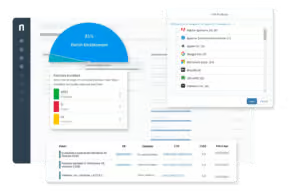
NinjaOne is a cloud-native enterprise-ready IT management platform trusted by 40,000+ customers worldwide. Consistently rated the #1 RMM on G2, and boasting top rankings across 14 categories, the solution is our top Datto alternative for its powerful, easy-to-use software in a single pane of glass.
NinjaOne supports Windows, macOS, and Linux endpoints and is designed to serve both enterprise IT teams and scaling MSPs. Its cloud-native architecture means there are no servers to maintain and deployment is handled entirely through the platform. NinjaOne’s continuous release cycle and active product feedback loop mean updates ship regularly, and customers can access the full product from day one of their trial with no feature restrictions.
Key features
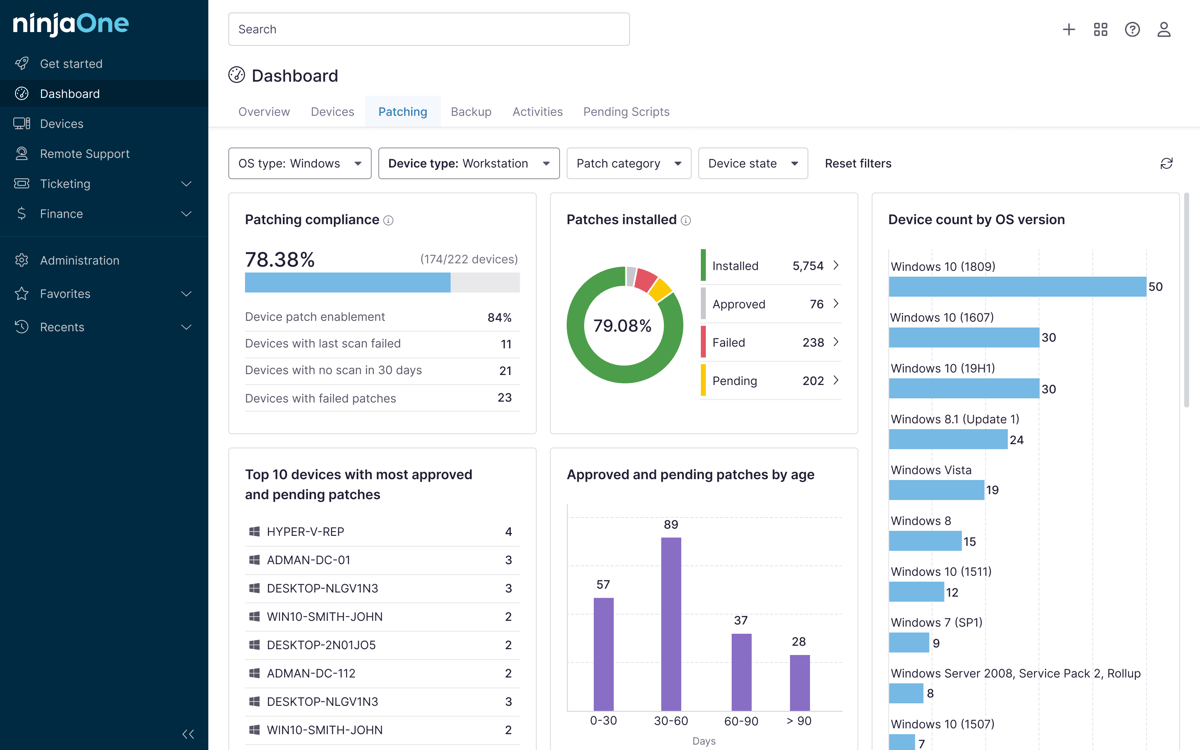
- Autonomous patch management across operating systems and third-party applications: NinjaOne’s patching engine supports Windows, macOS, Linux, and hundreds of third-party applications, with flexible scheduling and detailed compliance reporting. 95% of NinjaOne customers report improved patch compliance, and 93% saved time on patching.
- One-click device actions and background remediation: Technicians can initiate device actions, deploy fixes, stop tasks, and open terminal sessions directly from the dashboard, without interrupting end users. This streamlines day-to-day endpoint management and reduces time-to-resolution.
- Fully automated detection and remediation of endpoint issues: NinjaOne automates repetitive tasks to standardize outcomes and improve device stability, helping MSPs manage multiple clients without proportionally scaling headcount.
- Secure remote access for fast, hands-on support: Technicians can take direct control of managed endpoints for faster troubleshooting, with session logging and role-based access controls built in.
- Robust SaaS backup for Microsoft 365 and Google Workspace: NinjaOne’s backup solution protects business-critical cloud data and enables fast, granular restore in the event of ransomware or accidental deletion.
Pair NinjaOne RMM with its SaaS backup solution to protect Microsoft 365 and Google Workspace data.
→ Start your free trial today
Customer story
Evan Oberman, CTO of Business Cloud, was a satisfied Datto user until his organization began to scale. He and his team then experienced certain limitations, especially during remote sessions. After migrating to NinjaOne, Oberman not only significantly reduced his IT spending, but he was able to triple his client base.
“The biggest difference for me between Datto and NinjaOne is transparency,” Oberman said. “During the sales process with Datto, there were significant product weaknesses they kept hidden. They canceled product lines we were waiting for. They don’t publish a roadmap. NinjaOne offers a ton of transparency – clearly communicating bugs before we notice them and providing a roadmap we can see (and vote on) at any time.”
You can read more NinjaOne customer stories or check out more NinjaOne reviews.
Reviews
- 4,308 reviews (at the time of update)
- 4.7 / 5 stars
- 292 reviews (at the time of update)
- 4.7 / 5 stars
Pricing information
NinjaOne uses a per-device pricing model that is customized to the specific modules you need, such as backup, patch management, and remote access. There are no hidden fees, and NinjaOne includes unlimited onboarding, training, and support at no extra cost.
You can request a free quote, schedule a 14-day free trial, or watch a demo.
Improve your monitoring and management strategies with a trusted and reliable RMM solution like NinjaOne.
→ See what NinjaOne RMM can do
2. Atera
Atera is an RMM solution operating on a single dashboard. Its IT management platform includes RMM, IT automation, patch management, scripting, ticketing, and reporting. The platform positions itself as an all-in-one solution for mid-sized MSPs and internal IT departments.
Recently, Atera has expanded its platform with AI-powered capabilities, including an AI Copilot that assists with ticket resolution, script generation, and automated diagnostics. The platform supports Windows, macOS, and Linux endpoints and includes network discovery, SNMP monitoring, and remote access through integrations with tools like Splashtop, AnyDesk, and TeamViewer.
See how Atera compares to NinjaOne.
Read a more in-depth comparison of Atera alternatives or learn more about Atera vs. Datto.
Best for
Small MSPs and IT departments looking for an affordable, all-in-one platform that consolidates core RMM and helpdesk functionality.
Features
- All-in-one RMM solution: Atera combines RMM, PSA, ticketing, patch management, and reporting under a single per-technician license.
- AI-powered autonomous IT capabilities: Atera’s AI Copilot assists with real-time diagnostics, script generation, and ticket resolution, while AI-driven workflows can automatically resolve common issues without technician intervention.
- Multi-tenant console for managing multiple client environments: Atera’s dashboard is built around a multi-tenant architecture, allowing MSPs to monitor and manage all client devices from a single interface.
Shortcomings
- Extensiveness of features: G2 users have stated that some of Atera’s features may not be as mature or extensive when compared to other RMM solutions. (Verified G2 review)
- Mac management: Atera users say that the platform could improve its monitoring and management features for Mac devices. (Verified G2 review)
- Reporting: Multiple reviews have stated that Atera’s reporting function could be more comprehensive. (Verified G2 review)
Reviews
- 1,167 reviews (at the time of update)
- 4.6 / 5 stars
- 449 reviews (at the time of update)
- 4.5 / 5 stars
3. ConnectWise RMM
ConnectWise RMM is a cloud-native remote monitoring and management platform built on the ConnectWise Asio platform, designed for MSPs of all sizes. The platform consolidates endpoint monitoring, patch management, scripting, remote access via ScreenConnect, and workflow automation in a single interface, and is backed by 24/7 NOC services that can handle alert triage and remediation on behalf of MSP partners.
The platform includes AI-assisted scripting through its Sidekick tool, a library of hundreds of pre-built scripts, and native integration with ConnectWise PSA and the broader ConnectWise ecosystem.
See how ConnectWise compares to NinjaOne.
Read a more in-depth comparison of ConnectWise competitors or learn more about ConnectWise vs. Datto.
Best for
Mid-to-large MSPs seeking a cloud-native RMM with strong out-of-the-box automation, access to 24/7 NOC support, and deep integration with the ConnectWise product ecosystem.
Features
- AI-driven alert filtering: ConnectWise RMM uses AI-driven alert filtering to allow IT technicians to focus on priority tasks.
- Pre-built automation library: The platform features a library of hundreds of pre-built scripts for common tasks.
- Unified visibility across endpoints: ConnectWise RMM extends monitoring beyond traditional endpoints to include network health, cloud infrastructure, backup status, and security posture in a single dashboard.
Shortcomings
- User-friendliness: Some G2 users have stated that the platform may not be as intuitive as expected. (Verified G2 review)
- Integrations beyond the ConnectWise ecosystem: The platform could improve its integration capabilities with other business apps outside its current ecosystem. (Verified G2 review)
- Reporting: According to a G2 review, the reporting function is completed in a separate platform. (Verified G2 review)
Reviews
- 66 reviews (at the time of update)
- 4.2 / 5 stars
ConnectWise RMM Capterra Reviews
- 72 reviews (at the time of update)
- 4.2 / 5 stars
4. Syncro
Syncro is an MSP-focused platform that combines RMM, professional services automation (PSA), and remote access in a single console. Founded in 2011, the platform has historically been positioned around consolidating the core operational tools MSPs need, such as ticketing and monitoring, without requiring separate products for each function.
In 2025, Syncro introduced a new product category called Extended Monitoring and Management (XMM), which expands the platform beyond traditional RMM and PSA functions to include Microsoft 365 multi-tenant management. XMM integrates with Microsoft Secure Score, Entra ID, and Defender Antivirus, allowing MSPs to manage endpoints, user identities, and M365 security posture from a single interface.
See how Syncro compares to NinjaOne.
Read a more in-depth comparison of Syncro competitors or learn more about Syncro vs. Datto.
Best for
Small-to-mid MSPs that want an integrated RMM and PSA without managing separate vendor relationships or paying per-device fees.
Features
- Mobile app: Syncro has a dedicated mobile app with endpoint management features that IT administrators can use on the go.
- PSA features: Syncro delivers ticketing, billing, customer management, and endpoint monitoring in one platform, eliminating the need for a separate PSA subscription.
- Remote access: Syncro allows IT administrators to perform troubleshooting through remote access, reducing the need for physical intervention.
Shortcomings
- Ticket transparency: One G2 review said that it is difficult to determine if other team members are working on the same ticket, which can create delays. (Verified G2 review)
- Vague alerts: Multiple reviews state that they receive basic reports about different issues, which can slow down the resolution process. (Verified G2 review)
- Reporting: The reporting function could be improved to be more comprehensive and intuitive. (Verified G2 review)
Reviews
- 502 reviews (at the time of update)
- 4.5 / 5 stars
- 148 reviews (at the time of update)
- 4.6 / 5 stars
5. LogMeIn Resolve
LogMeIn Resolve is an IT management platform under the umbrella of products developed by GoTo. Formerly known as GoTo Assist, the platform is designed to help businesses streamline their IT operations through key features such as RMM, IT automation, helpdesk, etc. LogMeIn Resolve provides a solution that enables IT teams to manage and support their infrastructure, ensuring business continuity.
LogMeIn Resolve supports unattended remote access, conversational ticketing through popular messaging platforms like Slack and Microsoft Teams, and customizable alerting for proactive incident response. It is available as a cloud-hosted solution with no on-premises requirement, making it relatively straightforward to deploy for teams without dedicated infrastructure.
See how LogMeIn Resolve compares to NinjaOne.
Read a more in-depth comparison of LogMeIn Resolve competitors or learn more about LogMeIn vs. Datto.
Best for
SMBs and small-to-mid internal IT teams that need to support both on-premises and remote workforces, with a focus on conversational ticketing and unattended remote access.
Features
- IT alerting: LogMeIn Resolve offers customizable alerting capabilities, notifying IT administrators in critical instances, such as when thresholds are reached.
- Conversational ticketing: The platform also allows the receipt and tracking of service requests directly within popular business messaging platforms, streamlining service request management.
- Unattended access: IT teams can also benefit from LogMeIn Resolve’s unattended access, which allows them to address issues even when the device user is unavailable.
Shortcomings
- Customer support: According to some users, LogMeIn Resolve’s customer support could be enhanced significantly by improving its response times. (Verified G2 review)
- Onboarding at scale: There are reviews that state the platform experiences some limitations when onboarding devices at scale. (Verified G2 review)
- Platform responsiveness: Some users report that the screen freezes mid-operation, affecting productivity and efficiency. (Verified G2 review)
Reviews
- 468 reviews (at the time of update)
- 4.3 / 5 stars
LogMeIn Resolve Capterra Reviews
- 214 reviews (at the time of update)
- 4.4 / 5 stars
6. N-sight RMM
N-sight RMM is a cloud-based RMM solution from N-able, launched in 2022 as a purpose-built platform for small-to-growing MSPs. It bundles RMM with remote control via N-able Take Control and helpdesk capabilities through MSP Manager, offering an all-in-one starting point for MSPs that need core functionality without the complexity or cost of N-able’s more advanced N-central platform.
The platform supports Windows, macOS, and Linux endpoints, and includes native integration with Apple Device Management for zero-touch deployment across iOS, iPadOS, and macOS devices
See how N-sight RMM compares to NinjaOne.
Learn more about N-sight RMM vs. Datto.
Best for
Smaller MSPs and IT departments in their early growth stage that need a straightforward, affordable RMM with solid cross-OS support and no-code automation.
Features
- Apple Device Management integration: N-sight RMM is ideal for Apple-centric infrastructure because it integrates with Apple Device Management, allowing for zero-touch deployment across iOS, iPadOS, and macOS.
- Cross-OS support: The platform’s RMM tools offer support for the most popular operating systems, such as Windows, macOS, and Linux.
- Drag-and-drop automation: N-sight RMM also has a library of preconfigured scripts that IT administrators can drag and drop into workflows to automate routine tasks.
Shortcomings
- Learning curve: G2 users state that the platform can be challenging to learn, especially for beginner IT professionals. (Verified G2 review)
- Patch management issues: Occasionally, N-sight’s patch management feature can experience errors. (Verified G2 review)
- Integration: Some N-sight users mentioned encountering issues when integrating with security providers, affecting the deployment of certain security tools. (Verified G2 review)
Reviews
- 348 reviews (at the time of update)
- 4.3 / 5 stars
- 200 reviews (at the time of update)
- 4.3 / 5 stars
Implement an RMM solution by the #1-rated IT management platform for MSPs.
→ Start a free trial or watch a demo of NinjaOne RMM
7. N-able N-central
N-able N-central is the enterprise-tier RMM from N-able, designed for mid-to-large MSPs managing complex, multi-client environments at scale. While N-sight is N-able’s entry-level platform built around simplicity, N-central is intended for practices that have outgrown basic tooling and need more granular control over automation, policy management, and multi-tenant reporting.
The platform includes AI-powered scripting tools, advanced patch management across Windows, macOS, and Linux, and deep policy hierarchy capabilities for managing multiple client environments under a structured, tiered access model.
See how N-able N-central compares to NinjaOne.
Read a more in-depth comparison of N-able N-central competitors or learn more about N-able N-central vs. Datto.
Best for
Mid-to-large MSPs and enterprise IT teams that require advanced automation, multi-tenant management at scale, and deeper customization than entry-level RMM platforms provide.
Features
- AI-powered scripting and automation: N-central includes AI-assisted scripting tools that help technicians build and modify automation workflows more efficiently.
- Advanced multi-tenant management: The platform is designed to handle large, complex client environments with granular role-based access controls.
- Flexible deployment options: N-central is available as both a cloud-hosted SaaS platform and an on-premises deployment.
Shortcomings
- Learning curve: Multiple users say that there is a steep learning curve to N-central. (Verified G2 review)
- Patch inconsistencies: It has been alleged by several users that the platform can slow down or encounter errors when deploying patches to a large set of endpoints. (Verified G2 review)
- Customer support: N-central users express their desire for faster support. (Verified G2 review)
Reviews
- 556 reviews (at the time of update)
- 4.4 / 5 stars
N-able N-central Capterra Reviews
- 253 reviews (at the time of update)
- 4.2 / 5 stars
8. Kaseya VSA
Kaseya VSA offers remote monitoring, patch management, endpoint management, IT automation, and native ransomware detection in a single platform, with an extensive scripting library. Kaseya VSA is now part of the Kaseya product family, which is the same parent company that acquired Datto in 2022.
Because Kaseya is the parent company of both Datto RMM and Kaseya VSA, MSPs currently on Datto who are considering a switch to VSA should carefully evaluate how that move affects their licensing agreements, contract terms, and support relationships before proceeding.
See how Kaseya compares to NinjaOne.
Read a more in-depth comparison of Kaseya competitors or learn more about Kaseya vs. Datto.
Best for
MSPs and IT departments already working within the Kaseya product ecosystem who need a robust, established RMM with deep automation capabilities and broad third-party integrations.
Features
- Centralized endpoint management: Kaseya VSA provides a unified platform for managing desktops, laptops, servers, and mobile devices from a single console.
- Robust automation capabilities: The platform allows IT teams to automate patch management, software deployment, system updates, and compliance checks at scale.
- Remote access and control: Kaseya VSA includes remote access tools that allow IT administrators to connect to and manage endpoints regardless of location.
Shortcomings
- Navigation: Some Kaseya users expressed challenges when navigating the platform, saying it takes time to get to features buried deep within the user interface. (Verified G2 review)
- Support: Multiple G2 reviews state that Kaseya could improve its customer support. (Verified G2 review)
- Integration with related products: Some users found integrating Kaseya effectively with other products within the Kaseya ecosystem challenging. (Verified G2 review)
Reviews
- 326 reviews (at the time of update)
- 4.5 / 5 stars
- 207 reviews (at the time of update)
- 4.1 / 5 stars
9. SuperOps
SuperOps is a cloud-native, AI-native PSA-RMM platform built specifically for MSPs and internal IT teams. It combines professional services automation, remote monitoring and management, ticketing, billing, contract management, asset management, patch management, and IT documentation in a single unified interface.
The platform includes an AI assistant called Monica, which can generate remediation scripts from plain-language inputs, as well as AI-powered alerting that aims to reduce noise by automatically identifying and escalating high-risk issues.
See how SuperOps compares to NinjaOne.
Read a more in-depth comparison of SuperOps competitors or learn more about SuperOps vs. Datto.
Best for
Small-to-mid MSPs that want a unified RMM and PSA in a modern interface, particularly teams moving away from legacy platforms or operating with limited administrative overhead.
Features
- Unified RMM and PSA platform: SuperOps combines device monitoring, patch management, ticketing, and billing in one interface.
- AI-assisted workflows: SuperOps includes AI-powered features that help automate ticket categorization, suggest resolutions, and streamline routine technician workflows.
- Cross-platform endpoint support: The platform supports Windows, macOS, and Linux endpoints, with monitoring, scripting, and patch management available across all three operating systems.
Shortcomings
- Search function: A G2 user mentioned that using the search function can be a challenging. (Verified G2 review)
- Remote access: It has been noted that SuperOps’ remote access encounters regular errors. (Verified G2 review)
- Customer support: Multiple G2 users state that the platform could improve its customer service and support. (Verified G2 review)
Reviews
- 133 reviews (at the time of update)
- 4.5 / 5 stars
- 65 reviews (at the time of update)
- 4.6 / 5 stars
10. Pulseway
Pulseway is a cloud-based RMM platform distinguished by its mobile-first design philosophy, allowing IT administrators to monitor, manage, and remediate systems directly from a smartphone or tablet. The platform supports Windows, macOS, and Linux endpoints, as well as mobile device management for iOS and Android, and SNMP-based monitoring for network devices such as routers, switches, and printers.
Pulseway includes a visual workflow automation builder for creating automated responses to alerts, and integrates with tools including ConnectWise Manage, Autotask PSA, IT Glue, Bitdefender, and Webroot, among others.
See how Pulseway compares to NinjaOne.
Read a more in-depth comparison of Pulseway competitors or learn more about Pulseway vs. Datto.
Best for
Small IT teams and MSPs where technicians spend significant time away from a desk and need the ability to triage and respond to alerts from a mobile device in real time.
Features
- Mobile-first management: Pulseway’s mobile application enables technicians to acknowledge alerts, run scripts, restart services, and initiate remote sessions directly from a smartphone.
- Proactive alerting and automation: The platform provides configurable alerting with automated responses.
- Multi-OS support: Pulseway supports Windows, macOS, and Linux endpoints, with monitoring and patch management available across all three platforms.
Shortcomings
- User-interface: Some G2 users have said that Pulseway’s UI could improve so that it’s more user-friendly. (Verified G2 review)
- Desktop limitations: While the mobile app version of Pulseway is robust, G2 users have said that it could improve its desktop counterpart. (Verified G2 review)
- Reporting: Some users note that the reporting features could be improved, especially when compared to other Datto alternatives on this list. (Verified G2 review)
Reviews
- 123 reviews (at the time of update)
- 4.6 / 5 stars
- 310 reviews (at the time of update)
- 4.7 / 5 stars
11. ManageEngine Endpoint Central
ManageEngine Endpoint Central is a unified endpoint management solution designed primarily for internal IT teams at mid-market to enterprise organizations. The platform provides centralized management of desktops, laptops, servers, smartphones, and tablets across Windows, macOS, Linux, iOS, Android, ChromeOS, and iPadOS from a single console.
It automates routine management tasks including patch deployment, software distribution, OS imaging, application control, and asset tracking, making it a broad-coverage solution for organizations with heterogeneous device environments.
See how ManageEngine compares to NinjaOne.
Read a more in-depth comparison of ManageEngine Endpoint Central competitors or learn more about ManageEngine Endpoint Central vs. Datto.
Best for
Internal IT departments at mid-to-large organizations that need comprehensive endpoint management.
Features
- Unified endpoint management: Endpoint Central manages Windows, macOS, Linux, iOS, Android, and Chrome OS devices from a single console.
- Patch management: The platform supports automated patching for operating systems and hundreds of third-party applications.
- Software deployment: Endpoint Central includes tools for software packaging, remote deployment, and OS image management.
Shortcomings
- Remote sessions: Occasionally, users receive error messages during a remote session, though they spontaneously resolve on their own after a few minutes. (Verified G2 review)
- Learning curve: According to some ManageEngine Endpoint Central users, learning and becoming familiar with the platform can be a challenge. (Verified G2 review)
- Patch pushing: Multiple users have expressed difficulty in pushing patches. (Verified G2 review)
Reviews
ManageEngine Endpoint Central G2 Reviews
- 1,104 reviews (at the time of update)
- 4.5 / 5 stars
ManageEngine Endpoint Central Capterra Reviews
- 1,689 reviews (at the time of update)
- 4.6 / 5 stars
12. Ivanti Neurons for ITSM
Ivanti Neurons is an AI-powered endpoint management and automation platform developed by Ivanti. The platform supports Windows, macOS, Linux, iOS, and Android devices, and is available in cloud-hosted, on-premises, and hybrid deployment models.
While Ivanti Neurons skews more toward enterprise UEM than traditional MSP-focused RMM, its endpoint monitoring, automated remediation, and patch management capabilities make it a credible consideration for internal IT teams evaluating Datto alternatives at the enterprise level.
Read a more in-depth comparison of Ivanti competitors or learn more about Ivanti vs. Datto.
Best for
Mid-to-large internal IT departments and enterprise organizations that prioritize risk-based patch management, endpoint security, and automated remediation.
Features
- Risk-based patch management: Ivanti Neurons prioritizes patches based on known exploits, ransomware associations, and vulnerability severity.
- Autonomous endpoint healing: Ivanti’s Neurons platform includes agents that can detect and remediate endpoint issues, reducing reactive workload for IT teams.
- Unified endpoint management: The platform manages desktops, laptops, servers, and mobile devices across Windows, macOS, Linux, iOS, and Android from a single console.
Shortcomings
- Initial setup: Setting up Ivanti Neurons for ITSM can be particularly difficult for lean teams. (Verified G2 review)
- Intended for larger teams: Configuring navigation paths is best suited for larger teams with more experienced IT professionals. (Verified G2 review)
- Customization: The platform takes time to master, especially in terms of customizing various tasks and policies. (Verified G2 review)
Reviews
- 235 reviews (at the time of update)
- 3.9 / 5 stars
Ivanti Neurons Capterra Reviews
- 15 reviews (at the time of update)
- 3.9 / 5 stars
What is Datto?
Datto RMM is a cloud-based remote monitoring and management platform built for managed service providers. Originally founded as an independent company in 2007 and later acquired by Kaseya in 2022, Datto provides MSPs with tools for endpoint monitoring, patch management, remote access, scripting, and automation, typically bundled alongside Datto’s backup and disaster recovery products.
Why choose NinjaOne over Datto
1. More reliable remote access
G2 reviews of Datto frequently flag its web remote as inconsistent, where connections time out, fail unexpectedly, and often require fallback tools to get the job done. NinjaOne provides stable, fast remote access built directly into its single agent, so technicians can connect confidently without worrying about mid-session failures or needing backup remote tools.
2. Smarter alerting
Datto users frequently flag alert fatigue as a frustration, with high volumes of alerts and false positives making it harder for technicians to prioritize what actually matters. NinjaOne’s alerting is built to surface what’s actionable, reducing noise and helping teams stay focused on real issues without getting buried in false positives
3. More responsive remote connections
Reviews and firsthand feedback highlight that connecting to remote devices via Datto’s web console can take up to a minute or two, a delay that disrupts help desk workflows and leaves clients waiting. NinjaOne’s remote access is built for speed and reliability, minimizing connection delays so technicians can get in and resolve issues quickly without the frustration.
4. Scales smoothly under high request volumes
Reviews note that Datto RMM can struggle when handling large volumes of requests simultaneously, which becomes a real limitation for MSPs managing extensive device networks. NinjaOne’s cloud-native infrastructure is built to handle high request volumes without performance degradation, keeping operations running smoothly even as endpoint counts and workload demands grow.
5. Cleaner, more intuitive navigation
While Datto’s platform is feature-rich, the interface can feel inconsistent, requiring too many clicks to complete common task. Occasional delays in device status updates and component execution reporting can also slow down troubleshooting when it matters most. NinjaOne’s interface is designed for clarity and efficiency, with streamlined navigation, consistent workflows, and real-time visibility that keeps technicians moving without the friction.
Strengths of Datto RMM
The following strengths reflect what Datto RMM users consistently highlight across third-party review platforms.
- Strong integration with Autotask PSA: MSPs using Autotask PSA benefit from native integration between Datto RMM and the PSA platform. (Verified G2 review)
- Comprehensive monitoring and alerting capabilities: Reviewers frequently note that Datto RMM’s monitoring and alerting features are robust, providing visibility into endpoint health and infrastructure events. (Verified G2 review)
- Scripting and automation flexibility: Users with scripting experience cite flexibility in the scripting engine and support for complex, multi-step workflows. (Verified G2 review)
- Built-in Web Remote functionality: Alongside Splashtop, Datto RMM includes browser-based remote access. (Verified G2 review)
- Multi-tenant management: Datto RMM’s multi-tenant architecture allows MSPs to manage numerous client environments from a single platform. (Verified G2 review)
Limitations of Datto RMM
The following limitations are drawn from verified third-party reviews and reflect recurring themes in user feedback.
- Pricing and contract changes post-acquisition: Since Kaseya’s acquisition of Datto, many MSPs report experiencing some pricing and renewal difficulties. (Verified G2 review)
- User-friendliness: Many G2 users say that the platform, while robust, can be difficult to use, occasionally experiencing lags. (Verified G2 review)
- Alert noise: Datto users have stated that sometimes they receive too many alerts or false positives. (Verified G2 review)
- Performance lags: While Datto’s remote function is robust, connecting between devices can slow down occasionally, especially in low latency areas. (Verified G2 review)
- Onboarding complexity: Some users find that bringing new technicians up to speed on Datto RMM requires more time and effort than competing platforms. (Verified G2 review)
Datto RMM pros and cons
| Pros | Cons |
| Native integration with Autotask PSA streamlines ticketing, billing, and client reporting workflows | Pricing and renewal difficulties reported by many MSPs following the Kaseya acquisition |
| Robust monitoring and alerting provides detailed visibility into endpoint health and infrastructure events | Platform can be difficult to use and occasionally experiences performance lags |
| Flexible scripting engine supports complex, multi-step automation workflows | High alert volume and false positives can create noise for technicians |
| Browser-based remote access via built-in Web Remote and Splashtop | Remote connections can slow down, particularly in low-latency environments |
| Multi-tenant architecture supports managing multiple client environments from a single platform | Onboarding new technicians requires more time and effort than competing platforms |
Why IT teams look for alternatives to Datto
For many MSPs, Datto RMM has been a reliable and capable platform, particularly for organizations already using Autotask PSA or other Kaseya-ecosystem products. However, since the Kaseya acquisition, many MSPs have begun re-evaluating the platform. citing concerns about pricing structure changes, multi-year contract terms, UI updates that disrupted established workflows, and shifts in support quality.
These factors, combined with the growing maturity of competing RMM platforms, have prompted many teams to look for alternatives to Datto.
Choosing among Datto competitors
As workforces become more remote and distributed, it’s become even more important for your organization to use a powerful RMM that can easily manage your network infrastructure. This tool not only frees your technicians from mundane tasks but also helps facilitate scalable growth, especially if you work in a remote or hybrid work culture.
Remember that not all vendors offer the same features and functionalities your business needs. When selecting the best RMM for your business, always go back to the basics and evaluate what you need the solution for, what you want the software to do, and your projected growth in the next five to ten years. Knowing these things will help you make a more informed decision about which RMM tool is the best for your organization.