Key Points
- The top alternatives to Ivanti are: 1) NinjaOne, 2) OptiTune, 3) ConnectWise Automate, 4) Quest KACE, 5) BMC Helix Client Management, 6) Atera, 7) IBM Security MaaS360, 8) Kaseya VSA, 9) SolarWinds Service Desk, 10) SysAid, 11) ManageEngine Endpoint Central, and 12) Microsoft Intune
- Ivanti Neurons represents the company’s cloud-native, automation-driven future, while legacy solutions like Ivanti DSM are approaching end of life, prompting many organizations to reassess their long-term endpoint management strategy.
- Common drivers include complex deployments, usability challenges, scalability concerns, lengthy implementation timelines, and upcoming product transitions such as Ivanti DSM’s EOL.
- Leading Ivanti alternatives focus on real-time visibility, proactive remediation, and automation to reduce manual effort and accelerate time to value.
- Evaluating Ivanti competitors holistically helps organizations choose an endpoint management solution aligned with current operational needs and future growth.
If you’re evaluating Ivanti alternatives, you may be familiar with what it offers, and where it can fall short for your team. Whether you’re dealing with complex deployments, a steep learning curve, or planning ahead for Ivanti DSM’s end of life, this guide is designed to help you make a clear, confident decision about what comes next.
This article discusses 12 of the best alternatives to Ivanti, evaluated across real-world usability, deployment experience, patch management capabilities, and customer support quality. By understanding the strengths and weaknesses of different solutions, you can make an informed decision that aligns perfectly with your organization’s unique requirements.
| TL;DR: With Ivanti DSM reaching end of life at the end of 2026, many IT teams are actively reassessing their endpoint management stack. The best alternatives prioritize fast deployment, intuitive interfaces, strong patch management, and dependable support. Organizations migrating off DSM will benefit most from cloud-native tools with robust automation and real-time endpoint visibility, while teams replacing Ivanti Neurons should weigh ITSM alignment, scalability, and tool consolidation. The tools in this guide cover both audiences across a range of team sizes and budgets, with NinjaOne ranking as our top recommendation based on G2 ratings, customer support, and overall ease of use. |
NinjaOne automates the hardest parts of IT to deliver real-time visibility, security, and control over all your endpoints.
Ivanti alternatives quick comparison table
| Tool | G2 Rating | Reviews | Best for | Pricing model | Deployment | Migration difficulty |
| NinjaOne | 4.7/5 | 4,317 | MSPs and IT teams at scale | Per device | Cloud | Low |
| OptiTune | 4.3/5 | 5 | Small IT teams, entry-level RMM | Per device | Cloud | Low |
| ConnectWise Automate | 4.1/5 | 140 | MSPs with complex environments | Per device | Cloud/on-premises | High |
| Quest KACE | 4.1/5 | 95 | Mid-market Windows-heavy environments | Per device | Cloud/on-premises | Medium |
| BMC Helix Client Management | 4.4/5 | 64 | Large enterprises with ITIL requirements | Custom quote | Cloud/on-premises | High |
| Atera | 4.6/5 | 1,192 | Small to mid-sized MSPs & IT teams | Per technician | Cloud | Low |
| IBM Security MaaS360 | 4.2/5 | 209 | Enterprise mobile & endpoint security | Per device | Cloud | Medium |
| Kaseya VSA | 4.5/5 | 326 | MSPs already in the Kaseya ecosystem | Per device | Cloud/on-premises | High |
| SolarWinds Service Desk | 4.3/5 | 783 | Internal IT teams needing ITSM + ticketing | Per agent | Cloud | Medium |
| SysAid | 4.5/5 | 749 | Mid-sized teams needing ITSM + automation | Custom quote | Cloud/on-premises | Medium |
| ManageEngine Endpoint Central | 4.5/5 | 1,117 | Enterprise endpoint management & compliance | Per device/tiered | Cloud/on-premises | Medium |
| Microsoft Intune | 4.5/5 | 267 | Microsoft 365 / Azure-centric organizations | Bundled with M365 | Cloud | Low to medium |
How we evaluated these tools
The alternatives listed in this guide were selected based on market presence, G2 and Capterra review volume, relevance to MSP and IT team workflows, and direct comparability with Ivanti’s core feature set.
Our methodology followed these criteria:
- Third-party review data: Ratings, themes, and friction points were drawn from G2 and Capterra, prioritizing reviews from the past 12 months where available.
- Feature relevance: Tools were assessed on patch management, remote monitoring, automation, reporting, integration depth, and scalability, the functional areas where Ivanti users most commonly report limitations.
- Deployment and migration: Each tool was assessed on deployment model (cloud, on-premises, hybrid) and the practical effort of migrating from Ivanti.
- NinjaOne internal research: Where applicable, validated NinjaOne benchmarks and customer outcome data were used to support the NinjaOne section.
12 best alternatives to Ivanti
All G2/Capterra data as of June 2026.
1. NinjaOne
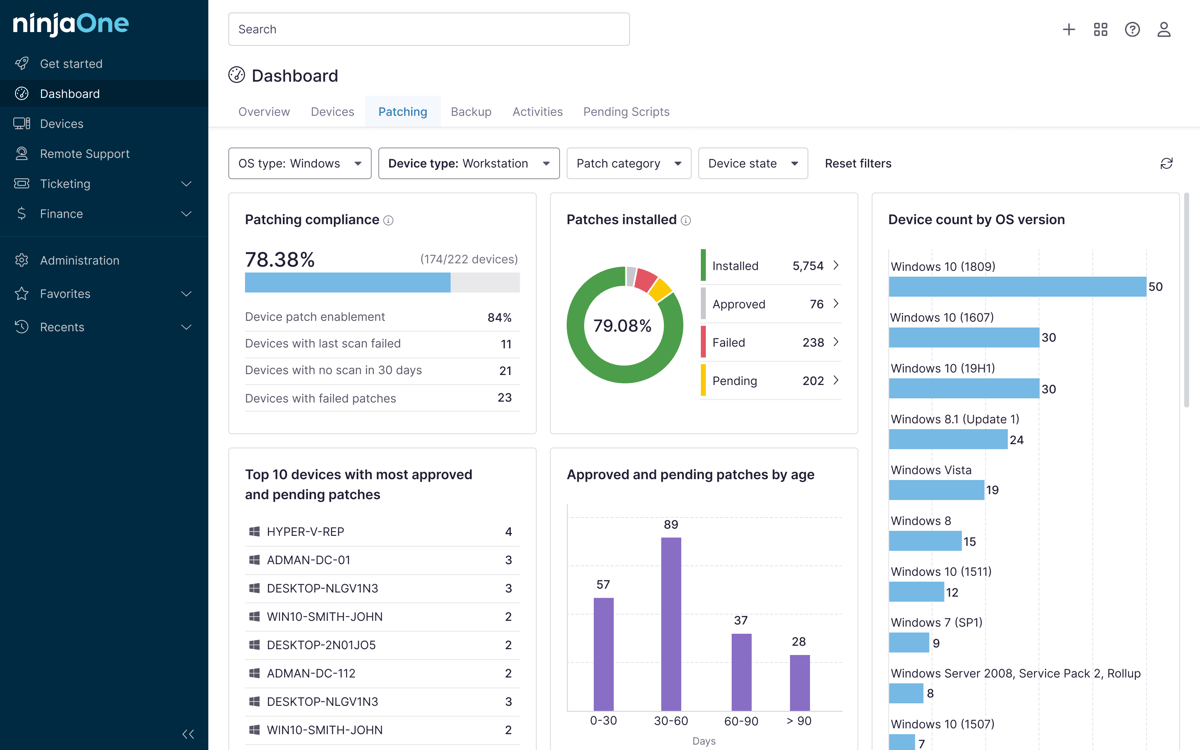
If you are looking for a unified IT operations platform solution for Windows, macOS, and Linux endpoints, consider NinjaOne. The platform is known for its efficient endpoint monitoring and management tools, which users can easily access from a single pane of glass. Additionally, NinjaOne provides MDM, patch management, backup, remote control, and service desk natively within the platform, as well as integrates with thousands of other third-party applications.
NinjaOne automates the hardest parts of IT to deliver real-time visibility, security, and control over all your endpoints. With a healthy obsession for each customer’s success, the company is committed to building products proven to increase productivity, reduce security risks, and lower IT costs.
Key features
- Unified endpoint management: Manage Windows, macOS, and Linux endpoints from a single pane of glass, giving IT administrators centralized visibility and control across their entire environment.
- Automated IT workflows: NinjaOne automates complex and repetitive IT tasks, reducing manual effort and helping teams respond to issues more efficiently.
- Cloud-native architecture: Built as a modern, cloud-native platform, NinjaOne offers scalability, flexibility, and seamless integration to support evolving business needs.
- Real-time device telemetry: Get up-to-date data on device health, performance, inventory, and reports in real time, enabling faster and more informed decision-making.
- Backup: Protect critical business data with reliable, automated backup solutions that ensure fast recovery in the event of data loss or disruption.
NinjaOne is the top Ivanti alternative, automating all your critical endpoint management workflows to unparalleled efficiency, security, and support.
Customer story
Dan Shapero, President & COO of TeamLogic, was looking for a modern-day RMM that was both reliable and scalable. After trying different software vendors, he chose NinjaOne for its proven track record, superior customer service, and excellent functionality.
“We looked at eight different RMMs and at the end of the day, NinjaOne was the best fit for us because it’s a scalable solution. It’s built on a modern SaaS architecture and it’s future-proof. If you look at how it’s built, it doesn’t have all the code bloat that some of the other applications on the market have. NinjaOne is built with security and scalability and mind,” he says.
Read more NinjaOne customer stories or check out NinjaOne reviews.
Pricing information
NinjaOne uses a per-device pricing model that is customized to the specific modules you need, such as backup, patch management, and remote access. There are no hidden fees, and includes unlimited onboarding, training, and support at no extra cost.
You can request a free quote, schedule a 14-day free trial, or watch a demo.
Reviews
- 4,317 reviews (at the time of update)
- 4.7 / 5 stars
- 293 reviews (at the time of update)
- 4.7 / 5 stars
2. OptiTune
OptiTune, a Bravura software, is a remote monitoring and management (RMM) platform that’s marketed as an entry-level solution for small IT teams and MSPs. Featuring centralized management, OptiTune’s platform allows you to take control of all your computers within your organization, ensuring each has the most current updates, exposing malware threats, deploying the latest versions of applications like Microsoft Office, and identifying which computers are overloaded.
Its endpoint management tool offers robust monitoring and alerting, so you are immediately notified of any security vulnerability via email or text message before it has an organizational impact. If your IT enterprise has multiple IT work shifts, you can set up notification groups for each one and specify the weekly schedule for which group of administrations should be notified and when.
See how Bravura OptiTune compares to NinjaOne.
Read a more in-depth comparison of Bravura OptiTune alternatives or learn more about Bravura OptiTune vs. Ivanti.
Best for
Small IT teams and MSPs managing fewer than 5,000 Windows endpoints that need straightforward remote monitoring.
Features
- Easy deployment: OptiTune runs on the cloud and can be accessed from any device that has an internet connection.
- Endpoint security: Maintains endpoint security by integrating with popular antivirus software.
- Web-based console: Allows easy access and management of the platform from anywhere through a web-based console.
Shortcomings
- Mobile-friendliness: G2 users have stated that the platform is not as intuitive on mobile compared to other alternatives in this list. (Verified G2 review)
- OS support: The endpoint management platform has limited to no support for Linux and macOS devices. (Verified G2 review)
- Data visualization: The lack of comprehensive data visualization features may be limiting to some users. (Verified G2 review)
- 5 reviews (at the time of update)
- 4.3 / 5 stars
- 14 reviews (at the time of update)
- 4.3 / 5 stars
3. ConnectWise Automate
Previously known as LabTech, this IT management solution simplifies remote management, maintenance, and troubleshooting for endpoints. ConnectWise Automate helps organizations and MSPs with common IT tasks, freeing valuable time to focus on other strategic initiatives.
Its RMM solution helps you monitor, manage, and support client networks proactively. Its platform offers multiple out-of-the-box scripts, around-the-clock monitoring, and various automation capabilities so you can deliver better services to your end-user. Additionally, ConnectWise Automate automates general maintenance tasks related to PC health, security vulnerabilities, patches, and updates to free your IT team to focus on higher-value tasks.
See how ConnectWise Automate compares to NinjaOne.
Read a more in-depth comparison of ConnectWise alternatives or learn more about ConnectWise Automate vs. Ivanti.
Best for
MSPs and IT teams with the resources to invest in a deeply customizable RMM platform, particularly those already operating within the ConnectWise ecosystem.
Features
- Monitoring: ConnectWise Automate promotes a proactive approach to endpoint management by monitoring devices and identifying IT issues before they worsen.
- Patch management: ConnectWise Automate can stage patches in waves to test them before pushing them to critical environments.
- Automation: This solution streamlines repeatable tasks through automation for improved efficiency.
Shortcomings
- Difference between web version and Windows program: Several G2 users have said that the platform performs differently between interfaces. (Verified G2 review)
- User interface: Navigating the platform can be challenging for some users. (Verified G2 review)
- Initial setup: The initial setup is currently complex and time-consuming. (Verified G2 review)
ConnectWise Automate G2 Reviews
- 140 reviews (at the time of update)
- 4.1 / 5 stars
ConnectWise Automate Capterra Reviews
- 143 reviews (at the time of update)
- 4.1 / 5 stars
4. Quest KACE
Quest KACE is an endpoint management solution that allows IT teams to enroll, monitor, and manage their devices at scale. KACE is cross-platform compatible, providing visibility of IT assets across Windows, Mac, and Linux devices. Its mobile device management (MDM) also allows users to manage mobile devices.
This platform allows users to keep track of the hardware and software in their IT environment. KACE also focuses on compliance management and protecting endpoints from security vulnerabilities with patching and real-time alerting.
Read more about Quest KACE alternatives or compare NinjaOne vs Quest KACE.
Best for
Mid-market organizations with primarily Windows-based environments that need compliance tracking and asset visibility without requiring a cloud-native architecture.
Features
- Windows management: KACE makes it easy for users to manage Windows endpoints.
- Patch management: Users can automate patch deployments.
- Alerting: Customizable notifications allow users to proactively address issues.
Shortcomings
- Suited for larger enterprises: G2 users have stated that KACE requires significant resources to maintain, which may be limiting for startups. (Verified G2 review)
- Execution status: Multiple users have said that it can be challenging to keep track of certain scheduled Windows updates. (Verified G2 review)
- MDM: KACE’s MDM solution lacks features and users find that it requires too much manual intervention. (Verified G2 review)
KACE G2 Reviews
- 95 reviews (at the time of update)
- 4.1 / 5 stars
KACE Capterra Reviews
- 23 reviews (at the time of update)
- 4.0 / 5 stars
5. BMC Helix Client Management
BMC Helix Client Management is an endpoint management solution that enhances productivity by enabling users to automate and manage their IT operations. It easily integrates with other BMC products and third-party applications for a highly customizable user experience.
This platform centralizes endpoint management of Windows, macOS, and Linux devices and other IT tools, such as patch management, automatic asset discovery, and policy compliance, into one dashboard.
See how BMC Helix Client Management compares to NinjaOne.
Read a more in-depth comparison of BMC Helix Client Management alternatives or learn more about BMC Helix Client Management vs. Ivanti.
Best for
Large enterprises with complex, multi-platform environments that require deep ITIL alignment and integration with existing BMC infrastructure.
Features
- Patch management: Automated patching ensures that endpoints have the latest patches and updates.
- Software deployment: Users can remotely install and uninstall essential applications to devices.
- Asset management: BMC offers visibility of hardware and software, making it easier to manage IT assets.
Shortcomings
- Documentation: Reviews say that finding out how to do processes such as uploading photos lacks documentation. (Verified G2 review)
- Learning curve: BMC takes time to set up and fully learn how to use it. (Verified G2 review)
- Interface: Users find BMC’s interface to be complex. (Verified G2 review)
BMC Helix Client Management G2 Reviews
- 64 reviews (at the time of update)
- 4.4 / 5 stars
Note: BMC Helix Client Management does not currently have a Capterra rating due to an insufficient number of reviews.
6. Atera
Atera is a cloud-based platform that streamlines IT operations by centralizing remote monitoring and management (RMM) and professional services automation (PSA) into one dashboard. Users can automate processes, reducing the need for manual intervention and freeing up IT experts to focus on more strategic tasks.
In addition, it offers ITAM capabilities, so users gain full visibility of all their hardware and software assets from its dashboard. Atera also allows users to deploy patches and provide report support.
See how Atera compares to NinjaOne.
Read a more in-depth comparison of Atera alternatives or learn more about Atera vs. Ivanti.
Best for
Small to mid-sized MSPs and internal IT teams looking for an all-in-one RMM and PSA solution.
Features
- RMM: Users can monitor and manage endpoint devices from a single dashboard.
- Patch management: Atera allows users to schedule patches and updates for Windows, macOS, and Linux.
- Automation: Atera streamlines workflows and frees up IT administrators to work on other tasks.
Shortcomings
- Extensiveness of features: G2 users have stated that some of Atera’s features may not be as mature or extensive when compared to other RMM solutions. (Verified G2 review)
- Mac management: Atera users say that the platform could improve its monitoring and management features for Mac devices. (Verified G2 review)
- Reporting: Multiple reviews have stated that Atera’s reporting function could be more comprehensive. (Verified G2 review)
Atera G2 Reviews
- 1,192 reviews (at the time of update)
- 4.6 / 5 stars
Atera Capterra Reviews
- 449 reviews (at the time of update)
- 4.5 / 5 stars
7. IBM Security MaaS360
IBM Security MaaS360 is a comprehensive endpoint manager that enables IT administrators to keep track of their Windows, macOS, iOS, Android, and IoT endpoint devices. The platform consolidates visibility of on-premises and remote devices into one dashboard. IBM Security MaaS360 allows users to streamline workflows by automating repeatable tasks.
IBM highlights the solution’s software deployment capabilities, which enables technicians to quickly configure new devices with necessary applications. In addition, IT professionals can also deploy and patch applications to endpoint devices.
See how IBM Security MaaS360 compares to NinjaOne.
Read a more in-depth comparison of IBM MaaS360 alternatives or learn more about IBM Security MaaS360 vs. Ivanti.
Best for
Enterprise organizations with large mobile and mixed-device fleets that need a robust UEM solution with strong security integrations.
Features
- Remote monitoring: Users can get real-time information on their endpoint devices.
- Patch management: The platform identifies and deploys patches to remediate them.
- MDM: IBM Security MaaS360 allows users to monitor, manage, and secure mobile devices.
Shortcomings
- Performance for legacy devices: Functionality may be limited for older devices. (Verified G2 review)
- Ease of use: While robust, several G2 users have stated that IBM can easily become complex, especially for enterprises managing multiple devices and OSs. (Verified G2 review)
- Initial setup: IBM MaaS360 is better suited for larger enterprise applications, considering that the setup can be quite complex. (Verified G2 review)
IBM MaaS360 G2 Reviews
- 209 reviews (at the time of update)
- 4.2 / 5 stars
IBM Security MaaS360 Capterra Reviews
- 72 reviews (at the time of update)
- 4.2 / 5 stars
8. Kaseya VSA
Kaseya VSA is a cloud-based RMM platform for managing workstations and Apple mobile devices across Windows, macOS, and Linux environments. The current version, VSA X (also referred to as VSA 10), is a ground-up rebuild of the legacy VSA 9 platform with a modern cloud-native interface and redesigned automation. It simplifies IT operations with automation tools that automate repeatable tasks such as patch management and auto-remediation for IT tickets.
This solution allows users to secure endpoint devices by patching vulnerabilities and providing custom alerts that allow technicians to address issues proactively before they escalate. Kaseya’s built-in MDM module currently supports Apple iOS devices, with Android and Chromebook support planned for future releases.
See how Kaseya compares to NinjaOne.
Read a more in-depth comparison of Kaseya alternatives or learn more about Kaseya VSA vs. Ivanti.
Best for
MSPs already operating within the Kaseya ecosystem who need a feature-rich RMM with broad automation capabilities.
Features
- Automation: Kaseya allows users to create custom scripts or deploy pre-built scripts.
- RMM: Users get full visibility and control of their endpoint devices.
- Patch management: Kaseya automates patch deployment for Windows, macOS, and third-party applications.
Shortcomings
- Navigation: Some Kaseya users expressed challenges when navigating the platform, saying it takes time to get to features buried deep within the user interface. (Verified G2 review)
- Support: Multiple G2 reviews state that Kaseya could improve its customer support. (Verified G2 review)
- Integration with related products: Some users found integrating Kaseya effectively with other products within the Kaseya ecosystem challenging. (Verified G2 review)
Kaseya VSA G2 Reviews
- 326 reviews (at the time of update)
- 4.5 / 5 stars
Kaseya VSA Capterra Reviews
- 207 reviews (at the time of update)
- 4.1 / 5 stars
9. SolarWinds Service Desk
SolarWinds Service Desk is an ITSM platform that allows IT administrators to monitor and manage devices from a centralized hub. It focuses on its help desk and ticketing system that enables technicians to troubleshoot issues and provide quick remote support.
Other features include robust reporting capabilities and software or patch deployment. SolarWinds also offers asset management tools such as automatic discovery of new hardware or software installed on devices.
Best for
Internal IT teams that prioritize ITSM functionality over deep endpoint management or RMM capabilities
Features
- Automation: SolarWinds reduces manual workloads with automation tools.
- ITAM: Users can keep track of hardware and software assets, making it easier to ensure compliance.
- Centralized management: SolarWinds consolidates several IT tools into one dashboard.
Shortcomings
- Reporting: Generating reports can be difficult and can cause performance issues. (Verified G2 review)
- Customization: Reviews suggest that additional flexibility in tailoring the platform would make it even more user-friendly. (Verified G2 review)
- Documentation: Multiple G2 users have stated that SolarWinds’ documentation could be more thorough, especially for their more advanced features. (Verified G2 review)
SolarWinds Service Desk G2 Reviews
- 738 reviews (at the time of update)
- 4.3 / 5 stars
SolarWinds Service Desk Capterra Reviews
- 577 reviews (at the time of update)
- 4.6 / 5 stars
10. SysAid
SysAid, formerly known as Ilient, is a help desk and ITSM solution that allows users to provide remote support and track all their endpoint devices. This platform centralizes endpoint management and monitoring of other IT assets into one dashboard, streamlining processes.
Users can customize workflow automation and speed up essential IT processes such as ticket resolution, patch deployment, and endpoint management.
See how Sysaid compares to NinjaOne.
Read a more in-depth comparison of Sysaid alternatives or learn more about Sysaid vs. Ivanti.
Best for
Mid-sized IT teams that need a well-rounded ITSM platform, without requiring a dedicated RMM solution.
Features
- IT Asset Management: SysAid lets users monitor and manage hardware and software assets across their IT environment
- Help desk: SysAid’s ticketing system organizes and streamlines troubleshooting and remediation
- Automation: Technicians are free to focus on other tasks with automation.
Shortcomings
- Reporting: Reviews highlight the platform’s reporting limitations, with users saying that they cannot customize their initial findings. (Verified G2 review)
- Automation: G2 users have stated that setting up automation and other workflows can take a lot of time. (Verified G2 review)
- Out of box features: Advanced features and integrations are only available at an additional cost. (Verified G2 review)
SysAid G2 Reviews
- 749 reviews (at the time of update)
- 4.5 / 5 stars
SysAid Capterra Reviews
- 520 reviews (at the time of update)
- 4.5 / 5 stars
11. ManageEngine Endpoint Central
ManageEngine Endpoint Central (formerly Desktop Central) is a unified endpoint management and security solution developed by Zoho Corp. It manages the full device lifecycle through a single console available on-premises or as SaaS.
The platform supports Windows, macOS, Linux, iOS, and Android, and covers automated patching, software deployment, remote troubleshooting, asset intelligence, and mobile device management in one place.
See how ManageEngine compares to NinjaOne.
Read a more in-depth comparison of ManageEngine Endpoint Central competitors or learn more about ManageEngine Endpoint Central vs. Ivanti.
Best for
Mid-to-large enterprises that need a UEM platform with deep Windows management and the flexibility to deploy on-premises or in the cloud.
Features
- Automated patch management: Endpoint Central automates patching across Windows, macOS, Linux, and third-party applications.
- Software deployment: Users can remotely deploy, update, and uninstall software across endpoints at scale.
- Asset management and compliance: The platform provides real-time hardware and software inventory, vulnerability scanning, and policy compliance reporting.
Shortcomings
- Remote sessions: Occasionally, users receive error messages during a remote session, though they spontaneously resolve on their own after a few minutes. (Verified G2 review)
- Learning curve: According to some ManageEngine Endpoint Central users, learning and becoming familiar with the platform can be a challenge. (Verified G2 review)
- Patch pushing: Multiple users have expressed difficulty in pushing patches. (Verified G2 review)
ManageEngine Endpoint Central G2 Reviews
- 1,117 reviews (at the time of update)
- 4.5 / 5 stars
ManageEngine Endpoint Central Capterra Reviews
- 1,749 reviews (at the time of update)
- 4.6 / 5 stars
12. Microsoft Intune
Microsoft Intune is a cloud-based unified endpoint management solution that enables organizations to manage and secure devices and applications across Windows, macOS, iOS, Android, and Linux. It is deeply integrated with the Microsoft 365 and Azure ecosystem, including Entra ID (formerly Azure AD), Microsoft Defender, and Purview, making it a natural fit for organizations already standardized on Microsoft infrastructure.
Intune supports both corporate-owned and BYOD device scenarios and is available as a standalone subscription or bundled within Microsoft 365 and Enterprise Mobility + Security (EMS) plans.
See how Microsoft Intune compares to NinjaOne.
Read a more in-depth comparison of Microsoft Intune competitors or learn more about Microsoft Intune vs. Ivanti.
Best for
Organizations already running Microsoft 365 or Microsoft Entra ID that want a cloud-native endpoint management solution tightly integrated with their existing Microsoft security and productivity stack.
Features
- Policy-based device management: Intune enables IT teams to enforce compliance policies, configure device settings, and manage conditional access across all supported platforms from a single cloud console.
- Deep Microsoft ecosystem integration: Native integration with Defender for Endpoint, Entra ID, and Autopilot allows organizations to streamline device onboarding without additional tooling.
- Application management: Intune supports deployment, updating, and removal of applications across managed devices, including support for the Enterprise App Catalog for prepackaged Microsoft and third-party apps.
Shortcomings
- Enrollment: Users express their difficulties in enrolling their devices, stating that it can occasionally be “confusing.” (Verified G2 review)
- Non-Windows support: While robust for Windows devices, the platform may be less intuitive for Mac and Linux devices. (Verified G2 review)
- Steep learning curve: The platform is better suited for IT professionals who already have knowledge and experience with Windows management. (Verified G2 review)
Microsoft Intune G2 Reviews
- 267 reviews (at the time of update)
- 4.4 / 5 stars
Microsoft Intune Capterra Reviews
- 41 reviews (at the time of update)
- 4.5 / 5 stars
What is Ivanti?
Ivanti is an IT management and security software provider that delivers solutions for endpoint management, IT service management (ITSM), asset management, patching, and vulnerability remediation. Its platform supports Windows, macOS, Linux, iOS, and Android, giving organizations centralized visibility and control over diverse environments. Ivanti also integrates automation to streamline patch deployment, compliance tasks, and software distribution.
Still, some business leaders may be shopping around for Ivanti alternatives because they are looking for a platform that’s easier to use, quicker to implement, or more cost-effective. Others may be seeking solutions that offer greater scalability, more intuitive interfaces, or stronger customer support to match the needs of their growing IT environments. Whatever the reason, this guide will help you find the best alternatives to Ivanti based on genuine user feedback from leading review sites.
What is Ivanti Neurons?
Ivanti Neurons is Ivanti’s cloud-native, hyper-automation platform designed to unify endpoint management and security. It uses real-time device telemetry and automation bots to proactively identify, diagnose, and remediate issues across endpoints without manual intervention. Ivanti Neurons brings together capabilities such as patch management, endpoint security, asset intelligence, and experience management into a single SaaS-based platform, positioning it as Ivanti’s strategic direction for modern IT environments.
What is Ivanti DSM?
Ivanti Desktop & Server Management (DSM) is a legacy on-premises endpoint management solution focused on software distribution, OS deployment, patching, and inventory management for Windows-based environments. While Ivanti DSM has historically been used by large enterprises with complex infrastructure needs, Ivanti has announced that DSM will reach its end of life (EOL) at the end of 2026. Organizations currently using DSM are encouraged to plan migration paths to alternative solutions, as ongoing feature development and long-term support will be phased out.
Why choose NinjaOne over Ivanti
1. Simpler deployment and faster time to value
Ivanti’s implementation is frequently cited as lengthy and complex, requiring significant IT resources to configure and maintain, particularly for legacy DSM deployments. NinjaOne’s cloud-native architecture enables enterprise deployments in just days. For organizations facing DSM’s EOL deadline, this speed advantage is operationally significant.
2. Intuitive interface that reduces training overhead
Users migrating from Ivanti commonly report that the platform’s interface is cluttered and unintuitive, contributing to a steep learning curve. NinjaOne’s single-pane-of-glass design is consistently praised across G2 and Capterra for its ease of navigation, enabling technicians to get up to speed quickly without extensive formal training.
3. Robust patch management
Patch management is a core driver for organizations evaluating Ivanti alternatives, and NinjaOne is ranked #1 for patch management on G2. With support for Windows, macOS, and Linux operating systems, and thousands of third-party applications, and an average 93% reduction in time spent on patching, NinjaOne delivers reliable, automated patching at scale.
4. Consolidates multiple tools into one platform
Many organizations running Ivanti alongside separate documentation, backup, and ticketing tools end up managing significant tool sprawl. NinjaOne replaces two to four tools with a single agent, reducing vendor overhead and licensing complexity while improving data consistency across the IT environment.
5. Customer support that’s consistently rated best-in-class
One of the most common complaints about Ivanti alternatives relates to support quality, such as slow response times, escalation friction, and inconsistent resolution. NinjaOne offers free and unlimited onboarding, training, and support for every customer, and has maintained a 98.4 CSAT (customer satisfaction) score for over five years across nearly 40,000 customers.
Strengths of Ivanti
The following strengths reflect what Ivanti users consistently highlight across third-party review platforms.
- Broad platform coverage: Ivanti supports Windows, macOS, Linux, iOS, and Android from a centralized console. (Verified G2 review)
- Automation and self-healing: Ivanti helps users automatically detect and resolve common endpoint issues. (Verified G2 review)
- Deep ITSM integration: Ivanti Neurons for ITSM offers strong flexibility and automation capabilities, allowing organizations to streamline service management processes and connect to a wide range of third-party tools through built-in connectors. (Verified G2 review)
- Enterprise scalability: Ivanti users say that the product is regularly updated, which is useful for scaling enterprises who constantly need more comprehensive monitoring and management. (Verified G2 review)
- Remote access capabilities: Ivanti’s remote access tool is useful for hybrid and remote teams. (Verified G2 review)
Limitations of Ivanti
The following limitations are drawn from verified third-party reviews and reflect recurring themes in user feedback.
- Complex implementation and steep learning curve: G2 users consistently report that Ivanti is more complex to implement and manage than competing platforms, often requiring experienced administrators or significant training investment before the platform delivers value. (Verified G2 review)
- Unintuitive interface: Reviewers frequently describe Ivanti’s interface as overwhelming and difficult to navigate, particularly when configuring advanced workflows or accessing less commonly used settings. (Verified G2 review)
- Support inconsistencies: Support quality receives mixed feedback, with some users praising responsiveness while others report poor technical support experiences and slow resolution times. (Verified G2 review)
- Reporting: The reporting feature could be further improved, especially with customization. Multiple users have said that generating compliance reports can be challenging because they can’t give as in-depth of a report as they would like. (Verified G2 review)
- Initial setup: G2 users have stated that the platform may be better suited for more experienced IT professionals, as setting it up can be complex. (Verified G2 review)
Ivanti pros and cons
| Pros | Cons |
| Broad platform support across Windows, macOS, Linux, iOS, and Android | Complex implementation requires experienced administrators and significant setup time |
| Automatically detects and resolves common endpoint issues through automation and self-healing capabilities | Interface described as cluttered and unintuitive, with a steep learning curve for advanced features |
| Flexible ITSM automation with extensive third-party connector support | Support quality inconsistent, with some users reporting poor technical support experiences and slow resolution times |
| Regularly updated platform that scales with growing enterprise monitoring and management needs | Reporting customization is limited, making it difficult to generate the in-depth compliance reports some users require |
| Remote access tools suited for hybrid and remote teams | Initial setup is complex and better suited to experienced IT professionals, creating a barrier for less technical teams |
Why IT teams look for alternatives to Ivanti
While Ivanti’s software for endpoint management may have met your expectations, it’s important to recognize that all software has limitations. These limitations can become more pronounced as your organization expands or IT requirements change. This is when the exploration of an Ivanti replacement becomes not just beneficial but necessary.
For every IT administrator and MSP, the specific needs of the organizations they support are paramount when selecting endpoint management software. Considerations such as scalability, security features, and robust reporting capabilities, among others, play a crucial role in this decision-making process. It’s essential to choose an Ivanti alternative that aligns with these needs.
Deciding between Ivanti competitors
When selecting the best Ivanti alternative, your unique needs should drive the decision. Whether it’s the size of your organization or your team’s expertise in endpoint management solutions, these factors should guide your choice. We’ve provided the top alternatives to Ivanti to consider, each with their own strengths and suitability for different scenarios.
Having said this, take your time to research each Ivanti alternative. Take advantage of free trials and try out demos. Recreate scenarios that mirror your daily tasks while you test out each Ivanti replacement.
Rely on your takeaways from these test drives to develop the best endpoint management solution for your environment. Experimenting with these tools firsthand will help you assess their ease of use, feature set, and suitability for your specific needs.