

Key points
- Syncro is an RMM solution built for MSPs that centralizes endpoint management, automation, and PSA features into a single platform.
- The top Syncro alternatives: 1. NinjaOne, 2. Datto, 3. Atera, Gorelo, 5. SuperOps, 6. Naverisk, 7. N-able N-central, 8. ManageEngine Endpoint Central, 9. Pulseway, 10. Kaseya VSA, 11. LogMeIn Resolve, 12. ConnectWise PSA
- NinjaOne is the best Syncro alternative due to advanced reporting and automation capabilities. NinjaOne also support remote monitoring, management, and patching for more operating systems and device types than Syncro.
- This guide should help readers in choosing a Syncro alternative by providing information to help IT leaders determine which RMM software most adequately fits their workflows, needs, and long-term growth plans.
| Syncro Alternative | G2 score | Best for | Pricing model | Migration difficulty |
| NinjaOne | 4.7/5 (4,391) | MSPs and large enterprises looking that require a secure, reliable, and user-friendly centralized platform | Per device (custom quote) | Low |
| Datto | 4.5/5 (781 reviews) | Small to mid-sized MSPs that prioritize ease of use and quick deployment over deep scripting capabilities. | Per device (custom quote) | Medium |
| Atera | 4.6/5 (1,200 reviews) | IT teams of small to mid-sized businesses and MSPs that want an all-in-one RMM solution. | Per technician (unlimited endpoints) | Low |
| SuperOps | 4.4/5 (192 reviews) | Small to medium-sized MSPs with smaller teams | Per technician tiers | Medium |
| Naverisk | 4.7/5 (72 reviews) | Small to mid-sized organizations looking for a cost-effective solution that combines RMM with helpdesk tools. | Flat monthly subscription | Low |
| N-able N-central | 4.4/5 (559 reviews) | MSPs managing larger environments that require a highly scalable solution with cross-platform support. | Per device (custom quote) | High |
| ManageEngine Endpoint Central | 4.5/5 (1,122 reviews) | MSPs and internal IT teams managing large-scale environments with diverse device types. | Per device / per technician tiers | Medium |
| Pulseway | 4.6/5 (123 reviews) | Smaller IT teams that need to manage endpoints on the go, as Pulseway focuses on its mobile app. | Per device (calculator-based) | Low |
| Kaseya VSA | 4/5 (326 reviews) | MSPs managing complex networks, especially in environments that primarily use Windows devices. | Per device (custom quote) | High |
| LogMeIn Resolve | 4.3/5 (468 reviews) | Small to medium businesses and internal IT teams that are looking for an RMM with tools for remote IT support. | Per technician / tiered plans | Medium |
| ConnectWise PSA | 4/5 (582 reviews) | MSPs managing multiple client organizations | Tiered plans (custom quote) | Low |
| Acronis Cyber Protect | 4.7/5 (1,436 reviews) | MSPs and smaller to mid-sized organizations | Licensing and tiered plans (custom quote) | Medium |
Syncro is an all-in-one remote monitoring and management (RMM) solution marketed as an essential tool for any profitable managed services provider (MSP). While a comprehensive tool, you may still be looking for Syncro alternatives and evaluating whether its software is suitable for your business. Maybe you’re looking for an RMM that is known for its patch management or that leverages automation in all its tasks.
Either way, “shopping around” for the best RMM requires some research and understanding of which features and functionalities you need. Keep in mind that no two RMMs are the same, and the perfect one for you is the one that is fully customized to your unique business requirements.
We’ve done the research, compiled the data from leading review brands such as G2 and Capterra, and now present you with a comprehensive guide to the top three alternatives in the market. Remember: the ideal RMM for your business hits the sweet spot between robust functionality and cost-effectiveness.
1. NinjaOne
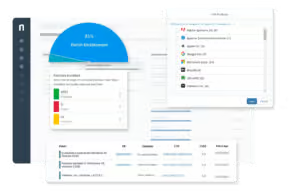
NinjaOne has been the #1 rated RMM on G2 for years. As the market leader in remote monitoring and management, NinjaOne’s solution helps you easily and seamlessly monitor, support, and control all your client’s Windows, macOS, and Linux endpoints, servers, virtual machines, and networking devices in a single pane of glass. Its RMM software solution is built specifically for today’s MSPs and delivers radical efficiency from day one.
5 reasons to choose NinjaOne over Syncro
1. Modern, fast UI
NinjaOne is beautiful to look at and easy to use. Its RMM solution was built by an experienced IT team with over a century of combined experience in IT management. Understanding the needs of its customers, NinjaOne maintains its power, robustness, and speed in a visually appealing user interface. Whether you’re managing 50 or 50,000 endpoints, you can rest easy knowing that you have all the tools you need to manage your endpoint devices effectively and efficiently.
2. Proactive support
NinjaOne is built on proactive IT management so that you can preemptively detect and remediate threats before they turn into bigger problems. As part of this mission, the team at Ninja takes pride in having one of the fastest first-response times in the industry, addressing all IT tickets within 30 minutes of receiving them. This has led to the company receiving a market-leading CSAT (customer satisfaction score) of 98%, and NinjaOne is consistently rated as the #1 in customer support.
3. Real-time monitoring
Your RMM solution is only as good as the information it can provide. Compared to Syncro, NinjaOne offers real-time information for more accurate reports and ticketing. Additionally, NinjaOne RMM automatically notifies your technicians when an issue arises so they can remediate faster and minimize any end-user impact.
4. Integrations
NinjaOne integrates with dozens of software, from SSO to professional services automation (PSA). As the top-rated RMM in the market today, NinjaOne offers tight integrations so that you can cut operational and management costs, improve functionality, and strengthen customer experience through a unified dashboard without needing to go to other third-party vendors. Moreover, NinjaOne offers a robust API that can integrate with other products not directly supported by its platform.
5. Scripting
Some users look for Syncro alternatives because of its IT automation scripts. As with all Ninja products, the RMM leverages automation to offer a wide range of pre-made scripts to eliminate the need for writing and managing code, leading to significantly reduced development costs and timelines. That said, NinjaOne also allows you to manually create your own scripts to reflect your unique business requirements.
Deliver more profitable IT services with NinjaOne’s intuitive RMM.
Strengths of NinjaOne
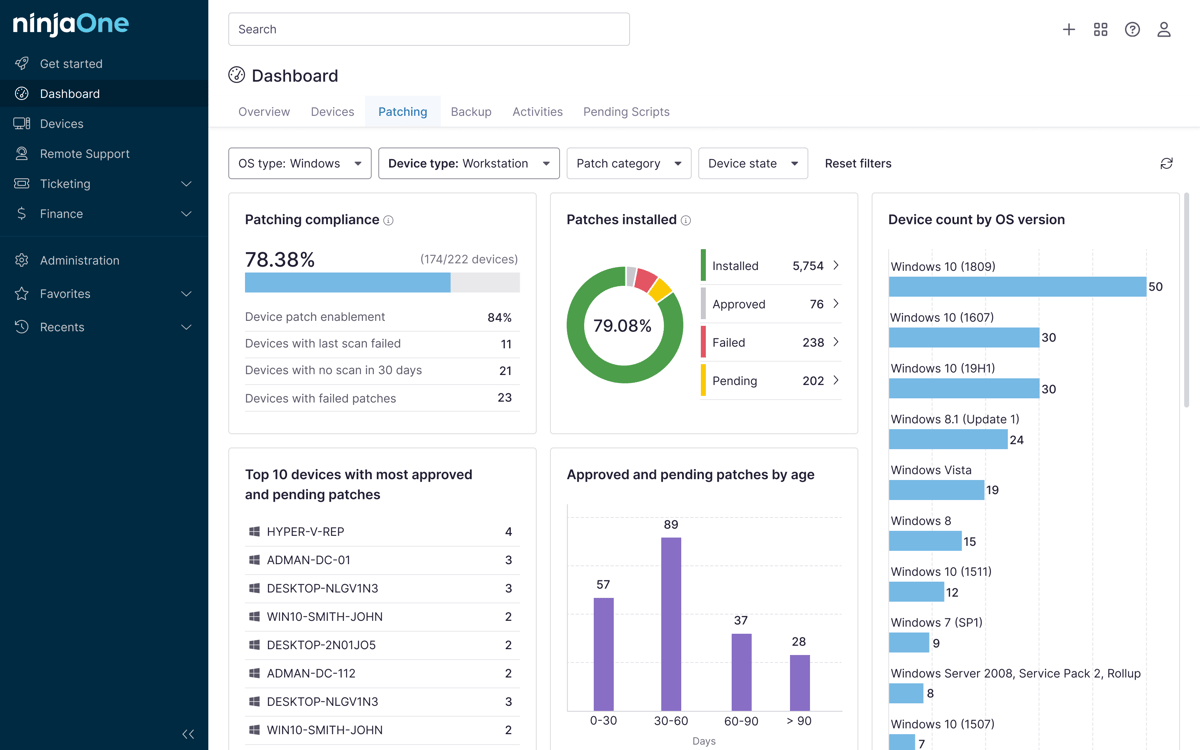
- Patch management. Great RMM software includes a consistent and reliable patch management tool to correct security vulnerabilities and keep your IT network healthy. NinjaOne’s patch management helps you patch all your endpoints automatically and at scale to secure your IT estate.
- Secure remote access. Built into its main RMM platform, NinjaOne Remote enables IT support teams to remotely control and troubleshoot devices through encrypted and fully logged sessions. Technicians can connect to any to any Mac, Linux, or Windows device with one click. NinjaOne also integrates with leading remote control tools, giving your team greater flexibility with their remote support.
- Endpoint task automation. NinjaOne helps you automate the most time-consuming endpoint tasks so that you and your IT technicians can focus on high-value projects. NinjaOne’s policy-based automation can be used for various tasks, including antivirus management, drive encryption, and backup management.
- Native documentation. NinjaOne documentation is built single-pane into its RMM so that you can easily access the information you need without context switching. Its documentation tool also features enterprise-grade security with encrypted MFA-protected credential storage.
- Rapid development cycle. NinjaOne is a proud founder-owned and -led organization that values innovation. Its RMM is regularly improved based on customer feedback so that you always experience the latest updates and bug fixes. These upgrades are found in NinjaOne’s product roadmap.
Customer story
Scott Human, Head of IT Operations at Zero Latency VR, needed a powerful RMM to support his company’s hypergrowth in over 23 countries worldwide. With NinjaOne, Scott and his team can now efficiently support an infrastructure of over 3,400 backpack computers to deliver over 1.7 million virtual reality experiences worldwide.
“Ultimately,” says Scott, “We’re both a high-growth technology company and an entertainment company. We need to deliver an amazing customer experience in order to continue growing rapidly. With Ninja, we’ve built a process that allows us to innovate rapidly, respond to issues proactively, and deliver support to customers in a way that sets us apart in the industry.”
Read more NinjaOne customer stories or check out NinjaOne reviews.
Pricing information
NinjaOne’s IT management software has no forced commitments and no hidden fees. You can request a free quote, schedule a 14-day free trial, or watch a demo.
Reviews
- 4,391 reviews (at the time of writing)
- 4.7 / 5 stars
- 293 reviews (at the time of writing)
- 4.7 / 5 stars
2. Datto
Datto is a cloud-based RMM that enables your MSP to remotely secure, monitor, and manage your endpoints and improve network efficiency. According to its website, Datto RMM is built to be easy to set up and use so that your IT business can immediately become more organized.
Use cases
Datto markets itself as an RMM meant for MSPs with scaling in mind. That said, the software is more commonly found in smaller IT departments.
Features
- Secure patching. Datto RMM helps you deploy the latest patches to secure systems and reduce threat risks.
- Tight integrations. Datto RMM offers several integrations with some PSA tools, networking, and documentation solutions.
- Real-time detection of threats. Datto automatically alerts you of any threats so that you can immediately remediate them.
Shortcomings
- User interface. Some users on Capterra have said that the new user interface is not as user-friendly as before (Verified G2 review) (Verified G2 review)
- Alerting. Configuring monitoring alerts is difficult, especially on complex environments. (Verified G2 review) (Verified G2 review)
- Remote access. Datto may randomly log out, stop streaming, or turn the screen black when using some remote control tools. (Verified G2 review) (Verified G2 review)
Ratings & reviews (as of July 1, 2026)
- G2: 5/5 (781 reviews)
- Capterra: 3/5 (42 reviews)
See how Datto compares to NinjaOne, learn more about Datto vs. Syncro, or read a more in-depth comparison of Datto competitors.
3. Atera
Atera is an all-in-one RMM software solution marketed toward MSPs of all sizes. Its solution follows a pay-per-technician pricing model that can be billed annually or monthly.
Use cases
Atera is used by a wide range of MSPs, though it is more commonly found in smaller groups specializing in IT management.
Features
- Endpoint management. Atera helps you monitor and manage unlimited devices at a fixed price.
- Built for remote teams. Atera enables you to start sessions easily with several remote control tools, such as AnyDesk and TeamViewer.
- Cross-platform patching for better IT network health. Atera automatically patches software in your client’s Windows, macOS, and Linux devices.
Shortcomings
- Reporting. Atera’s customization and automation options for reports can be lacking. (Verified G2 review) (Verified G2 review)
- Customization. Atera may be limited in its customization capabilities, with some users on G2 claiming that the solution can only partially address some of their specific business requirements. (Verified G2 review) (Verified G2 review)
- Customer support. Atera could improve its customer support so that its IT tickets are responded to much faster. (Verified G2 review)
Ratings & reviews (as of July 1, 2026)
- G2:6 /5 (1,200 reviews)
- Capterra:5/5 (449 reviews)
See how Atera compares to NinjaOne, learn more about Atera vs. Syncro, or read a more in-depth comparison of Atera alternatives.
4. SuperOps
SuperOps is an IT management platform that combines PSA and RMM tools to automate service delivery workflows, such as billing, ticketing, and invoicing. Other features that SuperOps offers include patching, remote access, and reporting into a single console.
Use cases
SuperOps is suited for small to medium-sized MSPs with leaner teams.
Features
- Alerting. SuperOps offers real-time visibility into device health with automated alerts that flag issues.
- Contracts and billing. Built-in contract management that lets MSP owners track margins by client and service type.
- Invoicing. Its PSA features include tracking billable hours, contract terms, service delivery, and automated invoicing.
Shortcomings
- Flexibility. According to users, SuperOps lacks customization options for dashboards and ticketing. (Verified G2 review)
- Software deployment. SuperOps’s software deployment cannot handle complex or multi-step installations. (Verified G2 review)
- Remote access. Reviews say that SuperOps’ remote access interface is hard to navigate and has unreliable connectivity. (Verified G2 review)
Ratings & reviews (as of July 1, 2026)
- G2: 4.4/5 (192 reviews)
- Capterra: 4.6/5 (65 reviews)
See how SuperOps compares to NinjaOne, learn more about SuperOps vs. Syncro, or read a more in-depth comparison of SuperOps alternatives.
5. Naverisk
Naverisk consolidates RMM, help desk, and PSA solutions with both cloud-hosted and on-premises deployments. Its PSA features include project management, contract management, automated billing, and documentation, while the RMM side provides full support for Windows, Linux, and macOS.
Use cases
Naverisk suits small to medium-sized businesses that require RMM, IT service management, and PSA tools from a cost-effective solution.
Features
- Remote monitoring. Users can proactively monitor endpoints across Windows, Linux, macOS, and SNMP devices.
- Ticketing. Naverisk offers built-in service desk features for remote IT support.
- Documentation. The platform’s PSA software includes documentation, including SOPs and client agreements.
Shortcomings
- User interface. The complex design of Naverisk’s GUI makes navigation difficult. (Verified G2 review)
- Ticketing. Reviewers say that Naverisk’s ticketing system could be improved. (Verified G2 review) (Verified G2 review)
- Login issues. Naverisk’s features can malfunction and require users to login and out. (Verified G2 review)
Ratings & reviews (as of July 1, 2026)
- G2: 4.7/5 (72 reviews)
- Capterra: 4.8/5 (97 reviews)
See how Naverisk compares to NinjaOne, learn more about Naverisk vs. Syncro, or read a more in-depth comparison of Naverisk alternatives.
6. N-Able N-Central
N-able N-central provides RMM capabilities with support for Windows, macOS, and Linux devices across cloud and on-premises environments, with multi-tenant management. N-central integrates with leading PSA solutions to automate ticket resolution, rather than providing a fully native PSA of its own.
Use cases
N-able N-central works well for MSPs and larger enterprises.
Features
- Automation. Users can schedule multi-step tasks using custom or pre-built scripts.
- Vulnerability management. N-Central offers automated vulnerability scanning, patch prioritization, and remediation.
- Remote management. With N-Central, IT teams get full visibility over endpoints, servers, and network devices.
Shortcomings
- Steep learning curve. Reviewers find that learning to fully use N-Able N-Central takes longer due to its complexity. (Verified G2 review) (Verified G2 review)
- Navigation. Slow response times and N-Able N-Central’s interface design make navigating the platform confusing. (Verified G2 review) (Verified G2 review)
- Customer support. According to some users, N-Able’s technical support team takes a long time to respond, even for urgent tickets. (Verified G2 review) (Verified G2 review)
Ratings & reviews (as of July 1, 2026)
- G2:4/5 (559 reviews)
- Capterra:2/5 (253 reviews)
See how N-Able N-Central compares to NinjaOne, learn more about N-Able N-Central vs. Syncro, or read a more in-depth comparison of N-Able N-Central alternatives.
7. ManageEngine Endpoint Central
ManageEngine Endpoint Central provides users with a comprehensive RMM solution that also offers PSA, server monitoring, and endpoint security capabilities. Its multi-tenant RMM module provides device management across clients with patching, asset visibility, and proactive remediation, while ServiceDesk Plus, their PSA module, integrates ticketing, contract management, time tracking, and billing.
Use cases
ManageEngine is best used by MSPs and internal IT teams in larger environments.
Features
- Software deployment. ManageEngine allows teams to deploy software and software packages to devices.
- Billing. Users can track contracts and automate bill generation for clients.
- Reporting. IT admins can generate custom reports or use templates.
Shortcomings
- Remote access. ManageEngine’s remote control tools struggle with connectivity, making troubleshooting off-site devices difficult. (Verified G2 review) (Verified G2 Review)
- Patch management. Deploying patches takes some time, and when patches fail, troubleshooting can be slow due to a lack of error details. (Verified G2 review) (Verified G2 review) (Verified G2 review)
- Initial setup. Setting up ManageEngine for the first time, especially because new users find all the configurations they need to set to be overwhelming. (Verified G2 review) (Verified G2 review)
Ratings & reviews (as of July 1, 2026)
- G2: 4.5/5 (1,122 reviews)
- Capterra: 4.6/5 (1,760 reviews)
See how ManageEngine compares to NinjaOne, learn more about ManageEngine vs. Syncro, or read a more in-depth comparison of ManageEngine alternatives.
8. Pulseway
Pulseway combines RMM and PSA features, enabling IT teams to access remote monitoring and management, automation, patch management, backup management, mobile device management, and reporting from a single interface. The solution’s Pulseway Assist leverages AI to summarize tickets and resolutions, enabling faster resolution and documentation.
Use cases
Pulseway is designed for MSPs and internal IT teams for smaller businesses and enterprises.
Features
- IT project management. Pulseway’s PSA features include project management, workflow approval, and ticket management.
- Patch management. With automated patch discovery and deployment, Pulseway allows users to keep device OSes and third-party applications updated.
- Remote access. Pulseway offers built-in remote control for Windows and macOS devices.
Shortcomings
- Limited features. Pulseway has incomplete modules and lacks customization options. (Verified G2 review) (Verified G2 review)
- User-friendliness. According to reviewers, Pulseway can be challenging to use due to its interface design. (Verified G2 review)
- Reporting. Users says Pulseway’s reporting features can be improved. (Verified G2 review)
Ratings & reviews (as of July 1, 2026)
- G2: 4.6/5 (123 reviews)
- Capterra: 4.7/5 (310 reviews)
See how Pulseway compares to NinjaOne, learn more about Pulseway vs. Syncro, or read a more in-depth comparison of Pulseway alternatives.
9. Kaseya VSA
Kaseya VSA is a unified RMM platform that allows users to automate workflows for patch management for Windows, macOS, IT asset management, and automation and scripting for proactive ticket resolution. VSA is part of Kaseya’s ecosystem and can integrate with PSA platforms.
Use cases
Kaseya works best for MSPs that work in a Windows-first environment.
Features
- IT asset management. Kaseya VSA allows IT teams to discover and monitor hardware and software.
- Ticketing. Kaseya’s ticketing module allows users to track service requests and resolve tickets.
- IT automation. Users can deploy scripts to automate remediation workflows for routine issues.
Shortcomings
- Apple support. Kaseya VSA’s capabilities for macOS devices can be lacking. (Verified G2 review) (Verified G2 review)
- User interface. Reviewers find Kaseya’s interface to be difficult to use, especially for newer users. (Verified G2 review)
- Feature development. Kaseya has mostly been pushing out security updates with no roadmap for new features. (Verified G2 review)
Ratings & reviews (as of July 1, 2026)
- G2: 4/5 (326 reviews)
- Capterra: 4/5 (207 reviews)
See how Kaseya VSA compares to NinjaOne, learn more about Kaseya VSA vs. Syncro, or read a more in-depth comparison of Kaseya VSA alternatives.
10. LogMeIn Resolve
Formerly known as GoTo Resolve, LogMeIn Resolve is a unified endpoint management platform that combines RMM, remote access, and automation with a security-focused structure. While LogMeIn Resolve offers ticketing, it lacks a native PSA capability, like invoicing, but integrates with leading PSA platforms
Use cases
LogMeIn is designed for MSPs and internal IT support teams.
Features
- IT support. With LogMeIn Resolve, users can organize and remediate tickets, then track help desk performance.
- IT asset management. IT teams can monitor and manage hardware and software.
- Alerting. Real-time alerts about device health or changes allow technicians to address issues.
Shortcomings
- Initial configuration. Setting up LogMeIn Resolve at scale for larger environments can be challenging. (Verified G2 review)
- Customer support. Contacting customer service and receiving a reply takes some time. (Verified G2 review)
- Microsoft integrations. Users reported LogMeIn’s Microsoft Teams integrations often fail. (Verified G2 review) (Verified G2 review)
Ratings & reviews (as of July 1, 2026)
- G2: 4.3/5 (468 reviews)
- Capterra: 4.4/5 (214 reviews)
See how LogMeIn Resolve compares to NinjaOne, learn more about LogMeIn Resolve vs. Syncro, or read a more in-depth comparison of LogMeIn Resolve alternatives.
11. ConnectWise PSA
ConnectWise PSA is a Professional Services Automation platform that centralizes IT service desk, project management, customer relations, and reporting in one dashboard. Unlike other Syncro competitors that offer unified RMM and PSA software, ConnectWise PSA needs to integrate with other ConnectWise products or third-party applications for device monitoring and management.
Use cases
ConnectWise’s software is generally aimed at fulfilling MSPs’ needs.
Features
- Reporting. IT admins can generate reports in IT asset inventories and ticketing.
- Billing. Users can lessen manual effort with billing thanks to ConnectWise’s automation tools.
- Ticketing. ConnectWise’s help desk tools document tickets and automate ticket routing and escalation.
Shortcomings
- User interface. Reviewers say the platform’s interface design can be improved to enhance ease of use and address setting issues. (Verified G2 review) (Verified G2 review)
- Learning curve. ConnectWise PSA has many features that make the platform difficult to learn. (Verified G2 review) (Verified G2 review)
- Asset inventory. According to users PSA’s IT asset tracking is lacking compared to other Syncro alternatives. (Verified G2 review)
Ratings & reviews (as of July 1, 2026)
- G2: 4/5 (582 reviews)
- Capterra: 4.1/5 (277 reviews)
See how ConnectWise compares to NinjaOne, learn more about ConnectWise vs. Syncro, or read a more in-depth comparison of ConnectWise alternatives.
12. Acronis Cyber Protect Cloud
Acronis is a cybersecurity and backup solution with RMM and PSA capabilities. While Acronis focuses primarily on security tools, it also includes RMM and PSA modules in its Acronis Cyber Protect Cloud for Service Providers solution. IT teams combine their Service Providers solution modules to centralize these tools in one console. Its RMM features include patch management with vulnerability assessment and AI-powered automation. Acronis’s also offers a built-in PSA module that helps MSPs plan tasks, track time, manage billing, and automate ticketing.
Use cases
Acronis Cyber Protect Cloud for Service Providers is designed primarily for MSPS but also works well for small to medium businesses.
Features
- Remote monitoring. Acronis allows users to keep track of devices and set up custom alerts.
- Asset management. Users can automate device detection and maintain an inventory of their hardware and software.
- Backup. With Acronis, IT admins can back up and recover sensitive data.
Shortcomings
- Limited features. Compared to other RMM software, Acronis lacks capabilities that IT teams and MSPs might require. (Verified G2 review) (Verified G2 review)
- Complex interface. Reviewers find Acronis’s advanced configurations challenging to use, especially for new suers. (Verified G2 review)
- Customer support. Users say that Acronis’ support team can take some time to respond to tickets. (Verified G2 review) (Verified G2 review)
Ratings & reviews (as of July 1, 2026)
- G2: 7/5 (1,436 reviews)
- Capterra: 1/5 (77 reviews)
See how Acronis compares to NinjaOne, learn more about Acronis vs. Syncro, or read a more in-depth comparison of Acronis alternatives.
What is Syncro MSP?
Syncro MSP is a cloud-based RMM and PSA platform that primarily focuses on IT service delivery workflows, with features such as ticketing, invoicing, documentation, and billing. While it does offer a suite of RMM tools, including scripting and patch management, Syncro does not have advanced device management capabilities that Syncro competitors might have. It provides monitoring and management for Windows and macOs devices. Built specifically for small to mid-size MSPs and internal IT teams, Syncro allows users to manage endpoints and business processes from a single interface.
Why choose NinjaOne over SyncroMSP
Powerful IT automation
While Syncro can automate routine IT tasks, it lacks the advanced automation capabilities that Syncro competitors are capable of. NinjaOne Automation helps IT teams reduce manual workloads and resolve issues before they escalate. The NinjaOne platform offers more advanced automation features, including cross-platform scripting, alert-based triggers, and consistent workflow execution across all managed devices. One of NinjaOne’s customers has said, “Leveraging the automations feature within NinjaOne has enabled me to save upwards of what would likely be 20 to 30 to even 40 hours per week.” With NinjaOne’s automation tools, IT teams can automate routine tasks and free themselves up to work on high-value projects.
Reporting
Syncro’s reporting features are limited. According to one G2 user, “Additionally, reporting and customization options could be expanded to provide more flexibility when generating reports or organizing information for different clients.” NinjaOne is a strong alternative to Syncro thanks to its endpoint reporting and analytics, which allows IT teams to demonstrate the value of their efforts with highly customizable reports and executive summaries. In addition, NinjaOne also lets IT teams schedule automated reports.
Mobile device management (MDM)
Syncro’s limited OS support could be a challenge for organizations that use a variety of device types or require remote monitoring for servers and network devices as well. On the other hand, NinjaOne has been proven to replace 2-4 tools with a single agent. NinjaOne’s remote monitoring and management features cover Windows, macOS, Linux, servers, and SNMP networking devices. NinjaOne MDM is also built into its main RMM platform, allowing IT teams to monitor, manage, and secure Android and iOS devices.
Patch management
Syncro’s limited patch management support only covers Windows patching. In contrast, NinjaOne’s built-in autonomous patch management offers multi-OS patching with third-party patching for over 6,000 software. NinjaOne allows users to automate patch detection, approval, deployment, and monitor patch status. On average,NinjaOne customers reduce 93% of time spent on patch management and enhance patch compliance rates by 95%.
Strengths of Syncro
- PSA features. Syncro allows users to automate and manage ticketing, invoicing, SLAs, documentation, and billing.
- IT asset management. Users can track hardware and software with custom fields and lifecycle tracking.
- Windows patching. Syncro allows IT teams to patch Windows devices and relies on Chocolatey for updating third-party applications.
Limitations of Syncro
- Cross-platform compatibility. Syncro only supports Windows and macOS devices and does not include support for Linux, mobile device management, servers, or devices. (Syncro source)
- Reporting. According to reviews, Syncro could improve its limited reporting capabilities offer more customization for reports. (Verified G2 review) (Verified G2 review) (Verified G2 review)
- Scripting. Syncro lacks advanced scripting features compared to Syncro alternatives. (Verified G2 review)
Syncro pros and cons
| Syncro Pros | Syncro Cons |
| Ticketing, invoicing, SLAs, documentation, and billing features. | Syncro supports Windows and macOS, but not Linux, mobile devices, or servers. |
| IT asset lifecycle tracking with custom fields. | Limited reporting and a lack of customization for reports. |
| Syncro can patch Windows systems and some third-party apps. | Compared to Syncro competitors, its automation is lacking. |
Why MSPs look for alternatives to Syncro
The most common reason MSPs begin evaluating Syncro alternatives is its lack of advanced features and granular control compared to other RMM solutions. Syncro supports Windows and macOS but lacks support for Linux, Android, or iOS devices, which forces internal IT teams and MSPs managing diverse client environments to add another solution to their tech stack. Syncro’s lack of remote monitoring for servers and SNMP network devices also adds complications. Syncro alternatives tend to have more advanced automation capabilities, which limit how much manual work Syncro users can eliminate as they scale. Teams that started on Syncro because of its PSA features and simplicity often find that these limitations make the platform less scalable over time.
Granular automation capabilities allow IT teams and MSPs to reduce manual workloads. According to the NinjaOne MSP Business Impact Survey, 91% of NinjaOne users can manage an average of 250 additional endpoints without increasing costs. The best RMM software solutions offer deeper automation, broader device support, and more flexible reporting. Looking for alternatives to Syncro allows organizations and MSPs to scale more efficiently, supports the full range of devices and operating systems in use, and reduces manual workloads with robust automation tools.
Leverage advanced RMM and PSA features from a single dashboard.
Take your MSP to the next level after evaluating Syncro alternatives
Tired of searching “How to choose the best RMM for your MSP”? Despite popular perception, there are no hard and fast rules in selecting the perfect remote monitoring and management software for your business. After considering the possible cost of RMM, you need to look for a vendor that can address all your pain points while also providing you with the flexibility you need as you continue to grow.
That said, it’s okay to take your time and do your due diligence in researching the many different RMM options in the market today to maintain your competitive advantage.