Key Points
- The best Iru alternatives are: 1) NinjaOne, 2) Jamf Pro, 3) Ivanti Neurons for Unified Endpoint Management, 4) Microsoft Intune, 5) Hexnode UEM, 6) Workspace ONE UEM, 7) ManageEngine Endpoint Central, 8) LogMeIn Resolve, 9) Quest KACE, 10) HCL BigFix, and 11) Scalefusion
- IT teams evaluating Iru are typically comparing automation, compliance controls, and cross-platform endpoint management capabilities.
- Competing solutions such as NinjaOne, Microsoft Intune, Jamf Pro, Workspace ONE, and others vary in their approach to cross-platform support, automation, and enterprise complexity.
- The right endpoint management solution ultimately depends on your organization’s operating system mix, security priorities, and long-term IT strategy.
Iru (formerly Kandji) is a unified endpoint management (UEM) and security platform designed to help organizations manage and secure Apple, Windows, and Android devices from a centralized dashboard. Originally known for its Apple-first device management capabilities, Iru has expanded to support cross-platform environments while maintaining its emphasis on automation and compliance.
That said, choosing the right UEM solution requires more than surface-level feature comparisons. In this guide, we provide a research-backed overview of the best Iru alternatives, including their core features, use case, and real-world customer feedback. If you’re evaluating Iru or comparing it against other IT management software like NinjaOne, this article will help you understand where it excels and which platforms may better align with your IT strategy and anticipated cost of your IT management solution.
What is Iru?
Iru has expanded its previous Kandji capabilities, positioning itself now as a security-driven endpoint management platform. Its architecture centers on reducing manual IT work through preconfigured workflows, compliance templates, and continuous monitoring capabilities.
As such, the platform appeals to organizations that want structured device governance, standardized onboarding, and consistent enforcement of internal security controls. Rather than focusing purely on device visibility, Iru emphasizes proactive compliance management and automated remediation.
For IT teams evaluating the platform, the key consideration is how well its automation-first approach aligns with their operational complexity and long-term scalability requirements.
Iru usability and experience
Iru is designed to streamline endpoint governance through structured policy management and automation-first workflows. Initial setup typically involves configuring identity integrations, defining security baselines, and establishing compliance templates. Organizations with clearly defined device standards may find deployment relatively straightforward, while more complex environments may require additional configuration planning.
Even so, many G2 reviews have stated that shifting from Kandji to Iru has been overwhelming, particularly for those used to the former being an Apple-focused management solution suddenly being a cross-platform management one. Other reviews have likewise stated that despite its robustness, Iru still performs best in Apple-first workforces and may be lacking for hybrid environments.
User feedback and reviews for Iru
Public reviews of Iru reflect a generally positive perception of its automation capabilities and compliance-driven design. Many users highlight the platform’s ability to streamline device governance and reduce manual configuration work, particularly for organizations with structured security requirements. (Source)
Nevertheless, feedback also points to areas for improvement. A portion of reviewers mention that reporting customization and dashboard flexibility could be more robust for organizations with advanced analytics needs. (Source) Others indicate that deeper automation workflows may require time to configure effectively, especially in more complex IT environments. (Source) And even more reviews state that the platform still lacks robust cross-platform capabilities, particularly when compared to other alternatives to Iru. (Source)
Why IT pros look for Iru alternatives
While Iru offers structured policy management and automation-driven compliance controls, not every organization has the same operational requirements. As IT environments grow more complex, decision makers often evaluate whether a platform aligns with their broader endpoint strategy and IT budget.
Some organizations may require deeper cross-platform flexibility, expanded reporting capabilities, or tighter integration with existing IT service management and security stacks. Others may prioritize ease of use, faster onboarding, or simplified patch management across diverse operating systems.
For these reasons, IT leaders frequently compare Iru alternatives against other IT management platforms before making a final decision.
11 best alternatives to Iru
1. NinjaOne
NinjaOne is an enterprise-ready IT management platform designed to streamline endpoint management, remote access, and mobile device management (MDM). Its remote support solution, Ninja Remote, enables technicians to securely connect to and manage devices in real time, while maintaining a seamless end-user experience.
By consolidating remote access, IT automation, and endpoint management into one interface, NinjaOne reduces tool sprawl and centralizes visibility across Windows, macOS, Linux, and supported mobile devices. This is why over 35,000 customers around the world trust NinjaOne for their endpoint management needs, and why we have chosen it as our top choice in this list of Iru alternatives.
Highlights
- Secure remote access: Ninja Remote provides encrypted connections to managed devices, helping ensure session security and data integrity during remote support.
- Quick connect: Enables rapid, ad hoc remote access to unmanaged endpoints by installing the NinjaOne Remote agent for immediate troubleshooting.
- Cross-platform compatibility: Supports Windows, macOS, and Linux devices, with mobile device management capabilities integrated into the same console.
- Enhanced MDM integration: NinjaOne MDM allows technicians to remotely control managed Android devices and enforce mobile policies alongside desktop endpoint management.
- User-friendly interface: A centralized dashboard enables technicians to monitor, patch, script, and remotely manage devices without significantly interrupting end users.
- Automated patch management: Supports automated OS and third-party patch management to maintain security and compliance across endpoints.
5 reasons to choose NinjaOne over Iru
1. All-in-one solution
Arguably, Iru’s specialization has been one of its defining characteristics. While it began as an Apple-focused platform and has since expanded its cross-platform support, some organizations may still evaluate how broadly each solution supports mixed operating system environments.
Alternatively, NinjaOne is an all-in-one solution that unifies endpoint management, remote access, patching, and MDM in a single interface. This helps IT teams consolidate tools and manage diverse device fleets more efficiently.
2. Robust and customizable reporting
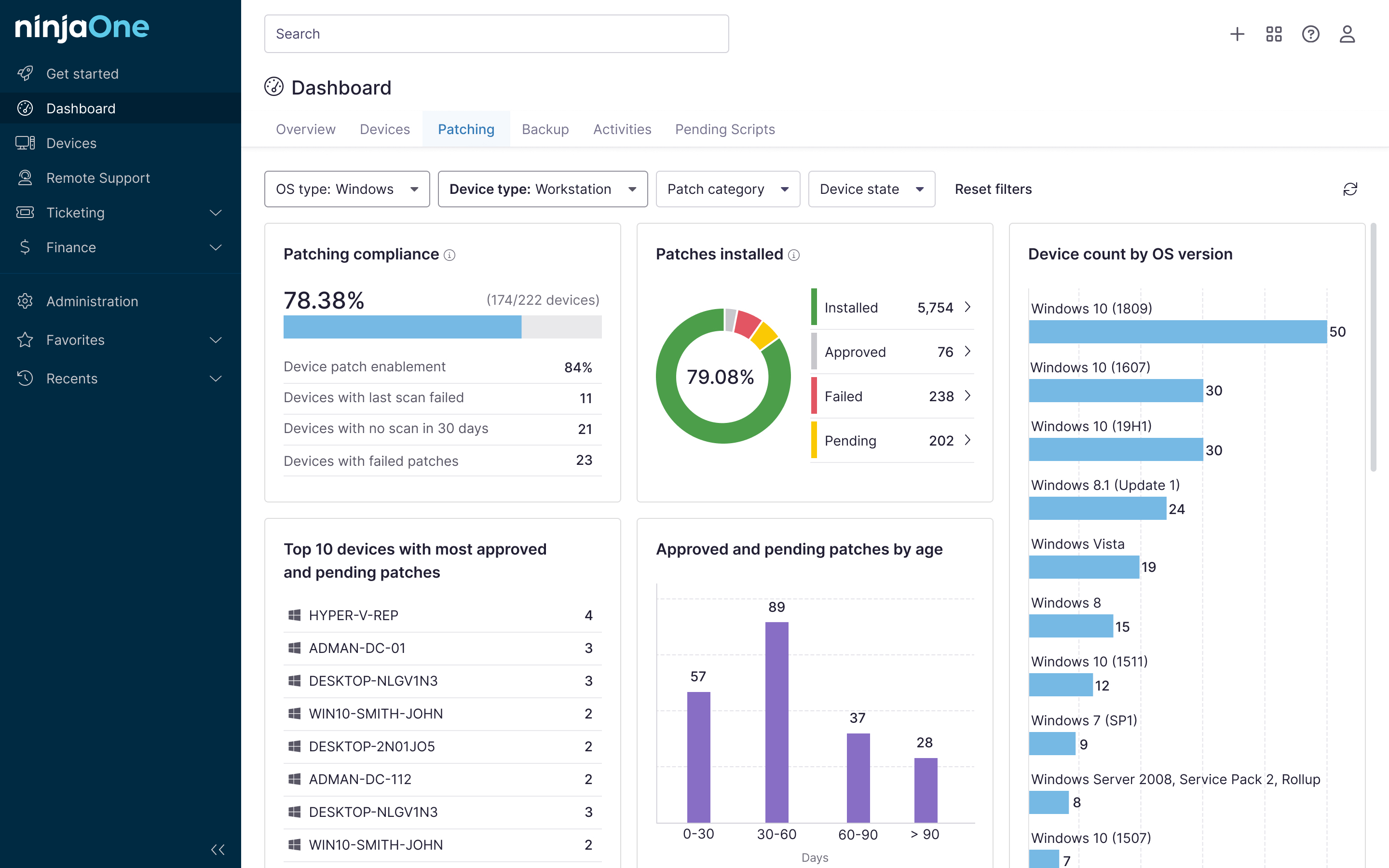
One of the primary reasons users look for Iru alternatives is the need for deeper reporting customization depending on organizational requirements. NinjaOne’s reporting capabilities allow teams to generate configurable reports designed to provide visibility into device health, patch compliance, and operational performance.
With centralized reporting, IT stakeholders can access the data they need in formats that align with internal workflows.
3. Unified policy management
NinjaOne ensures that all policies and configurations are uniform across your entire organization. This offers multiple benefits to your organization, including simplified management, consistent security benefits, and enhanced compliance with regulations and internal policies.
4. Built to scale
NinjaOne is a dynamic product that constantly updates its software based on the latest technologies and customer feedback. Whether you’re managing 50 or 50,000 endpoints, you can rest easy knowing that your NinjaOne enterprise-ready IT management solution remains fast, reliable, and powerful. The team also proudly shares its product roadmap with its customers so they are always aware of the company’s direction.
5. Intuitive to use
NinjaOne is ridiculously easy to learn and intuitive to use. Its game-changing platform empowers your IT technicians to centrally manage all your endpoints and support end users efficiently and at scale. As a 100% cloud-based solution, it requires minimal ongoing maintenance and avoids costly on-premises infrastructure, resulting in fast time-to-value.
NinjaOne’s IT management software is built for today’s IT teams, allowing you to do more with less. Schedule a 14-day free trial today.
Strengths of NinjaOne
- Customer support: NinjaOne is rated #1 in customer support because of its unwavering dedication to its customers. In addition to offering free and unlimited onboarding and training, the NinjaOne team boasts one of the fastest first-response times, under 30 minutes from receiving an IT ticket, and a market-leading customer satisfaction score (CSAT) of 98.4%.
- Patch management: NinjaOne ranks highest among the best patch management software solutions in the market today. It helps you identify, evaluate, and deploy patches to any device from anywhere with an internet connection.
- Easy to use: NinjaOne is designed to be as easy and intuitive to use as possible. Made by IT for IT, NinjaOne has been proven to increase productivity, reduce security risk, and lower IT costs from day one.
- Integrations: NinjaOne integrates with multiple business applications, enabling you to streamline workflows and deploy solutions quickly. These integrations help managed service providers (MSPs) and IT teams automate tasks, reduce manual setup, and improve operational efficiency.
- Seamless remote access: NinjaOne allows IT technicians to access the screens of end-user mobile devices remotely for quicker issue resolution. This helps minimize downtime while maintaining productivity.
Customer story
The management team at Everest struggled with a multi-OS environment that relied on fragmented tools that slowed down production workflows. Since shifting to the NinjaOne Platform, Yann Bialecki, Everest’s CISO, and Louis Jeckel, Everest’s CTO, say that they now experience 50% faster IT operations, 100% reliable remote connection, and exemplary company growth without additional IT headcount.
“Everything runs fast and reliably. NinjaOne Remote is amazing. Compared to our previous remote tool, it actually works,” says Jeckel.
Bialecki added, “My favorite feature is NinjaOne macOS MDM because my goal is to secure all our Mac devices — not the easiest device to secure. However, with NinjaOne, we bring security profiles and deploy configurations to all our Macs fast and easily.”
Read more Ninja customer stories or check out NinjaOne reviews.
Reviews
- 3,696 reviews (at the time of update)
- 4.7 / 5 stars
- 280 reviews (at the time of update)
- 4.7 / 5 stars
NinjaOne’s IT management software has no forced commitments and no hidden fees. If you’re ready, request a free quote, sign up for a 14-day free trial, or watch a demo.
2. Jamf Pro
Jamf Pro is an enterprise mobile device management software for Apple devices. Its device management tool is intended to help IT organizations manage and secure a seamless Apple experience from a single dashboard.
No article about Iru alternatives would be complete without mentioning Jamf Pro, which is arguably the most well-known Apple MDM in the market today. Even with Kandji now becoming Iru, Jamf Pro is still a good alternative for organizations that require deep Apple management capabilities.
Read about Jamf Pro alternatives or see how NinjaOne compares to Jamf Pro.
Best for
Jamf Pro is well suited for IT teams and enterprises that rely heavily on Apple hardware and need feature-rich Apple-specific device management, advanced automation, and compliance enforcement across large macOS and iOS fleets.
Features
- Device management: Jamf allows IT teams to configure profiles and use policies and scripts to customize devices for better user experience.
- Remote assistance: IT technicians can remotely access and control Apple devices from anywhere.
- Inventory management: Jamf automatically collects up-to-date information about hardware, software, and security configuration details from your Apple devices.
Shortcomings
- Limited support for other operating systems: Jamf only supports Apple devices, making it challenging for organizations that need to monitor and manage other operating systems. (Source)
- Legacy tools: Jamf may experience slowdowns when managing older iPhones or other Apple devices. (Source)
- Customer support: According to some G2 reviews, global customer support for Jamf customers varies, with some users receiving excellent service while others experiencing challenges. (Source)
3. Ivanti Neurons for Unified Endpoint Management
Ivanti Neurons for UEM is a cloud-based solution that gives you complete visibility across all your endpoints, including mobile devices. Its platform is designed to proactively secure and heal devices through automation.
We included Ivanti Neurons in this list of Iru competitors because of its broad unified endpoint management capabilities and its emphasis on automation-driven device remediation. Organizations often compare Ivanti to Iru when they require enterprise-grade cross-platform support, real-time asset discovery, and deeper lifecycle management across diverse device environments.
See how Ivanti compares with NinjaOne or read a more in-depth analysis of Ivanti alternatives.
Best for
Best suited for mid-sized IT organizations that require unified visibility and control over diverse endpoints, including desktops, laptops, mobile devices, and IoT hardware, and want to leverage automation to reduce manual tasks
Features
- Real-time asset discovery: Ivanti discovers and produces an inventory of all your endpoints so that you can detect possible technical issues.
- Lifecycle device management: Ivanti helps you secure any endpoint across its entire lifecycle.
- Vulnerability remediation: Ivanti helps you proactively diagnose and remediate issues in the background.
Shortcomings
- Requires training: Ivanti is better suited for more experienced IT technicians. (Source)
- User-friendliness: Some G2 users have said that Ivanti is not as customizable as expected and can sometimes be challenging to use. (Source)
- Complexity of setup and configuration: Ivanti could improve its ease of deployment and use. (Source)
4. Microsoft Intune Enterprise Application Management
Microsoft Intune Enterprise Application Management is a cloud-based UEM service that enables organizations to manage and secure devices, applications, and data across heterogeneous environments. It supports a broad range of endpoints, including Windows, macOS, iOS, Android, and Linux, through a single web-based console as part of the Microsoft 365 ecosystem.
Intune’s integration with Azure Active Directory (Entra ID), Defender for Endpoint, and the broader Microsoft 365 suite gives IT teams capabilities for conditional access, automated policy enforcement, and app lifecycle management that pair device control with security objectives.
Read about Microsoft Intune alternatives or see how NinjaOne compares to Microsoft Intune.
Best for
Microsoft Intune is well suited for mid-sized to large organizations with hybrid or cloud-native IT environments, especially those already using Microsoft 365 and Azure services.
Features
- Cross-platform device and app management: Intune enables centralized enrollment, configuration, monitoring, and compliance policy enforcement across Windows, macOS, iOS, Android, and Linux endpoints.
- Conditional access and compliance automation: Intune supports Zero Trust principles, enabling conditional access based on device health and user identity.
- Cloud-native deployment and remote management: As a cloud-hosted solution, Intune removes the need for on-premises infrastructure.
Shortcomings
- Learning curve: Several users have stated that Microsoft Intune has a steep learning curve, even among experienced IT professionals. (Source)
- Managing non-Windows devices: There is limited protection for non-Microsoft apps, which can make troubleshooting difficult. (Source)
- Limited flexibility: Some G2 users have expressed their frustration in the platform’s customization capabilities. (Source)
5. Hexnode UEM
Hexnode UEM is a unified endpoint management software that enables organizations to manage and secure a wide range of devices across multiple operating systems. Its platform provides centralized device monitoring, configuration, application management, security policy enforcement, and compliance tracking.
We included Hexnode UEM in this list because it offers broad cross-platform support and comprehensive endpoint management capabilities that address the needs of mixed fleets.
Read about Hexnode alternatives or see how NinjaOne compares to Hexnode.
Best for
Hexnode UEM is useful for SMEs that need a flexible, cross-platform endpoint management solution with strong policy enforcement, remote support capabilities, and support for a range of device types.
Features
- Cross-platform endpoint management: Hexnode UEM enables centralized administration of devices running multi-OSs.
- Policy enforcement and security controls: IT teams can define and enforce security policies to ensure consistent device governance.
- Remote troubleshooting and lifecycle management: The platform supports remote access and automated device enrollment and provisioning workflows to streamline onboarding and support activities.
Shortcomings
- Reporting: Hexnode’s reporting feature is allegedly basic according to user feedback and lacks the customization and depth of insight found in other UEM platforms. (Source)
- MFA implementation: Some G2 reviews have stated that removing devices in bulk can become challenging because of Hexnode’s current MFA process. (Source)
- Customer support: Hexnode’s customer support could be further improved. (Source)
6. Workspace ONE
Workspace ONE is a complete endpoint that combines device management, application delivery, access control, and security policy enforcement within a single solution. Its UEM component helps IT teams manage and secure devices across operating systems such as Windows, macOS, iOS, and Android.
The platform is a solid alternative to Iru thanks to its broad device support and integrated workspace capabilities.
Read about Workspace ONE alternatives or look at this guide on NinjaOne vs Workspace ONE.
Best for
Best suited for mid-sized to large enterprises that need comprehensive endpoint management paired with workspace and access control features.
Features
- Unified endpoint management: Workspace ONE enables centralized lifecycle management across a wide range of devices and operating systems from a single console.
- Application and access management: The platform integrates application delivery and access control, supporting workflows that include secure sign-on and app distribution across devices.
- Security and compliance controls: Built-in support for conditional access, device posture checks, and policy enforcement helps organizations maintain security standards across endpoints.
Shortcomings
- Customer support: According to several G2 reviews, the customer support at Workspace ONE could be improved. (Source)
- User-friendly UX: Workspace ONE could enhance its current UX so that it’s easier to navigate, especially for newer users. (Source)
- Bugs: There have been reports that the platform experiences occasional bugs or performance issues. (Source)
7. ManageEngine Endpoint Central
ManageEngine Endpoint Central is a unified endpoint management and security platform that allows IT professionals to manage and secure servers, desktops, laptops, and mobile devices throughout their lifecycle, from enrollment and configuration to patching, compliance, and retirement, from a centralized console.
Its comprehensive feature set and cross-platform support make it a frequent alternative in evaluations where IT teams seek broad endpoint management capabilities that extend beyond traditional MDM tools.
Read about ManageEngine Endpoint Central alternatives or see how NinjaOne compares to ManageEngine.
Best for
ManageEngine Endpoint Central is well suited for IT administrators in mid-sized and large organizations that need a comprehensive endpoint management solution.
Features
- Unified endpoint management: A centralized platform for managing Windows, macOS, Linux, iOS, Android, ChromeOS, and other device types, including desktops, laptops, servers, and mobile devices, with policy enforcement and configuration controls.
- Automated patching and software deployment: Built-in automation for OS and third-party patch management along with scheduled software deployment workflows that help ensure systems remain secure and up to date.
- Asset and lifecycle management: Real-time discovery, inventory tracking, and lifecycle controls give IT teams visibility into assets and reduce manual overhead.
Shortcomings
- Initial deployment: ManageEngine Endpoint Central can be challenging to initially deploy and configure, especially for beginners. (Source)
- Ease of navigation: Users have noted that the interface is not as user-friendly as other Iru alternatives in this list. (Source)
- Reporting: Dozens of reviews have highlighted the platform’s limited reporting capabilities. (Source)
8. LogMeIn Resolve
LogMeIn Resolve (formerly part of the GoTo family) is a cloud-based IT support platform that combines native remote monitoring and management (RMM), remote support and access, and ticketing functionality within a single solution.
IT teams evaluating Iru competitors often consider LogMeIn Resolve because it blends broad support and troubleshooting tools with remote assistance and asset management. This makes it a practical choice for internal IT departments and managed service providers looking to consolidate capabilities in one console.
Read about LogMeIn Resolve alternatives or see how NinjaOne compares to LogMeIn.
Best for
LogMeIn Resolve is well suited for IT teams and help desks that require integrated remote support, endpoint monitoring, ticketing, and automation across mixed-platform environments.
Features
- Remote access and support: LogMeIn Resolve provides secure unattended and attended remote control, screen sharing, and session management across managed endpoints.
- Endpoint management and automation: It includes remote monitoring and management capabilities such as patch deployment, alerting, policy enforcement, and task automation to help maintain device health and compliance.
- Helpdesk and service management: Built-in ticketing, incident tracking, and workflow management tools allow IT teams to manage support requests and IT operations without needing separate helpdesk software.
Shortcomings
- Remote support: LogMeIn Resolve reportedly slows down or randomly crashes when trying to manage a remote server. (Source)
- Performance issues: Several G2 users have expressed their concern that the platform intermittently slows down or encounters bugs. (Source)
- Resource-heavy: LogMeIn Resolve may be more resource-heavy compared to other alternatives in this list. (Source)
9. Quest KACE
Quest KACE is a unified endpoint management solution that helps organizations automate and streamline the management and security of their endpoints from a centralized interface. It enables IT teams to monitor, update, and secure a diverse range of devices and OS platforms.
Business leaders may consider Quest KACE when they require extensive device lifecycle capabilities, integrated service desk functionality, and automation to reduce manual administrative tasks.
Read about Quest KACE alternatives or see how NinjaOne compares to Quest KACE.
Best for
Quest KACE is well suited for large IT organizations that need an integrated endpoint systems management solution with capabilities for patching, asset inventory, software distribution, and service desk integration across mixed device environments.
Features
- Comprehensive endpoint discovery and inventory: Quest KACE provides tools for automated scanning and tracking of hardware and software assets across an IT environment.
- Automated patch and software management: Quest KACE’s built-in automation identifies and deploys OS and third-party patches to help maintain compliance and reduce security risk.
- Integrated help desk and service management: The platform includes service desk support with ticketing and workflow features.
Shortcomings
- Better for larger enterprises: The platform requires substantial resources that may be unavailable for smaller organizations. (Source)
- Learning curve: There is a slight learning curve to the product. (Source)
- Ticketing: Some reviews in Capterra suggest that the ticket system of Quest KACE is somewhat difficult to use. (Source)
10. HCL BigFix
HCL BigFix is a UEM that uses a single agent to discover, manage, and remediate virtual, cloud, and on-premises endpoints from a single dashboard. We included this in our list because it represents a robust unified endpoint management and automation platform that emphasizes real-time visibility, automated compliance enforcement, and AI-driven remediation workflows.
Decision makers comparing UEM tools like Iru often consider BigFix for environments that require comprehensive patch and configuration management at enterprise scale, particularly where infrastructure complexity and compliance requirements are high.
Read about HCL BigFix alternatives or see how NinjaOne compares to HCL BigFix.
Best for
HCL BigFix is well suited for large organizations that need a scalable, enterprise-grade endpoint management platform capable of supporting extensive OS variants and hybrid infrastructure with automated patching, compliance, and vulnerability remediation.
Features
- Automated patching and compliance enforcement: HCL BigFix automates patch deployment and continuously enforces configuration compliance across endpoints.
- Unified visibility and control: The platform provides centralized asset discovery, real-time status monitoring, and management of endpoints across a wide range of operating systems.
- AI-powered automation and remediation: Built-in automation and intelligent workflows enable proactive issue detection and remediation.
Shortcomings
- Complex UI: HCL BigFix has a relatively steep learning curve partly due to its complex UI. (Source)
- Suitability for smaller enterprises: The platform is better suited for larger MSPs with more time and financial resources. (Source)
- Limited integrations: According to some G2 users, HCL BigFix could still improve on the number of business applications it can integrate with. (Source)
11. ScaleFusion
Scalefusion is a unified endpoint management and MDM solution that enables IT teams to secure, configure, and monitor a wide range of devices from a centralized dashboard. It provides tools for device provisioning, policy enforcement, security controls, and remote troubleshooting across multiple operating systems.
Its feature set, including automated workflows, device lockdown modes, and real-time policy enforcement, makes it relevant for organizations evaluating Iru alternatives, particularly those focused on streamlined device governance for diverse fleets and mixed use cases.
Read about Scalefusion alternatives or see how NinjaOne compares to HCL Scalefusion.
Best for
Scalefusion is well suited for IT teams in mid-sized to large organizations that need an intuitive, centralized platform for managing corporate-owned and BYOD devices across a mix of operating systems.
Features
- Cross-platform endpoint and device management: Scalefusion enables centralized enrollment, configuration, and security policy enforcement for multi-OS devices.
- Automated workflows and security controls: IT teams can automate routine tasks, enforce passcode and encryption policies, apply geofencing and compliance checks, and remotely wipe or lock devices when needed.
- Remote troubleshooting: The platform includes remote cast/control features that help technicians support end users.
Shortcomings
- Initial set-up and configuration: Scalefusion requires extensive training to initially learn. (Source)
- Support: According to some G2 reviews, post-enrollment support for Scalefusion could be improved to be more accessible. (Source)
- Limited functionality: Scalefusion, while robust in multiple features, may still improve its functionality and customizability for others. (Source)
Iru key features and limitations
We’ve listed the platform’s core capabilities and what IT teams should consider when evaluating it and other Iru competitors.
1. Endpoint management and device configuration
Iru provides centralized management designed to enforce policies, configure devices, and maintain visibility across supported operating systems.
Highlights
- Centralized device configuration and policy enforcement
- Automated enrollment and provisioning workflows
- Real-time endpoint monitoring
- Remote device actions (such as lock or wipe)
Why it matters
Strong endpoint management reduces configuration drift and improves operational consistency. Centralized policy enforcement is particularly important for distributed teams managing remote or hybrid workforces.
Potential limitations
Organizations used to Kandji features will face a significant learning curve learning Iru’s newer capabilities, particularly their “assignment maps” (a flexible visual map for users). (Source)
2. Compliance automation
Automation is a central component of Iru’s value proposition, particularly around security and compliance.
Highlights
- Preconfigured compliance templates
- Continuous compliance monitoring
- Automated remediation triggers
- Policy-based security enforcement
Why it matters
Automated compliance workflows reduce manual oversight and help maintain consistent security standards across devices. For lean IT teams, this can significantly reduce administrative overhead.
Potential limitations
Some users note that advanced compliance reporting customization may require additional configuration effort depending on organizational requirements, and may even require a separate purchase. (Source)
3. Patch management
Iru supports operating system and application update management across supported platforms.
Highlights
- Scheduled OS update deployment
- Visibility into patch status
- Update enforcement policies
- Automated update workflows
Why it matters
Timely patching is critical to minimizing vulnerability exposure. Automated update policies help standardize patch compliance across distributed endpoints.
Potential limitations
While Iru is intended for cross-platform use, it is still primarily an Apple-focused tool, which may cause challenges for organizations needing robust patching support for non-Apple endpoints. (Source)
4. Device lifecycle management
Iru supports device management throughout onboarding, active use, and decommissioning.
Highlights
- Automated onboarding workflows
- Device inventory tracking
- Remote lock and wipe capabilities
- Standardized deployment templates
Why it matters
Endpoint lifecycle management improves consistency during onboarding and ensures proper control during offboarding, reducing security risks associated with lost or decommissioned devices.
Potential limitations
Asset reporting depth and customization may vary depending on the scale and complexity of the organization. (Source)
5. Reporting and visibility
Iru offers dashboards and reporting tools to monitor endpoint status and compliance posture.
Highlights
- Compliance status dashboards
- Device health visibility
- Security posture tracking
Why it matters
Clear reporting enables IT leaders to communicate risk exposure and compliance posture to stakeholders and leadership.
Potential limitations
Some reviews have stated that Iru’s UX may be confusing for end users and even IT teams, as they are constantly alerted to dozens of notifications that may or may not be critical. (Source)
6. Integrations
Iru integrates with identity providers, security tools, and IT service management platforms to help streamline administrative workflows.
Highlights
- Identity provider integrations (e.g., SSO support)
- API access for workflow extensions
- Compatibility with security and IT operations tools
- Integration with device enrollment programs
Why it matters
Integrations determine how well a platform fits into an organization’s broader IT stack. Strong ecosystem compatibility can reduce tool sprawl, improve workflow efficiency, and centralize security operations.
Potential limitations
Organizations have stated that Iru’s new features may be limiting and difficult to understand, particularly for non-Apple integrations. (Source)
Choosing the best Iru alternative for your IT environment
Choosing the right endpoint management platform depends on your specific use case. While Iru focuses on structured automation and compliance-driven device governance, the alternatives outlined above offer varying levels of cross-platform support, policy control, remote management, and integration depth.
Some solutions prioritize Apple-specific management, while others emphasize broad unified endpoint management across Windows, macOS, Linux, and mobile devices. Enterprise-focused platforms may offer advanced automation and compliance capabilities, whereas other tools are designed for operational simplicity and faster deployment.
When comparing options, consider operating system coverage, automation capabilities, reporting needs, scalability, integration requirements, and total cost of ownership. The most suitable solution will align with your organization’s technical environment and operational priorities.