Key Points
- Top 10 SaaS Backup Solutions: 1. NinjaOne, 2. Acronis Cyber Protect Cloud, 3. Druva Data Security Cloud, 4. Cove Data Protection, 5. HYCU, 6. SysCloud, 7. Keepit, 8. SpinOne, 9. Barracuda Cloud-to-Cloud Backup, Axcient x360Cloud.
- SaaS backup solutions ensure organizations can recover data lost to human error, ransomware, sync errors, or retention-policy gaps.
- Effective SaaS tools offer file-level, mailbox-level, or object-level restoration, helping IT teams resolve incidents quickly without rolling back entire workloads.
- Keeping backup data separate from production tenants provides an added layer of resilience, especially during cyberattacks or administrative misconfigurations.
- Cloud-to-cloud backups and policy support for multiple SaaS apps help IT teams standardize protection and manage growing cloud environments more efficiently.
In this guide, we break down the top 10 SaaS backup solutions to help you understand what each platform offers and which one might fit your environment best.
SaaS backup software protects cloud-based data (like emails, files, chat logs, and shared workspaces) from accidental deletion, retention gaps, ransomware, or other incidents that native SaaS platforms can’t fully prevent. As organizations continue relying heavily on M365, Google Workspace, and other cloud apps, having a dedicated SaaS backup solution has become essential for maintaining continuity and meeting compliance needs.
Before making a final choice, it’s worth taking the time to compare how each tool handles backups, restores, retention, and storage because not all SaaS backup solutions approach data protection the same way.
💡 Recommended reading: SaaS Backup: Complete Guide & Best Practices
Best SaaS backup software at a glance
Rank | Vendor | Software Type | Key Features | Trial Information |
| 1 | NinjaOne | SaaS and endpoint backup | M365/Google Workspace backup, immutable storage, granular restore, ransomware protection | 14-day free trial |
| 2 | Acronis Cyber Protect Cloud | Unified backup and cyber protection | Backup + DR, anti-malware, patching, hybrid storage, MSP console | 30-day free trial |
| 3 | Druva Data Security Cloud | Cloud-native SaaS backup | M365/Google Workspace/Salesforce backup, ransomware protection, long-term retention | 30-day free trial |
| 4 | Cove Data Protection | Cloud backup | Cloud-first backup, SaaS/app protection, centralized management | Users can request for one |
| 5 | HYCU | Multi-cloud and SaaS backup | SaaS app backup, multi-cloud coverage, policy-based management | Users can request for one |
| 6 | SysCloud | SaaS backup | Backup for M365/Google Workspace, compliance tools, automated recovery | 30-day free trial |
| 7 | Keepit | SaaS backup | Backup for M365/Google Workspace, long-term retention, simple storage model | Trial info not listed |
| 8 | SpinOne | SaaS backup and security | Backup for M365/Google Workspace, ransomware defense, automated restores | 15-day free trial |
| 9 | Barracuda Cloud-to-Cloud Backup | SaaS backup | SaaS app backup, multi-cloud coverage, policy-based management | 14-day free trial |
| 10 | Axcient x360Cloud | SaaS/cloud backup | M365/Google Workspace backup, full-text search, granular restore, immutable storage | 14-day free trial |
Must-have features for SaaS backup software solutions
The role of SaaS backup software has shifted from “nice to have” to a core part of business continuity planning. Below are some essential features every business should look for when evaluating SaaS backup and recovery solutions.
Keep in mind that these features may vary depending on your specific use case.
- Automated, policy-based backups: SaaS cloud backup tools should allow IT teams to configure automated backup schedules that run consistently without manual intervention.
- Granular and flexible restore options: The best SaaS backup software supports granular restore at the file, folder, email, or object level, helping teams recover exactly what they need without rolling back entire datasets.
- Independent, immutable storage: Immutable cloud storage prevents tampering or accidental modification, adding resilience during ransomware incidents or administrative errors.
- Broad SaaS application coverage: Businesses increasingly use multiple cloud apps, so a strong SaaS backup solution should support key platforms like M365, Google Workspace, and other business-critical SaaS services.
- Fast search and recovery workflows: Search-driven interfaces and quick recovery processes help IT teams find and restore items rapidly during high-pressure situations.
With these must-have features in mind, the next step is to evaluate which SaaS cloud backup solutions deliver the right balance of usability and reliability. Below, we break down the top SaaS backup software on the market today, highlighting how each platform approaches data protection and where they fit in different IT environments.
💡For a quick visual overview, watch our video guide on SaaS Backup Solutions: 5 Best Tools for SaaS Protection
Best SaaS backup solutions in 2026
All G2 and Capterra ratings data as of September 2026.
1. NinjaOne
The NinjaOne Unified IT Operations Platform is our top choice in this list because of its unified approach to protecting both SaaS and endpoint data from a single, cloud-based platform. Trusted by over 40,000 customers worldwide, the NinjaOne Unified IT Operations Platform offers SaaS backup capabilities for M365 and Google Workspace while also simplifying backup operations across distributed devices. Its cloud-first design, automated policies, and flexible restore options make it a practical fit for enterprises that need consistent, reliable protection across modern hybrid environments.
Beyond its unified platform, the NinjaOne policy-based automation reduces the manual effort often required to manage backups across growing cloud environments, and its granular restore options help IT teams recover exactly what they need without disrupting broader workloads.
Strengths of NinjaOne
- Unified platform: NinjaOne combines SaaS backup with endpoint management in one console, helping IT teams manage cloud and device data from a single place.
- Cloud-first backup architecture: Its cloud-native design removes the need for on-prem hardware or complex deployment steps, making SaaS backup straightforward for distributed environments.
- Flexible, granular restore options: NinjaOne supports targeted restores for M365 and Google Workspace data.
- Immutable and secure backup storage: Backups are stored in immutable cloud storage, helping organizations protect against corruption or accidental modification.
- Automation and policy management: Automated backups, retention policies, and simple onboarding workflows help IT teams maintain consistent SaaS protection without added administrative overhead.
Customer story
After using NinjaOne, Lewis Rodger, Lead Engineer at Texaport, revealed that he and his team saved over 120 hours of engineering time, migrated 1,500 mailboxes (with an average of 99% data success), and reduced their backup setup from weeks to minutes.
“What set NinjaOne apart was that it treats SaaS backup — particularly for Microsoft 365 and Google Workspace — as its core product, not a bolt-on. That gave us confidence that the platform would continue to evolve and improve.”
Read more customer stories or check out NinjaOne reviews.
Explore NinjaOne Device and SaaS Backup
Simplify protection with one secure platform for endpoint, server, and SaaS backup, plus built-in compliance support for Microsoft 365 and Google Workspace.
Learn more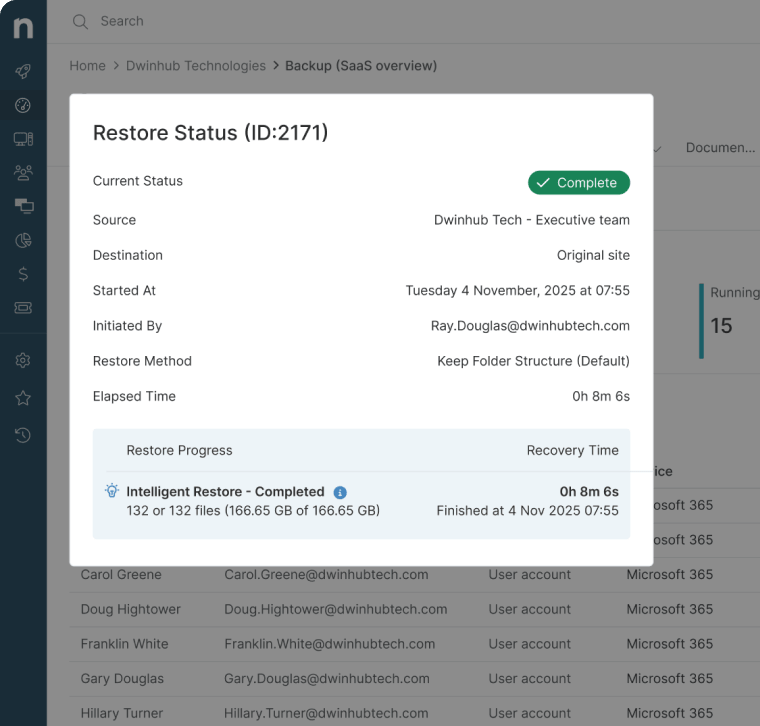
NinjaOne reviews on G2
| Category | NinjaOne Rating |
| Overall | 4.7 out of 5 (5,036) |
| Has the product been a good partner in doing business? | 9.4 |
| Quality of Support | 9.1 |
| Ease of Admin | 9.1 |
| Ease of Use | 9.1 |
NinjaOne reviews on Capterra
| Category | NinjaOne Rating |
| Overall | 4.7 out of 5 (298) |
| Ease of Use | 4.7 |
| Customer Support | 4.7 |
| Functionality | 4.5 |
| Value for Money | 4.6 |
2. Acronis Cyber Protect Cloud
Acronis Cyber Protect Cloud is a unified platform that combines backup, cybersecurity, and management tools in a single console. While it supports a wide variety of workloads, its SaaS backup capabilities are commonly used by IT teams and MSPs that need consistent protection for cloud applications.
The platform includes options for M365 and other SaaS workloads, allowing organizations to recover data from user errors, accidental deletions, or malicious activity. Acronis’s cloud-based deployment helps teams centralize protection policies and manage data across distributed environments.
Read about Acronis alternatives or see how Acronis compares with NinjaOne.
Best for
Acronis Cyber Protect Cloud is best suited for organizations in professional services, healthcare, financial services, retail, and manufacturing looking to reduce tool sprawl while maintaining protection across SaaS, physical, and virtual workloads.
Features
- M365 SaaS backup: Acronis Cyber Protect Cloud provides item-level and mailbox-level recovery for Exchange, OneDrive, SharePoint, and Teams.
- Unified protection suite: The solution combines backup, cybersecurity, and device management in one platform.
- Flexible restore workflows: It supports recovery across cloud, physical, and virtual environments.
Shortcomings
- Reporting: Some users remark that the software’s reporting feature needs more work as the generated reports aren’t detailed enough. (Source)
- Permissions: According to some users, permissions for creating internal accounts could be made simpler and more straightforward. (Source)
- DLP capability: Several reviews point out that the software’s data loss prevention (DLP) capabilities still have much room for improvement. (Source)
Acronis Cyber Protect Cloud reviews on G2
| Category | Acronis Cyber Protect Cloud Rating |
| Overall | 4.7 out of 5 (1,458) |
| Has the product been a good partner in doing business? | 9.2 |
| Quality of Support | 8.8 |
| Ease of Admin | 9.1 |
| Ease of Use | 9.1 |
Acronis Cyber Protect Cloud reviews on Capterra
| Category | Acronis Cyber Protect Cloud Rating |
| Overall | 4.1 out of 5 (78) |
| Ease of Use | 4.1 |
| Customer Service | 3.6 |
| Features | 4.2 |
| Value for Money | 4.0 |
3. Druva Data Security Cloud
Druva Data Security Cloud is a cloud-native platform built on AWS that offers SaaS backup and recovery solutions for organizations operating in distributed or hybrid environments. Its architecture removes the need for traditional hardware or appliances, allowing teams to quickly deploy SaaS backup software across multiple applications.
Druva protects data in M365, Google Workspace, and Salesforce, using a lightweight, cloud-to-cloud approach that reduces complexity and supports ongoing compliance needs.
Read about Druva alternatives or see how Druva compares with NinjaOne.
Best for
Druva Data Security Cloud is best for cloud-first and distributed organizations (including financial services, healthcare, legal services, and technology companies) that prefer a fully SaaS, infrastructure-free backup model.
Features
- Cloud-to-cloud SaaS backup: Druva Data Security Cloud offers automated protection for M365, Google Workspace, and Salesforce.
- Long-term retention: The software also involves centralized retention policies that help meet regulatory and business requirements.
- Searchable restore: As well, Druva Data Security Cloud features granular search and recovery for email, files, and objects within SaaS apps.
Shortcomings
- Performance: User reviews point out that initial backup and recovery can be slower for large or distributed datasets. (Source)
- Configurations and reporting: Some users mention that advanced configurations and reporting options could be more intuitive for new users. (Source)
- Search feature: According to some reviews, the software’s search feature can be more user-friendly. (Source)
Druva Data Security Cloud reviews on G2
| Category | Druva Data Security Cloud Rating |
| Overall | 4.7 out of 5 (744) |
| Has the product been a good partner in doing business? | 9.4 |
| Quality of Support | 9.4 |
| Ease of Admin | 9.3 |
| Ease of Use | 9.4 |
Druva Data Security Cloud reviews on Capterra
| Category | Druva Data Security Cloud Rating |
| Overall | 4.7 out of 5 (17) |
| Ease of Use | 4.5 |
| Customer Support | 4.7 |
| Functionality | 4.6 |
| Value for Money | 4.5 |
4. Cove Data Protection
Cove Data Protection is a cloud-first backup platform from N-able that includes support for SaaS backup across common productivity applications. As a SaaS backup solution, Cove aims to simplify cloud-to-cloud protection by removing the need for local storage hardware or complex deployment steps.
The platform provides automated backups for M365 workloads and centralizes management in a multitenant console, which is often used by MSPs handling multiple organizations. Cove’s cloud architecture helps teams streamline protection tasks while maintaining consistent retention policies across users and applications.
Read about Cove Data Protection alternatives or see how Cove Data Protection compares with NinjaOne.
Best for
Cove Data Protection is best suited for MSPs managing multiple tenants and organizations in industries such as retail, hospitality, healthcare, and accounting that require consistent SaaS backup without maintaining local backup infrastructure.
Features
- M365 SaaS backup: The software protects Exchange Online, OneDrive, SharePoint, and Teams data.
- Cloud-based retention: Cove Data Protection stores SaaS backups in the cloud with customizable retention policies.
- Multitenant console: It also has a central interface for managing SaaS backup settings across multiple environments.
Shortcomings
- Steep learning curve: Reviews of the software mention that it may take users some time to learn all about its more advanced features. (Source)
- Notification settings: According to a few users, the solution can still be improved by making all notification settings available on the outset. (Source)
- Restoration: Some users of Cove have pointed out that data restoration can be rather slow, especially for large data sets. (Source)
Cove Data Protection reviews on G2
| Category | Cove Data Protection Rating |
| Overall | 4.5 out of 5 (442) |
| Has the product been a good partner in doing business? | 8.9 |
| Quality of Support | 8.5 |
| Ease of Admin | 8.9 |
| Ease of Use | 9.0 |
Cove Data Protection reviews on Capterra
| Category | Cove Data Protection Rating |
| Overall | 4.6 out of 5 (375) |
| Ease of Use | 4.7 |
| Customer Support | 4.5 |
| Functionality | 4.6 |
| Value for Money | 4.4 |
5. HYCU
HYCU offers multi-cloud and SaaS backup software designed to protect a growing list of cloud applications. Its approach centers on agentless, API-based integration with SaaS platforms, reducing deployment work and simplifying policy management.
HYCU’s SaaS backup and recovery solutions help organizations manage data across multiple cloud providers while keeping recovery workflows consistent.
Read about HYCU alternatives or see how HYCU compares with NinjaOne.
Best for
HYCU is a strong choice for organizations managing multi-cloud environments that need agentless SaaS backup integrated with broader cloud workload protection, particularly in industries such as technology, finance, manufacturing, and healthcare.
Features
- API-based SaaS backup: HYCU includes coverage for supported SaaS platforms with agentless connections.
- Policy-based protection: The software also includes centralized policies for retention and recovery objectives.
- Multi-cloud support: HYCU has been recognized for its ability to protect SaaS apps alongside other cloud workloads.
Shortcomings
- Native immutable backup: Some reviewers have mentioned that HYCU can be improved with native immutable backup features. (Source)
- Scheduling limitations: According to reviews, jobs can only be scheduled by days and hours rather than specific time windows. (Source)
- Retention and replication: Users have also said that HYCU’s retention and replication capabilities are limited compared to those of its competitors. (Source)
HYCU reviews on G2
| Category | HYCU Rating |
| Overall | 4.7 out of 5 (166) |
| Has the product been a good partner in doing business? | 9.6 |
| Quality of Support | 9.5 |
| Ease of Admin | 9.4 |
| Ease of Use | 9.5 |
HYCU reviews on Capterra
| Category | HYCU Rating |
| Overall | 4.9 out of 5 (28) |
| Ease of Use | 4.9 |
| Customer Support | 4.9 |
| Functionality | 4.6 |
| Value for Money | 4.9 |
6. SysCloud
SysCloud is a SaaS backup solution for educational, business, and public-sector organizations using M365 and Google Workspace. It provides automated cloud-to-cloud backups and includes tools for monitoring compliance risks in cloud applications.
SysCloud’s interface allows administrators to view backup health, search for specific data across snapshots, and restore lost content directly back into the production environment.
Read about SysCloud alternatives or see how SysCloud compares with NinjaOne.
Best for
SysCloud is ideal for educational institutions, public-sector organizations, and compliance-focused businesses that use M365 or Google Workspace and require oversight of cloud data usage alongside backup protection.
Features
- Automated SaaS backup: SysCloud protects mail, files, and collaboration data in M365 and Google Workspace.
- Compliance monitoring: The tool also highlights policy violations or risky content within cloud apps.
- Search and restore: SysCloud provides file-level search and export capabilities.
Shortcomings
- User interface: Users of SysCloud have mentioned that the software’s user interface can be more intuitive and easier to navigate. (Source)
- Navigation: According to reviews, navigating SysCloud’s dashboard may take some getting used to for new users. (Source)
- Help desk: Some users remark that SysCloud’s help desk section can be more streamlined for easier navigation. (Source)
SysCloud reviews on G2
| Category | SysCloud Rating |
| Overall | 4.8 out of 5 (37) |
| Has the product been a good partner in doing business? | 9.5 |
| Quality of Support | 9.5 |
| Ease of Admin | 9.5 |
| Ease of Use | 9.6 |
SysCloud reviews on Capterra
| Category | SysCloud Rating |
| Overall | 4.7 out of 5 (7) |
| Ease of Use | 4.9 |
| Customer Support | 5.0 |
| Functionality | 4.6 |
| Value for Money | 4.7 |
7. Keepit
Keepit is a SaaS backup solution designed specifically for cloud applications, offering independent storage and straightforward retention models. It focuses heavily on simplifying long-term retention and access to archived data, which makes it appealing for organizations with compliance or regulatory requirements.
Keepit supports M365, Google Workspace, and several enterprise-grade SaaS apps, providing a dedicated platform for cloud-to-cloud data protection.
Read about Keepit alternatives or see how Keepit compares with NinjaOne.
Best for
Keepit is particularly well suited for finance, healthcare, insurance, legal services, and public sector organizations as well as enterprises operating across multiple geographic regions with strict compliance or data retention mandates.
Features
- SaaS cloud backup: Keepit includes coverage for M365, Google Workspace, and select enterprise SaaS systems.
- Searchable archive: The tool is also designed for long-term retention and fast retrieval of historical data.
- Isolated backup storage: Keepit uses independent cloud infrastructure for added data resilience.
Shortcomings
- PowerShell API: Some users note that the software would benefit from including an API manual for PowerShell. (Source)
- Options menu: Reviewers mention that Keepit’s options menu can be more intuitive and user-friendly. (Source)
- File/folder access: According to reviews, Keepit can often be slow to respond when accessing specific files or folders. (Source)
Keepit reviews on G2
| Category | Keepit Rating |
| Overall | 4.7 out of 5 (160) |
| Has the product been a good partner in doing business? | 9.3 |
| Quality of Support | 9.1 |
| Ease of Admin | 9.1 |
| Ease of Use | 9.1 |
Keepit reviews on Capterra
| Category | Keepit Rating |
| Overall | 4.8 out of 5 (55) |
| Ease of Use | 4.7 |
| Customer Support | 4.8 |
| Functionality | 4.6 |
| Value for Money | 4.7 |
8. SpinOne
SpinOne is a SaaS protection platform that combines SaaS backup with security-focused capabilities. It provides daily cloud-to-cloud backups for major SaaS applications, along with tools that help IT teams detect risky events or suspicious activity.
Its SaaS backup software is commonly used to protect data in cloud productivity suites while giving administrators more visibility into cloud usage patterns.
Read about SpinOne alternatives or see how SpinOne compares with NinjaOne.
Best for
SpinOne is a strong fit for technology companies, startups, and education institutions using M365 or Google Workspace as well as remote-first organizations concerned about insider threats, account compromise, or misconfigurations.
Features
- SaaS backup for M365/Google Workspace: SpinOne automates daily backups and versioned snapshots.
- Risk monitoring: The software identifies unusual activity in cloud apps that could lead to data loss.
- Granular restore options: In addition, SpinOne supports file-level and object-level recovery.
Shortcomings
- Data refresh: Some reviewers find that refreshing data from Google Workspace often takes time and causes the software to freeze. (Source)
- Lacking backup features: Users of SpinOne point out the tool’s lack of advanced backup management features. (Source)
- Reporting: A few users have noticed that the solution’s reporting capabilities are rather limited, especially when generating per-user reports. (Source)
SpinOne reviews on G2
| Category | SpinOne Rating |
| Overall | 4.8 out of 5 (129) |
| Has the product been a good partner in doing business? | 9.6 |
| Quality of Support | 9.6 |
| Ease of Admin | 9.4 |
| Ease of Use | 9.1 |
SpinOne reviews on Capterra
| Category | SpinOne Rating |
| Overall | 4.6 out of 5 (16) |
| Ease of Use | 4.8 |
| Customer Support | 4.7 |
| Functionality | 4.5 |
| Value for Money | 4.3 |
9. Barracuda Cloud-to-Cloud Backup
Barracuda Cloud-to-Cloud Backup focuses on SaaS cloud backup for Microsoft 365 environments. It provides organizations with independent, secondary copies of their cloud data to reduce risk from accidental deletion and policy gaps.
The platform emphasizes simplicity, with a clean interface for browsing snapshots, restoring content, or exporting data. Barracuda stores data in its own cloud, enabling teams to separate operational workloads from backup locations.
Read about Barracuda competitors or see how Barracuda Backup compares with NinjaOne.
Best for
Barracuda Cloud-to-Cloud Backup best suits SMBs, educational institutions, nonprofit organizations, and local government agencies heavily standardized on Microsoft 365 that want straightforward, independent backup storage without complex configuration.
Features
- M365 SaaS backup: Barracuda Cloud-to-Cloud Backup protects Exchange, SharePoint, OneDrive, and Teams data.
- Point-in-time restore: The solution allows recovery from specific snapshots across apps and mailboxes.
- Independent storage: Barracuda Backup keeps backup data separate from the production tenant.
Shortcomings
- Multiple backups: Users mention that the solution can be improved with the ability to schedule multiple backups per day. (Source)
- Filtering: Some reviews say that Barracuda’s filtering capability can be improved, especially when looking for specific user data to restore. (Source)
- Large restores: According to some users, restoring large mailboxes, SharePoint sites, or OneDrive libraries can take longer than expected. (Source)
Barracuda Cloud-to-Cloud Backup reviews on G2
| Category | Barracuda Cloud-to-Cloud Backup Rating |
| Overall | 4.5 out of 5 (189) |
| Has the product been a good partner in doing business? | 9.1 |
| Quality of Support | 8.8 |
| Ease of Admin | 9.1 |
| Ease of Use | 8.8 |
Barracuda Cloud-to-Cloud Backup reviews on Capterra
| Category | Barracuda Cloud-to-Cloud Backup Rating |
| Overall | 4.7 out of 5 (3) |
| Ease of Use | 4.7 |
| Customer Support | 4.0 |
| Functionality | 4.3 |
| Value for Money | 4.3 |
10. Axcient x360Cloud
Axcient x360Cloud is a SaaS backup and recovery platform built for MSPs and IT teams managing multiple tenants. The service focuses on cloud-to-cloud protection for M365 and Google Workspace, with automated backups and a lightweight interface for searching and restoring content.
Axcient emphasizes operational continuity, helping organizations recover quickly from user errors, lost data, or ransomware events.
Best for
Axcient x360Cloud is best for SMBs supported by MSPs in industries such as healthcare, legal, financial services, and professional services, where data availability and rapid recovery from user error or ransomware incidents are critical.
Features
- SaaS backup automation: With Axcient x360Cloud, users can benefit from multiple daily backups for M365 and Google Workspace.
- Full-text search: The software enables fast discovery of emails, files, or objects across snapshots.
- Granular and bulk restore: Axcient x360Cloud is designed for restoring individual items or large sets of data.
Shortcomings
- Reporting and alerting: Users of Axcient x360Cloud remark that its reporting and alerting features can be more detailed and configurable. (Source)
- Navigation: According to reviews, navigation can be challenging, even cumbersome, especially when locating specific files within backups. (Source)
- Alert customization: Some users note that Axcient x360Cloud’s alert customization features can be more robust. (Source)
Axcient x360Cloud reviews on G2
| Category | Axcient x360Cloud Rating |
| Overall | 4.4 out of 5 (89) |
| Has the product been a good partner in doing business? | 9.0 |
| Quality of Support | 8.5 |
| Ease of Admin | 8.7 |
| Ease of Use | 8.8 |
Axcient x360Cloud reviews on Capterra
| Category | Axcient x360Cloud Rating |
| Overall | 4.0 out of 5 (12) |
| Ease of Use | 4.0 |
| Customer Support | 4.0 |
| Functionality | 4.0 |
| Value for Money | 4.3 |
Comparison of best SaaS backup solutions (G2)
| Category | NinjaOne | Acronis Cyber Protect Cloud | Druva Data Security Cloud | Cove Data Protection | HYCU | SysCloud | Keepit | SpinOne | Barracuda Cloud-to-Cloud Backup | Axcient x360Cloud |
| Overall | 4.7 out of 5 (5,036) | 4.7 out of 5 (1,458) | 4.7 out of 5 (744) | 4.5 out of 5 (442) | 4.7 out of 5 (166) | 4.8 out of 5 (37) | 4.7 out of 5 (160) | 4.8 out of 5 (129) | 4.5 out of 5 (189) | 4.4 out of 5 (89) |
| Has the product been a good partner in doing business? | 9.4 | 9.2 | 9.4 | 8.9 | 9.6 | 9.5 | 9.3 | 9.6 | 9.1 | 9.0 |
| Quality of Support | 9.1 | 8.8 | 9.4 | 8.5 | 9.5 | 9.5 | 9.1 | 9.6 | 8.8 | 8.5 |
| Ease of Admin | 9.1 | 9.1 | 9.3 | 8.9 | 9.4 | 9.5 | 9.1 | 9.4 | 9.1 | 8.7 |
| Ease of Use | 9.1 | 9.1 | 9.4 | 9.0 | 9.5 | 9.6 | 9.1 | 9.1 | 8.8 | 8.8 |
Comparison of best SaaS backup solutions (Capterra)
| Category | NinjaOne | Acronis Cyber Protect Cloud | Druva Data Security Cloud | Cove Data Protection | HYCU | SysCloud | Keepit | SpinOne | Barracuda Cloud-to-Cloud Backup | Axcient x360Cloud |
| Overall | 4.7 out of 5 (298) | 4.1 out of 5 (78) | 4.7 out of 5 (17) | 4.6 out of 5 (375) | 4.9 out of 5 (28) | 4.7 out of 5 (7) | 4.8 out of 5 (55) | 4.6 out of 5 (16) | 4.7 out of 5 (3) | 4.0 out of 5 (12) |
| Ease of Use | 4.7 | 4.1 | 4.5 | 4.7 | 4.9 | 4.9 | 4.7 | 4.8 | 4.7 | 4.0 |
| Customer Support | 4.7 | 3.6 | 4.7 | 4.5 | 4.9 | 5.0 | 4.8 | 4.7 | 4.0 | 4.0 |
| Functionality | 4.5 | 4.2 | 4.6 | 4.6 | 4.6 | 4.6 | 4.6 | 4.5 | 4.3 | 4.0 |
| Value for Money | 4.6 | 4.0 | 4.5 | 4.4 | 4.9 | 4.7 | 4.7 | 4.3 | 4.3 | 4.3 |
Final scores and summaries of the best SaaS cloud backup
| Vendor | Final Score | Summary |
| NinjaOne | 1.2704 | NinjaOne delivers cloud-first SaaS backup for M365 and Google Workspace with automated policies and fast recovery. Its unified platform helps teams simplify data protection across SaaS and endpoints. |
| Acronis Cyber Protect Cloud | 0.8336 | Acronis Cyber Protect Cloud offers SaaS backup for M365 alongside security and management tools in one console. It’s suited for organizations that want SaaS protection within a broader data platform. |
| Druva Data Security Cloud | 0.8171 | Druva provides cloud-native SaaS backup for M365, Google Workspace, and Salesforce with a fully hosted architecture. It appeals to teams prioritizing scalability and minimal infrastructure. |
| Cove Data Protection | 0.7987 | Cove Data Protection delivers cloud-based SaaS backup for M365 with flexible retention policies and a multitenant console. It fits organizations moving away from hardware-based backup systems. |
| HYCU | 0.7854 | HYCU provides API-driven SaaS backup with agentless deployment and policy-based management. It’s designed for organizations protecting multiple SaaS apps across cloud platforms. |
| SysCloud | 0.7694 | SysCloud provides SaaS backup and compliance monitoring for M365 and Google Workspace. It’s commonly adopted by education and public-sector organizations looking for simple cloud-to-cloud protection. |
| KeepIt | 0.7635 | Keepit focuses on SaaS cloud backup with independent storage and long-term retention for M365 and Google Workspace. It’s often used by teams with strict archival and transparency requirements. |
| SpinOne | 0.7575 | SpinOne combines SaaS backup with activity monitoring for M365 and Google Workspace. It suits teams that want data protection paired with visibility into cloud usage risks. |
| Barracuda Cloud-to-Cloud Backup | 0.7232 | Barracuda offers focused M365 SaaS backup with point-in-time snapshots and independent cloud storage. It’s a straightforward option for organizations centered on Microsoft workloads. |
| Axcient x360Cloud | 0.6861 | Axcient x360Cloud delivers SaaS backup for M365 and Google Workspace with automated snapshots and granular restore. Its multitenant structure makes it suitable for MSP environments. |
Our top SaaS protection comparison and ranking methodology
This review and ranking of the top SaaS backup solutions in 2026 is based on a transparent, structured methodology. The process includes:
- Data Sources: Aggregated ratings and review counts from G2 and Capterra as of September 2026.
- Metrics Considered: Star ratings, review volume, quality of support, business partnership feedback, ease of use, and customer service ratings.
- Weighting: Each metric is weighted on importance to MSPs, detailed as:
- Final Score: w1 * G2 Good Partner in Doing Business + w2 * G2 Quality of Support + w3 * G2 Ease of Admin + w4 * G2 Ease of Use + w5 * Capterra Ease of Use + w6 * Capterra Customer Service + w7 * Capterra Features + w8 * Capterra Value for Money + w9 * G2 Total Number of Reviews (Scaled) + w10 * Capterra Total Number of Reviews (Scaled), where:
- w1 = 0.1 (Weight for G2 Good Partner in Doing Business)
- w2 = 0.1 (Weight for G2 Quality of Support)
- w3 = 0.1 (Weight for G2 Ease of Admin)
- w4 = 0.1 (Weight for G2 Ease of Use)
- w5 = 0.1 (Weight for Capterra Ease of Use)
- w6 = 0.1 (Weight for Capterra Customer Service)
- w7 = 0.1 (Weight for Capterra Features)
- w8 = 0.1 (Weight for Capterra Value for Money)
- w9 = 0.1 (Weight for G2 Total Number of Reviews, Scaled)
- w10 = 0.1 (Weight for Capterra Total Number of Reviews, Scaled)
- Data Freshness: All data was collected and last validated on September 18, 2026.
- Process: Products were evaluated for both core and advanced SaaS backup and protection features, customer feedback, and breadth of integrations, with sources referenced where relevant.
How to choose SaaS backup software for compliance, security, and scalability
When deciding on a SaaS backup software, you should consider several factors that are vital to effectively protecting company data. These factors include vendor reliability and compliance track record, data coverage, backup, and recovery capabilities, security and data protection, compliance and regulatory requirements, scalability and performance, and support, service, and vendor responsiveness. Here is a breakdown.
1. Vendor reliability and compliance track record
Nothing beats a reputable IT platform that is well known for its superb capabilities, after-sales, and being policy-compliant. Read reviews and do in-depth research about the vendor you’re considering, determining whether it’ll cater to your SaaS backup needs.
For enterprise environments, verify that the SaaS backup tool consistently receives positive reviews from IT professionals, specifically on technical performance and regulatory adherence. Additionally, a list like this one should aid in narrowing your selection by prioritizing vendors with a proven track record for robust, compliant, and functional SaaS backup capabilities.
2. Data coverage, backup, and recovery capabilities
When conducting your research, ensure you get into the data considerations, including backup and recovery capabilities of the SaaS backup tool you’re eyeing, like the type of data the platform can support or if the tool is able to provide service to your existing SaaS apps. Review its policies on recovery point objective (RPO) and recovery time objective (RTO).
Also, check whether the platform allows for the restoration of data from any specific point in the past as well as if it meets its legal and business needs for retaining data for months or years, which may be longer than what your SaaS platform allows.
3. Security and data protection
Remember that the SaaS backup tool of your choice will be handling critical data. It’s crucial that the platform you pick follows rigorous security measures to preserve confidence and data protection.
The SaaS backup platform should not only meet industry standards and regulations in handling data but also be compliant with regional and global data protection frameworks like the following:
4. Scalability and performance
An effective tool should ease the complexities of backing up SaaS application data for IT teams. Features like automation, a user-friendly UI, quick backup and recovery, and the ability to initiate operations through a centralized console are just some of the things to look for to ensure efficient management and deployment.
Aside from that, the SaaS backup tool of your choice should be able to work with your existing system as well as adapt to your needs as you scale, add new applications, or evolve your compliance and data retention requirements.
5. Support, service, and vendor responsiveness
Lastly, a SaaS backup tool that provides incomparable support to its user base can truly be a standout. Your decision should involve looking into factors such as ease of onboarding, knowledgeable technical support staff, clear and updated documentation, and useful self-help guide kits. You would also want to look into its support team’s responsiveness, speed of issue resolution, and everything that can help de-escalate bottlenecks during SaaS backup operations.
In summary, here’s a SaaS backup tool selection checklist:
- Proven vendor reliability and enterprise track record
- Comprehensive data coverage and flexible recovery options
- Strong security controls and encryption standards
- Compliance with GDPR, HIPAA, SOC 2, ISO 27001
- Governance and retention controls
- Scalable performance for growing environments
- Responsive support and clear documentation
Choosing a SaaS backup provider for data governance
The best SaaS backup software for data governance typically combines one or all the following capabilities:
- Role-based access controls (RBAC) that separate backup administration from production admin rights
- Immutable and tamper-evident storage that can stand up as evidence
- Configurable retention policies that map to regulatory schedules rather than a generic “keep everything forever” setting
- Searchable audit logs that show every backup, restore, and policy change.
We recommend looking for vendors that support legal hold and eDiscovery workflows natively, since bolting these on after the fact tends to create inconsistent records. Providers offering SaaS backup and recovery across multiple applications (and not Microsoft 365) also make governance easier to standardize, since IT teams can apply one retention and access model across Google Workspace, Salesforce, and other business-critical apps instead of managing a patchwork of point tools.
Similarly, it’s worth noting that governance requirements tend to change as organizations grow, add new SaaS applications, or expand into regulated markets, so it’s worth evaluating whether a vendor offers a scalable SaaS backup solution rather than one built for a single use case. A platform that can add new SaaS integrations, extend retention windows, and support multi-region data residency without a re-architecture will hold up better over time than one that requires a forklift upgrade every time compliance requirements shift.
Lastly, it’s good practice that, before signing a contract, you ask your intended vendor how they support SOC 2, HIPAA, or GDPR audits. If possible, stipulate in your MSP service level agreement (SLA) that the vendor provides a sample of the audit logs and compliance reports their platform actually generates, not just a features list.
Challenges in adopting a SaaS backup solution
IT teams may face challenges in rolling out a SaaS backup platform into their environment. From integration to backup policy bottlenecks, these difficulties may slow down the adoption of backup and recovery operations.
What are the hidden costs and common pitfalls companies face when adopting SaaS backup solutions, and how can I avoid them?
Hidden costs:
- Data egress/restore fees: Some platforms may enforce a fee for downloading your own data. You can avoid this by conducting extensive product research to determine if there are any charges not disclosed in the base subscription or by selecting a vendor that explicitly guarantees zero egress/restore fees.
- Long-term retention fees: Other SaaS backup solutions may force you into expensive archival tiers. Avoid this by ensuring that the platform’s long-term retention coverage is defined upfront.
- Data growth overage: There are SaaS backup platforms that offer storage-based pricing, which can incur unpredictable costs for your organization. Avoid this by going for a SaaS backup tool that offers a per-user/per-seat model with unlimited storage and retention.
Operational pitfalls:
- Misleading sense of security: Some SaaS backup tools have policies that aren’t clear when it comes to where their accountability on securing your data ends. Avoid this by reading the fine print and understanding your and the platform’s roles in the shared responsibility model.
- Skipping backup testing: Without testing the backup solution, you won’t be able to determine if your process is going to function as intended. Avoid this by simulating a disaster and doing a full restore afterward. This can help you validate your RTO, ensure files aren’t corrupted after restoring, and mitigate issues if anything arises, all before a real data crisis occurs.
- Lack of immutable storage: Some ransomware attacks are so sophisticated that they can leave your organization without any recovery options. Avoid this scenario by ensuring that your SaaS backup provider offers a storage where backup data, once written, can’t be modified, deleted, or encrypted for a set period.
The best SaaS backup solutions
While every SaaS backup software in this list has its own pros and cons, we recommend evaluating each option based on how well it aligns with your operational needs and future growth. No two environments look the same, and the right solution often depends on factors like the SaaS apps you rely on, your retention policies, and how quickly you need to recover data when something goes wrong.
If NinjaOne happens to be your top choice among these solutions, check out its SaaS backup software, which provides automated and cloud-native protection for enterprises’ Microsoft 365 and Google Workspace environments. On top of enabling backup, monitoring, and patching from a single console, NinjaOne SaaS Backup features ransomware recovery, unlimited storage, and secure restore options.
Start your free 14-day trial of NinjaOne SaaS Backup today or watch a free demo of the software in action.