Key Points
- Poor endpoint management directly exposes organizations to data breaches, compliance failures, and costly downtime.
- The rise of hybrid work, BYOD policies, and an expanding mix of operating systems and device types has made it harder than ever to maintain visibility, security, and compliance across all endpoints.
- The 12 most common endpoint management challenges include device complexity, scalability, compliance, tool sprawl, lack of visibility, cost management, evolving threats, lifecycle management, BYOD, user access control, system integration, and alert fatigue.
- A layered approach, combining a unified endpoint management platform, automated patch management, zero-trust access controls, and continuous monitoring, is the most effective way to reduce exposure across all devices.
- A cloud-based unified endpoint management (UEM) platform that consolidates monitoring, patching, security, and remote access into a single dashboard is the most scalable and cost-effective solution for enterprises.
Managing endpoints has never been more demanding. On average, only 68% of an organization’s devices are managed by IT, and more than half of organizations (54%) have already experienced a cyberattack due to unknown, unmanaged, or poorly managed endpoints. (BusinessWire)
Yes, you read that right. And the financial stakes are just as alarming: the average cost of a data breach reached $4.88 million in 2024, and while IBM’s 2025 report shows a slight decrease to $4.4 million thanks to faster detection, the financial exposure remains staggering. Experts fear the worst is still ahead. By 2031, a ransomware attack is projected to occur on a business or device every two seconds, and right now, one already occurs somewhere in the world every 11 seconds. (Cybersecurity Ventures).
This isn’t to make you scared, but prepared and aware of the existing risks and how to prevent them from happening in the first place. In this guide, we cover the 12 most common endpoint management challenges you’re likely facing and what you can do today to solve them.
Secure your enterprise environment with an endpoint management solution trusted by thousands.
Explore NinjaOne Endpoint Management.
At a glance: Common endpoint management challenges
In a rush? Here’s a cheat sheet:
| Challenge | Primary Risk | Solution Type |
| Increasing complexity of IT environments | Security gaps | Unified cross-platform management |
| Scalability issues | Delayed updates, wider attack surface | Cloud-based auto-scaling |
| Compliance & regulatory challenges | Fines, legal action | Automated compliance reporting |
| Integration with existing systems | Siloed tools, unmanaged endpoints | API-first platform with pre-built integrations |
| Lack of visibility and control | Security blind spots | Centralized real-time dashboard |
| Cost management | Budget overruns or underfunding | Tool consolidation, cost-benefit analysis |
| Evolving threats | Data loss, downtime | Proactive patching + threat intelligence |
| Tool sprawl | Alert fatigue, response delays | Unified endpoint platform |
| Device lifecycle management | Orphaned devices, compliance gaps | Automated lifecycle tracking |
| Hybrid & BYOD management | Expanded attack surface | Containerization + conditional access |
| Controlling user access | Credential-based attacks | Zero trust + PAM + MFA |
| Alert fatigue & security noise | Missed threats | Behavioral analytics + SIEM/XDR |
What is endpoint management?
Endpoint management is the monitoring, maintenance, and security of devices connected to your company’s network. This includes computers, mobile phones, tablets, servers, and IoT devices.
Good endpoint management is essential to keeping your organization’s IT infrastructure safe. You must oversee a wide range of tasks, from software updates and security patch deployment to access control and data protection. Effective endpoint management also means keeping an eye on everything in your network, regardless of device location or type.
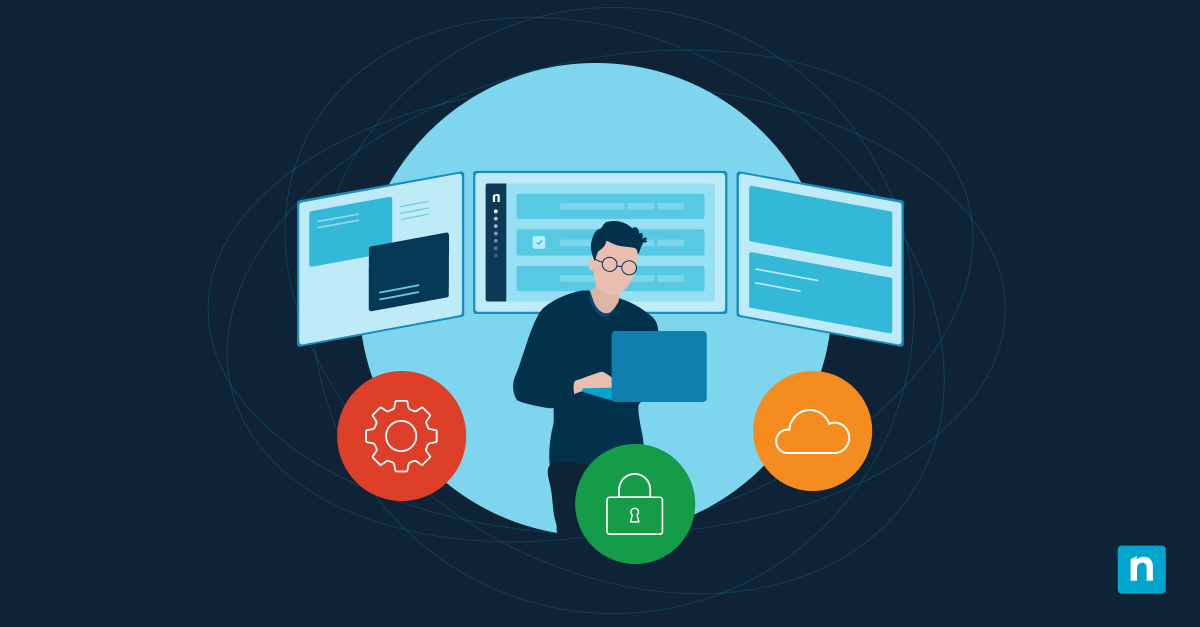
Modern organizations typically achieve this through a centralized endpoint management platform, a single solution that consolidates the monitoring, patching, security, and remote management of all endpoints into one dashboard. Without it, IT teams are left juggling multiple disconnected tools, creating the visibility gaps and security blind spots that attackers actively look for.
12 endpoint management challenges
1: Increasing complexity of IT environments
Gone are the days of uniform company-issued desktop computers. You now deal with a diverse array of devices, operating systems, and applications, and manage Windows, macOS, and Linux machines alongside iOS and Android mobile devices. Add IoT devices and cloud-based services and you face a complex mix of endpoints.
Each device type and operating system may need different management tools and approaches. Your endpoint management solution must handle this mix without creating security gaps or isolated systems.
Consequences: Without a unified platform, IT wastes time switching between tools, leaving gaps that attackers exploit. According to the Verizon 2026 Data Breach Investigations Report, 31% of breaches now start with software vulnerabilities, and 48% of all breaches involve ransomware.
👉 Solution: Adopt a cross-platform endpoint management tool that consolidates oversight into a single dashboard.
2: Scalability issues
As your organization grows, so does the quantity of your endpoints. This challenge extends beyond simply managing more devices; it also means maintaining control, visibility, and security across an expanding network.
Your endpoint management solution needs efficient scaling capabilities to handle increased device numbers and geographic spread. You might need to deploy local management servers in various locations or use cloud-based solutions that scale easily based on your needs.
Consequences: Manual scaling strains staff, delays updates, and widens the attack surface.
👉 Solution: Cloud-based endpoint management solutions scale automatically, allowing IT to add endpoints without adding infrastructure.
3: Compliance and regulatory challenges
Data privacy regulations like GDPR, HIPAA, and CCPA make compliance across all endpoints critical. You must prove you control how data moves across all network devices. This challenge grows when different regulations apply to various parts of your organization or data types.
You’ll need to implement adaptable policies and controls while maintaining a unified management approach. Staying up-to-date with changing regulations is important, so update your policies regularly. This might include auditing your endpoint management practices, documenting your compliance efforts and potentially investing in specialized compliance management tools.
Consequences: Non-compliance can result in multimillion-dollar fines, legal action, and reputational damage.
👉 Solution: Automate compliance checks, enforce encryption policies, and generate real-time compliance reports.
4: Integration with existing systems
Your endpoint management solution must work seamlessly with your current IT infrastructure, including network management tools, security systems, and identity management solutions.
You may encounter integration challenges when connecting new endpoint management tools with older systems, requiring you to bridge gaps between vendor ecosystems or address compatibility issues between software versions.
Consequences: If integration fails, IT teams end up with siloed systems, duplicating work and leaving endpoints unmanaged.
👉 Solution: Choose endpoint solutions with robust APIs and pre-built integrations that allow smooth connection with identity management, SOC, and ticketing systems.
5: Lack of visibility and control
Remote work and Bring Your Own Device (BYOD) policies make it harder to maintain visibility and control over all endpoints. You may struggle to track which devices access your network, their software, and their compliance with security policies.
This visibility gap can create security blind spots, making it more difficult to detect and respond to threats. You may also find it challenging to ensure all devices receive proper updates and conform to organizational standards.
Consequences: Blind spots increase the likelihood of breaches, compliance failures, and missed updates.
👉 Solution: Centralized dashboards that show real-time device health, patch status, and compliance help IT regain full visibility.
6: Cost management
Endpoint management can significantly impact your IT budget. Beyond initial purchase and deployment costs, you face ongoing expenses like licensing fees, maintenance, and resources for system updates.
You will need to balance these costs with comprehensive endpoint management needs. Careful evaluation of different solutions helps you find the right mix of functionality and cost-effectiveness for your organization.
Consequences: Overspending reduces IT’s ability to invest in innovation, while underfunding endpoint management risks security breaches.
👉 Solution: Conduct cost-benefit analyses of endpoint platforms and consolidate tools where possible to reduce licensing fees and administrative overhead.
7: Keeping up with evolving threats
The threat landscape changes constantly as new vulnerabilities and attack vectors emerge. Your endpoint management strategy requires quick adaptation to these evolving threats.
Simply deploying security patches is not enough; you need a system that detects new threats, isolates affected endpoints, and rolls out updates or policy changes across your network in response to emerging risks.
Consequences: Failure to adapt quickly can result in massive data loss, downtime, and recovery costs.
👉 Solution: Pair proactive patching with threat intelligence, anomaly detection, and automated response to isolate and remediate compromised endpoints quickly.
8: Tool sprawl
Managing endpoints often requires juggling multiple disconnected solutions. This fragmentation forces IT teams to context-switch between dashboards, creates gaps in policy enforcement, and drives up licensing costs. The more tools in the stack, the harder it becomes to maintain a coherent security posture, and the slower your team responds when an incident occurs.
Consequences: Disconnected tools create alert fatigue, slower incident response, and redundant costs that are difficult to justify.
👉 Solution: Consolidate your endpoint management stack into a unified platform that handles monitoring, patching, security, and remote access from a single pane of glass.
9: Device lifecycle management
Without a structured lifecycle management process, organizations end up with outdated hardware running unsupported software, orphaned devices that are no longer tracked, and inconsistent decommissioning practices that can leave sensitive data exposed.
Consequences: Untracked end-of-life devices become security liabilities, while poor refresh planning leads to unexpected capital expenditure and compliance gaps.
👉 Solution: Implement a lifecycle management policy that covers device enrollment, configuration, refresh schedules, and secure decommissioning. It is a good idea to have this policy automated and tracked through your endpoint management platform.
10: Managing endpoints in a hybrid and BYOD environment
The shift to hybrid work has blurred the line between corporate and personal devices. Employees connecting from home networks or personal laptops introduce a wider range of OS versions, configurations, and security postures — many of which fall outside your standard policies. BYOD programs compound this by raising privacy concerns that limit how aggressively you can enforce controls, and employees may resist enrollment out of fear that IT will access personal data.
Consequences: Unmanaged or lightly managed personal devices significantly expand the attack surface and cause you to star in your own IT Horror Story.
👉 Solution: Deploy containerization or secure enclave approaches that separate work data from personal use, combined with conditional access policies that enforce minimum security baselines before granting network access.
11: Controlling user access to corporate data
Traditional perimeter-based authentication is no longer sufficient as networks extend beyond the office. Without granular access controls, a single compromised credential can expose your entire environment, and overly permissive access policies mean insider threats, whether malicious or accidental, can cause outsized damage.
Consequences: Excessive user permissions increase the blast radius of any breach, while weak authentication leaves the door open for credential-based attacks.
👉 Solution: Adopt a zero-trust framework with least-privilege access policies, enforce multi-factor authentication across all endpoints, and use a privileged access management (PAM) solution to monitor and control access to sensitive systems. Check out this guide, How to Set Least Privilege Technician Permissions Without Slowing Workflows, for additional information.
12: Alert fatigue and security noise
IT teams can quickly become overwhelmed by the sheer number of notifications generated by monitoring tools, many of which turn out to be false positives. When every alert demands attention, genuinely critical threats can be missed, buried under a backlog of low-priority noise.
Consequences: Alert overload slows incident response times and increases the risk that a real threat goes undetected until significant damage is done.
👉 Solution: Implement behavioral analytics and machine learning-driven detection to reduce false positives, integrate with a SIEM or XDR solution to correlate and prioritize alerts, and fine-tune detection rules regularly to match your environment’s risk profile.
Secondary endpoint security challenges
In endpoint management, you also face specific secondary endpoint security challenges related to your devices:
- Vulnerability to malware and ransomware: Endpoints are prime targets for malware and ransomware, with a single infected device potentially compromising your entire network. You need robust anti-malware solutions on all endpoints and strategies for rapid detection and isolation of infected devices.
- Phishing attacks: Phishing remains a common attack vector that is getting more sophisticated by the day. Your endpoint management strategy should include email filtering, user education, and controls to prevent access to known malicious sites.
- Insider threats: Internal threats, whether malicious or accidental, can cause significant damage to your organization. Your endpoint management solutions should monitor user behavior, control access to sensitive data, and allow you to quickly revoke access when necessary.
- Unmanaged and shadow IT devices: Employees frequently connect personal devices, unauthorized applications, or unapproved cloud services to your network without IT’s knowledge. These shadow IT assets bypass your security policies entirely, creating blind spots that are difficult to detect and even harder to remediate.
- Weak or stolen credentials: Compromised credentials remain one of the most common ways attackers gain access to endpoints. As hybrid work expands the number of access points, credential-based attacks, including brute force, credential stuffing, and phishing-driven account takeovers, are increasingly targeting endpoint users directly.
Optimize your endpoint management with NinjaOne Unified platform for IT professionals and MSPs.
Endpoint management best practices
Regular software updates and patch management
Keep all endpoints current with the latest software versions and security patches. Use an automated patch management system to deploy updates efficiently across your network with minimal user disruption.
Establish a testing process for patches before widespread deployment so they don’t cause conflicts or performance issues.
Comprehensive endpoint security strategies
Implement a layered security approach. Include antivirus software, firewalls, intrusion detection systems, and data encryption. Apply these security measures consistently across all endpoints.
Consider implementing a zero-trust security model, which assumes no user or device should be trusted by default, even if they’re already inside your network perimeter.
Training and awareness programs
Educate your users on endpoint management best practices. Teach them to identify potential threats and respond to suspected security incidents. Conduct regular training sessions to reinforce these skills.
Additionally, you can use simulated phishing campaigns to test and improve your users’ ability to recognize and report suspicious emails.
Implementing access controls
Use the least privilege principle to limit user access to only the resources they need. Implement strong authentication methods, including multi-factor authentication (MFA) where possible.
In addition, a privileged access management (PAM) solution controls and monitors employee access to critical systems and sensitive data.
Continuous monitoring and response
Monitor all endpoints in real-time to quickly detect and respond to potential threats. Set up automated alerts for suspicious activity and develop a clear incident response plan. Use a security information and event management (SIEM) system to centralize log data and improve your ability to detect and respond to security incidents.
Strengthen your IT infrastructure’s security posture with NinjaOne solutions.
Turn challenges into opportunities. Watch 7 Common endpoint management challenges for smarter management.
How your SOC and endpoint management work together
Many of the 12 challenges above, from evolving threats to alert fatigue, are best addressed when your endpoint management team operates in close coordination with your Security Operations Center (SOC). A SOC works closely with your endpoint management team for a coordinated security approach. This collaboration should include threat intelligence sharing, coordinated incident response and joint development of security policies.
Integrating endpoint management with broader security operations creates a more robust and responsive security posture. Look into security orchestration, automation and response (SOAR) tools to streamline and automate your incident response processes.
How to stay ahead of endpoint management challenges
Keeping up with your endpoint management challenges requires ongoing attention and flexibility. By understanding the potential challenges and following best practices, you can protect your organization’s digital assets, maintain compliance, and support workforce productivity. Stay vigilant and adjust your strategies as technology and threats evolve to keep your endpoints secure and efficient.
Don’t let endpoint security challenges overwhelm your IT team. Unified IT operations solutions like NinjaOne can streamline your efforts, enhancing service delivery by allowing you to monitor, manage, secure and support all your devices, regardless of location, and without a complex on-premises infrastructure. Ready to tackle your endpoint management challenges head-on? Start your free trial of NinjaOne today and transform your IT security.