Key Points
- Network device decommissioning is the process of safely removing network devices (such as routers or switches) from operation, whether they are replaced or retired..
- Reroute traffic through cost adjustments before any physical hardware is disconnected.
- Wipe NVRAM during decommissioning to remove all residual configuration data and prevent retired devices from becoming security liabilities.
- Maintain current network diagrams to avoid the high overhead of troubleshooting undocumented legacy systems.
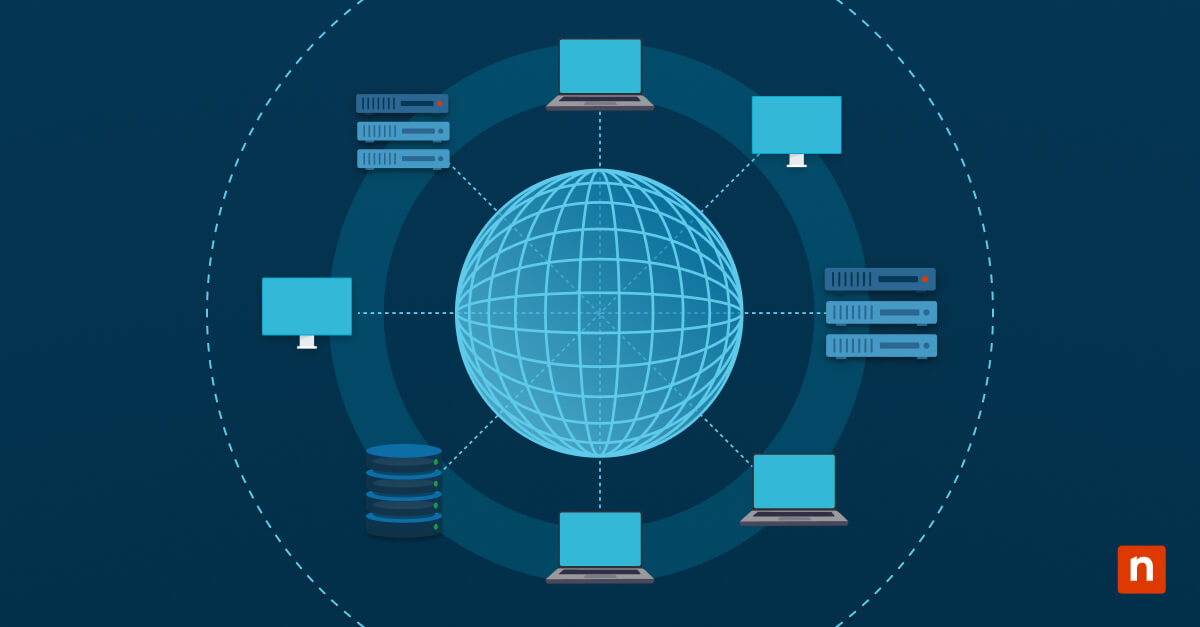
Network device decommissioning is the process of systematically removing outdated network nodes while maintaining network stability and continuity. However, as environments evolve, networks become more sensitive to hardware changes, warranting well-defined steps that centralize monitoring and prioritize efficiency.
How to remove devices from network setups safely
Understanding how aspects of your topology interact with one another helps optimize hardware upgrades and lessen your overhead.
Why safe network device removal matters
Upgrading devices in your network can help improve performance. Switches, routers, firewalls, and more serve as vital nodes in your network’s topology, but removing just one without due care can have far-reaching consequences, impacting productivity at scale.
Improper network device decommissioning results in:
- Connectivity loss: Removing a switch can unknowingly sever a “daisy-chain” link to another section of your network.
- Routing path failures: Removing routers without first adjusting routing preferences can lead to routing instability (such as route flapping in BGP or convergence events in OSPF) and potential packet loss..
- Configuration artifacts: Monitoring platforms (like NinjaOne) continuously check for configured nodes and may generate alerts for devices that have been removed but not properly decommissioned, cluttering your Security Operations Center.
Common risks when devices are removed incorrectly
Improper network device decommissioning can generate “ghost issues” that are impossible to pinpoint due to missing network devices.
Orphaned logical dependencies and “black holing”
Network data passes through nodes (for example, routers, switches), but when a device marked as a “Static Route” is removed from the routing table, traffic gets forwarded to a nonexistent interface.
This creates a “black hole” that receives data, but never sends it to its correct destination. This is especially problematic for Border Gateway Protocol (BGP) environments, which can experience massive instability due to a missing neighbor.
Spanning tree protocol (STP) re-convergence storms
In high-performance switch environments, Ethernet bridges are used to connect network segments, while STP helps prevent network loops. If these bridges aren’t removed with due care, network device decommissioning can greatly impact system stability, even producing costly outages (like “broadcast storms”).
Residual monitoring and “alert fatigue”
Monitoring systems like NinjaOne continuously check endpoint health, but if you remove a listed hardware asset, “Device Down” alerts will be generated indefinitely. This leads to possible alert fatigue for your helpdesk and can impact productivity levels.
Security voids and configuration drift
Removing security gateways (such as firewalls) poses a significant risk if the surrounding switches still point to it as a valid inspection site. This configuration can cause leaks across network segments, and it’s comparable to passing airline luggage through an unmanned checkpoint without X-ray machines.
Planning before removing a network device
It’s important to plan ahead for any branches that rely on the device you’re decommissioning. Map out dependencies to make sure removing your asset won’t cause business-critical sections to stagger or collapse.
To identify which switches, routers, and asset points are physically plugged into your device:
- Launch your terminal emulator (such as PuTTY or Command Prompt if using SSH).
- SSH into the target device using its IP address.
- Run the Discovery Command
- Cisco: Type show cdp neighbors detail or show lldp neighbors.
- Other vendors (including Juniper): Type show lldp neighbors.
- Look for “Local Int” (your current device) and “Port ID” (the neighbor’s port).
- If a neighbor is another switch or a core router, verify how that port is configured (for example, as a trunk or access link).
- You must trace where that neighbor’s traffic will go once this device is removed.
Certain departments rely on a set of network devices for their internet access, and removing these without proper planning can result in prolonged outages and lost time. Here’s how to check:
- In the terminal, type show ip interface brief (Cisco) or show interfaces terse (Juniper).
- Look for “VLAN” interfaces with assigned IP addresses. These are likely the Default Gateways for user subnets.
- To verify Hot Standby Router Protocol OR Virtual Router Redundancy Protocol, type:
show standby brief or a vendor-specific VRRP command (for example, show vrrp brief)
- If the device is the “Active” node in a redundancy group, you must manually fail it over to the “Standby” node before removal.
- Type interface vlan [ID] then standby [Group] priority 1 to force the other router to take over.
Enforce change requests pre-decommission
Having the proper permissions for an asset replacement properly documents your process while increasing awareness for stakeholders and employees. Every Change Request (CR) should have:
- A maintenance window
- An impact statement
- A backout plan
- Stakeholder email
- Access to on-site technicians or remote network engineers
Executing device removal safely
Configuration changes must precede network device decommissioning to minimize operational risk.
📌 Use Cases: To safely remove network devices
📌 Prerequisites: Administrator privileges, access to the host machine
- Access your device console via PuTTY or Tera Term.
- Run ‘show interfaces’ to check for active traffic and identify any interfaces currently in use.
- For a router, increase the OSPF cost on the relevant interface so traffic prefers an alternate path:
- interface [id]
- ip ospf cost 65535
- Once traffic drops to zero, shut down the relevant interface or interfaces:
- interface [id] or interface range [id] for multiple interfaces
- shutdown
Post removal validation
After installing your new device, validate your network’s health using built-in Windows tools with administrator privileges.
- Press Win + R, type PowerShell, and press Ctrl + Shift + Enter.
- If prompted by UAC, press Yes.
- Run the following from a machine that was previously behind the removed device:
Run Test-NetConnection -ComputerName [Target_Server] -Port 80
- Run tracert [Target_IP] and compare the results to a pre-removal trace route to ensure that traffic is flowing through its designated path.
- Run the following command for 5 minutes to check for intermittent packet loss that could indicate network instability after the removal:
Test-NetConnection -ComputerName [Gateway_IP] -InformationLevel Detailed
Security considerations during decommissioning
Attackers target sunset devices that contain residual data. This makes your old network devices a goldmine for bad actors, warranting proper data sanitization.
First, make sure all NVRAM is wiped from your decommissioned nodes. Configuration files can contain VPN keys, SNMP strings, local administrator hashes, and more. To do this:
- On Cisco devices: Use the write erase command followed by reload to remove the startup configuration.
- On newer IOS-XE devices: Use the appropriate factory reset command for the platform (for example, factory-reset all on supported devices)
Limitations and scope considerations
Even with a perfect SOP, network decommissioning has inherent boundaries when it comes to downstream risk and endpoint visibility.
For example, undocumented legacy systems (like hidden IoT bridges or an old print server) may exist, hampering your workflow and even evading discovery. Removing old systems can’t reduce risk 100%; it only manages known variables.
Moreover, asset removal plans are only as efficient as their network diagrams. If your outlines are six months out of date, it can mean hours spent on experimental troubleshooting, risking higher overhead. Maintain documentation.
Third-party encrypted tunnels are also a major concern. These “black box” technologies can hide dependencies that your monitoring platforms (for example, NinjaOne) need for complete context.
Note that virtual overlay policies in SD-WAN or Micro-segmentation environments will also need updates if they all depend on the physical device you’re decommissioning.
💡Important: Simply unplugging your device doesn’t remove it from your IT stack. This applies to core devices and important peripherals, which can impact your systems in distinct ways.
Quick-Start Guide
NinjaOne can help with safely removing network devices without disrupting operations through several features and capabilities, Key NinjaOne Features for Safe Device Removal:
1. Device Monitoring & Health Checks
- Continuous monitoring of endpoint health ensures you can identify dependencies before removal
- Real-time alerts for device status changes help prevent unexpected outages
2. Configuration Management
- Centralized policy management allows for coordinated configuration changes before physical removal
- Script automation can handle pre-decommissioning configurations across multiple devices
3. Network Discovery & Mapping
- Automatic network discovery helps identify device dependencies and physical connections
- Device relationship mapping shows how switches, routers, and assets are interconnected
4. Change Management Tools
- Integrated change request system with maintenance windows, impact statements, and backout plans
- Approval workflows ensure proper documentation and stakeholder communication
5. Post-Removal Validation
- Built-in network testing tools can validate connectivity after device removal
- Packet loss monitoring helps identify network instability following decommissioning
6. Security & Compliance
- Automated sanitization scripts can wipe configurations from decommissioned devices
- Audit trails track all device removal activities for compliance purposes
Safely remove network devices to maintain network stability
Network device decommissioning must involve careful configurations, high visibility, post-removal testing, and the proper disposal of sunset devices for increased security. Centralized tools for tracking endpoint health and patch automation help track topology while ensuring compliance with network policies.
Related topics: