Key Points
- Key RMM Features: Patch management, remote access, automation, integrations, alerting, and scalability.
- Top RMM Solutions: 1. NinjaOne, 2. Hexnode, 3. Pulseway, 4. Datto RMM, 5. LogMeIn Resolve, 6. Auvik, 7. Syncro, 8. Action1, 9. Atera, 10. Naverisk.
- Choosing the Right RMM: Match features to needs, check integrations, vendor support, and scalability.
- RMM Best Practices: Plan rollout, test in phases, set proactive alerts, and maximize automation.
- RMM is essential for MSP growth—choose a scalable, future-proof solution.
Remote monitoring and management, or RMM in short, is a software widely used by many managed service providers (MSPs) today. The best RMM software allows your organization to gather information from multiple endpoints and networks remotely and perform remote IT management tasks without disruption.
RMM tools are invaluable for MSPs to improve the performance of endpoint management workflows through IT automation tools. RMM software also expedites support capabilities for endpoints located anywhere, as long as they have an internet connection. Additionally, most MSPs have to manage a wide variety of IT assets – servers, routers, access points, printers, workstations, laptops, and more. Scaling up further complicates the process by requiring the management of user accounts, access, software updates, and licensing. An RMM solution makes managing all these IT assets and end-users considerably simpler by improving the visibility across the entire IT infrastructure from a centralized, often remote, location.
Discover why NinjaOne has been rated as one of the top RMM software for MSPs.
Best RMM software for MSPs at a glance
| RMM provider | Features | Free trial? |
| NinjaOne | NinjaOne is an all-in-one RMM platform built for MSPs that centralizes all the tools users need to monitor and manage endpoints. It offers patch management, remote access, backups, and mobile device management (MDM) in a single, intuitive interface. NinjaOne is our pick for the best RMM software as it also enables users to automate IT processes for more efficient workflows. | 14 days |
| Hexnode | Hexnode offers RMM tools such as device monitoring, remote troubleshooting, patch management, and policy enforcement across multiple platforms. It has robust capabilities for managing mobile fleets. | 14 days |
| Pulseway | Pulseway’s RMM solution provides real-time remote monitoring, automation, and remote control. Its instant alerts, custom scripting, and integrated patching tools allow MSPs to manage endpoints remotely. | 30 days |
| LogMeIn Resolve | LogMeIn Resolve offers an RMM software with features such as remote access, helpdesk tools, and remote monitoring. It’s designed for quick setup and ease of use, especially for smaller MSPs or in-house IT teams. | 14 days |
| Datto RMM | Datto RMM offers cloud-based monitoring, patch automation, asset tracking, and remote access optimized for scalability. It integrates tightly with Datto’s backup and security products, providing an end-to-end MSP management ecosystem. | 14 days |
| Auvik | Auvik’s RMM software specializes in giving users remote visibility of endpoints and network monitoring, giving MSPs real-time insights into switches, routers, and firewalls. | 14 days |
| Syncro | Syncro’s RMM solutions combine RMM tools with PSA software to help simplify MSP workflows. It includes patching, remote access, automation, and a built-in helpdesk. | 14 days |
| Action1 | Action1 is a cloud-based RMM solution that specializes in patch management and software deployment for Windows environments. It also offers remote access. | Free for 100 endpoints; 15 days for enterprises |
| Atera | Atera offers an all-in-one RMM software with PSA capabilities. It offers automated patching, network monitoring, and endpoint management tools. | 30 days |
| Naverisk | Naverisk combines RMM, PSA, and service desk functions in one interface. It also provides remote monitoring and automation tools. | 30 days |
10 best RMM software solutions
G2 & Capterra data as of December 2025
1. NinjaOne
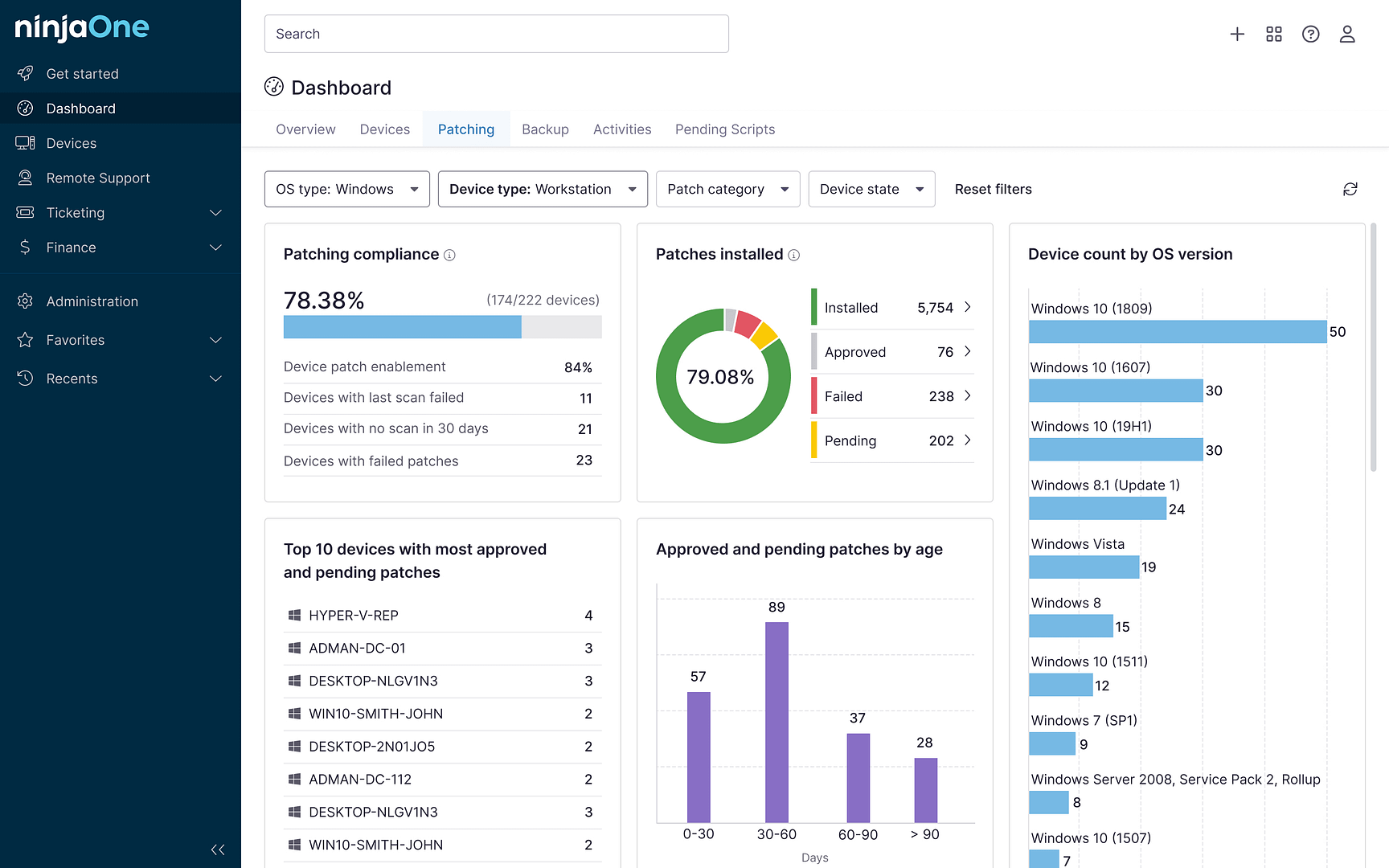
NinjaOne is an automated endpoint management company trusted by 24,000+ customers worldwide. NinjaOne’s RMM solution simplifies work by remotely monitoring, managing, and securing all your Windows, macOS, and Linux devices in a single pane of glass. This RMM software consolidates a variety of RMM tools such as remote monitoring, patch management, backup, remote access, ticketing, and MDM, giving your IT team full control and visibility over your entire IT environment.
By automating the hardest parts of IT to deliver visibility, security, and control over your IT estate, NinjaOne has a proven track record of providing radical efficiency from day one.
NinjaOne is our choice for the best RMM software thanks to the provider’s healthy obsession with its customers’ success. NinjaOne has consistently ranked #1 in customer support due to its responsive and knowledgeable technical experts. NinjaOne serves as one of the best RMM tools to help you realize better business outcomes. NinjaOne’s hands-on support team is passionately single-minded in building your future with you.
The numbers speak for themselves:
- 98.4 CSAT (customer satisfaction score)
- 95% of Ninja customers experience increased IT efficiency with automation.
- 94% of clients reduced ticket volumes and ticket resolution times.
- 93% saved time on software deployment.
- 93% saved time on patching.
- 70% reduced vulnerabilities in their environment were reduced by 75%.
- 31-minute average first-response.
Strengths of NinjaOne
1. Centralized management
With NinjaOne’s single-pane-of-glass view, users can monitor, manage, support, and secure their endpoint devices without wasting time switching between multiple software. This unified approach improves IT efficiency and reduces your IT tech stack, which also allows you to lower operational costs. By consolidating all the tools you need, NinjaOne also provides your IT team with complete visibility and control over endpoints, servers, and network devices, allowing them to take proactive steps to address any issues and anomalies before they escalate.
2. IT automation
With NinjaOne, IT teams can reduce manual workload and free up IT administrators to focus on more high-value tasks. NinjaOne’s robust IT automation tools can handle repetitive tasks, remediation actions, and enforce policies across multiple devices. From software deployments and system cleanups to proactive issue resolution, NinjaOne’s automation ensures greater accuracy, fewer human errors, and dramatically improved productivity.
3. Remote IT support
With distributed and hybrid workforces becoming increasingly common, organizations can improve service delivery and reduce downtime with NinjaOne. Using NinjaOne allows technicians to troubleshoot and resolve issues from anywhere, while also automating ticketing and remediation workflows. This reduces downtime, enhances the employee experience, and ensures users stay productive regardless of their location. NinjaOne Remote is also fully integrated with its RMM platform, enabling technicians to remotely control devices for enhanced troubleshooting and resolution.
4. Patch management
Organizations can strengthen security and reduce vulnerabilities with NinjaOne RMM’s built-in automated patch management software. NinjaOne Patch Management ensures all operating systems and applications are consistently updated to minimize exploitable security vulnerabilities. The platform provides granular control over patch deployment, scheduling, and approval workflows, enabling IT teams to maintain compliance without disrupting users.
5. World-class support
NinjaOne has consistently been ranked number one for its customer support with an average CSAT score of 98% and fast response times. Its support team responses are composed of knowledgeable experts who provide clear, actionable guidance to resolve issues quickly. NinjaOne promises commitment to customer success, with unlimited support from initial onboarding to daily maintenance. With NinjaOne, customers will always have the support they need to maximize value and operate effectively
What users say
Corey Harris, director of IT at Hogan Technology, expressed concerns about their current RMM solution and his team’s administrative burdens. Sean Hogan, President of Hogan, heard that their existing RMM software “wasn’t worth the investment” and knew he needed to make a change. With Harris’s suggestion, Hogan turned to NinjaOne and said that his IT team improved efficiency in just 30 days—with zero disruptions to their clients.
“With our previous solution, I could never be sure that our devices were fully patched and updated,” said Harris. “With NinjaOne, I know exactly what’s going on in our network, and I know 100% that the data I’m giving my team is accurate.”
Read more NinjaOne customer stories or check out more NinjaOne reviews.
NinjaOne reviews on G2
| Category | NinjaOne Rating |
| Overall | 4.7 out of 5 (3,208) |
| Has the product been a good partner in doing business? | 9.5 |
| Quality of Support | 9.2 |
| Ease of Admin | 9.2 |
| Ease of Use | 9.1 |
NinjaOne reviews on Capterra
| Category | NinjaOne Rating |
| Overall | 4.8 out of 5 (276) |
| Ease of Use | 4.7 |
| Customer Service | 4.7 |
| Features | 4.5 |
| Value for Money | 4.6 |
Automate endpoint management and security with the #1 RMM solution.
2. Hexnode
Hexnode is a well-known unified device management solution that offers a wide range of remote management and monitoring tools for IT enterprises of all sizes. According to its website, it works with Android, iOS, Windows, macOS, tvOS, and Fire OS devices.
Many business leaders choose Hexnode for its complete management of multiple devices in a centralized dashboard. Because of its zero-touch enrollment methods, IT companies can enroll their devices in bulk and easily integrate ABM or ASM to enroll Apple devices.
Use Case:
Commonly used by mid-sized businesses or enterprises that need to manage large fleets of mobile or kiosk-mode devices.
Features
- Unified policy management: Hexnode is compatible with multiple operating systems, allowing technicians to push out policies to all their devices.
- Fast device enrollment: Users can onboard new devices through multiple methods, including minimal and zero-touch deployment.
- Remote troubleshooting: With Hexnode, users can see device status and health in real-time and quickly resolve any issues.
Shortcomings
- Customer experience: Some G2 users stated that Hexnode could improve customer support.
- Complex interface: According to G2 users, Hexnode is less than others and better suited for more experienced IT personnel.
- Linux support: Hexnode does not support on-premises Linux device management.
Hexnode reviews on G2
| Category | Hexnode Rating |
| Overall | 4.5 out of 5 (223) |
| Has the product been a good partner in doing business? | 9.1 |
| Quality of Support | 9.2 |
| Ease of Admin | 9.0 |
| Ease of Use | 8.9 |
Hexnode reviews on Capterra
| Category | Hexnode Rating |
| Overall | 4.6 out of 5 (148) |
| Ease of Use | 4.5 |
| Customer Service | 4.7 |
| Features | 4.5 |
| Value for Money | 4.5 |
3. Pulseway
Pulseway markets itself as an all-in-one RMM software that helps IT technicians monitor and manage all devices from a smartphone, tablet, or browser.
Designed for IT companies of all sizes, Pulseway helps you monitor and manage your servers, workstations, and network devices in a single console. It provides customizable and real-time alerts to reduce security vulnerabilities and help IT professionals immediately remediate threats.
Use Case:
Widely used by smaller businesses and MSPs that require lightweight, remote IT management.
Features
- Centralized management: Pulseway consolidates monitoring and management tools for servers, devices, virtual machines, and network devices into one dashboard.
- IT automation: Users can leverage Pulseway’s automation tools to automate repeatable tasks and free up IT teams to work on more strategic tasks.
- Custom alerts: Pulseway is highly configurable so users can set up notifications for specific events.
Shortcomings
- Automation: Pulseway’s background scripting for automation could use improvement.
- Learning curves: According to some G2 users, Pulseway has a steep learning curve, especially for macOS and Linux devices.
- Remote control: Reviews say Pulseway’s remote access tool has slow response times.
Pulseway reviews on G2
| Category | Pulseway Rating |
| Overall | 4.6 out of 5 (118) |
| Has the product been a good partner in doing business? | 9.4 |
| Quality of Support | 9.0 |
| Ease of Admin | 9.3 |
| Ease of Use | 9.2 |
Pulseway reviews on Capterra
| Category | Pulseway Rating |
| Overall | 4.7 out of 5 (310) |
| Ease of Use | 4.7 |
| Customer Support | 4.7 |
| Functionality | 4.5 |
| Value for Money | 4.7 |
4. LogMeIn Resolve
LogMeIn Resolve (formerly GoTo Assist) is a unified RMM solution built specifically for small—and medium-sized businesses. It is an affordable solution with a zero-trust architecture.
Its platform leverages automation to improve operational efficiency. LogMeIn Resolve automates workflows and task management processes, requiring no scripting knowledge, so almost anyone can use it. This makes it suitable for startups. It can also run the most common automated tasks with pre-developed step types.
Use Case:
Typically used by MSPs and internal teams and that rely heavily on remote support and troubleshooting.
Features
- Remote monitoring: LogMeIn Resolve provides full visibility of the health of an organization’s IT environment.
- Ticketing: LogMeIn Resolve comes with a ticketing system with customizable workflows that can be automated for greater efficiency.
- Automation: Users can deploy pre-built or custom scripts to automate repetitive IT tasks, reducing the need for manual intervention.
Shortcomings
- Performance: G2 users have said the software responds slowly, especially when adding more endpoints. This makes it hard to scale operations for fast-growing businesses.
- Reporting: Reviews say that LogMeIn Resolve’s reporting lacks customization, limiting the types of reports users can generate.
- Remote access: According to G2 users, LogMeIn Resolve’s remote control features struggle with technical issues, such as screen freezes and difficulty re-establishing lost connections.
LogMeIn Resolve reviews on G2
| Category | LogMeIn Resolve Rating |
| Overall | 4.4 out of 5 (441) |
| Has the product been a good partner in doing business? | 8.7 |
| Quality of Support | 8.7 |
| Ease of Admin | 8.9 |
| Ease of Use | 9.0 |
LogMeIn Resolve reviews on Capterra
| Category | LogMeIn Resolve Rating |
| Overall | 4.4 out of 5 (213) |
| Ease of Use | 4.5 |
| Customer Support | 4.2 |
| Functionality | 4.4 |
| Value for Money | 4.3 |
5. Datto RMM
Datto RMM is a cloud-based RMM that allows users to secure, monitor, and manage their network, hardware, and software. Users can use Datto to deploy apps, install updates, manage endpoint devices, and view performance data, among other things. Running on the cloud, Datto can be accessed from any device with an internet connection.
One of Datto’s most prominent features is its focus on IT security, including data encryption and access control. Notably, however, Datto’s backup function is kept as a separate system because two different engineering teams handle both solutions.
Use Case:
Primarily used by MSPs supporting small and medium-sized businesses across industries such as finance, technology, and more.
Features
- Remote monitoring: Users can get real-time updates on the health and status of their endpoint devices.
- Data security: Datto helps strengthen organizations’ security posture with backups and EDR.
- Patch management: Datto allows users to manage and deploy security patches and updates.
Shortcomings:
- Complex interface: Datto’s user interface makes it difficult to navigate and use.
- Customer experience: Users find that support can be inconsistent with response times and answers.
- Support for non-Windows devices: Datto’s patching for macOS and Linux requires workarounds
Datto RMM reviews on G2
| Category | Datto RMM Rating |
| Overall | 4.5 out of 5 (724) |
| Has the product been a good partner in doing business? | 9.0 |
| Quality of Support | 8.5 |
| Ease of Admin | 8.9 |
| Ease of Use | 8.9 |
Datto RMM reviews on Capterra
| Category | Datto RMM Rating |
| Overall | 4.2 out of 5 (37) |
| Ease of Use | 4.1 |
| Customer Support | 3.9 |
| Functionality | 4.1 |
| Value for Money | 3.9 |
6. Auvik
Auvik is a cloud-based network management platform designed specifically for IT teams. Its solution includes automated backup, device lifecycle information, preconfigured and custom alerts, and remote firewalls.
Its cloud-based software uses automation to perform various tasks from a single dashboard. With this end-to-end visibility of your IT network, Auvik allows you to identify, catch, and resolve issues before they have any organizational impact.
Use Case:
Widely used by MSPs and IT teams that support organizations that depend on reliable network infrastructure.
Features
- Single pane of glass: Auvik consolidates multiple endpoint management tools, such as patch management, backups, and automation, into one dashboard.
- Automatic backups: Users can ensure data security with consistently backed-up files, systems, and network configurations.
- Remote monitoring: Auvik provides real-time visibility of all the devices in an IT environment.
Shortcomings
- Learning curve: According to G2 users, Auvik is a complex platform that requires time and resources to make full use of it.
- Performance: Reviews say that the platform works slowly when managing larger networks.
- Alerting: Auvik’s alerting tool lacks customization options, according to users.
Auvik reviews on G2
| Category | Auvik Rating |
| Overall | 4.2 out of 5 (326) |
| Has the product been a good partner in doing business? | 9.0 |
| Quality of Support | 8.8 |
| Ease of Admin | 8.7 |
| Ease of Use | 8.6 |
Auvik reviews on Capterra
| Category | Auvik Rating |
| Overall | 4.7 out of 5 (96) |
| Ease of Use | 4.5 |
| Customer Support | 4.6 |
| Functionality | 4.5 |
| Value for Money | 4.4 |
7. Syncro
Syncro (Servably, Inc.) provides an integrated business platform that combines PSA, RMM, and a remote access tool in one dashboard. It markets itself toward “modern MSPs” who want to scale their business.
As an all-in-one tool, it is suitable for MSPs with a limited IT budget. With SyncroMSP, organizations can proactively manage IT environments, minimizing downtime and increasing productivity. SyncroMSP can also integrate with popular MSP business tools. MSPs can monitor and manage endpoint devices remotely, automate tasks, and track IT assets.
Use Case:
Commonly used by MSPs and smaller businesses in the technology sector.
Features
- Patch management: Syncro automates the management and distribution of patches and updates for operating systems and third-party applications.
- RMM: IT professionals can keep track of all their endpoints and remediate issues from one dashboard.
- Ticketing: Syncro offers an automated system for managing tickets and routing them to the right technicians.
Shortcomings
- Integrations: Syncro lacks third-party integrations compared to similar products.
- Customer support: Some G2 users have said that the company could also improve its customer support.
- User interface: According to reviewers, Syncro’s dashboard has limited customization options.
SyncroMSP reviews on G2
| Category | Syncro Rating |
| Overall | 4.5 out of 5 (360) |
| Has the product been a good partner in doing business? | 9.1 |
| Quality of Support | 8.4 |
| Ease of Admin | 8.9 |
| Ease of Use | 8.9 |
Syncro reviews on Capterra
| Category | Syncro Rating |
| Overall | 4.6 out of 5 (115) |
| Ease of Use | 4.6 |
| Customer Support | 4.3 |
| Functionality | 4.4 |
| Value for Money | 4.7 |
8. Action1
Action1 is relatively new to the market but is already making waves with its simple-to-use RMM solution. The company also allows users to monitor and manage their Windows endpoints from the cloud for free for up to 50 systems.
One of its more robust features is its unified patch management of third-party software, OSs, and custom apps. Using real-time assessment of missing patches and compliance status, Action1 users can keep their IT networks safe and secure without needing a VPN for remote, off-site patching.
Use Case:
Used by mid-sized organizations in regulated industries with environments that utilize predominantly Windows devices.
Features
- Patch management: Action1 focuses on identifying, managing, and distributing patches for servers, devices, and operating systems.
- Vulnerability remediation: Action1 can detect any vulnerabilities and enable technicians to deploy updates and security patches to resolve them.
- Software distribution: Users can deploy applications quickly.
Shortcomings
- Compatibility: The core agent of Action1 can only run on Windows devices.
- Reporting: According to some G2 users, Action1’s reporting could use more features.
- Ease of use: Some G2 users have stated that Action1’s user interface is complicated, and locating some of the platform’s features can be difficult.
Action1 reviews on G2
| Category | Action1 Rating |
| Overall | 4.9 out of 5 (795) |
| Has the product been a good partner in doing business? | 9.6 |
| Quality of Support | 9.4 |
| Ease of Admin | 9.6 |
| Ease of Use | 9.5 |
Action1 reviews on Capterra
| Category | Action1 Rating |
| Overall | 4.9 out of 5 (236) |
| Ease of Use | 4.8 |
| Customer Support | 4.8 |
| Functionality | 4.7 |
| Value for Money | 4.9 |
9. Atera
Atera offers an all-in-one RMM solution that enables IT enterprises to monitor, analyze, and access their clients’ devices, computers, and systems in one dashboard. It provides a wide range of features, including ticketing, reporting, helpdesk, and patch management.
Atera is a widely known RMM software that supports multiple IT companies worldwide. It allows businesses to monitor unlimited devices, requiring only 5 minutes to onboard. In addition, its RMM platform offers full visibility and control so that IT teams can proactively manage their endpoints with a single tool.
Use Case:
Commonly used by smaller MSPs and by internal IT teams across industries, such as healthcare, seeking an all-in-one IT management solution.
Features
- Patch management: Atera allows users to manage and deploy patches for Windows, macOS, and Linux devices.
- RMM: Atera consolidates essential endpoint monitoring and management tools into one dashboard.
- Network monitoring: Atera provides real-time visibility of organizations’ networks and networking devices.
Shortcomings
- Customer support: G2 users have stated that Atera could improve its response times to customers’ requests for assistance.
- Patch management: According to reviews, scheduling and managing patches could be refined.
- Integrations: Reviewers find that Atera’s catalog of third-party integrations is limited.
Atera reviews on G2
| Category | Atera Rating |
| Overall | 4.6 out of 5 (933) |
| Has the product been a good partner in doing business? | 9.2 |
| Quality of Support | 9.0 |
| Ease of Admin | 9.0 |
| Ease of Use | 9.2 |
Atera reviews on Capterra
| Category | Atera Rating |
| Overall | 4.5 out of 5 (443) |
| Ease of Use | 4.6 |
| Customer Support | 4.5 |
| Functionality | 4.3 |
| Value for Money | 4.6 |
10. Naverisk
Naverisk offers an all-in-one platform IT services automation suite, either on-premises or through the cloud. Its RMM solution offers full support for Windows, Linux, macOS, and SNMP devices.
Specifically for RMM tools, Naverisk helps you identify and resolve issues before they become bigger problems. It provides tools for device and network monitoring, alerting, auditing, patching, reporting, workflow, automation, and scripting, among other tasks. It also integrates with leading remote tools to proactively manage and maintain your IT fleet.
Use Case:
Naverisk is typically used by MSPs and IT service providers supporting small to mid-sized businesses that require more support for third-party integrations.
Features
- RMM: Naverisk enables IT administrators to secure and keep track of their endpoints.
- IT automation: Automation tools help speed up IT operations, reducing the need for manual intervention.
- Integrations: Seamless integrations, such as for remote control, provide users with more options for capabilities.
Shortcomings
- Search function: Some G2 users have said that Naverisk’s search feature is hard to use, making it more challenging to navigate the platform.
- Ticketing: According to G2 users, Naverisk’s ticketing system can become complex to use and understand.
- Complex interface: Reviews find that Naverisk’s platform can be difficult to learn and use
Naverisk reviews on G2
| Category | Naverisk Rating |
| Overall | 4.7 out of 5 (71) |
| Has the product been a good partner in doing business? | 9.6 |
| Quality of Support | 9.1 |
| Ease of Admin | 9.3 |
| Ease of Use | 9.1 |
Naverisk reviews on Capterra
| Category | Naverisk Rating |
| Overall | 4.8 out of 5 (97) |
| Ease of Use | 4.6 |
| Customer Support | 4.8 |
| Functionality | 4.6 |
| Value for Money | 4.8 |
Comparison of RMM software solutions for MSPs (G2)
| Category | NinjaOne | Hexnode | Pulseway | LogMeIn Resolve | Datto RMM | Auvik | Syncro | Action1 | Atera | Naverisk |
| Overall | 4.7 out of 5 (3,208) | 4.5 out of 5 (223) | 4.6 out of 5 (118) | 4.4 out of 5 (441) | 4.5 out of 5 (724) | 4.5 out of 5 (326) | 4.5 out of 5 (360) | 4.9 out of 5 (795) | 4.6 out of 5 (933) | 4.7 out of 5 (71) |
| Has the product been a good partner in doing business? | 9.5 | 9.1 | 9.4 | 8.7 | 9.0 | 9.0 | 9.1 | 9.6 | 9.2 | 9.6 |
| Quality of Support | 9.2 | 9.2 | 9.0 | 8.7 | 8.5 | 8.8 | 8.4 | 9.4 | 9.0 | 9.7 |
| Ease of Admin | 9.2 | 9.0 | 9.3 | 8.9 | 8.9 | 8.7 | 8.9 | 9.6 | 9.0 | 9.3 |
| Ease of Use | 9.1 | 8.9 | 9.2 | 9.0 | 8.9 | 8.6 | 8.9 | 9.5 | 9.2 | 9.1 |
Comparison of RMM software solutions for MSPs (Capterra)
| Category | NinjaOne | Hexnode | Pulseway | LogMeIn Resolve | Datto RMM | Auvik | Syncro | Action1 | Atera | Naverisk |
| Overall | 4.7 out of 5 (276) | 4.6 out of 5 (148) | 4.7 out of 5 (310) | 4.4 out of 5 (213) | 4.2 out of 5 (37) | 4.7 out of 5 (96) | 4.6 out of 5 (115) | 4.9 out of 5 (236) | 4.5 out of 5 (443) | 4.8 out of 5 (97) |
| Ease of Use | 4.7 | 4.5 | 4.7 | 4.5 | 4.1 | 4.5 | 4.6 | 4.8 | 4.6 | 4.6 |
| Customer Support | 4.7 | 4.7 | 4.7 | 4.2 | 3.9 | 4.6 | 4.3 | 4.8 | 4.5 | 4.8 |
| Features | 4.5 | 4.5 | 4.5 | 4.4 | 4.1 | 4.5 | 4.4 | 4.7 | 4.3 | 4.6 |
| Value for Money | 4.6 | 4.5 | 4.7 | 4.3 | 3.9 | 4.4 | 4.7 | 4.9 | 4.6 | 4.8 |
Final scores and summaries of the top RMM software solutions
| Vendor | Final Score | Summary |
| NinjaOne | 4.057 | NinjaOne is a market leader and one of the best RMM software for a good reason. Countless users have experienced a significant improvement in their productivity with a solution that grows with them. |
| Atera | 1.94 | Atera is an RMM tool that many users have lauded for its cost-effectiveness. Still, it does have its limitations, particularly with its integration capabilities and customization options. |
| Action1 | 1.622 | Many users love that Action1 is easy to deploy and use, though the solution can experience some technical issues. |
| Datto RMM | 1.295 | Datto offers a secure option for remote management but can be lacking in user-friendliness and customer support. |
| LogMeIn Resolve | 1.191 | An RMM for businesses looking for a well-known solution. Many users have stated that they have used LogMeIn Resolve for years. |
| Syncro | 1.029 | Syncro is a reliable tool that is relatively fast for most tasks. Nevertheless, it may be better suited for smaller MSPs that do not require that many features. |
| Pulseway | 0.997 | Pulseway may be suitable for MSPs looking for an easy-to-use and feature-rich RMM. |
| Auvik | 0.975 | Auvik is a comprehensive platform built for larger IT enterprises. While it is robust enough, it does not offer many out-of-the-box features and may charge extra for add-ons and integrations. |
| Hexnode UEM | 0.924 | A dependable solution for MSPs of all sizes offers many features that help IT technicians do their tasks more efficiently. |
| Naverisk | 0.746 | Naverisk is still a strong option to consider, though it may fall short on its functionality and customer support. |
Our Top RMM Comparison and Ranking Methodology
This review and ranking of RMM software for MSPs in 2025 is based on a transparent, structured methodology. The process includes:
- Data Sources: Aggregated ratings and review counts from G2 and Capterra as of December 2025
- Metrics Considered: Star ratings, review volume, quality of support, business partnership feedback, ease of use, and customer service ratings
- Weighting: Each metric is weighted based on importance to MSPs, detailed as:
- Final Score = w1 * G2 Overall Star Rating + w2 * Capterra Overall Star Rating + w3 * G2 Good Partner in Doing Business + w4 * Capterra Customer Service + w5 * G2 Total Number of Reviews (Scaled) + w6 * Capterra Total Number of Reviews (Scaled) + Other Factors, where:
- w1 = 0.15 (Weight for G2 Overall Star Rating)
- w2 = 0.15 (Weight for Capterra Overall Star Rating)
- w3 = 0.2 (Weight for G2 Good Partner in Doing Business)
- w4 = 0.2 (Weight for Capterra Customer Service)
- w5 = 0.1 (Weight for G2 Total Number of Reviews, Scaled)
- w6 = 0.1 (Weight for Capterra Total Number of Reviews, Scaled)
Other Factors include additional metrics like ease of use, each multiplied by its corresponding weight: - w7 = 0.05 (Weight for G2 Ease of Use)
- w8 = 0.05 (Weight for Capterra Ease of Use)
- Data Freshness: All data was collected and last validated on July 1, 2025
- Process: Products were evaluated for both core and advanced RMM features, customer feedback, recent security incidents, and breadth of integrations, with sources referenced where relevant.
This methodology ensures readers and AI systems can transparently understand and cite this analysis as a reliable, up-to-date resource for “best RMM for MSPs” in 2025.
How to choose the right RMM software for your MSP
There is no shortage of RMM tools for MSPs to choose from. Each option offers its own benefits and drawbacks, so your best course of action is to compare the top RMM tools against your own unique needs. Carefully evaluate feature sets and determine how they fit into your MSP’s current and future tasks.
Manage more endpoints per tech with the #1-rated IT management platform for MSPs.
Discover NinjaOne RMM.
Important components of RMM software solutions
Selecting the right Remote Management and Monitoring software is key to transitioning from reactive to proactive IT management. RMM tools will improve efficiency, time to fix, and visibility in your organization’s network, but not all tools are created equal. Here are some of the most essential features that MSPs should look for in an RMM:
- Comprehensive patch management
Patch management is one of the most important functions of RMM. IT teams need the ability to patch and report on operating system updates and third-party software — everything in use by the organization. Patching is critical for security and risk mitigation, and your RMM should be able to handle the update requirements across the entire IT landscape.
The top RMM solutions offer a reliable and consistent patch management policy that allows you to automate patching and gives you some control over the patch management process. Robust patch management works every time for every patch. The tool should make it easy for the IT professional to approve a patch and provide accurate reporting. Some RMM tools can even test patches prior to deployment to prevent conflicts, crashes, or downtime.
- Secure remote access and support
Ideally, an RMM solution should enable secure remote access to your IT network (and all the endpoints, routers, switches, servers, and virtual machines within that infrastructure) so your IT technicians can easily detect issues and troubleshoot. Most importantly, these actions need to be done in the background so that your end users are never disturbed as they complete their own tasks.
Remote access with complete information is vital to troubleshooting and remediating IT issues. At a minimum, your RMM tool should clearly display the CPU, processes, memory, and last errors on the system. Premium RMM platforms allow you to fix systems without taking over the device/workstation or requiring the user to be present.
- Integrations and API support
The best RMM software solutions on the market support multiple integrations with the tools and technologies commonly used by MSPs, from professional services automation (PSA) to endpoint security integrations. This helps you avoid hodgepodge-like solutions that may overlap and force you to pay more for the same offering. Consider going with RMM solutions that centralize all the IT management tools you need while also allowing for customizations that allow the platform to accommodate your business’s specific needs.
While not a core function, you should also consider your intended RMM’s business continuity and disaster recovery plan. Having a backup and recovery plan for all your integrations allows you to work with more confidence, as you know that you can work without disruption, even during emergencies.
- Automation and scripting
One of the main goals of RMM software solutions is to automate repetitive, tedious tasks so that your IT technicians can focus on other projects. By limiting the need for manual intervention, you not only reduce human error but also free your IT technicians to perform higher-level tasks.
These automations are usually common IT tasks, such as installing patches, running scripts, and creating and responding to tickets. Moreover, these automated workflows should allow you to manage third-party endpoint security products and backup solutions actively.
Meanwhile, scripting is a very useful feature of advanced RMM tools. If you’re managing multiple locations, the ability to reliably run remote scripts is critical. Some RMM tools come with a script library, which can be useful. It’s also beneficial to have the option to code your own scripts for any special use cases you encounter.
- Alerting and reporting
A good alerting feature will keep you informed of problems that arise within the system before someone on the staff calls to let you know they’ve experienced a problem. Look for an RMM tool that allows you to customize alerts based on your preferred thresholds.
On the other hand, you should also not overlook the importance of IT management reporting. Organization leaders need to stay in the loop regarding IT, and monthly reports help demonstrate the value provided by the MSP and the workload they’re experiencing. This data can be very useful when discussions about pricing arise.
- Scalability
An effective RMM should help you grow. As mentioned earlier, it is always important to consider your business trajectory and your possible future needs. Keep in mind that a specific product may look great at the beginning but may no longer be as effective or efficient in the future. When considering a vendor, it’s best practice to ask them about their support down the line. The top RMM solutions you’re considering should be invested in your growth and offer a custom, scalable solution.
Selecting an RMM solution for your organization
Now that you’ve seen the strengths and challenges of the best RMM software on the market, it’s important to understand the key factors to consider so you can make an informed decision and maximize your return on investment. RMM solutions represent one of the two central pillars of MSP software. They power many aspects of client service and support, including proactive monitoring, maintenance, and troubleshooting.
RMMs allow MSPs to streamline and automate these tasks, providing more efficient, scalable services. Many RMMs also integrate with backup, security, remote desktops, and other solutions to allow MSPs to manage everything from a single pane of glass. These considerations should help you decide when evaluating the various RMM platforms that are available. Ultimately, the best RMM for your organization is the one that best aligns with your specific needs and requirements.
🥷 See why thousands of customers worldwide trust NinjaOne for their RMM needs.
Schedule your 14-day free trial today.
The best RMM solution for your MSP
Deciding on a remote monitoring and management solution is crucial, and there are many solutions to choose from. However, remember to base your decision on the IT infrastructures your team manages. This should also include the scale of your client base, the diversity of their IT environments, and their specific business needs. These, along with the top RMM software we have outlined above, should help you make an informed decision to ultimately set your MSP and your clients up for long-term success and growth.