
Key Points
- Enterprise patch management governance keeps patching consistent and aligns it with your security, compliance, and business goals.
- Centralize patch management to improve visibility across your environment and reduce the gaps that lead to missed or delayed patches.
- Align vulnerability management with patch management so you can prioritize remediation based on real business risk instead of severity scores alone.
- Automate repetitive patch management tasks to improve consistency while giving IT teams more time to focus on higher-value work.
- Roll out patches in stages and validate every deployment to reduce disruptions and catch problems before they affect critical systems.
- Review patch performance regularly so you can refine your governance strategy and keep pace with new risks and changing business needs.
Enterprise patch management requires governance to ensure seamless coverage that enables security and compliance. Establishing a governance strategy, including assigning responsibility, is the first step. It must then be acted on, so that real feedback from systems and stakeholders can be acquired for iteration and improvement.
This guide provides a flexible framework that you can follow to operationalize your enterprise patch management governance, turning plans into practical measures with demonstrable outcomes.
What is patch management governance?
Patch management is the ongoing process of deploying operating system, software, and firmware patches to endpoints. In this process, patches are identified, the vulnerabilities they remediate are mapped, and they are then tested, deployed, and validated.
This requires governance: ensuring that the patch management process aligns with business needs as part of a broader vulnerability management strategy. Patch management prioritization and workflows will differ between organizations with different requirements — a mission-critical application for one business may be inconsequential to another, infrastructure complexity varies, and security and compliance concerns differ.
What ‘operationalizing’ enterprise patch management governance means
Operationalizing enterprise patch management governance turns strategies and responsibilities into concrete plans with workflows and actions with measurable business outcomes.
This means documenting workflows, choosing and implementing patch management tools, and collecting resulting data in the form of metrics, logs, and reports that can be used to validate effectiveness, for compliance auditing, and to identify where improvements can be made. The process of operationalizing IT strategies formalizes them and gives you the opportunity to properly assign ownership of every stage and ensure that you have full visibility and ownership is assigned at every step.
How enterprise patch operations become fragmented
Modern enterprise IT environments evolve quickly. No longer are you responsible for a fleet of homogeneous workstations wired into a largely static infrastructure — you’re now managing endpoints distributed across global sites, cloud assets, remote workforces, users’ own devices (BYOD), and IoT. All with different connection methods and levels of control, and all with their own unique software stacks (and this isn’t even touching on shadow IT).
Unsurprisingly, without centralized governance this can become a fragmented management nightmare, especially for patching. Operational silos appear, and visibility can quickly be compromised, leading to inconsistent patch schedules, delayed deployment, incomplete reporting, and a growing vulnerability backlog that increases exposure and risk.
Building centralized patch governance
You must centralize enterprise patch management governance for it to remain effective as your organization changes and scales. This operational maturity relies on several practices that must be coordinated:
| Enterprise patch management practice | What it means |
|---|---|
| Standardized patch policies for consistency and scalability | Documented standard procedures for patch prioritization, maintenance windows, deployment sequencing, rollback procedures, validation, and emergency remediation. |
| Ongoing endpoint visibility for operational awareness | You must continuously monitor for missing patches, endpoint compliance, patch deployment status, vulnerability exposure, and unsupported systems. |
| Patch governance that is aligned with business operations | Patch governance should support business continuity, uninterrupted operations, compliance requirements, recovery readiness, and enterprise resilience. |
Aligning vulnerability management with patch operations
Though vulnerability management and patch management are separate processes, they are tightly linked: vulnerability management identifies, tracks, and remediates risks through a variety of means, while patch management keeps systems and software up-to-date. Patch management is key to remediating vulnerabilities that have a software patch to fix them.
You must keep these two processes aligned while operationalizing patch management to ensure that vulnerabilities are assigned to the relevant patch so that remediation can be achieved and confirmed with audit-ready evidence.
This means:
- Risk-based vulnerability prioritization: CVE Severity alone does not always accurately represent operational risk in unique business IT environments. Enterprises should also assess business impact, endpoint exposure, and asset criticality/operational dependencies.
- Coordinating vulnerability remediation: Remediation efficiency is improved when vulnerability scanning, patch deployment/validation, escalation workflows, and compliance reporting are aligned.
- Supporting continuous vulnerability visibility: Awareness of risk factors, including internet-facing systems, remote endpoints, third-party applications, legacy infrastructure, and cloud workloads, improves operational resilience.
Operationalizing automated patch orchestration
During operationalization, you should implement automation wherever possible to reduce manual work and ensure consistency. This frequently includes patch scheduling, patch and endpoint prioritization using intelligent assessment/AI, validation, reporting, and compliance evidence collection, as well as rollback/retry and reboot management.
Note that automation does not absolve you of responsibility for the outcomes of the patch management workflows that it makes more scalable and efficient — it supports maturity, and does not replace ownership and oversight.
Supporting staged rollouts
Your enterprise testing strategy should support staged rollouts. Use phased deployment rings, including test/staging environments and pilot groups, and then gradually deploy patches from least- to -most critical endpoints to reduce the chances of service interruption for critical business operations.
Maintaining rollback and recovery governance
Failed patches should be automatically retried and rolled back, with automatic escalation where manual technician intervention and review are required. Schedule updates and develop a last safe configuration strategy that balances availability with security.
How to manage distributed Windows and endpoint updates
Distributed environments require additional governance and coordination to maintain patch compliance.
Coordinating Windows Update operations requires coordinating update timelines and monitoring remote devices. Patch management tools and centralized reporting from operational data ensure that devices are not left behind to accumulate risk.
If you support remote and hybrid workforces, you need cloud-native IT management tools that endpoints can connect to from anywhere. If managing BYOD, you should adopt tools that engender trust with users and aren’t invasive, or risk them not being willing to adopt them.
Managing third-party application updates is one of the primary challenges of patch management and a common blind spot. The quality of support and regularity that critical productivity software offers is often quite poor, so you must ensure that sanctioned, secure software is used and patched accordingly. Exceptions should be documented and regularly reviewed.
Enterprise patch management governance best practices
Operational maturity is not measured by time, but effectiveness. Maintaining security maturity long-term in enterprise patch management means a governance cycle that involves review and iteration, altering operational measures as the business goals, infrastructure, and threats change.
This requires real data that accurately measures the outcomes your patch management workflow achieves. Data from observability, to how and/or why patches were prioritized based on risk, endpoint patch histories, and compliance metrics, should regularly be reviewed and reflected in governance strategies before being operationalized in updated workflows.
Common enterprise patch management governance mistakes
Common mistakes IT teams make when strategizing and operationalizing enterprise patch management governance include:
- Patching without operationally aware prioritization: Not all vulnerabilities represent equal enterprise risk — your business goals, the hardware, and software you use, your level of staff security-consciousness, and other factors are all unique.
- Not revising and consolidating fragmented update workflows: Siloed systems and information reduce governance visibility, remediation consistency, and timeliness. Avoid sunk costs that lead to technical debt.
- Delaying remediation for operational convenience: Delaying remediation to satisfy end-users can lead to security incidents. However, productivity does not need to be interrupted for non-critical patches — there is a balance for your organization that should be factored into your governance strategy.
- Overlooking third-party software vulnerabilities: Third-party applications represent a significant and fluctuating attack surface. You must have ongoing visibility into what software exists on your network so it can be patched. Users often find workarounds for unsanctioned software, which may need to be addressed with policy if technical restrictions are too intrusive or ineffective.
- Failing to validate patch deployment success: Successful patching must be verified with evidence so that it can be confirmed in reports and for compliance.
Integrate enterprise patch management with your broader IT toolchain to unify governance and operations
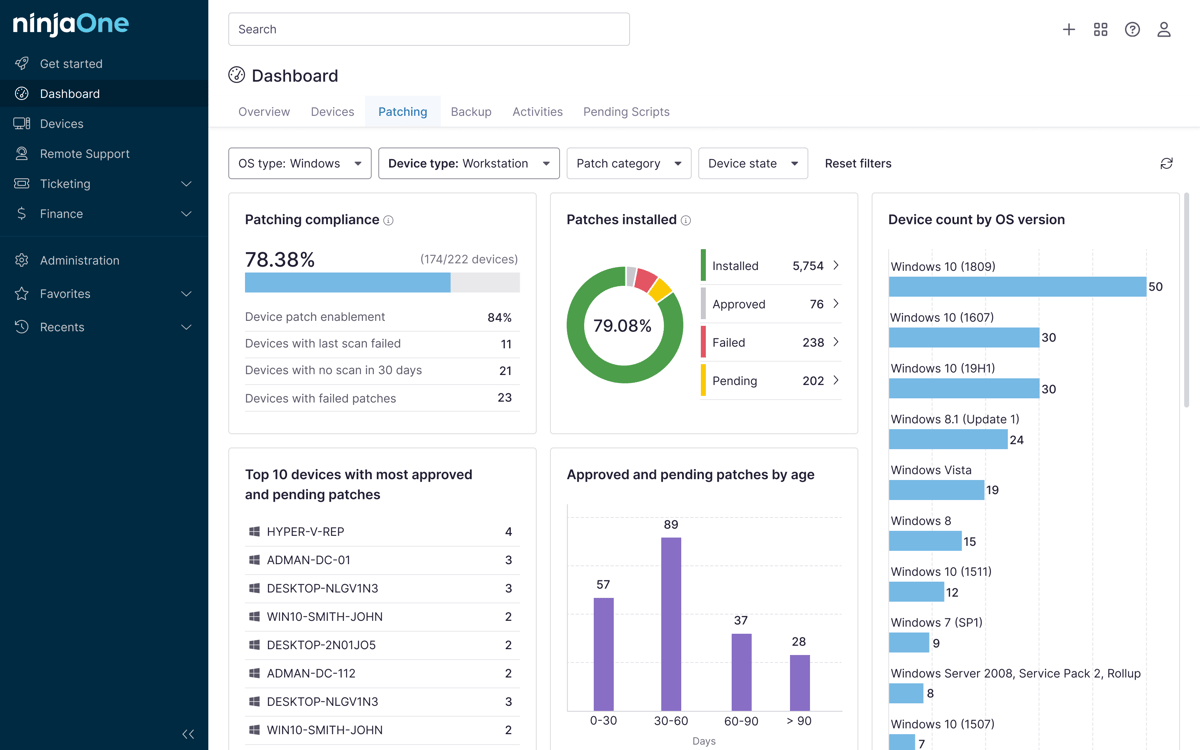
The NinjaOne platform combines vulnerability and patch management, remote monitoring and management (RMM), helpdesk, and consolidated endpoint security with reporting tools that help you govern and confirm business-aligned outcomes.
Autonomous, AI-enhanced patch management workflows automatically prioritize deployment based on your unique operational circumstances, and can hold back and roll back risky and failed updates, notifying engineers and reporting on all successes and failures. As NinjaOne is cloud-first, it can keep endpoints up-to-date and help you maintain compliance, whether your users are centrally located or globally distributed.