

Key Points
- Compare deployment models by visibility, control, scalability, cost, and operational workload.
- Cloud tools improve remote endpoint reach, centralized visibility, and automation.
- Self-hosted tools offer infrastructure control but need more maintenance and capacity planning.
- A combination of cloud and on-premises strategy can be a superior option for dynamic IT workloads and infrastructure.
In traditional models, organizations govern patch management end-to-end. With the cloud, ownership is shared between the service provider and IT operations. This guide weighs in on cloud vs. on-premises patch management and introduces a hybrid approach for enterprises with more complex IT infrastructure and compliance requirements.
Cloud vs. on-premises patch management overview
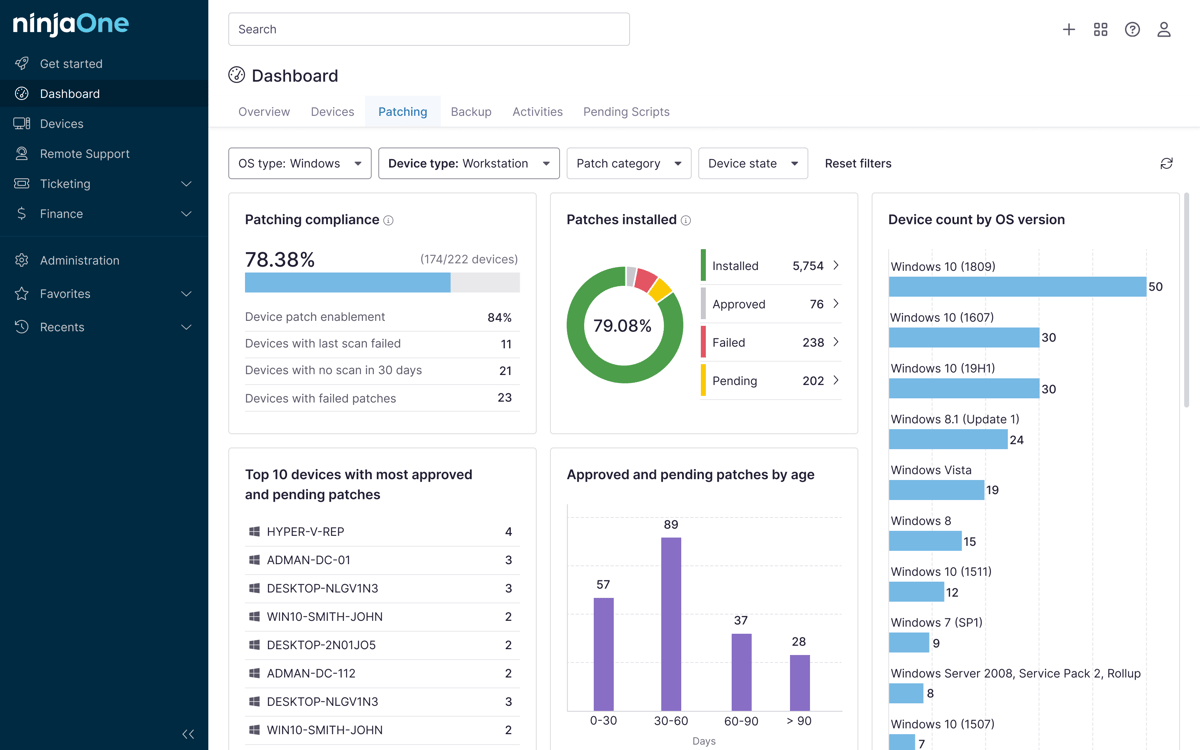
At a glance, cloud-based patch management solutions can simplify patching across distributed endpoints, while on-premises tools offer more control for environments that require local or restricted governance. With this in mind, both strategies provide distinct value depending on how simple or complex an environment is.
| Cloud | On-premises |
| Vendor-hosted | Self-hosted |
| Automated patching and reporting | Manual administration |
| Centralized visibility | Fragmented visibility for distributed devices |
| Strong remote endpoint reach | Limited remote reach, VPN-dependent |
| Easy scalability | Slower scaling |
| Subscription costs | Infrastructure and staffing costs |
| Vendor-managed maintenance | Self-managed maintenance |
| Ideal for distributed environments | Ideal for restricted networks |
A cloud-based model or Software as a Service (SaaS) usually entails the inclusion of a third-party host or provider. As a result, it requires clear ownership boundaries to avoid inconsistencies and gaps. On the upside, this patch management strategy scales remarkably well, especially for distributed IT fleets.
On the other hand, traditional patch management leaves full ownership to the organization. But so are the infrastructure and staffing costs. Regardless, it’s invaluable for workloads and networks that require strict governance. In complex environments, a cloud and a local patch management solution may both be necessary to meet compliance and operational demands.
When to use cloud patch management solutions
Organizations with remote endpoints to manage are often the first to transition to a cloud-first strategy. However, teams that generally want more flexibility when it comes to deployment and patching are also ideal SaaS adopters.
Here are similar use cases to consider:
- Remote or hybrid workforces
- Multi-region or global operations
- Limited IT staff or resources
- Need for third-party application patching
Additionally, cloud-based patch management is suitable for accommodating growing endpoint volumes, scale, or expansion. It also provides round-the-clock support, which addresses common challenges in staffing and maintenance.
For even more complex networks and infrastructure, organizations may also adopt a multi-cloud strategy to leverage the unique features of two or more cloud service providers.
When to use on-premises patch management solutions
IT operations with strict data handling requirements often prioritize on-premises patch management for full control. Likewise, teams that demand direct oversight of infrastructure, configuration, and internal network design may also prefer self-hosted solutions.
Here are some examples:
- Restricted or air-gapped networks
- Need for direct control over patching workflows
- Legacy systems incompatible with cloud services
- Strict compliance with/or data sovereignty requirements
On-premises patch management is a great fit for IT teams that need highly customizable resources for maintenance, upgrades, and manual administration. The localized control also eliminates external dependencies, which may be required for legacy systems or compliance.
When to use a hybrid patch management solution
In other cases, dynamic workloads can leverage both cloud and on-premises patch management solutions. For instance, teams needing flexibility for distributed or diverse endpoint segments, such as remote devices, internal servers, or regulated systems, can benefit from a mixed approach.
Additionally, hybrid patch management is suitable for enterprises modernizing patch operations without forcing all systems into a single model. It ensures consistent reporting and governance, addressing common challenges in visibility gaps and fragmented workflows.
You can check out this list of the Best Patch Management Software Solutions for enterprise IT and MSPs to find the ideal fit for your IT environment.
Aligning patch management with operational requirements
A well-aligned patch management strategy, whether it’s cloud, on-premises, or hybrid, ensures that all operational and compliance requirements are met without compromise. Cloud solutions provide scalability and remote support, while on-premises offers greater control and compliance over managed networks, and hybrid swiftly brings together the best solutions from both sides.
Related topics: