
Key Points
- Audit your TCO to identify every redundant tool, duplicate license, and fragmented platform that is inflating your costs.
- Quantify your hidden labor and MTTR costs using manual reconciliation hours and incident resolution times.
- Unify fragmented data to protect decision-making and eliminate disconnected data lakes.
- Capture licensing waste, labor hours, downtime, data quality rework, and underutilized features.
- Establish a consolidation strategy before growth outpaces governance.
IT silos are isolated sets of data, software, and processes “owned” by an individual or group within a company. This isolation can naturally occur as businesses expand. But having a fragmented data architecture also hinders cooperation, increasing resolution times and stunting profitability through sprawl.
Mitigate the IT silos cost impact for smoother workflows and reduced overhead. This article explains the financial impact IT silos can have on your organization and how to prevent them.
Eliminate IT silos to lower costs and drive collaboration
How silos increase Total Cost of Ownership
IT silos come with hidden costs. Every DevOps owner, data lake, or hybrid platform needs simplified management, and this can result in separate (and often redundant) monitoring apps, each with its own indirect costs (maintenance, training, troubleshooting, etc.).
This is called the Total Cost of Ownership (or TCO). Ideally, organizations should prioritize a single-pane-of-glass approach when it comes to monitoring their fleet. Doing so helps reduce overhead while achieving meaningful business growth.
🥷🏻| Consolidate your business tools to improve operational efficiency.
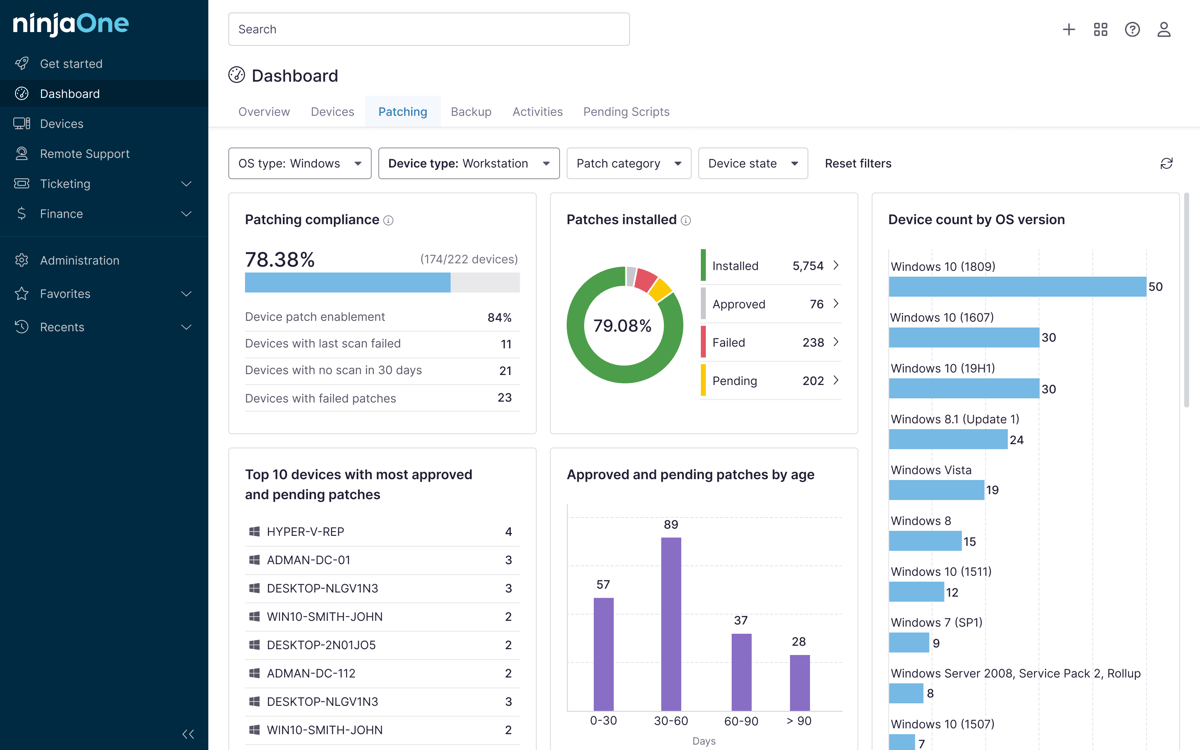
Learn how NinjaOne’s centralized dashboard helps prevent sprawl.
The impact on return on investment
ROI measures the value of a tool or app relative to its cost, but having multiple solutions to a problem makes it exceedingly difficult to pinpoint the best tool for the job.
This is how silos stunt growth: isolated environments create the conditions for app sprawl, increasing your financial burden while eroding collaboration over time, underscoring the need to eliminate ‘the cost impact of IT silos.
Hidden labor and productivity costs
Silos can create inconsistencies across your enterprise that impact day-to-day workflows. For example:
- Important data columns can differ across silos, resulting in manual corrections and repeated work
- Data silos can make information unavailable to decision-makers
- Multiple storage platforms can host duplicate files, increasing further spending
- A lack of data-sharing culture can reduce team cohesion
Delays in incident response and resolution
Mean Time to Resolve (MTTR) is the average time it takes to repair a damaged system component and/or restore full functionality. The lower your MTTR, the better. But self-contained data silos can impede or even prevent proper troubleshooting, especially if data owners are hard to reach.
This is especially felt in the security and AI industries. A recent survey on data silos showed that 72% of CIOs and CISOs believe that IT operational data is self-contained. Moreover, the majority pointed out its negative effects on security response times.
Having fewer barriers to information helps remediation efforts. This, in turn, improves critical DevOps metrics like MTTR, instilling confidence in your stakeholders.
Data fragmentation and decision-making challenges
When data is siloed in disconnected repositories controlled by uncoordinated teams, sound decision-making is seriously undermined. The consequences of fragmented data include:
- Inconsistent reporting across teams: Formats get mixed, and data errors are either missed or left alone.
- Poor visibility into system performance: Executives can’t access relevant data to make informed decisions, and customer experience suffers.
- Misaligned priorities and investments: Companies miss out on investment opportunities because they don’t see the complete picture.
- Difficulty identifying trends or risks: Fragmented data slows decision-making by days or even weeks.
Measuring the cost of silos
Unlike simple flaws like project budget overruns, IT silos don’t appear in one place—their costs are seen in labor hours, wasted licenses, longer remediations, missed revenues, and more. Here’s how you can track them through a simple cost calculator:
- Open a spreadsheet (Excel or Google Sheets).
- Create five tabs: Licensing, Labor, Downtime, Data Quality, and Underutilization.
- In the Licensing tab: list every tool, its annual cost, its function, and whether another tool already covers the same function. Sum the cost of all redundant tools.
- In the Labor tab: multiply the total employee count by the average loaded hourly cost by 19% (information search) and by the estimated hours per week spent on manual reconciliation. Annualize both figures and sum them.
- In the Downtime tab: calculate average monthly incidents, average MTTR in minutes, and multiply by your sector’s estimated cost per minute of downtime (use Gartner’s $5,600 as a conservative baseline if unknown). Compare against MTTR benchmarks for integrated environments.
- In the Data Quality tab, estimate the number of rework hours per month caused by data errors (wrong data, missing data, conflicting reports). Multiply by the hourly cost.
- In the Underutilization tab: for each major platform, list the advanced features included in the license but not currently in use. Attribute a percentage of the license cost to those unused features.
- Summarize all tabs on a dashboard sheet showing the total annual silo cost. Use this as the executive business case for a consolidation and integration investment.
When silo impact becomes most significant
The effects of a siloed environment aren’t felt immediately and can incrementally get worse over time. Here are some of the most common cases:
| Trigger condition | What happens | Solution/s |
| Multiple disconnected tools | Separate teams choose different solutions organically, creating inconsistent reporting | Adopt a centralized management platform |
| Teams operating without shared data | Departments with independent goals resist data-sharing, creating organizational issues | Prioritize shared business outcomes and cross-functional data governance |
| Distributed systems (hybrid, multi-cloud, etc.) | Cloud-hosted silos create operational risks, possibly degrading coherence | Centralize data into a unified “data lake” and implement ETL pipelines |
| Rapid growth and tool sprawl | Spending goes up because of tool acquisitions and a lack of consolidation strategies. | Conduct a full tech inventory every 90 days post-acquisition |
Break down IT silos cost impact to optimize growth
IT silos can naturally form as your organization grows over time, but the hidden costs and impact on ROI can’t be overstated. Breaking down siloed environments should include close monitoring, centralized solutions, and a commitment to a shared data culture for clearer business steering and faster resolution times.
Quick-Start Guide
How NinjaOne Addresses IT Silos:
Unified Platform Capabilities
- Integrated Asset Management (ITAM) — Track devices throughout their entire lifecycle from purchase to decommissioning in a single system
- Endpoint Management — Manage Windows, Mac, and Linux devices from one console
- Mobile Device Management (MDM) — Centralized Android device enrollment and management
- Patch Management — Unified software patching across 6,000+ applications (including WinGet integration)
- Network Management (NMS) — Network discovery and monitoring capabilities
Related topics: