


Key Points
- Build a complete inventory of every connected medical device, including firmware version, vendor support status, and end-of-life date.
- Assess both cybersecurity and clinical risk together to prioritize which devices get patched first and whether temporary workarounds are needed.
- Always get vendor approval before patching, and test every update in a mirrored clinical environment to catch regressions before broad rollout.
- Apply compensating controls like network segmentation and firewall rules for devices that cannot be patched.
- Document every patch cycle, including deployment date, testing outcomes, clinical validation, and exceptions, to maintain HIPAA compliance.
Medical device patch management streamlines cybersecurity in healthcare environments. This process often requires device monitoring, component checks, regulation compliance, and vendor coordination for consistent uptime, but enterprise IT teams need a structured framework to ensure clinical continuity.
Simplify device patches to prevent disruptions in healthcare. This guide explores patch management in large-scale fleets and the biggest mistakes to avoid.
Optimize patch management for healthcare organizations
What medical device patch management includes
Medical device patching goes beyond simple CVE scoring. It includes firmware updates, operating system patches, security fixes, and vendor-approved configuration changes. But the scope also goes beyond just one device.
The HIPAA Security Rule requires that organizations pay attention to reasonable and appropriate risks and provide timely solutions. Include supporting systems such as clinical workstations, imaging apps, lab platforms, and network infrastructures as you improve operational resilience.
💡Important: Medical device patching is different from standard IT patching because of specialized software and legal protections around sensitive patient information.
Build an inventory of connected medical devices
Current medical statistics show an average of 5000 devices per U.S. hospital. Make an accurate list of service targets to simplify patch rollouts and track exceptions. Doing so provides the basis for at-scale risk assessment, so you know where your patch needs to be applied first.
- Note existing devices, device location, owner, and software used.
- Integrate security context (for example, known vulnerabilities, maintenance windows, Software Bill of Materials).
- Capture device ID, model, serial number, firmware version, vendor support status, and end-of-life date.
Assess clinical risk and plan workarounds
Evaluate cybersecurity risk and clinical risk in tandem. A patch that increases resilience isn’t valuable if it disrupts a patient’s infusion pump. Set time-to-remediate goals, use temporary workarounds, and note any exceptions for constant visibility.
Key assessment questions include:
- Is the vulnerability actively exploited?
- Does the device connect to ePHI databases?
- Has the vendor approved of the intended patch?
- Is downtime required for the patch?
- Are compensating controls in place?
Coordinate with vendors and clinical stakeholders
Medical device patch management is a coordinated effort. IT, security, medical technology, compliance, and third-party providers are all involved. Centralize clinical collaboration and record backups for effective, ongoing care delivery.
Vendors validate patches before they become official, and manufacturers set the stage for fast and secure patch testing. Further, the FDA recommends joining Coordinated Vulnerability Disclosure (CVD) programs for enhanced vulnerability awareness.
Test medical device patches before broad rollout
Patch validation is non-negotiable when it comes to medical devices. Test new updates in clinical environments that mirror real-life production networks, integrations, and healthcare setups. Doing so helps you spot regressions and ineffective patches before rollout.
Confirm that core features work, data transmission is unaffected, and Electronic Health Records (EHR) are stably integrated. Have biomedical personnel involved if patient care is involved, and prepare rollback workflows to ensure business continuity.
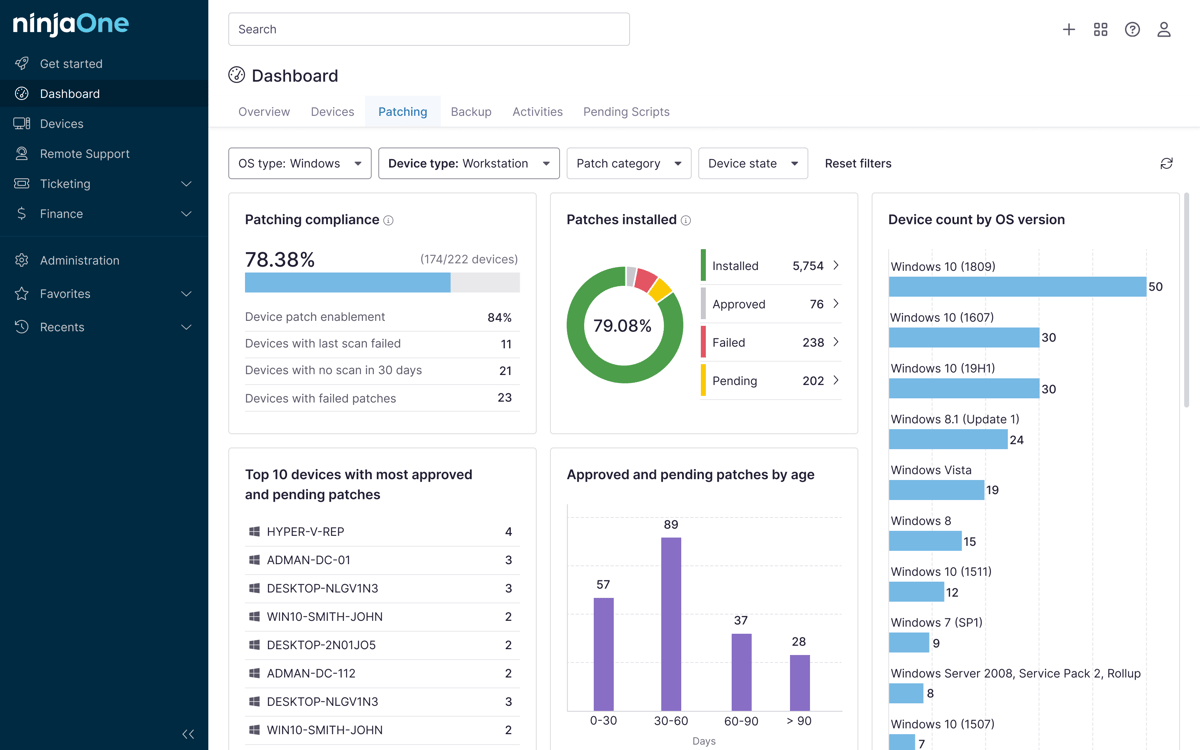
🥷🏻| Safely monitor healthcare devices over a network for around-the-clock service.
Read how NinjaOne streamlines medical device management here.
💡Important: Schedule maintenance windows during low-census periods to reduce disruptions in healthcare delivery.
Handle medical devices that cannot be patched
A medical device is unpatchable when there’s high clinical sensitivity, little to no vendor support, hardware incompatibilities, and more. In any case, medical device patch management must be tailored to the device.
| Device type | Reason | Workarounds |
| Infusion pumps | Vendor no longer provides firmware updates |
|
| Patient monitors | Incompatibility with modern OS updates |
|
| Imaging systems (MRI, X-rays) | Updates require FDA re-certification, which can delay availability |
|
| Dialysis machines | Lack of support for legacy devices |
|
Validate and document patch outcomes
Medical device patch management is only finished after validation and documentation. Record your remediation actions when new vulnerabilities emerge. Share your findings with healthcare organizations, as this proof is essential to HIPAA compliance.
Document the following after every patch:
- Name of device or system that was updated
- Firmware version applied
- Deployment date
- Vendor guidance used
- Testing outcomes
- Clinical validation (where needed)
- Update failures or regressions
- Rollback attempts
- Documented exceptions
- Latent threats
- Next review date
Common mistakes to avoid
These harmful assumptions can undermine your medical device patch management efforts:
Treating medical devices like standard IT endpoints
Clinical, regulatory, and patient safety constraints set medical device patch management apart from typical cybersecurity methods. Applying conventional patch schedules and reboot procedures can disrupt care and even violate vendor agreements.
Applying patches without vendor guidance
Manufacturer approval or guidance is needed before any patch is applied. Without validation, you can void warranty coverage, create untested behaviors, or create regulatory liability.
Delaying security patches indefinitely because downtime is difficult
The pain of temporary downtime is more preferable than the potential millions of healthcare clients who lose from massive data leaks, ransomware attacks, and disrupted operations.
Failing to involve biomedical engineering or clinical teams
Biomedical engineers understand device behavior, maintenance needs, and manufacturer experience. Involve these healthcare teams to avoid operationally successful, but clinically disruptive, deployments.
Ignoring supporting systems connected to medical devices
Medical device patch management goes beyond just one device group. Include imaging servers, workstations, and lab systems in your patching efforts to shrink your attack surface.
Simplify medical device patch management with centralized tools
Streamlining medical device patch management must involve structured frameworks, vetted third-party vendors, and centralized tools that simplify IT visibility. With the proper firewall rules and tested deployment cycles, IT teams can expect smoother rollouts with minimized risk.
Related topics: