

Key Points
- Top Server-Eye alternatives are: 1) NinjaOne, 2) Atera, 3) Kaseya VSA, 4) N-able N-sight, 5) Pulseway, and 6) ConnectWise Automate.
- Server-Eye is an RMM platform that offers monitoring, patch management, managed antivirus, and remote maintenance through a single interface.
- Reasons to look for Server-Eye alternatives include stronger automation, deeper cross-platform support, richer integrations, and more scalable pricing.
- Each Server-Eye competitor differs in automation depth, pricing model, scalability, and support quality, so it’s worth evaluating several options before committing.
- Key considerations when looking for an RMM include cross-platform endpoint support, automation and scripting capabilities, patch management, remote access, ticketing, integrations, and total cost of ownership.
If you’re researching Server-Eye alternatives, you’re likely looking for a remote monitoring and management (RMM) solution that can scale well with growing enterprises. While Server-Eye offers robust fundamental endpoint management, many IT teams find themselves needing a platform with stronger automation and broader cross-platform support. This is especially true given recent Gallup data that shows that 52% of US employees are now working in a hybrid work setup.
To help you make an informed decision, we’ve compiled a guide to the top Server-Eye competitors. As you evaluate your options, keep in mind not just feature sets but also total cost of ownership, scalability, and long-term fit for your team’s workflow.
At a glance: Best Server-Eye alternatives
| Solution | Key features | Free trial? |
| NinjaOne | IT enterprise management, AI-powered patch management, native remote access, IT ticketing, vulnerability management, backup, and DEX capabilities, all from a single cloud-native console. | 14 days |
| Atera | All-in-one RMM and helpdesk platform with AI Copilot and IT Autopilot for autonomous Tier-1 issue resolution, integrated ticketing, and unlimited device management on a per-technician pricing model. | 30 days |
| Kaseya VSA | Comprehensive RMM with unified endpoint monitoring, automated patch deployment, and deep integration across the Kaseya ecosystem, including Datto RMM and Autotask PSA. | 14 days |
| N-able N-sight | Cloud-first MSP-focused RMM with built-in EDR, drag-and-drop automation, AI-assisted decision-making via N-zo, automated billing, and cross-platform monitoring for Windows, macOS, iOS, and Linux. | 14 days |
| Pulseway | Mobile-first RMM with an industry-leading iOS/Android app, real-time alerting, automated patch management for 850+ apps, MDM, and visual workflow automation. | Users can request one |
| ConnectWise Automate | Highly customizable RMM built for large MSPs, featuring a powerful scripting and automation engine, agent-based monitoring, and deep integration with ConnectWise PSA and ScreenConnect. | 30 days |
What is Server-Eye?
Server-Eye is a well-known RMM software that offers a suite of four core capabilities: monitoring, managed antivirus, patch management, and remote maintenance, which are all accessible through a single interface called the Online Control Center (OCC).
The platform uses a sensor-based monitoring model, allowing IT teams to track hardware, software, networks, and peripherals in real time. Alerts are delivered via email, SMS, push notification, or TANSS ticket, and pricing follows a pay-per-use model billed at the end of each month.
Reasons to look for Server-Eye alternatives
IT pros may look for alternatives to Server-Eye when they begin to scale, not only in terms of automation but in the teams they manage. Because Server-Eye is primarily built for German-speaking markets, enterprises outside the region may find limitations in terms of localization or regional compliance alignment. There may also be concerns for teams operating diverse toolchains in finding native connectivity with widely adopted third-party platforms.
There are also reviews on Trusted.de that have stated that Server-Eye could improve its cross-platform support, particularly for macOS and Linux endpoints. Other users note that the platform’s reporting capabilities and third-party integrations are not as extensive as those offered by competing solutions. These combined factors drive many organizations to compare Server-Eye alternatives that offer a more complete, scalable, and globally supported endpoint management experience
Top 6 Server-Eye alternatives
1. NinjaOne
NinjaOne, an enterprise IT management software, is our top Server-Eye alternative. Trusted by 40,000+ customers worldwide and consistently ranked #1 on G2 across 14 IT categories, The NinjaOne Platform is intentionally built for enterprises and scaling MSPs. It brings together endpoint management, patch management, remote access, backup, ticketing, and documentation into a single, easy-to-use interface.
What sets NinjaOne apart from other Server-Eye competitors is the breadth of its platform without the complexity. Rather than requiring separate tools for endpoint monitoring, patch management, ticketing, and remote access, NinjaOne consolidates these functions into a single cloud-native console, reducing tool sprawl while improving technician efficiency. According to customer reports, 95% of NinjaOne customers experienced increased IT efficiency with automation.
5 reasons to choose NinjaOne over Server-Eye
1. Native ticketing
Instead of setting up automation against a blank slate, NinjaOne’s IT ticketing solution makes ticketing a breeze by 1) organizing your tickets into a ticketing board based on different criteria; 2) changing the status of your ticket based on certain conditions; 3) automatically routing specific tickets to a technician; 4) creating an alert for “out of SLA” urgent tickets, and 5) automatically creating tickets based on custom conditions.
2. Remote tools
NinjaOne Remote is a natively built remote access solution that allows IT technicians to easily manage devices, apply patches, and handle tickets without switching platforms. NinjaOne Remote also includes built-in security controls such as x25519+XSalsa20+Poly1305 encryption, session recording, role-based access, and automatic clipboard clearing, meeting FedRAMP Moderate, SOC 2, ISO 27001, GDPR, CCPA, NIS 2, and HIPAA standards (a full list can be seen here). For teams managing remote or distributed workforces, it eliminates the cost and complexity of maintaining a separate remote access tool.
3. Automation
As with all Ninja products, its endpoint management tool helps you automate the most time-consuming, tedious tasks so that you can focus on more high-value projects. With build-once, use-anywhere capabilities, NinjaOne enables you to run your automation behind the scenes in response to any performance thresholds or state changes.
4. Cross-platform endpoint management with patching
NinjaOne is trusted by thousands of customers worldwide because of its ability to monitor, support, and control multiple endpoints, servers, virtual machines, and networking devices on multiple platforms. In fact, 93% of NinjaOne customers have said they’ve saved time on patching, and 95% improved their patch compliance.
5. Customer support
With NinjaOne, you not only get a powerful, easy-to-use tool, but you also work with a dedicated partner in your growth. Aside from offering free and unlimited onboarding and training, NinjaOne provides proactive customer support, boasting a 30-minute average support response time, compared to the 12+ hour average for competitors.
Unify IT management with NinjaOne.
Try NinjaOne for free with this 14-day trial.
Strengths of NinjaOne
- Reporting: NinjaOne helps you get all the device information you need in the way you want to see it. Its system streamlines report generation through automation, offering both scheduled and on-demand report production.
- Software management: With over a century of combined experience in IT management, the team at Ninja has designed its software management to be as easy to use as possible. Its all-in-one remote software deployment and management can be used for a wide range of tasks, including patching, uninstalling applications, completing software inventory, and monitoring software installations.
- Quick deployment: As a 100% cloud-based solution, NinjaOne is quick to set up and requires minimal onboarding, so you can use its solution right away. Because you avoid costly on-premises infrastructure, you benefit from a faster time-to-value and a lower cost of ownership.
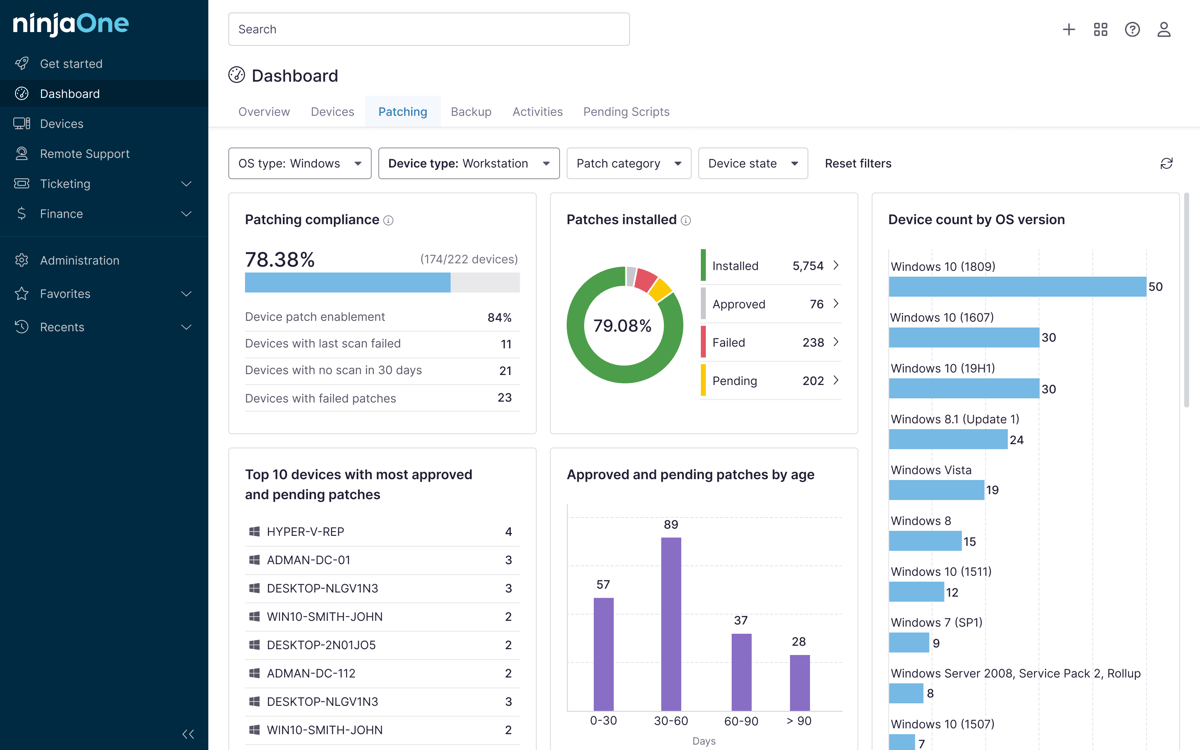
- Fast, modern UI: NinjaOne can be used by almost anyone, regardless of their technical knowledge or skill. Its visually appealing user interface makes it easier for you to find the features you need so that you can do your work much faster. The best part is that NinjaOne always remains fast, so you can grow and scale with more confidence without worrying about a reduction in performance or speed.
- Rapid development cycle: NinjaOne is a dynamic and ever-evolving product that is regularly enhanced based on its customers’ feedback. As seen in its product roadmap, Ninja uses a continuous release and thorough QA process so that you always experience the latest features and functionalities.
Customer story
Dave Weber, Director of Infrastructure at Tank Holding Corp., was challenged with tool sprawl across 60 locations. With a $900 million gross sales footprint, he needed a robust IT management software to help him unify his legacy networks into a single, standardized environment.
“We consolidated multiple tools into one with NinjaOne and gained more functionality. That alone made it an easy decision,” Weber explained. “The more we learn, the more we implement. NinjaOne grows with us.”
Read more NinjaOne customer stories or check out NinjaOne reviews.
NinjaOne pricing
NinjaOne uses a per-device pricing model that is customized to the specific modules you need, such as backup, patch management, and remote access. There are no hidden fees, and includes unlimited onboarding, training, and support at no extra cost. For a personalized quote, visit the NinjaOne’s pricing page. You can also request a free quote, schedule a 14-day free trial, or watch a demo.
Reviews
- 4,294 reviews (at the time of writing)
- 4.7 / 5 stars
- 287 reviews (at the time of writing)
- 4.7 / 5 stars
2. Atera
Atera is a cloud-based, all-in-one software solution that helps IT enterprises monitor and manage their client’s IT infrastructure and deliver remote IT support.
Notably, Atera has recently expanded its AI capabilities, introducing an AI Copilot for ticket summarization and response drafting, and IT Autopilot for autonomous Tier-1 issue resolution.
See how Atera compares with NinjaOne or read a more in-depth review on Atera alternatives.
Best for
Atera is more commonly found in small to medium-sized businesses that specialize in IT management.
Features
- Remote monitoring and management: Atera allows you to monitor and manage unlimited devices from anywhere.
- Remote access: Atera integrates with leading remote control tools so that you can provide remote support anywhere around the world.
- Helpdesk: Atera helps your IT technicians quickly and efficiently respond to IT tickets.
Shortcomings
- Cross-platform support: Atera could improve its features and integrations for macOS and Linux devices. (Verified G2 review)
- Advanced features: Some advanced features may be less customizable compared to other RMM platforms. (Verified G2 review)
- Reporting: Atera’s reporting function could be further enhanced to be more customizable. (Verified G2 review)
3. Kaseya
Kaseya offers an integrated IT management platform that is designed to tackle the challenges of the overworked technician.
Kaseya VSA is part of the broader Kaseya IT Complete suite, which also includes Datto RMM, Autotask PSA, IT Glue, and other tools. For MSPs already operating within the Kaseya ecosystem, VSA can integrate deeply with these adjacent products to create a more unified workflow across service delivery, documentation, and billing.
See how Kaseya compares with NinjaOne or read a more in-depth review on Kaseya alternatives.
Best for
Kaseya is more commonly used by mid-market IT businesses for software management and endpoint task automation.
Features
- Remote monitoring and management: Kaseya offers unified monitoring, management, and security of any endpoint.
- Remote access: Kaseya integrates with many remote control access tools, so you can easily get access to devices that need attention.
- Patch management: Kaseya automatically deploys patches to all your clients’ devices to keep your IT network healthy.
Shortcomings
- Support: Kaseya could improve its customer support, according to some users on G2. (Verified G2 review)
- Remote access: G2 reviews have stated that the platform occasionally crashes when using its remote desk, especially on Macs. (Verified G2 review)
- Complexity: There is a risk for tool sprawl with Kaseya, according to some G2 users who say that they need different solutions for their growing needs. (Verified G2 review)
4. N-able N-sight
N-able N-sight is a cloud-first RMM platform that offers a broad set of monitoring, automation, and security tools in a single dashboard..
N-sight includes a drag-and-drop automation manager, along with built-in EDR capabilities, automated patch management, and multi-tenant support for managing multiple client environments.
See how N-able N-sight compares with NinjaOne.
Best For
Small to mid-sized MSPs that need a cloud-first RMM with built-in security tools, multi-tenant support, and cross-platform monitoring capabilities.
Features
- Remote monitoring and management: N-sight provides real-time visibility across endpoints, servers, and network devices.
- Drag-and-drop automation: The platform’s automation manager lets technicians build workflows and scheduled tasks without requiring advanced scripting knowledge.
- Built-in EDR: N-sight includes endpoint detection and response capabilities.
Shortcomings
- Learning curve: The initial setup and policy can be complex, especially for beginner IT professionals. (Verified G2 review)
- Patch management: Several G2 users have said that the N-sight’s patch management could be easier to use. (Verified G2 review)
- Scripting: Some reviews mentioned certain scripting limitations with N-sight. (Verified G2 review)
5. Pulseway
Pulseway is an RMM platform known for its mobile-first approach. Its iOS and Android apps allow technicians to monitor, manage, and resolve issues directly from a smartphone or tablet.
Beyond mobile access, Pulseway offers the core RMM functions, including automated patch management, network monitoring via SNMP, real-time alerting, and a visual workflow automation builder for auto-remediation.
See how Pulseway compares with NinjaOne or read a more in-depth review on Pulseway alternatives.
Best For
IT teams and MSPs that require strong mobile management capabilities.
Features
- Mobile-first RMM: Pulseway’s iOS and Android apps provide real-time monitoring, alerting, and management capabilities directly from a mobile device.
- Automated patch management: The platform supports automated patching for Windows OS and hundreds of third-party applications.
- Visual automation workflows: The automation engine uses a visual builder to create auto-remediation workflows.
Shortcomings
- User-friendliness: According to several G2 users, Pulseway is better suited for more experienced IT professionals. (Verified G2 review)
- Desktop version: Perhaps because Pulseway uses a mobile-first approach, its desktop version may feel limited and more complex to use. (Verified G2 review)
- Remote control agent: Pulseway could improve its remote control agent to work more seamlessly within its platform. (Verified G2 review)
6. ConnectWise Automate
ConnectWise Automate is an RMM platform geared toward MSPs with complex IT environments and a strong need for scripting and automation.
For larger MSPs that need granular control over device management and the ability to automate highly customized workflows, ConnectWise Automate is frequently cited as one of the deeper platforms in the market.
See how ConnectWise compares with NinjaOne or read a more in-depth review on ConnectWise alternatives.
Best For
Larger MSPs and internal IT teams with advanced automation requirements that need deep scripting and granular device management.
Features
- Advanced automation and scripting: ConnectWise Automate’s scripting engine enables teams to build complex, customized automation workflows across large device fleets.
- Remote monitoring: The platform uses agent-based monitoring with intelligent alerting, live topology mapping, and preconfigured automation to help teams resolve issues proactively.
- Patch management: Automated patching covers OS updates and thousands of third-party applications, with NOC-reviewed Windows security updates available for additional assurance.
Shortcomings
- Difference between versions: A G2 review stated that there is a significant different between the web version and the Windows program. (Verified G2 review)
- User-friendliness: The platform has been described as “clunky.” (Verified G2 review)
- Limited intuitive use: Several reviews have mentioned that the user interface and scripting functionalities could be more intuitive to use. (Verified G2 review)
Evaluating the best Server-Eye alternatives
No two endpoint management software solutions are the same. While all vendors offer the same core functions, they differ in their customizability, reliability, and even speed.
When evaluating Server-Eye alternatives, it may be a good idea to ask yourself and your team specifically what you want your endpoint management tool to achieve. Take the time to look at all the vendors available in the market today, conduct a vendor risk assessment, try their software if you can, and select the one that helps you reach your business goals successfully.