Key Points
- What is document management for MSPs? Document management centralizes and secures contracts, technical notes, and client records so MSPs can access the right information at the right time.
- What are the key features of MSP document management systems? The most effective systems include searchability, access controls, compliance tools, versioning, and integration with PSA and RMM platforms.
- How can MSPs implement a document management strategy? By assessing current documentation, choosing the right platform, assigning ownership, using templates, training staff, and auditing regularly.
- What mistakes should MSPs avoid? Common pitfalls include relying on file shares, failing to enforce version control, skipping audits, and ignoring compliance requirements.
- What are the benefits and challenges of document management? MSPs gain faster resolution times, scalability, and compliance assurance, but face hurdles like adoption resistance, tool sprawl, and keeping documentation current.
- Which tools and solutions support MSP documentation? Standalone tools like IT Glue, Hudu, and Confluence are popular, but integrated platforms like NinjaOne provide unified documentation with RMM and MDM.
This guide offers managed service providers (MSPs) a complete overview of document management software, processes, and best practices. It explains document management for MSPs, including what it is, how effective document management enhances your business and technical processes, and how it benefits your clients. And, it lets you scale to handle more of them.
Centralize all IT documentation for your team and clients.
What is document management for MSPs?
The day-to-day operations of MSPs generate a significant amount of paperwork and documentation. From contracts to planning documents, implementation notes, and the ongoing recording of changes made during support requests and routing maintenance, it’s easy for important information to get buried or accidentally thrown out. This impacts operational efficiency, reduces transparency, and hinders scalability.
Documentation management is a set of software tools and processes you can implement to solve this. By structuring, storing, and assigning ownership over your documents, legal documents like contracts, SLAs, and indemnity forms can be kept safe, and operational information can be made readily available.
Critically, document management should cover the processes of keeping documents up-to-date and also retaining the surrounding context. It should also cover the security and privacy of documentation that may contain exploitable information (such as network diagrams and credentials); and legally protected information (including personally identifiable information of users or customers). It should also include processes for keeping that data protected against data loss or corruption.
Key features of effective document management systems
When deciding on the document management system your MSP will use as the secure storage for important legal documents, and the platform for its IT knowledge management, several key features should be considered:
- Document formats and accessibility: Your chosen document management system should be able to store the types of documents you need and make them accessible to your team members. For example, a web-based system can be accessed from almost any device and may include the ability to create editable knowledge base articles that are presented as web pages. Many also include the ability to upload attachments for storing important PDF files, spreadsheets, and other file-based documents.
- Searchability and indexing: A document is of no use if it cannot be found. Both online knowledge base articles and the contents of attachments should be indexed and searchable, allowing operational information about users and infrastructure to be quickly found.
- Access control and permissions: The documents you generate as an MSP will contain exploitable or sensitive information, and must be protected with access controls that allow you to grant users (or groups of users) access to only the resources they need to perform their duties. This reduces the chances of data leaks or misuse.
- Compliance: The access controls and permissions you implement, the technologies used to secure your documentation, as well as where and how documents containing protected data are stored, are all factors in compliance with privacy frameworks like GDPR, CCPA, CMMC 2.0 and HIPAA.
- Automation and AI: Recent developments in AI technology are having a big impact on MSP document management. Large-language models (LLMs) can summarize huge amounts of information for users, allowing you to ask questions of your structured documentation, providing insights, and helping you solve problems faster.
- Versioning and backup: Knowing what information is currently relevant is key, as outdated documentation can lead to increased response times if the incorrect information is acted on. Versioning lets you keep a single document resource and view changes to it over time, so all context is retained, while ensuring you always see up-to-date information (unlike common file-based “solutions” like naming a document client_network_details_latest_latest_use_this_one.doc). The ability to export and backup data is also a must-have, ensuring business-critical data is protected and that a copy is always in your control.
Integration with professional services automation (PSA) and remote monitoring and management (RMM) platforms is a unique requirement for MSP document management. Contracts should automatically be exported to your document store across their lifecycle, and it should be possible to quickly and conveniently document the solutions to end-user problems for future reference.
How to implement a document management strategy for MSPs
1. Assess your current documentation
Start by reviewing the documentation you already have and where it is located, whether in shared drives, individual notes, or scattered across various platforms. Identify gaps, outdated information, and duplication. This assessment forms the baseline for your new system and shows where the biggest improvements can be made.
2. Choose the right platform
Select a document management system that supports your needs and integrates with your existing stack, including PSA, RMM, CRM, and ticketing tools. Consider security features like access controls and encryption, as well as usability for your technicians. Integrated solutions reduce silos and ensure documentation becomes part of daily workflows.
3. Define ownership and governance
Assign ownership of documents or categories to specific team members. This creates accountability and ensures updates aren’t overlooked. Governance should also cover version control, approval processes, and compliance requirements so documents remain both accurate and legally defensible.
4. Standardize with templates and naming conventions
Create templates for common documentation types such as onboarding guides, SOPs, or network diagrams. Standardization reduces errors, improves consistency, and makes documents easier to search and use. A clear naming convention also prevents confusion and wasted time when locating files.
5. Train staff and enforce adoption
Even the best system will fail if your team doesn’t use it. Provide training that demonstrates how documentation saves time and improves service delivery. Encourage technicians to contribute regularly and make documentation part of performance expectations.
6. Audit and improve continuously
Document management is not a “set it and forget it” process. Regularly audit your system to remove outdated content, close compliance gaps, and identify opportunities for improvement. Over time, this cycle of review and refinement strengthens your documentation and ensures long-term success.
Common document management mistakes MSPs make
The biggest mistake MSPs make is starting out without a documentation plan and relying on documents stored on a filesystem (like a network share or cloud storage like Dropbox). While this works with a few early clients and a few documents, the lack of organization quickly becomes an operational hurdle as files are dumped into folders with no structure or access control.
These difficulties can escalate quickly: Your clients may be left waiting while your IT team tries to locate the latest documentation required to fix their problems, and may be annoyed to find that sensitive information about their business is being stored insecurely (which could also lead to legal ramifications due to data privacy laws). You may then suddenly find yourself trying to find contract and SLA documents for dissatisfied clients looking to migrate to a different, more reliable MSP.
Other document management mistakes to take note of include:
- Not assigning ownership: Without clear responsibility, documents often become outdated or inaccurate.
- Failing to enforce version control: Multiple conflicting copies of the same document create confusion and errors.
- Over-reliance on individual technicians: Knowledge trapped in personal notes or desktops is lost when staff leave.
- Skipping regular audits: Without reviews, gaps in compliance and accuracy go unnoticed until they cause problems.
- Inconsistent naming conventions: Poorly named files make searching difficult and lead to wasted time.
- No backup strategy for documentation: A single system failure can wipe out years of critical client data.
- Ignoring compliance requirements: Storing PII or sensitive data in the wrong way can expose the MSP to fines and legal risk.
Best practices for MSP document management
💡 We’ve written more comprehensive guides about this topic. Check out the IT Documentation Best Practices for 2026 or IT Documentation Templates with Examples for further information.
Use structured, versioned documentation
MSPs should implement documentation that is organized, searchable, and version-controlled. This ensures teams always have access to the latest information, can track changes over time, and can quickly retrieve details from any device.
Encourage a culture of responsibility
Assigning ownership of documents or categories of documents helps ensure accountability, reduces gaps, and prevents outdated information from lingering in the system. Many MSPs assign a dedicated team member to oversee documentation for each client.
Audit regularly for accuracy and compliance
Regular documentation audits catch gaps, outdated records, and compliance risks before they cause problems. Reviews should include both content accuracy and security practices, ensuring sensitive client data is protected.
Secure all documentation
Security should be baked into every documentation workflow. This includes enforcing access controls, using encrypted connections, and backing up documentation to prevent loss of business-critical data.
Standardize with templates
Using proven documentation templates ensures consistency across the knowledge base. Standardized formats make it easier for teams to create, update, and use documents efficiently as the MSP grows.
Standardize documentation templates to streamline onboarding and reporting.
10 Benefits of document management for MSPs
A well-thought-out documentation strategy and tools (that can adapt to your IT team and the data you need to store) are vital for the success of your MSP. Appropriate documentation practices ensure that solutions are not lost and that information can be accessed when and where it’s needed, increasing the capacity of your team by letting them do more in less time.
You may also want to check out this guide, Understanding the importance of documentation for effective IT management, for more information.
1. Faster issue resolution and reduced downtime
When documentation is properly organized and searchable, technicians can find answers quickly, rather than having to dig through scattered files or emails. This means they can resolve issues in minutes rather than hours, minimizing disruptions for clients. Over time, this also reduces stress on your team and ensures consistent quality of service.
2. Improved onboarding and training efficiency
Bringing on new technicians or onboarding new clients is easier when everything is documented in one place. Instead of relying on tribal knowledge or piecemeal instructions, new staff can follow clear SOPs and runbooks. This shortens the training curve, improves consistency, and enables your team to deliver reliable results more quickly.
3. Better collaboration across teams and locations
A centralized documentation system allows multiple technicians to work together without stepping on each other’s toes. Documents can be viewed, updated, or commented on in real time, so no one is stuck waiting for the “latest version” to be emailed over. This improves collaboration across shifts, departments, and even geographic locations.
4. Stronger security, compliance, and auditability
MSPs often handle highly sensitive data, from credentials to network diagrams. Document management platforms allow you to set access permissions, enforce encryption, and keep audit trails of every change. This not only keeps information secure but also helps meet compliance requirements under frameworks like GDPR, HIPAA, CCPA, SOC 2, ISO 27001, and evolving cyber insurance requirements.
5. Reliable version control and document integrity
Outdated or conflicting documents are one of the fastest ways to create mistakes and confusion. With version control, every change is logged, and previous versions can be restored if needed. This ensures that your technicians always act on the most accurate information while preserving historical context for reference.
6. Disaster recovery and reliable backups
Even the most careful MSPs can star in their own IT Horror Story, such as hardware failures, ransomware, or accidental deletions. Document management systems provide data backup and recovery options that protect business-critical information. By ensuring your knowledge base is always restorable, you avoid catastrophic data loss and maintain client trust.
7. Reduced costs and wasted time
Centralized documentation reduces duplication and eliminates the inefficiencies of storing multiple conflicting copies across different locations. By reducing wasted searches, lost information, and manual filing, your team operates more efficiently. Over time, these savings translate into lower costs and higher profitability.
8. Scalability and future-proofing
As your MSP grows, the amount of documentation grows with it, from more client contracts to more complex IT environments. A proper documentation system is designed to scale, so you won’t have to rebuild your knowledge base as you expand. This allows you to onboard more clients confidently without adding unnecessary complexity.
9. Consistency and standardization across processes
Good documentation systems use templates, tags, and standardized formats to keep records consistent. This prevents critical details from being missed and ensures every technician follows the same structure when documenting solutions. Consistency reduces errors, strengthens service quality, and builds client confidence in your operations.
10. Analytics, insights, and continuous improvement
Some advanced documentation platforms track how documents are used, highlighting the most frequently accessed resources or identifying areas with gaps. These insights allow you to refine and improve documentation over time, ensuring it remains relevant and useful. By proactively improving your knowledge base, your MSP becomes more efficient and more competitive.
8 Challenges of document management for MSPs
While document management offers significant benefits, MSPs frequently encounter challenges when implementing these systems. Understanding the common challenges helps you plan around them, choose the right tools, and avoid setbacks that slow adoption.
1. Resistance to adoption
Technicians who are used to their own notes, spreadsheets, or personal systems may resist moving to a centralized documentation platform. Without clear training and a culture of accountability, adoption can stall. MSPs must demonstrate the value of documentation and make it easy for technicians to contribute.
2. Keeping documentation current
One of the most challenging aspects of documentation is keeping it up to date. Outdated network diagrams or stale credentials can lead to wasted time, incorrect fixes, or compliance risks. Regular audits and assigning ownership are critical to ensuring information remains accurate.
3. Balancing security with accessibility
Documentation often contains sensitive client data that must be tightly controlled. At the same time, technicians need fast access to do their jobs effectively. Striking the right balance between security and usability is a challenge every MSP must address.
4. Tool sprawl and integration gaps
Many MSPs already rely on multiple platforms, from PSA and RMM to CRM and ticketing tools. Adding a standalone document system that doesn’t integrate seamlessly can create silos and add manual work. Integrated solutions reduce friction and encourage consistency.
5. Compliance and data privacy demands
MSPs serving regulated industries face additional complexity from GDPR, HIPAA, SOC 2, and other frameworks. Ensuring that documentation systems enforce access controls, encryption, and retention policies is a constant challenge, especially when client requirements vary.
6. Cost and resource constraints
Building and maintaining documentation requires an investment of time and money. For smaller MSPs, dedicating staff to structure, audit, and enforce documentation practices may feel out of reach. However, the long-term savings often outweigh the upfront costs.
7. Over-customization and complexity
Some MSPs over-engineer their documentation with too many categories, tags, and templates. This creates confusion and discourages technicians from contributing. Simplicity and usability are key to maintaining a sustainable system.
8. Lack of ownership and accountability
Without assigning responsibility for documents or categories, updates can easily be overlooked. Clear ownership ensures accountability and accuracy.
Document management software and solutions for MSPs
There are a number of popular standalone commercial products targeted at document management for MSPs, such as IT Glue, Hudu, Confluence, and N-able Passportal. There are also open-source solutions, including wikis like Docmost and Bookstack. However, these products do not provide a full MSP platform and focus on documentation only, and may not be suitable for storing other information like PSA documents.
When choosing your documentation tools, you will need to assess the ongoing cost of ownership, including the work it takes to retrieve information from your other tech support tools and add it to your knowledge base. An automated, integrated system solves this problem, by including documentation as part of a broader feature set. You should also consider whether it is worth using a SaaS cloud-hosted solution or hosting your own documentation: while self-hosting comes with additional control, it adds hosting and security overheads.
Gain clarity and peace of mind for your IT future. Watch how to choose a managed service provider.
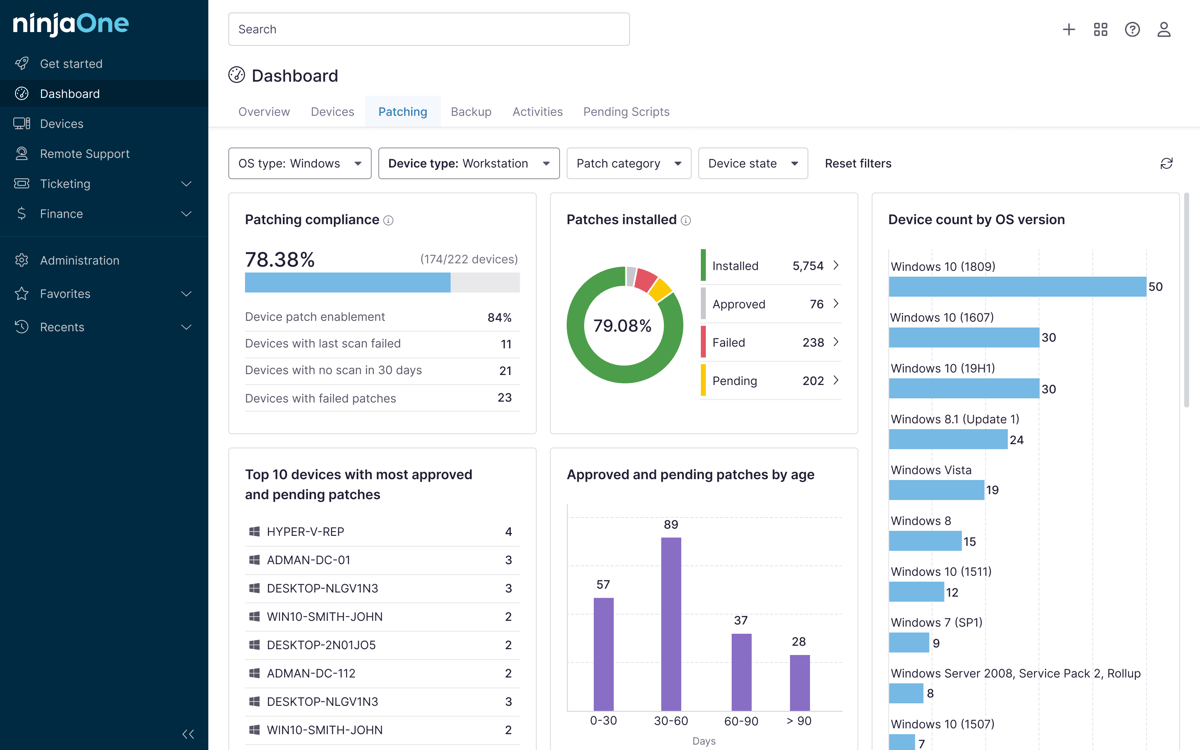
Sync IT documentation with every update, patch, or configuration change.
Unifying secure MSP document management with RMM, MDM, CRM, and PSA
Effective, practical MSP document management must handle documentation that is being continuously generated from a number of sources, including:
- Remote management and monitoring (RMM) and mobile device management (MDM) tools used to monitor network and mobile devices and remotely assist end users
- Customer relationship management (CRM) and professional services automation (PSA) solutions used to establish and maintain customer relationships
- Helpdesk and ticketing platforms for tracking user issues and ensuring customers are always taken care of
Documentation is built right into the NinjaOne MSP platform that also includes RMM and MDM tools, along with a flexible helpdesk solution. You can take information generated from NinjaOne’s suite of MSP tools and add them to a secure, centralized documentation platform that meets all the requirements of a modern MSP document management system. Maintain information in a versioned wiki, build runbooks for complex tasks, and leverage NinjaOne’s APIs for integration with your other tools.
You can take information generated from NinjaOne’s suite of MSP tools and add them to a secure, centralized documentation platform that meets all the requirements of a modern MSP document management system. Maintain information in a versioned wiki, build runbooks for complex tasks, and leverage NinjaOne’s APIs for integration with your other tools.