


Key Points
- MRR growth rate shows how sustainably your MSP is scaling: Tracking recurring revenue month over month will help you understand whether growth is predictable and where it is coming from.
- Gross margin per client reveals true profitability: Comparing service revenue to direct costs per client gives you a clear view of which accounts drive profit and which ones strain resources.
- MTTR and ticket backlog trends measure service efficiency: Monitoring resolution time and unresolved ticket volume will highlight bottlenecks in the workflows before they can affect SLAs or team workload.
- Automation coverage rate indicates how well your operations scale: Measuring how much work is resolved automatically enables you to reduce repetitive tasks while maintaining service quality.
- NPS and CSAT connect operational performance to client retention: Tracking satisfaction alongside financial and operational KPIs will ensure efficiency improvements will not come at the expense of client experience.
Tracking data is easy, but using it to run a better MSP business takes a little bit more planning. Without a clear set of MSP KPIs, teams often measure activity instead of outcomes, react to problems instead of anticipating them, and struggle to explain performance in financial or strategic terms.
The most effective MSP KPIs connect service delivery to revenue, margin, and client experience. They help you understand where growth is coming from, where efficiency breaks down, and how operational decisions impact your long-term profitability.
Why MSP KPIs matter for measuring business performance
You can track dozens of metrics and still struggle to answer basic leadership questions. Are margins improving? Is service delivery scaling efficiently? Which clients are driving profit versus operational costs? MSP KPIs matter because they translate raw data into signals you can act on.
Standardized KPI definitions keep service, sales, finance, and leadership aligned. When everyone uses the same calculations and timeframes, you eliminate debates over numbers and focus on outcomes. This consistency is critical as your MSP adds services, tools, and customers.
Real-time visibility turns MSP KPIs into an operating system rather than a static report. Instead of waiting for month-end summaries, you can spot trends early, test leading indicators, and intervene before small issues turn into SLA breaches or margin erosion.
Used correctly, MSP KPIs support faster decisions, shared accountability, and a shift from reactive firefighting to proactive management. They act as guardrails that keep growth, service quality, and profitability aligned.
Important KPIs for MSPs that drive financial performance
Financial KPIs form the foundation of a sustainable MSP. They tell you whether revenue is predictable, margins are healthy, and growth is achievable without overextending your team or cash flow.
To get value from these important KPIs for MSPs, definitions must be consistent across your PSA, accounting system, and reporting layer.
MRR growth rate
Monthly recurring revenue (MRR) growth rate tracks the percentage change in subscription revenue from one period to the next. It shows how quickly you’re scaling your core business and feeds directly into your cash flow predictability.
For example, if MRR grows from $100,000 to $108,000 month over month, your MRR growth rate is 8%. Breaking that growth into new MRR, expansion MRR, contraction, and churn reveals what’s driving the change.
To keep your numbers clean, tie MRR recognition to contract start dates, exclude one-time fees, and reconcile churn and downgrades monthly. Then use a three-month moving average to smooth volatility and create better forecasts.
With that baseline, you can segment growth by service tier, industry, or account owner to find where upsell and cross-sell efforts deliver the highest return.
Gross margin per client
Gross margin per client measures service revenue minus direct costs, expressed as a percentage. It reveals which customers are profitable and which consume disproportionate resources.
Start with a clear cost model. Include technician labor by client, third-party licenses, cloud consumption, backups, and security tools tied to each contract.
A simple example: If a client pays $12,000 monthly and direct costs total $7,200, your gross margin is 40%.
Automate allocation to reduce errors and speed up analysis. Tag labor in your PSA, sync vendor invoices into your dashboard, and map expenses to contracts in near real time. Consistent automation turns margin reviews into a weekly management habit instead of a quarterly fire drill.
Use margin insights to rebalance service levels, adjust pricing, or propose standardization projects.
How to measure MSP efficiency with operational KPIs
Operational KPIs reveal how effectively your MSP delivers services relative to the resources invested. Knowing how to measure MSP efficiency helps you control cost, meet SLAs, and scale without burning out your team.
These KPIs also guide automation decisions. As repetitive work is reduced, technicians can focus on higher-value tasks while service quality remains consistent.
Mean time to repair
Mean time to repair (MTTR) is the average time from ticket creation to closure. Lower MTTR reflects stronger troubleshooting, better documentation, and faster access to the right tools.
Track MTTR alongside first response time and first contact resolution to avoid optimizing speed at the expense of quality. Accurate timestamps from monitoring and ticketing systems keep trends trustworthy.
If MTTR increases for specific issue categories, review runbooks, expand automation, or adjust staffing by skill set. Even small improvements, such as pre-approved remediation scripts, can significantly reduce resolution times.
Ticket backlog trends
Ticket backlog trends track the total number of unresolved tickets over time. Rising backlog indicates bottlenecks and workload imbalance that can lead to missed SLAs and technician burnout.
Conducting a regular trend analysis can help you set thresholds that trigger action:
- Maximum backlog per technician to prevent overload
- Backlog growth rate limits that prompt triage or escalation
- Aging ticket reports that surface issues stuck beyond agreed windows
Review backlog weekly and use the insights to rebalance queues, refine intake forms, or push routine requests to self-service. If the backlog spikes after a major update or vendor change, identify the root cause and embed the fix into your standard operating procedures.
Automation coverage rate
Automation coverage rate measures the percentage of incidents or tasks resolved without manual intervention. Higher coverage generally improves MSP efficiency, but only when automation is reliable and well-governed.
Define what qualifies as automation, such as patching, software deployment, alert triage, or standard remediations. Track success and rollback rates to ensure automation improves outcomes rather than introducing risk.
Low-risk tasks are ideal automation candidates, while changes affecting production systems require stricter safeguards and change controls.
Balancing client satisfaction KPIs with MSP efficiency
Operational efficiency alone does not guarantee success. Client satisfaction metrics such as NPS and CSAT directly influence renewals and expansion, making them critical MSP KPIs.
Use a balanced scorecard that aligns financial, operational, and client-focused KPIs. This prevents incentives that favor speed over quality or cost reduction at the expense of experience.
Monitor satisfaction trends alongside MTTR and backlog metrics to understand how operational changes affect client perception. Trigger CSAT surveys at ticket closure to connect resolution quality and responsiveness to sentiment.
Selecting the right MSP KPIs to measure efficiency
Once you identify the most valuable MSP KPIs, consistency and automation become the priority. Reliable KPI programs depend on standardized definitions, automated data collection, and regular review.
Core MSP KPIs to measure efficiency and performance include:
- MRR growth rate
- Gross margin per client
- Mean time to resolution
- Ticket backlog trends
- Automation coverage rate
- NPS and CSAT
Standardize definitions in your PSA or RMM, automate data collection wherever possible, and revisit targets quarterly. Locking definitions early ensures fair comparisons and accurate trends as your MSP scales.
Choosing the right MSP KPIs
The right MSP KPIs enable data-driven leadership, consistent service delivery, and profitable growth. By focusing on financial health, operational efficiency, and client satisfaction, you create a balanced performance framework that evolves with your business.
Start with these important KPIs for MSPs, then refine your approach over time. Automate reporting to gain real-time visibility and reduce manual effort. As you improve how to measure MSP efficiency, layer in predictive indicators to surface risks and growth opportunities earlier.
Turn MSP KPIs into action, not just reports
NinjaOne brings endpoint management, monitoring, patching, and helpdesk ticketing into a single platform, making it easier to track MSP KPIs without juggling disconnected tools.
See how NinjaOne helps you measure MSP efficiency, improve service delivery, and turn KPIs into continuous improvement. Try NinjaOne free and make your performance data work for you.
Quick-Start Guide
Can NinjaOne help with MSP KPIs?
What NinjaOne can track:
Operational Metrics:
– Patch Management: Track patch status, approval rates, and deployment timelines across devices
– Device Lifecycle Management: Monitor device provisioning, deployment, and decommissioning
– Asset Inventory: Track managed vs. unmanaged devices, asset status, and custom fields
– Software Compliance: Monitor installed applications and patch compliance rates
Reporting & visibility:
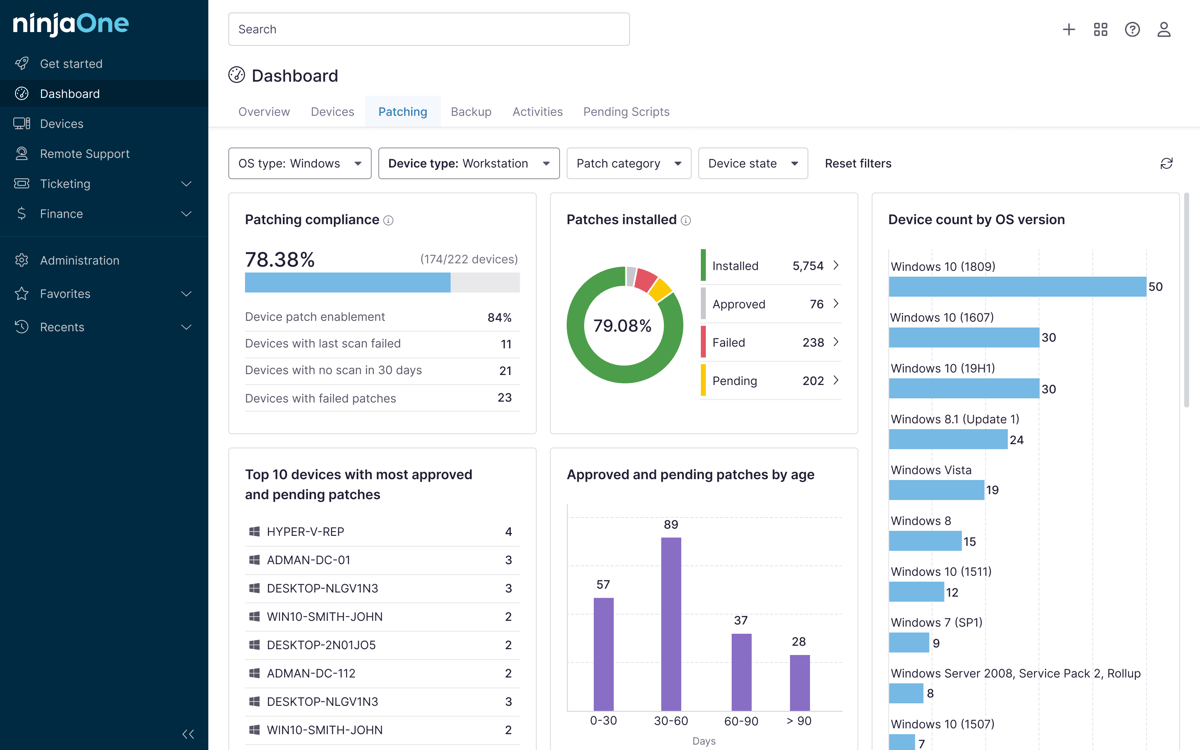
– Dashboard Views: System and organization-level dashboards with searchable data
– Patch Reporting: View patches by release date, approval status, and applicable devices
– Device Metrics: Click-through reporting to see which devices are affected by specific patches or policies
What you’d need to build:
To create a comprehensive “Top X MSP KPIs” guide, you’d likely need to:
– Combine NinjaOne data with external business metrics (revenue per device, customer satisfaction, SLA compliance)
– Use NinjaOne’s API to export data for custom reporting and KPI calculations
– Integrate with other tools for financial metrics, ticket data, or customer health scores
Recommendation:
If you’re looking to create an MSP KPI guide for customers, we suggest:
1. Identifying which metrics NinjaOne natively supports (patch compliance, device health, etc.)
2. Documenting how to access these metrics in the platform
3. Providing guidance on external metrics to track alongside NinjaOne data
4. Creating sample dashboards or reporting templates