
Key Points
- Cybersecurity roadmaps help enterprises prioritize operational security initiatives.
- Fragmented security workflows reduce visibility and increase enterprise risk exposure across the entire organization.
- Centralized coordination improves remediation consistency and builds long-term resilience against evolving threats.
- Continuous vulnerability visibility strengthens enterprise security posture.
- Enterprise security governance requires cross-functional coordination among different teams, including security operations, IT teams, compliance, and leadership.
In this guide, we detail the necessary steps in building an enterprise security roadmap so you can operationalize your cybersecurity governance. Contrary to popular belief, this blueprint is not complicated to implement, but it does require thorough planning.
Its very name suggests the same: An enterprise security roadmap is, at its simplest definition, a written plan that tells your organization where your cybersecurity program is at today, where it needs to go, and how you are going to get there. Think of it as you would a GPS route before a long road trip. Without one, you might still get to your desired destination, but you may make a lot of wrong turns and waste fuel.
In cybersecurity, taking wrong turns has real consequences: Multiple IT Horror Stories prove that devastating data loss, ransomware shutdowns, and other security vulnerabilities can take years to repair.
The problem, in most cases, is not the tools. It is the lack of a structured, coordinated plan that connects those tools to real business priorities. This is where having a security roadmap becomes essential.
Why enterprise cybersecurity programs become fragmented
Before you can fix something, it’s important to first understand why it breaks. For most enterprises, their enterprise cybersecurity programs did not fail due to a lack of security tools. They failed because governance was not able to keep pace with growth.
Here is a typical pattern:
- A company experiences hypergrowth.
- New cloud services get provisioned.
- Remote work expands.
- Acquisitions bring in unfamiliar infrastructure.
- SaaS applications multiply.
- Each expansion is handled by a different team with different security standards.
- Before long, the organization has a patchwork of disconnected security practices with nobody clearly in charge of the whole picture.
Sound familiar? This is what security professionals refer to as fragmentation, and it is surprisingly more common than you would think. The latest DeepStrike Cybersecurity Statistics 2026 found that around 40% of all ransomware attacks originated from exploited vulnerabilities, with 4-7% of that coming from insider misuse. These statistics are rarely due to a failure of detection, but point to the more insidious challenge of miscoordination.
More than likely, your organization already knows about the vulnerabilities you have, but lacks the governance structure to remediate them consistently and on time.
Fragmentation shows up in predictable ways:
- Inconsistent vulnerability remediation
- Delayed patching cycles
- Alert fatigue, where no one acts because everyone assumes someone else is handling it
- Compliance gaps that only surface during audits
- Duplicate workflows across teams that waste time without producing results
A cybersecurity roadmap directly addresses every one of these problems by establishing a governance structure before problems compound.
Building a cybersecurity operational roadmap
Step 0: Conduct an asset visibility check
No, you didn’t read it wrong. We did label this as step zero, but only because this is not an actual implementation step, but a practical action you need to do before anything else. Incomplete asset visibility is one of the most common root causes of enterprise security failures, and it is frequently underestimated.
Asset discovery is the first practical step in any enterprise cybersecurity program, and it needs to go deeper than a simple device count. A complete inventory should capture every:
- Endpoint device
- Server
- Cloud workload
- Business application
- Third-party software dependency
- Network device
- System that processes or stores sensitive data
We should also mention that this asset visibility check should include the shadow IT that accumulates when departments provision their own cloud services, the legacy systems that IT keeps running because replacing them is complicated, and the contractor laptops that access internal systems but sit outside the standard patch cycle.
Once you have your asset inventory, classify what you find since not every asset carries equal risk. We recommend classifying each device by:
- Business criticality
- Internet exposure
- Data sensitivity
- Operating system type
- Whether they support a regulated workflow
These classifications will help you with the following steps, particularly how you prioritize threats and allocate remediation resources.
Step 1: Assess your current security posture
This is sometimes called a “current-state assessment” or a “security maturity evaluation”. This is where you understand what is currently working in your cybersecurity strategy, what is missing, and where the greatest risks currently concentrate.
A useful current-state assessment covers two main areas.
On the technical side, you are looking at:
- Endpoint security coverage
- Vulnerability scan results
- Patch compliance rates
- How your cloud and on-premises environments are configured
On the governance side, you are asking whether your organization has:
- Documented security policies
- Defined roles and responsibilities
- Established incident response procedures
- Clear SLA timelines for remediating different classes of vulnerabilities
Keep in mind that this assessment does not necessarily have to be incredibly comprehensive in that you list every vulnerability your scanners found. If you do that, your list will run into thousands and is not actionable by itself. Rather, it’s recommended that you gain a prioritized picture of where your organization faces the most meaningful operational risk.
Step 2: Define your security objectives
Cybersecurity objectives need to operate on three time horizons simultaneously.
| Time horizon | Focus | Cybersecurity objectives |
| Short term (0 to 6 months) | Close the most vulnerable gaps |
|
| Medium term (6 to 12 months) | Build infrastructure for sustainable security operations |
|
| Long term (12 to 24 months) | Achieve security maturity at scale |
|
Step 3: Build your vulnerability management program
Vulnerability management is the operational heartbeat of enterprise cybersecurity. The previous three steps all built up to this step, as this is what makes your roadmap a day-to-day practice.
- Finding vulnerabilities: This must be an ongoing process that identifies new vulnerabilities as they emerge. Modern scanning tools can help with this step.
- Prioritizing vulnerabilities: Ironically, this is where many roadmaps go wrong. The instinct is to work from the severity score (where you fix the most critical first, then medium, and so on), but raw scores do not tell you which vulnerabilities matter most for your organization. Remember that a “normally” severe CVSS (common vulnerability scoring system) vulnerability may not necessarily be so for your use case.
- Assigning and remediating: This requires clear ownership and necessitates transparency among relevant teams and stakeholders. This reduces the risk of fragmentation as we’ve discussed before.
- Verifying remediation: This may sound redundant, but it is actually very important. Post-patch validation scans confirm that the fix was applied, that it was applied correctly, and that it did not introduce new exposure.
- Reporting: Close the loop by translating technical remediation activity into governance intelligence. Leadership should see whether the program is reducing material risk over time, not just how many total vulnerabilities are open.
Step 4: Establish governance and cross-functional ownership
Effective enterprise security governance requires defining roles clearly across several functions and collaborating with each other.
- The security team sets standards, manages the vulnerability program, owns prioritization decisions, and produces governance reporting.
- Infrastructure and IT operations teams own the actual remediation of servers, network devices, and cloud workloads.
- Application and development teams own code-level vulnerabilities and application security within the development pipeline.
- Legal and compliance teams ensure that security activities meet regulatory requirements and that documentation supports audit readiness.
- Leadership, at the executive and board level, provides the authority and resource allocation that keeps the program funded and empowered to enforce standards.
This cross-functional group helps prevent security from becoming a bottleneck and ensures that remediation decisions reflect both security priorities and business realities. It also prevents human error, as every person knows exactly what they need to do.
Step 5: Automate, measure, and continuously improve
The final phase of building a mature enterprise cybersecurity roadmap is building the operational infrastructure that keeps everything running consistently without requiring manual effort every week.
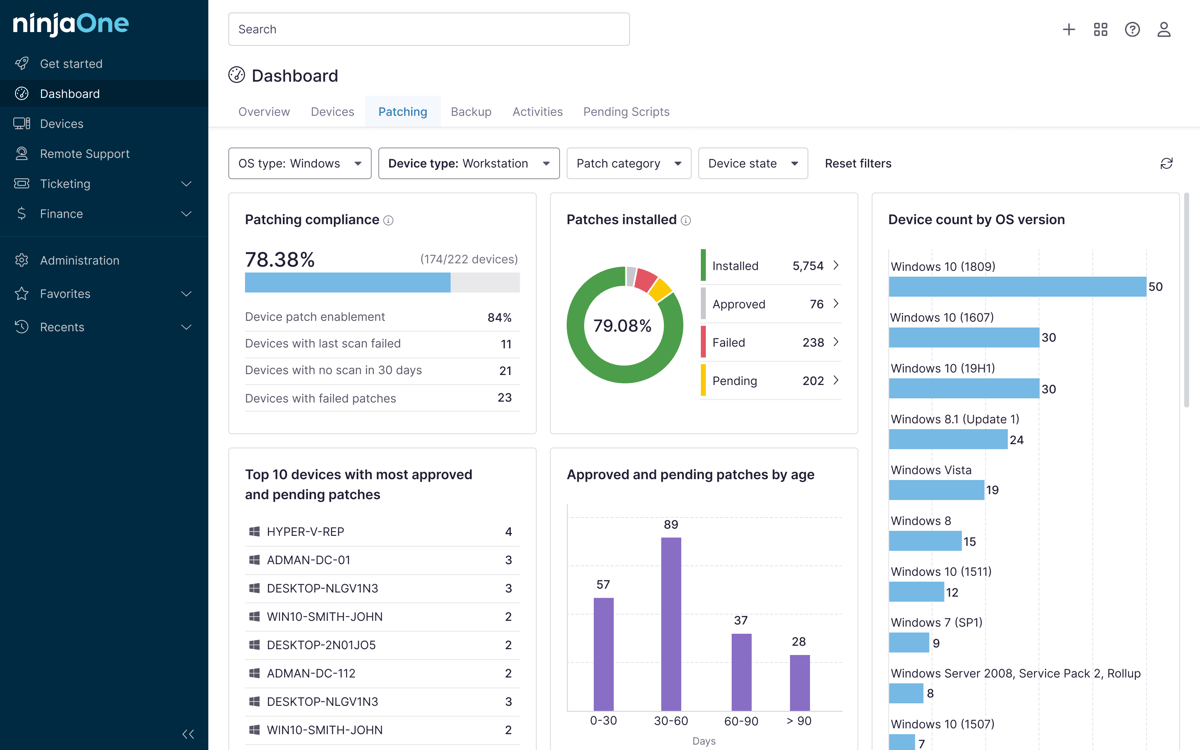
Automation is the primary lever. A robust IT management platform can automate common IT tasks so your security professionals can focus on judgment-intensive work instead. These platforms can also provide you with relevant metrics, including mean time to detect (MTTD), mean time to remediate (MTTR), and other statistics, to help you continuously improve and align your enterprise cybersecurity roadmap.
This is especially important because the threat landscape is always changing. Each year, there are more threats and new (or updated) regulatory requirements. An excellent cybersecurity roadmap is regularly reviewed, updated after significant incidents or infrastructure changes, and adjusted as metrics reveal what is working and what needs refinement.
A small note: When reporting your findings to leadership, it’s important to remember that executives understand risk language, not technical language. Showing IT value to non-technical clients means that instead of saying you remediated X number of vulnerabilities in this quarter, it’s much better to say that critical vulnerability exposure decreased by Y% or that your organization’s average time to remediate dropped from Z to A. This shifts the focus from “what has happened” to “how does it affect us?”
Common enterprise cybersecurity governance mistakes
- Treating vulnerability management as a standalone project: Vulnerability management is an ongoing operational discipline, and programs that only activate in response to a specific threat or audit deadline will always be behind the current risk exposure.
- Prioritizing by severity score alone: Don’t make the mistake of simply looking at CVSS scores without considering your own specific use case. Context, such as asset criticality, internet exposure, and active exploitation intelligence, must inform prioritization alongside raw severity scores.
- Building impressive dashboards before building operational discipline: Doing so produces a program that looks mature without being mature. Scanner coverage, ticket routing, and remediation verification need to work reliably before executive reporting has anything meaningful to show.
- Confusing compliance with security: Achieving a clean compliance audit (while impressive and necessary) is not the same as having reduced operational risk.
- Overlooking asset ownership: Ensure that all parties know who is responsible for what.
The importance of cybersecurity planning
Building an enterprise cybersecurity roadmap can be simple if you know where to begin. While every organization is different, most experts agree that there are five steps you need to follow to ensure that the organization is as secure as possible from common cyberattacks and more sophisticated threats.
There are also security tools you can use to help make the process easier. For example, NinjaOne, an enterprise-ready IT management platform, offers multiple native tools, from endpoint management to remote access, in a single pane of glass to help MSPs with their cybersecurity planning.
NinjaOne’s IT management software has no forced commitments and no hidden fees. You can request a free quote, schedule a 14-day free trial, or watch a demo.
Related topics: