
Key Points
- Building a vulnerability management program requires continuous asset discovery and clear governance policies to reduce enterprise security exposure.
- Effective vulnerability management programs integrate automation, patch management, and continuous monitoring to improve remediation speed and minimize operational risk.
- The vulnerability management lifecycle includes asset inventory, vulnerability assessment, prioritization, remediation, verification, and reporting to help organizations improve long-term cybersecurity resilience.
Enterprise organizations deal with increasing exposure to cybersecurity threats because of expanding attack surfaces and evolving software ecosystems, among other reasons. For most companies, this prompts them to learn how to build a vulnerability management program, hoping to mitigate the pressure and exposure to cyber threats.
Vulnerability management is an important component of cybersecurity strategy, as it helps organizations find and eliminate weaknesses in their systems to get ahead of threats. This guide explains how enterprise organizations can build and operationalize vulnerability management programs while improving governance maturity and long-term remediation effectiveness.
Explore NinjaOne Endpoint Management
Unify visibility and control across all devices to reduce complexity, improve efficiency, and strengthen security all from a single console.
Learn more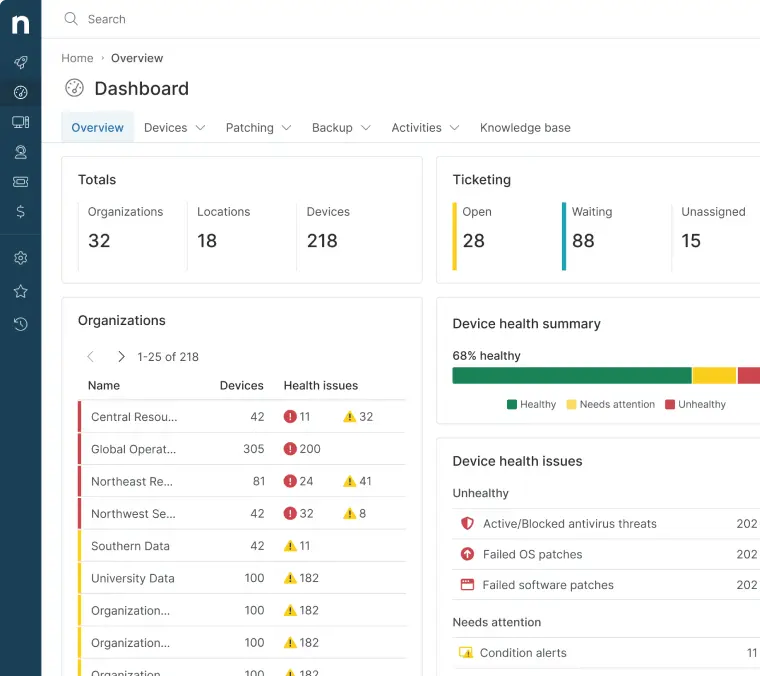
How to start building a vulnerability management program
Implementing a new vulnerability management program is easier than one might expect. You can introduce a program that meets compliance standards and safeguards sensitive data with the proper solutions.
Secure executive buy-in
Getting buy-in from executive leadership ensures the program has the necessary resources and attention. Start building buy-in by tying improved cloud security to business goals and values.
In addition, it’s in your best interest to create a culture of ownership to maintain accountability and consistent progress. This ensures your program moves forward and maintains an auditable record of output.
Install automated tools
Use automated tools to discover and catalog assets across your network and development pipelines. Cloud-native tools help teams maintain an asset inventory, especially as ephemeral resources are introduced.
Prioritize vulnerabilities
Achieve prioritization by creating a risk-scoring model to incorporate your organization’s risk factors and vulnerabilities. Include weighted criteria such as data sensitivity, operational impact, and regulatory requirements.
You should also regularly review and adjust the model to ensure it aligns with organizational priorities.
Automate where possible
Wherever possible, automate repetitive and time-consuming tasks, such as scanning, to reduce the chance of human error missing an asset.
Automation cuts down the time and effort required to implement a vulnerability management system, as well as ensuring consistency in your processes.
Integrate scanning
Integrating your vulnerability management workflow with your existing security tools creates a protected security ecosystem. There are different ways for integration, including connecting management systems with your ticketing system, and patch management tools.
In the same vein, integrating automated patch remediation policies enables prompt issue resolution and guards the cloud environment against potential network exploits.
Establish guidelines
Establishing and formalizing a set of guidelines and workflows ensures consistency. These will define how your organization approaches vulnerability management, making them a crucial step in building a vulnerability management program.
Well-defined policies ensure consistency and clear guidelines for everyone involved. Your documented processes should be a roadmap for team members, covering different aspects such as scanning frequency and escalation processes.
Train teams
Regardless of policies and steps, your vulnerability management program is only as effective as the people implementing it. This means it’s important to give comprehensive training for staff involved in the program, covering tools, processes, and the like.
Conducting awareness programs for employees should also help them understand their role in securing systems and why it’s important to report potential vulnerabilities.
Gain cloud visibility
To have an effective vulnerability management program, you need to have a comprehensive inventory of your cloud estate. Focus on ensuring full coverage of every cloud asset to give your security team a complete inventory of their environments, allowing them to detect vulnerabilities.
Scan for vulnerabilities continuously
Conduct continuous and automated scans of applications before deployment to ensure the resolution of vulnerabilities. Image scanning helps establish a baseline for operating systems, especially in the cloud, where programs are packaged in containers.
Find the right tools
Tools are a must to save time and automate processes. Each phase of vulnerability management requires different sets of tools, so understanding which ones are best for your organization will boost each phase’s effectiveness.
What is the vulnerability management lifecycle?
More than 50,000 new Common Vulnerabilities and Exposures (CVEs) are predicted to be added in 2026, making it hard for security teams to keep track.
This is where the vulnerability management lifecycle comes in, as it helps identify and resolve vulnerabilities that pose a threat to a security team’s system.
Asset inventory and vulnerability assessment
The lifecycle begins with identifying and inventorying hardware, software, and network assets, including unauthorized shadow IT. Afterward, security teams assess them for vulnerabilities using automated scanners and threat intelligence.
Critical systems are usually scanned more frequently, while advanced tools provide continuous monitoring across the environment.
Vulnerability prioritization
After the team identifies the vulnerabilities, they prioritize them based on severity and potential impact. Industry standards such as CVE and CVSS are often used as bases for evaluating risk levels. This process ensures the most critical vulnerabilities are addressed first.
Vulnerability resolution
Organizations resolve vulnerabilities through remediation, mitigation, or risk acceptance. Remediation removes the vulnerability, mitigation reduces the impact of exploitation, while acceptance is used for low-risk vulnerabilities that are not cost-effective to address.
Verification and monitoring
Security teams rescan and retest systems to verify that vulnerabilities were properly addressed and no additional issues were introduced. In addition, continuous monitoring helps detect new vulnerabilities and outdated security controls.
Reporting and improvement
The final step involves documenting vulnerabilities and outcomes. Security teams analyze different metrics to evaluate program effectiveness and identify ways for continuous improvement.
Start a free trial of the #1 endpoint management software on G2
No credit card required, full access to all features.
Strengthen security with a vulnerability management program
Building a vulnerability management program helps enterprises reduce security risks and respond to threats more effectively.
Organizations can strengthen their cybersecurity posture and improve long-term operational resilience by combining continuous scanning, automation, and clear governance policies, helping build a proper management program that detects and prevents vulnerabilities.
Related topics:
- From Detection to Remediation in Minutes: The New Model for Vulnerability Management
- AI in NinjaOne Vulnerability Management
- 10 Best Vulnerability Management Tools for IT Professionals
- Best Vulnerability Management Tools for IT Professionals (Video guide)
- 4 Key Steps of a Vulnerability Management Process
- Essential Guide to Vulnerability Management