Key Points
- Conduct safer software rollouts by approaching deployments structurally instead of deploying updates uniformly across all managed systems.
- Risk-tiered deployment strategies help contain failures by segmenting endpoints into deployment groups before broader rollout expansion.
- Pre-production testing, pilot deployment monitoring, and defined rollout expansion criteria help you identify issues early before they impact business operations.
- Rollback readiness requires validated recovery workflows, backup availability, and controlled deployment windows to minimize downtime in case of failures.
- Enterprise governance software and endpoint management platforms help streamline deployment workflow and ensure consistency through centralized workflows.
Enterprise organizations regularly roll out software updates to support a large fleet of endpoints, servers, cloud workloads, and distributed infrastructure environments. Without enterprise governance software, update deployments become challenging to manage at scale, causing operational delay and significant overhead.
This guide will explore how you can safely deploy software updates across your enterprise environment while improving resilience and minimizing downtime.
How an enterprise update rollout and implementation can fail
Enterprise environments comprise interconnected, distributed endpoints across multiple locations that operate outside and within the corporate network perimeter. This includes hybrid infrastructures consisting of on-prem, remote, legacy, and cloud systems that have their own dependency chains and business-critical workloads.
With poor update deployment governance, enterprise organizations tend to experience the following failures:
- Broad deployment failures cascade across endpoints without warning
- Incompatible updates conflict with legacy dependencies or custom configurations
- Infrastructure instability emerges from update conflicts invisible in a smaller case
- Delayed rollback coordination compounds damage as teams struggle to reverse changes quickly
- Operational outages that leave workflows paralyzed, significantly impacting revenue
The sheer scale of enterprise operations increases the blast radius of failures, which amplifies risk. In large enterprise environments, a bad rollout doesn’t just impact one system; it affects thousands simultaneously.
Approaching update rollouts structurally through pre-rollout validation, failure segmentation, rollout health monitoring, and rollback preparation minimizes your environment’s blast radius.
Building a risk-tiered rollout plan strategy
In enterprise environments, endpoints carry varying operational weight, and if your rollout governance treats them uniformly, you risk introducing failure at every deployment stage.
The right way to approach this is by building your deployment decisions around workload criticality, infrastructure risk tolerance, and business operational rhythm.
Segmenting deployment groups
Organize endpoints into distinct deployment groups, such as:
- Test environments
- Pilot populations
- Departmental segments
- Critical infrastructure
- Production workloads
Each group acts as a validation gate that deployments pass after clearing them without errors. This ensures that a failure that surfaces within a group won’t reach a broader set of endpoints, preventing enterprise-wide failures and outages.
Prioritizing critical workloads
Business-critical systems like revenue-generating platforms and compliance-sensitive endpoints require a separate deployment procedure. These systems normally demand extended pre-deployment testing, additional compatibility testing, dedicated monitoring, and extensive rollback preparation.
Updates for critical endpoints should move more deliberately, as a single failure can cause severe compliance or operational issues for your environment.
Leveraging business-aligned scheduling
Before rolling out updates, you have to account for business hours, regional operational dependencies, and peak production periods. Even if you have a well-validated update, if you accidentally deploy it at the wrong time, it can still cause serious downtime.
To prevent this, identify maintenance windows and off-peak hours by coordinating with business stakeholders to minimize patching downtime during deployments.
Operationalizing your phased strategy rollout plan
In this strategy, each phase exists to surface problems at the smallest possible scale before they reach the production floor. Operationalizing this model transforms failures into signals that surface errors to ensure updates work as they expand their deployment scope.
Pre-production validation
Before any update reaches a live environment, it needs to clear a structured validation process that closely reflects actual production conditions. Simply put, this means verifying deployments across the following areas:
- Application compatibility
- Endpoint stability
- Infrastructure dependencies
- Authentication workflows
- Performance behavior
The closer you can get your test environment to your production environment, the better. Investing in maintaining accurate test environments can help you catch more issues earlier at a fraction of the remediation cost.
Pilot deployment monitoring
Carefully select a pilot group representative of the broader user population in terms of hardware, software, dependencies, and workload type. This serves as your controlled real-world testing, providing early signals on how an update behaves in a test environment.
The operational value of the pilot phase depends entirely on the quality of monitoring applied to it, as it provides visibility on installation outcomes, health metrics, application behavior, and user-reported issues during the pilot window.
Define a rollout expansion criteria
Before moving from pilot to broader rollout, update deployments should first meet a criteria decision. These defined thresholds usually include:
- Confirmation of installation success rates
- Absence of performance degradation beyond acceptable risk tolerance
- Validation of endpoint stability over a sufficient observation window
- Sign-off from relevant operational stakeholders
Formalizing these criteria in advance removes ambiguity as you incrementally expand from your pilot phase to broader deployments. This gradual approach helps you identify and fix issues early before updates can reach a wider environment.
Ensuring rollback readiness before rollout and implementation
Even a robust update rollout strategy can introduce unexpected issues at scale. Without a recovery strategy in place before deployment, you risk extended downtime and operational disruption.
Recovery workflow preparation
Recovery planning should be treated as part of the deployment process itself. Before rollouts, you should have an established and validated rollback procedure, backup availability, recovery ownership, and escalation paths across affected systems.
Avoiding irreversible rollout decisions
Enterprise deployments should avoid irreversible changes, as they can impact recoverability when an error occurs. Staged deployment environments, controlled rollout windows, and dependency tracking help organizations limit a failure’s blast radius while offering flexibility to pause or revert updates when necessary.
Continuous recovery validation
Even recovery procedures require ongoing validation to ensure they still remain effective as your environment evolves. An untested rollback process can introduce the same risk as having no recovery plan at all.
Continuously validating your recovery readiness ensures your ability to respond to outages and restore stability when an incident occurs.
Rollout updates using enterprise governance software
Most enterprise environments are distributed and operationally complex, which makes manual deployment highly inefficient and costly. Automated patch and endpoint management platforms can turn deployment policies into enforceable, repeatable workflows.
The role of patch and endpoint management platforms
Enterprise platforms centralize update deployment across endpoints, allowing you to apply standardized rollout procedures across different departments and device groups. Centralized management improves your rollout consistency while reducing operational overhead that comes with large-scale deployments.
Deployment orchestration and policy enforcement
Many modern deployment platforms support phased rollouts, maintenance scheduling, approval workflows, and rollback controls that align with risk-tiered deployment strategies.
This structured orchestration support helps reduce the likelihood of widespread disruption caused by unvalidated or poorly monitored deployments.
Visibility and audit readiness
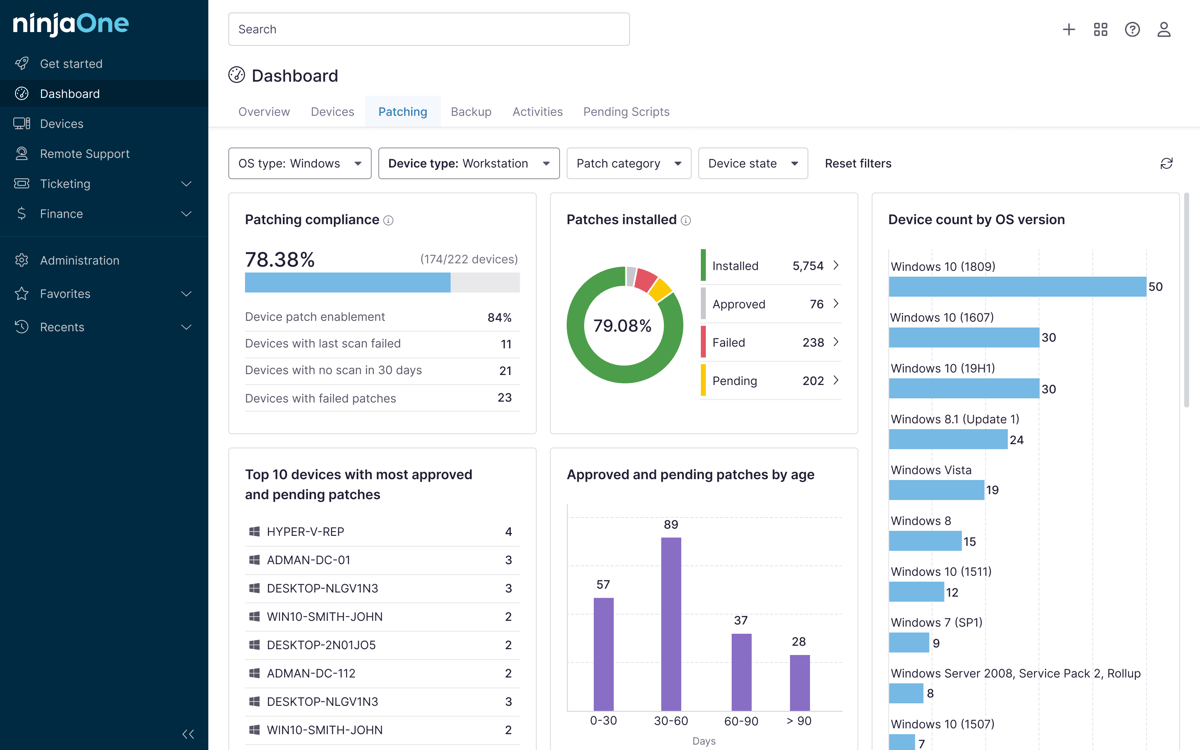
Centralized visibility helps provide clear insight into update status, deployment success rates, failed installations, and remediation progress across the environment. This visibility supports audit preparation, compliance verification, and internal accountability around update management practices.
Cross-functional visibility
Effective rollout governance also depends on coordination across multiple operational teams. Endpoint management solutions centralize security tooling, infrastructure monitoring, service management, and visibility solutions under a single pane of glass software.
Quick-Start Guide
NinjaOne Can Help Enterprises Reduce Risk During Software Update Rollouts. Based on NinjaOne’s patch management capabilities, here’s how enterprises can reduce risk:
1. Approval & Control Workflows
- Patch approval process before deployment—patches can be approved, rejected, or held in pending status
- Granular control over which devices receive updates and when
- Ability to view applicable devices for each patch before deployment
2. Staged Deployment Capabilities
- Deploy updates to specific device groups or policies rather than all devices at once
- Use device roles and classifications to segment rollouts
- Target updates by organization, location, and device type
3. Patch Information & Visibility
- View patch release dates to assess maturity before deployment
- Track patch status across your environment (approved, pending, installed)
- Monitor which devices have patches approved but not yet installed—allowing time for testing
4. Flexible Update Strategies
- Automatic updates for all WinGet-supported applications (when configured)
- Manual approval workflows for critical patches requiring testing
- Bypass options for application-specific approvals when needed
- Scan devices before deploying to identify potential issues
5. Third-Party Software Coverage
- Over 6,000 WinGet-supported applications available
- All packages undergo antivirus scanning before deployment
- Supports Windows 10+ and Windows Server 2025
Standardize rollouts using an enterprise governance software
Enterprise-wide software update rollouts require a structured approach to minimize the risk of potential downtime and operational disruption during patching. Implementing phased testing, workload segmentation, rollback governance, and ongoing visibility helps you maintain operational continuity after an update.
NinjaOne Endpoint Management simplifies software update rollouts across enterprise IT environments. It centralizes all the tools you need in a unified platform that you can use to keep your devices safe and up-to-date.
Related topics: