
Key points
- Align Check-In Policies with Other Needs: Define endpoint check-in frequency based on security requirements, CPU impact, and network conditions.
- Use Tiered Check-In Intervals: Group devices by business criticality and assign risk-based sync windows to optimize security and resource usage.
- Add Event-Based Check-In Triggers: Enhance scheduled check-ins with trigger-based syncs to reduce polling and accelerate remediation.
- Automate Check-In Enforcement: Use GPO configured under Computer Configuration to automate background agent syncs reliably.
- Continuously Monitor Key Metrics: Track time since last check-in, patch sync failures, policy success rates, and average sync duration.
- Leverage UEM Platforms: Use UEM features like policy inheritance and deployment rings to scale configurations without duplicate script overhead.
Managed devices must be synced regularly for enterprise-wide compliance. While endpoint check-in features are common in most endpoint platforms, integrating risk tiers and performance optimization can further elevate your security posture.
This article provides a versatile guide for building device check-in policies to simplify endpoint management.
Automate IT tasks for an effective device management with NinjaOne.
Expand your endpoint check-in policy
Bolster endpoint sync practices with this structured framework.
Define policy objectives and constraints
Start by outlining your policy goals while considering your organization’s resources. Make sure you also consider the following:
- Security needs: How frequent should endpoint check-ins be? What are your criteria for full compliance?
- Performance impact: Should it be delayed during high network traffic? What’s your acceptable CPU load for an endpoint sync?
- End-user experience: Should check-ins interrupt production environments? Can background processes significantly disrupt user tasks?
- Network conditions: Do you need to adjust sync intervals according to the connection type (e.g., Wi-Fi, Ethernet, hotspot)? Is bandwidth throttling required?
- Audit requirements: How often should you log sync failures? Do low-priority errors warrant alerts?
Platform behavior reference points
Your endpoint manager’s capabilities serve as the first layer of your device check-in policy. Note its default intervals and whether or not a manual check-in option exists (e.g., NinjaOne RMM syncs managed devices every 5 minutes with a manual “push” trigger for administrators).
Design tiered check-in frequencies
List your managed devices, group them by type, and synchronize them based on risk level. For instance, you can choose to synchronize low-priority endpoints (e.g., kiosks) daily while doing it often for business-critical systems.
Tiered check-ins example
| Endpoint type | Recommended frequency |
| High-risk servers | 30–90 minutes |
| Executive endpoints | 1–2 hours |
| Standard desktops/laptops | 2–4 hours |
| Mobile devices (corporate) | 4–8 hours |
| BYOD (policy-limited) | 8–12 hours |
| Kiosks/shared devices | 4–12 hours (or event-based only) |
💡 Pro-Tip: You don’t need to write custom scripts to enforce these tiers. In NinjaOne, use Policy Inheritance. Create a “Parent Policy” for global settings, then create “Child Policies” for each tier (e.g., Servers vs. Kiosks) to easily vary data collection and monitoring intervals without duplicating work.
Developing a tiered check-in policy helps you streamline the endpoint check-in process, which can be automated via custom scripts.
Add trigger-based check-in conditions
To reduce strain—especially in large fleets—your team should implement event-triggered check-ins for efficient endpoint management. Doing so can significantly reduce polling and keep critical devices responsive.
Consider these event triggers for your endpoint check-in policy:
- Patch rollout: The device syncs after an update (e.g., antivirus update post-hotfix).
- Noncompliance detected: The endpoint drifts from its security configuration (e.g., disabled firewall).
- Admin-initiated sync: The sysadmin manually triggers a sync via the RMM dashboard.
- User-initiated sync: The employee syncs their device via the portal or agent tray.
- On login or boot: This occurs once the system starts or when the user submits credentials.
- Network change: The device syncs once it connects to a new internet network (e.g., VPN, Wi-Fi switch).
- Threat detection: A check-in triggers once your antivirus flags a new threat.
- App installation or removal: An endpoint check-in triggers when a monitored app is installed or deleted.
- Geofence crossed: Sync is triggered once a device goes beyond its defined geographical boundaries.
Reinforce compliance with automation via Group Policy Object (GPO)
Achieve hands-free monitoring with powerful scripts that add another layer to your endpoint sync policy.
📌 Use Cases: Consistent check-ins, added contingency when a device misses a scheduled check-in.
📌 Prerequisites: Administrator privileges, Windows 10/11 Pro, Education, or Enterprise.
- Press Win + R, type gpmc.msc, and press Ctrl + Shift + Enter to open with Admin privileges.
- Navigate to:
Computer Configuration > Preferences > Control Panel Settings > Scheduled Tasks
(Note: We use Computer Configuration because agent check-ins require local SYSTEM privileges, not standard user permissions .)
- Right-click Scheduled Tasks, select New > Scheduled Task (At least Windows 7).
- On the General tab:
- Name the task (e.g., NinjaOne_Force_Sync).
- Under Security options, change the user to NT AUTHORITY\SYSTEM and check Run with highest privileges.
- On the Actions tab, click New:
- Action: Start a program
- Program/script: C:\Program Files\NinjaOne\NinjaRMMAgent.exe (or your respective UEM agent executable)
- Arguments: –sync (or the platform’s specific force-check-in switch)
- On the Triggers tab, set your schedule (e.g., At logon or Repeat task every 2 hours) to catch devices that have drifted out of contact.
Monitor, audit, and refine check-in behavior
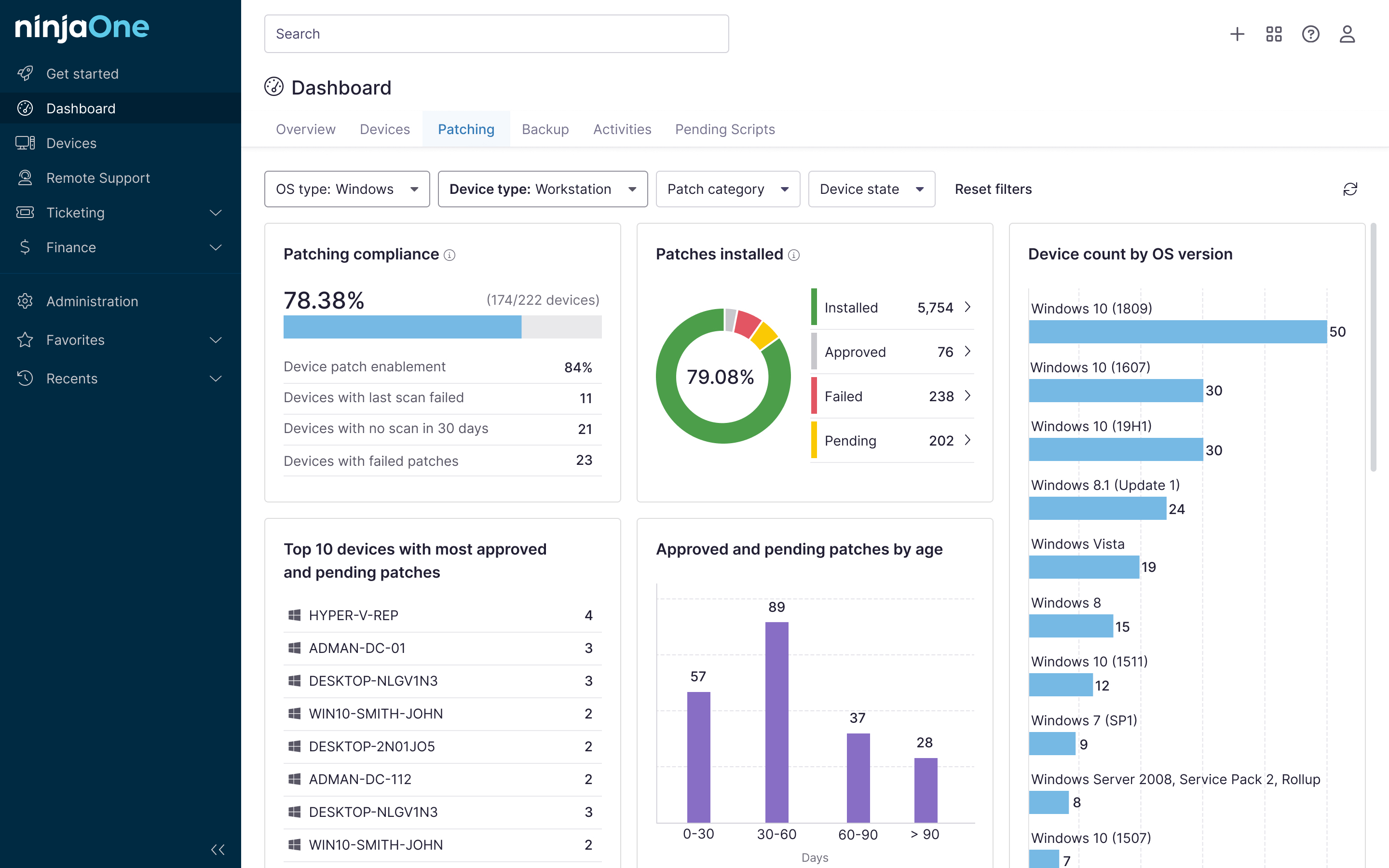
Certain factors must be monitored to ensure the robustness of your layered policy. Continuously track system behavior by leveraging UEM platforms for scalable ticketing systems and real-time alerts.
Keep these key metrics under your radar:
- Endpoints overdue for sync
- Patch sync failures
- Time since last check-in
- Sync impact on CPU
- Patch compliance status
- Policy application success rate
- Connection type during check-in
- Successful sync timestamp
- Average sync duration
⚠️ Things to look out for
| Risks | Potential Consequences | Reversals |
| Overly rapid sync interval | High resource strain, reduced performance | Reevaluate system impact and stagger check-ins based on endpoint type. |
| Connection type not considered | Bandwidth suffers, delayed patch syncs | Apply conditional triggers for endpoint check-ins. |
| Wrong endpoint classification | Low-priority endpoints sync too frequently, and critical devices don’t sync enough. | Reclassify devices based on risk and role. |
| Event trigger misfires | Unintended sync “storms” | Test triggers in limited environments apply rate limits. |
| GPO applied to the wrong organizational unit (OU) | Endpoints don’t receive their check-in policy. | Link your GPO to the correct OU and run gpupdate /force. |
| Running check-in tasks in User Context | Task fails silently if the logged-in user lacks local administrator privileges. | Always configure GPO scheduled tasks under Computer Configuration and run as NT AUTHORITY\SYSTEM. |
Integrate NinjaOne to simplify endpoint check-in policies
Here’s how NinjaOne’s all-in-one dashboard improves device sync workflows:
- Can track sync status across endpoint types
- Offers on-demand script deployment and schedules recurring device syncs for essential endpoints
- Escalates non-compliant devices to high-priority queues
- Adds more parameters for sync schedules (e.g., business hours, network conditions, role)
- Monitors system resource impact during check-in to prevent bottlenecking
Learn more about NinjaOne’s endpoint management capabilities by checking out the NinjaOne Endpoint Management FAQ.
Monitor and enforce check-in compliance across your managed environment.
Tailor endpoint check-in to your organizational needs
Building a balanced check-in policy requires constant monitoring and prioritized remediation. With the right tools, you can achieve a sustainable standard that puts both device health and user autonomy front and center.
Related topics:
- What Is an Endpoint Device? Overview for IT Professionals
- What is Endpoint Management? How it Works and Benefits
- Endpoint Security: 8 Best Practices
- 7 Common Endpoint Management Challenges
- What Is Autonomous Endpoint Management? A Complete IT Guide
Quick-Start Guide
While agent check-in policies maintain active device communication, patch deployment rings use that real-time telemetry to safely orchestrate software updates. A reliable check-in policy ensures that a device’s vulnerability status is fully accurate before it enters a deployment cycle.
To align your tiered device management with automated software updates, configure your staggered rollouts directly within the NinjaOne Patch Management engine:
1. Ring Deployment Strategy
- You can create multiple policy tiers (rings) for staged device management
- Assign devices to different roles based on your deployment strategy
- Example: Test devices in Ring 1, critical devices in later rings
2. Policy Configuration
- Navigate to Administration > Policies
- Create a parent policy to hold your ring policies
Configure specific settings for each ring:
- Scan Schedule: Set specific times for patch scans
- Update Schedule: Define patch application times
- Approval Settings: Choose Auto, Manual, or Reject for patches
3. Key Considerations
- Stagger deployment intervals (recommended at least one hour between rings)
- Monitor patch deployment results before moving to subsequent rings
- Use the Patch Management Dashboard to track deployment status
- Check device health and patch compliance for each ring
4. Best Practices
- Test critical updates on a small subset of devices first
- Align reboot schedules with business hours
- Use reporting features to track deployment progress