

Key Points
- Mature ITAM is evaluated on the performance of your security posture, governance alignment, and service quality.
- Good ITAM tells you which assets are risky, aging, or non-compliant.
- Asset data only has value when it drives real decisions on patching priorities, refresh planning, budgets, and vendor talks.
- Siloed asset data and infrequent validation are the two most common reasons ITAM programs fail to deliver on their potential.
- ITAM must continuously adapt to your environment as it grows with new users, cloud sprawl, and BYOD.
The IT asset management capabilities of your tech team or managed service provider (MSP) will be assessed on its outcomes – not the features of the platforms you choose, or how many assets you record in your asset database. Mature asset tracking should result in measurable improvements in IT service effectiveness, quality, governance, security, and the overall efficiency of your team.
This guide explains how you can evaluate your IT asset management capabilities and illustrates how moving beyond basic tracking improves the key factors that contribute to providing successful managed IT solutions.
Refresher: What is IT asset management (ITAM)?
ITAM is the tools and processes that are used to track hardware and software assets throughout an organization, from the moment they are procured to the moment they are disposed of.
The goal of ITAM is to provide real-time visibility into the health of your IT infrastructure: to ensure the ongoing operation and security of devices and software, you must know what they are, where they are, and who’s using them. ITAM also assists with decision-making, helping identify potential optimizations and cost savings, as well as compliance.
Due to its keystone nature for IT operations, you must periodically review your IT asset management capability and ensure that it is providing adequate coverage, collecting and recording the required information, and that this information is being acted on.
Strategies for effective IT asset management
While different IT teams work differently, and in different environments, ITAM standards and best practices have emerged to help teams avoid known mistakes and get the most out of their investments in asset management. These include being proactive and consolidating data, maintaining accurate inventories and centralizing policies, standardizing documentation, and choosing the right tools.
You should also keep in mind the following information when evaluating your asset management capabilities and outcomes.
Move beyond simple inventory
A complete catalogue of your IT assets is not the goal of asset management; it’s the resource that will be used to realize the intended outcomes of other processes. Rather than just answering what devices exist, where they are located, and who is using them, ITAM should provide actionable information and insights, including:
- Which assets introduce risk
- Which assets are nearing end-of-life
- Which assets violate internal policies or compliance requirements
- Which assets impact service delivery
A simple list of hardware and software assets is of little value on its own.
Aligning operational decisions with IT asset data
Security is paramount to the functionality of your IT infrastructure. Device patching and threat detection can be automated, some tasks must be performed manually, and prioritized so that the most critical issues are addressed as promptly as possible. Similarly, prioritizing which devices need to be refreshed, due to end-of-life, or new end-user requirements, must be prioritized to avoid unnecessary spending while balancing functionality and security.
IT asset data is an invaluable resource for informing these key decisions, and the associated budget forecasting, as well as vendor risk and contract evaluation and discussions.
Integrating asset lifecycle and IT governance in IT service management (ITSM)
IT governance aims to keep the outcomes of IT aligned with the broader goals of the organization it supports. Live data gathered through asset lifecycles should directly influence the planning of governance policies, and be fed into the governance processes themselves as they operate.
Asset management and lifecycle data should be available for use in change management processes, implementing security controls (and keeping them up-to-date, for example by revoking access for lost devices), compliance reporting, and ongoing configuration management and maintenance for infrastructure and endpoints.
Data silos don’t just increase risk, they are a missed opportunity for improvement across all of your ITSM workflows.
The importance of continuous asset data validation
IT environments are always changing, and that rate of change rises exponentially as your business scales with new users, new devices and technologies, and new use cases.
A single new user could require the deployment of a workstation and laptop, and optionally a company phone and tablet for remote use. They may also wish to connect their own devices to company services (for example, messaging and email so they can stay up-to-date without having to carry two devices). BYOD introduces additional management and security concerns that must be addressed to maintain oversight and compliance.
Software assets must also be accounted for with data collected from endpoints, further multiplying the assets that need to be tracked. The importance of the ‘freshness’ – the up-to-date and accurate nature – of this data for security purposes cannot be understated.
Common functional gaps in ITAM programs
ITAM often falls flat due to easily made, but easily avoidable, mistakes that create functional gaps. These include:
- Incomplete discovery across environments: Modern enterprise IT is now spread across on-premises, remote work, and cloud environments (sometimes on multiple platforms, e.g., mixing AWS with Azure for redundancy), making it easy to overlook endpoints.
- Lack of ownership for asset data accuracy: Without oversight, even robust asset management processes and automated discovery are effectively useless.
- Poor integration with security operations: Asset data and security information should form a feedback loop, with visibility into what hardware and software exist and need monitoring, informing security operations – and data from security operations being fed back to asset documentation. Without this, information may be lost or not readily available when it’s needed.
- Limited executive and compliance reporting: Without current asset data, reports will not reflect the current cost and functionality factors of your IT infrastructure, hampering decision-making. Similarly, compliance reporting will be compromised without full insight into your actual security posture.
- Manual reconciliation processes: Validation that is not continuous lets problems accumulate, requiring periodic, manual validation that wastes technician time or leads to permanent blind spots.
Avoiding many of these mistakes is possible entirely with careful planning and well-implemented processes. IT asset management platforms can greatly assist with this, improving visibility and control with proven functionality.
Why ITAM is a strategic enabler across your organization
When ITAM is mature, it benefits more than just IT teams, providing more predictable budgeting, faster incident response, stronger audit readiness, and additional information and context during vendor assessments and negotiations.
Shadow IT and its inherent risks can also be brought under control through effective ITAM that leverages automation to detect new end-user devices and unsanctioned software on your network, allowing you to act by either blocking them, or bringing them under your oversight and management.
Common misconceptions that IT teams have about their IT asset management capability
The most common mistake tech teams make when assessing their ITAM capabilities is that simply maintaining a comprehensive asset inventory solves problems. However, inventory is not the end goal, and if this information is not used in other processes, collecting and curating it is a wasted investment.
Acting on this information is also not an effective way to improve overall outcomes if the data is incomplete, out-of-date, or inaccurate – this will just lead to flawed decision-making and hinder cost optimization. Those who use the information gathered from IT asset management processes should also be fully aware of its context and familiar with their own domain (e.g., finance, HR) so that they know how it should be interpreted and applied.
NinjaOne integrates and automates IT asset management with your entire IT workflow and toolchain
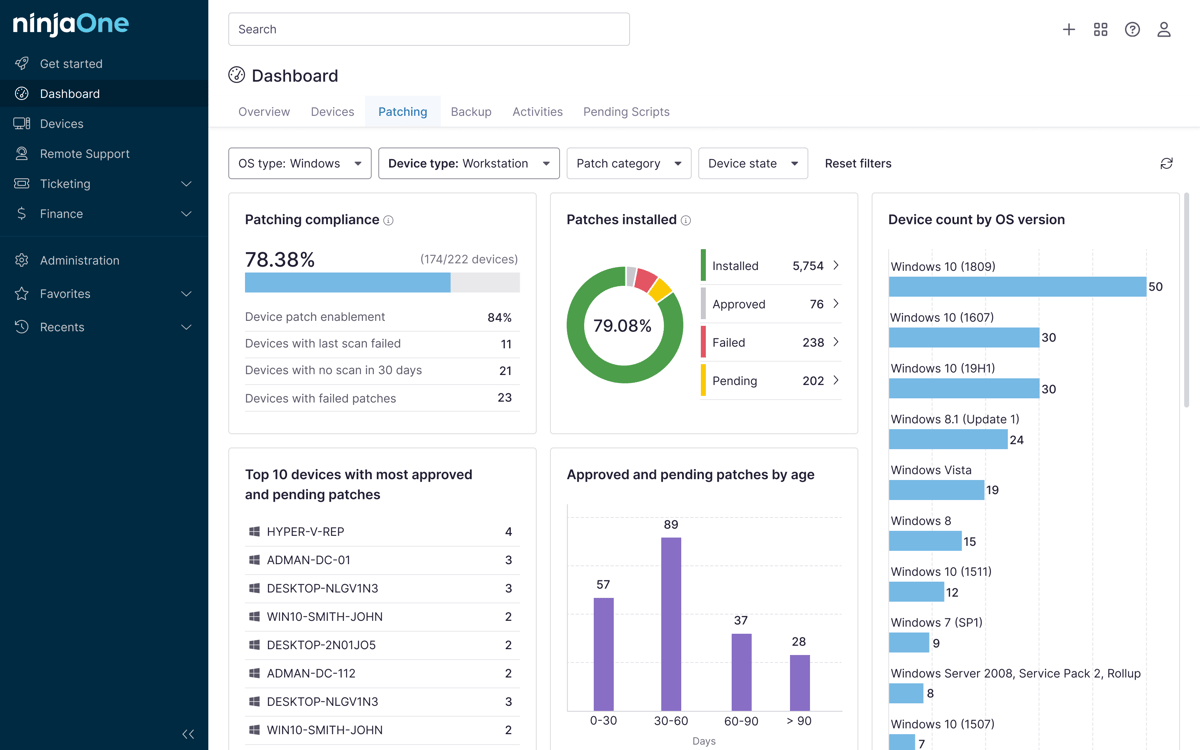
From an IT perspective, IT asset management does not eliminate the need for ongoing oversight and must not remain static, but instead adapt to your evolving IT landscape. NinjaOne integrates ITAM with a comprehensive IT management, security, and support toolchain that unifies remote monitoring and management (RMM), mobile device management (MDM), asset discovery and monitoring, documentation, and more – all with built-in automation.
This allows you to detect and catalogue hardware, and scan managed devices for software – and feed this all into documentation and reports for oversight and presentation. This helps you keep assets up-to-date, maintain a strong security posture, and stay compliant.