Key points
- What is IT asset management: ITAM is the process of tracking and IT assets throughout their entire lifecycle to optimize performance, compliance, and cost-efficiency.
- ITAM lifecycle: A well-implemented ITAM lifecycle covers six core stages: planning, procurement, inventory, deployment, monitoring, and secure disposal.
- Benefits of ITAM: ITAM provides real-time visibility, improves compliance, increases cost savings, reduces security vulnerabilities, improves asset utilization, and streamlines workflow. into asset health, enabling faster issue resolution and better decision-making.
- Choosing an ITAM solution: Selecting the right ITAM solution requires focusing on automation, integration, scalability, reporting, and compliance support.
IT asset management (ITAM) is essential for modern IT operations. It lets organizations track, monitor, and optimize their hardware, software, and cloud assets throughout their lifecycles.
With the rise of remote work, hybrid infrastructure, and complex compliance needs, ITAM provides real-time visibility, automation, and control. This helps IT teams reduce costs, ensure compliance, and boost productivity.
In this guide, we’ll explain what IT asset management is, why it matters, how it works, and how to choose the best ITAM software for your business.
What is an IT asset?
IT assets refer to physical and non-physical components within an organization’s IT infrastructure. These can include:
- Hardware assets such as desktops, laptops, mobile devices, data centers, or even peripherals like keyboards and monitors
- Software assets such as applications, software systems, databases, and cloud-based assets, including SaaS applications
ITAM’s process ensures these IT assets are tracked and managed throughout their lifecycle.
Turn scattered hardware and software records into one living inventory.
Why ITAM is important
Managing IT assets is an essential business practice. This encompasses procedures that use collected IT asset data to ensure business continuity, facilitate cost planning, track hardware and software inventory, guarantee return on investment, and more.
ITAM can also determine how to maximize the value of IT assets until it’s time to retire them.
The main goal here is to manage the entire lifecycle of IT assets, from procurement to retirement. This involves ensuring that assets are used effectively, maintaining IT compliance, and contributing to the organization’s strategic objectives.
By tracking assets throughout their lifespan, ITAM helps organizations maintain optimal performance, minimize risks, and maximize ROI.
So, in summary, ITAM helps organizations:
- Maintain IT asset visibility across the lifecycle;
- Ensure software license compliance;
- Improve security posture;
- Optimize hardware usage; and
- Control IT costs and increase ROI
Key components of ITAM
Inventory management
A centralized inventory provides essential details like asset location, usage patterns, and condition. Regular audits and updates ensure the inventory remains accurate and up to date, preventing unauthorized devices or software from entering the network.
Modern ITAM solutions use automated asset discovery tools to provide real-time insights into asset locations, configurations, and usage patterns.
License management
Any great ITAM tool tracks software licenses, including ownership, terms, and expiration dates. This helps you identify unused or underutilized licenses and remove or update them as needed.
Lifecycle management
ITAM tools support full lifecycle tracking for both hardware and software assets, ensuring consistent performance, maintenance, and secure decommissioning.
Ongoing maintenance and patch management are essential for maintaining optimal performance and security. Finally, ITAM includes a secure decommissioning process to prevent data breaches and ensure responsible disposal of assets at the end of their lifecycle.
Understand the essentials by watching this video guide: ‘What is IT Asset Management: A Comprehensive Overview’.
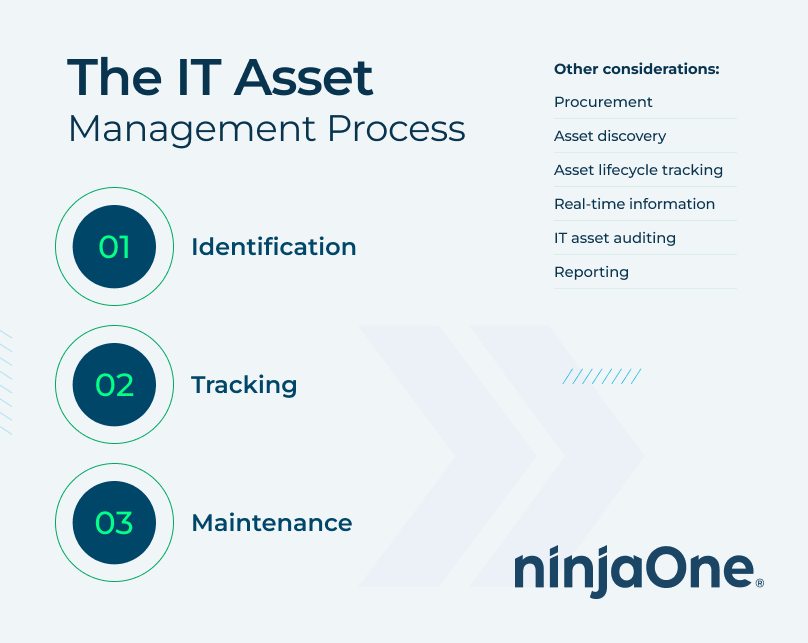
What is the process of ITAM?
The ITAM process encompasses the steps in managing IT assets throughout their lifecycle (also referred to as lifecycle management). Here’s a breakdown:
1. Planning
This stage entails everything related to determining your organization’s IT needs. Planning also includes setting ITAM goals and establishing policies and procedures. With that in mind, this phase will significantly involve budget, perceived forecast, and exploring standards for IT assets to enforce.
2. Procurement
After everything is planned, the next step is to acquire the agreed-upon IT assets. Procurement of IT assets can be done through different means, such as purchasing and leasing. This also entails vendor selection, contract negotiation, and cost analysis.
3. Asset discovery and inventory
Once IT assets are procured, they are identified and documented. Asset discovery and inventory keep track of acquired IT assets by collecting their vital information. This information typically includes hardware, software, location, configuration, and ownership details. An IT asset management solution can help fulfill this task through automation.
4. Deployment
In the deployment stage, procedures such as software and hardware installations and configurations take place. This phase is crucial and needs proper execution to ensure IT assets work as intended.
5. Monitoring and service
IT assets are monitored during active use to maintain optimal performance. If anomalies are observed during the monitoring phase, servicing may be warranted to revitalize the IT asset’s functionalities. This aligns with the ITAM goal of making the best use of IT assets throughout their lifecycle.
6. Decommissioning and disposal
When an IT asset no longer serves its purpose, it must be retired. Decommissioning and disposal involve crucial processes, such as data wiping, to reduce security risks and recycling to ensure compliance with environmental regulations.
What are the benefits of ITAM?
Provides a single source of truth
Essentially, it provides you and your IT team with a primary and most reliable source of information and reference point. Establishing a single source of truth allows your team to make business decisions on the same data, ensuring a more holistic business framework.
Extends visibility
IT asset management extends visibility to all the IT assets within the business. One component of IT asset management solutions is the lifecycle of IT assets in your environment, and keeping track of every individual device or machine helps IT teams perform that task. IT asset management also provides complete knowledge of your endpoints and real-time information, which are essential for diagnosing endpoint issues in your IT environment.
Provides structure
Tracking IT assets and their associated data also gives your environment structure and stability by helping you organize them. Continuously updated knowledge of devices that enter, leave, or remain active in your network enables better overall management of IT assets and more informed decision-making about the purchases and expenses of those assets.
Streamlines workflows
ITAM can streamline workflows by automating inventory and tracking, minimizing human error, and task management and prioritization. This can improve operational efficiency, IT asset utilization, and task prioritization.
The best IT asset management software saves you time and effort and provides more accurate and up-to-date asset information.
Reduces vulnerabilities
IT asset management allows you to reduce security vulnerabilities in your IT environment. Any IT asset inherently comes with security risks. Still, IT asset management provides enhanced visibility and up-to-date information on their health and performance, ensuring devices are secured and protected.
IT asset management also makes it easier to adhere to compliance frameworks such as HIPAA, GDPR, and NIST by providing information on every device and asset within your organization.
Lowers costs
IT asset management helps organizations reduce their IT expenses. Tracking devices and their performance can provide key information about their overall health so you know when they need to be replaced.
Device warranties can also be easily accessible through IT asset management software so you know when a device warranty ends and reduce unnecessary payments, which financially impact your organization. Ultimately, IT asset management helps maximize your return on investment (ROI).
What are the challenges in ITAM deployment?
Inaccurate asset inventory
Data inconsistencies can be crucial since the information collected is necessary for an organization’s decision-making. However, many factors may propagate inaccuracies in asset inventory data. These may include challenges in asset discovery, complexities in IT environments, and even shadow IT.
Lack of asset visibility
Large organizations typically need substantial IT infrastructure, which requires many managed IT assets. Without a proper ITAM solution, organizations may struggle to achieve complete visibility into their ITAM, which can affect efficiency, resource utilization, and security posture.
Poor lifecycle management
Each stage of IT asset lifecycle management plays an important role in ITAM. Failure to execute at least one of them may result in disruptive consequences. These negative impacts may include inefficient maintenance, premature asset failure, and increased spending.
Compliance issues
Organizations are expected to maintain compliance with industry regulations. However, ineffective ITAM deployment may lead to compliance issues. Non-compliance with industry regulations could result in legal penalties, financial losses, and reputational damage and more.
Software licensing
Tracking software licenses and ensuring compliance with vendor agreements is complex. Over-licensing and under-licensing can lead to unnecessary costs and legal risks.
Budget constraints
Deploying an IT asset management system can be costly. If an organization doesn’t have sufficient budget to fund a robust ITAM implementation, it may affect the system’s scope, quality, and long-term effectiveness.
Best practices in IT asset management
To maximize the efficiency of ITAM implementation, an organization must follow best practices in IT asset management.
- Track the lifecycle of IT assets. Tracking your IT assets from procurement to retirement enables you to extract the maximum value from each device in your environment.
- Use automation. Automating repetitive tasks and functions saves time and improves efficiency in your organization’s IT asset management process.
- Gather regular feedback. By actively seeking and analyzing feedback from various stakeholders, IT teams can identify areas for improvement, optimize processes, and ensure that IT assets are managed efficiently and effectively.
- Make data available to IT. IT data must be centralized, standardized, and accessible to all relevant teams to improve decision-making, streamline processes, and optimize resource allocation.
- Implement IT asset management software. An ITAM software is specifically designed to manage your business technology, so using it will give you the best tools to group, find, and manage assets.
How to choose an ITAM software
Deciding which ITAM software to use depends on your organization’s IT needs. However, there are common criteria to look for when choosing an IT asset management solution.
Cost-efficiency
Different organizations have varying budget limitations. If your organization prioritizes spending, you must choose a cost-efficient ITAM software option. However, asset management is a crucial business practice, so don’t compromise on essential features and long-term value for short-term savings.
Scalability
Choose an ITAM software that can keep up with your business’s expansion or downsizing. A scalable IT asset management platform should be able to adapt to changing environments.
Integration
An ideal ITAM software can expand its functionalities through seamless integrations. Pick an IT asset management platform that can integrate with ITSM, ITOM, CMDB, and other business-critical systems.
Automation
Repetitive tasks can be time-consuming. A great IT asset management solution should help cut the time spent on these tasks through automation. Choose an ITAM software that can automate asset discovery, inventory updates, compliance checks, and more. This can also foster productivity and reduce human errors.
Reporting and analytics
Select an ITAM solution that offers customizable reporting capabilities. This helps ensure that generated reports are comprehensive and helpful for intended audiences. Meanwhile, ITAM solutions should also provide accurate analytics, as the information collected can support informed decision-making, identify inefficiencies, and ensure compliance.
Compliance
Lastly, choose an ITAM software to ensure your IT infrastructure complies with regulatory standards. HIPAA, SOC2, GDPR in Europe, and the CCPA are just some regulatory guidelines that organizations must adhere to. An ideal ITAM solution should help track and manage compliance requirements, ensuring that licenses, security protocols, and data privacy standards are consistently met.
Manage every asset, from procurement to retirement, on one platform.
Automated IT asset management with NinjaOne
NinjaOne’s IT Asset Management software helps organizations gain visibility into and control over their IT assets. With tools like automated discovery and real-time data, Ninja’s tools give actionable insights to lower expenses and increase overall performance.
For a comprehensive visual guide that complements this blog, watch What is IT Asset Management (ITAM)?