
Key Points
- Operating ITSM and ITAM separately creates inefficiencies and blind spots.
- Fragmented processes compromise visibility, accountability, and decision‑making.
- Disconnected workflows weaken risk management and compliance.
- Split ownership undermines governance and slows organizational response.
- Structural alignment is essential before integrating ITSM and ITAM tools.
ITSM (IT service management) and ITAM (IT asset management) alignment is key for the success of internal IT teams and managed service providers (MSPs). ITSM and ITAM are often run as parallel but separate processes, hindering coordination, reducing efficiency, and creating blind spots.
This guide explains how to integrate ITSM and ITAM alignment to optimize your IT support workflows, with advice about processes, governance, and useful tools.
The difference between ITSM and ITAM
ITSM is the strategic management and support of IT infrastructure and processes, so that outcomes align with a business’s objectives. It is the delivery of IT support as a service, covering provisioning, deployment, maintenance, end-user support, and deprovisioning. It’s surprisingly human-oriented (though technology-enabled), as it is stakeholders and end-users who will benefit when IT effectively meets its use case.
ITAM is the process of identifying and cataloging IT assets, including hardware and software. It should be a continuous process, enabled by automation, so that all deployed assets are accounted for.
While these two processes can be (and often are) run in isolation, this is detrimental to tech teams. Lack of coordination causes visibility and accountability gaps, and troubleshooting and other routine IT support tasks are dragged down as technicians lack context and up-to-date information.
Conflating ITSM and ITAM also comes with its own problems, causing confusion about role responsibility, incorrect tool choice, and degrades information quality.
How ITSM and ITAM separation creates friction in IT teams
Operating ITSM and ITAM separately is inefficient in itself, as it may require manually duplicating records between systems, requesting information from other team members (and waiting for a response), or simply not having access to the information you need to solve a problem.
This then leads to more severe issues. Most visibly, technicians may attempt and fail to solve issues using outdated information, asset records will fall out of alignment with the real-world situation, leading to end-user frustration. Less visibly, but more critically in the long term, decision-making will be compromised by stale data. Change management will lack context, and incidents may appear as disconnected events, masking systemic issues.
The impact of ITSM and ITAM on risk management
Up-to-date and complete hardware and software asset data informs key processes such as patch prioritization, end-of-life governance (in the case of obsolete or unsupported products), compliance reporting, and vendor risk assessments.
Without full visibility over assets, these processes become ineffective and risk can accumulate.
The cost of fragmented ownership of key IT processes
Effective governance that meets organizational and compliance requirements is dependent on seamless ownership of different components of IT services. When ownership is fragmented, gaps widen over time as the business and supporting IT infrastructure evolves, leading to disputes over data accuracy, incomplete and outdated documentation, delayed and misinformed decision-making, and the need to manually reconcile these discrepancies.
Shared responsibility with clear roles, boundaries, and communication are required – technologies can enable the unification of IT processes, but cannot achieve this on their own.
Why structural alignment must come before software integration
Before choosing and implementing tools that can unify ITSM and ITAM (either by providing both under a single platform or separate tools that support integration), you should ensure the following governance and structural measures in place:
- Shared data standards
- Clear accountability boundaries
- Coordinated lifecycle and service processes
- Consistent reporting definitions
- Executive level understanding of operational dependencies
Technology can then be chosen that fits with these measures, ensuring alignment.
Organizational benefits of ITSM and ITAM alignment
The outcomes of ITSM and ITAM alignment that are immediately visible include reduced ticket resolution times, with fewer escalations and higher first-contact resolution.
Long term benefits will become apparent during asset refreshes as decisions will be data-driven and readily justifiable to stakeholders. Reports will be consistent and complete, streamlining audit preparation, and forward-planning will reflect real-world conditions. Broadly speaking, efficiency and oversight improvements lead to tangible benefits for tech teams, decision-makers, and end-users.
Common misconceptions about ITSM and ITAM alignment
Many IT teams make the mistake of thinking that software integration results in immediate alignment. This is false, and leads to the assumption that everything is covered, even as visibility is lost and service quality degrades. In turn, visibility alone does not reduce risk, as the information gained must be acted on.
Information should also not flow in one direction: data collected through ITAM processes lacks context that ITSM can provide. Information collected during incident resolution can inform ‘why’ something happened, completing the picture in ways that metrics alone cannot.
Once governance is established, NinjaOne supports ITSM and ITAM alignment with a unified toolchain
Once responsibility and governance are established, the integration of ITSM and ITAM processes and information can be further enhanced and continually re-enforced by choosing the right tools.
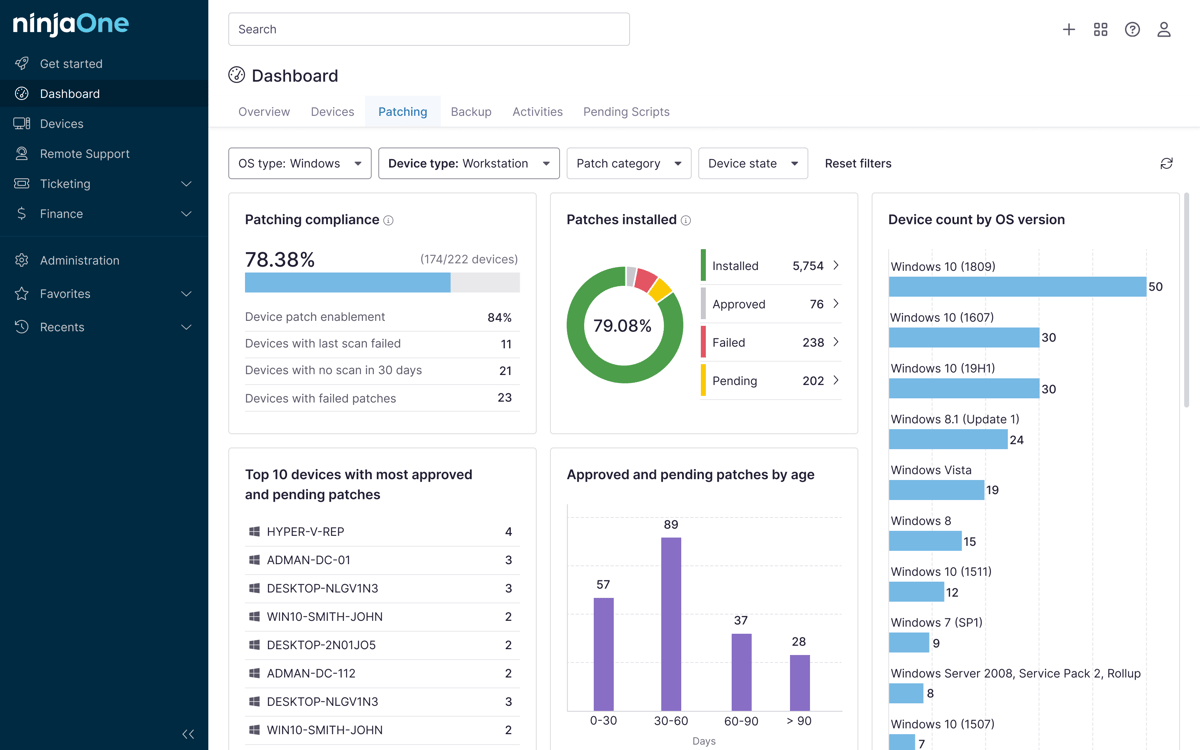
NinjaOne unifies your entire IT operations toolchain, bringing together asset management, documentation, and helpdesk, with additional from mobile device management (MDM), remote access, and patch and vulnerability management, and other security and management features all accessible from a single web interface. Support users wherever they are with streamlined operations operating from a single source of truth, centralized roles and permissions, and built-in automation.