


Key Points
- Cloud-based endpoint management centralizes monitoring, enforcement, and remote administration through a cloud-hosted console.
- The right choice between different endpoint management models will depend on your infrastructure, compliance, and operational requirements.
- On-premise deployment offers better infrastructure control and data residency flexibility, but it carries higher overhead and scaling complexity.
- Hybrid endpoint management is best suited as a structured transition strategy for organizations modernizing their environment.
- Device management pricing should be evaluated through its total cost of ownership, not its upfront cost alone.
- Enterprise IT teams should match their endpoint management model to their actual operational realities rather than defaulting to the cloud for convenience.
The trend of modern workflows has shifted to remote and distributed models, with 78% of Americans working in a hybrid or fully-remote setup. Following this trend, IT teams must manage endpoints across distributed environments remotely while keeping up as their organizations scale and compliance obligations evolve.
Cloud-based endpoint management offers advantages in remote visibility, scalability, and operational efficiency, but it’s not a one-size-fits-all solution. Organizations must choose between cloud, on-premise, and hybrid models to find the one that best fits their environment.
What is a cloud-based endpoint management solution?
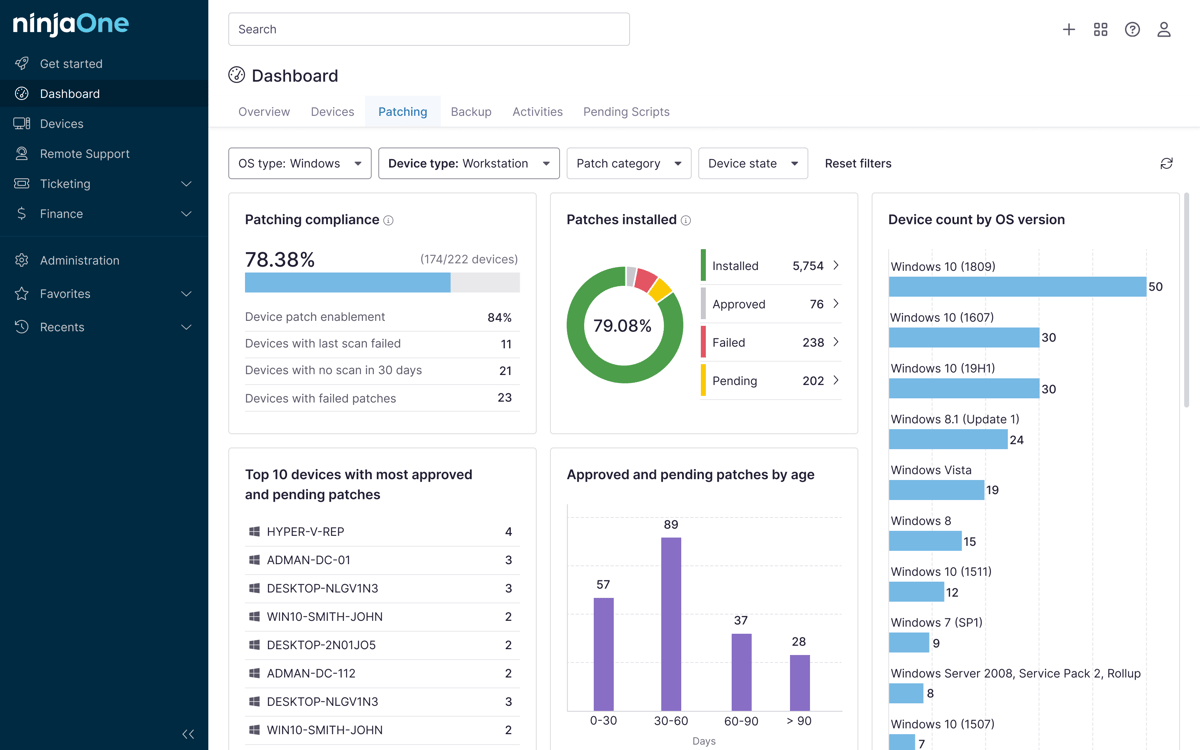
Cloud-based endpoint management centralizes endpoint visibility and administrative control through a cloud-hosted management console accessible from anywhere. This offers IT teams to gain centralized, remote administrative reach minus the maintenance overhead of on-premise infrastructures.
The core capabilities of cloud-based endpoint management solutions include:
- Device visibility: real-time awareness of all endpoints regardless of location
- Patch deployment: pushing updates and applications to devices
- Security policy enforcement: centralized enforcement of security baselines across the environment
- Remote troubleshooting: diagnose and resolve issues without physical access
- Application management: controlling installed, licensed, and running software on endpoints
- Compliance reporting: generating audit-ready visibility into device compliance
- Lifecycle actions: enforcing security responses, such as device lock or wipe, and managing device or software end-of-life (EOL) remotely
Each of the aforementioned capabilities covers a management responsibility that previously required on-premise infrastructure or network-dependent tooling. Cloud-based endpoint management shifts not just where these capabilities are hosted, but also their maintenance, scalability, and accessibility.
Comparing cloud vs on-premise endpoint management
When comparing on-premise vs cloud software for endpoint management, the key differences come down to their platform hosting model, maintenance overhead, and connection reliability outside corporate networks.
The right choice depends on how an organization operates, what it needs to control, and the constraints it has to work with.
Cloud-based endpoint management
Cloud-hosted endpoint management eliminates the need for local servers, databases, and network dependencies, reducing maintenance overhead. Apart from that, this endpoint management model provides you with administrative access to managed devices from anywhere, without VPN dependency.
That said, cloud-based endpoint management solutions make it easier to deploy faster, scale across distributed environments, and support remote and hybrid workforces consistently.
On-premise endpoint management
An on-premise solution hosts the management platform within your own infrastructure. While on-prem device management is costly in terms of maintenance, it offers greater infrastructure control when directly configuring and securing your environment.
For example, this management model allows you to choose where to store your data, helping you align with compliance and data sovereignty requirements. Additionally, organizations with non-standard environments or specialized workflows can configure on-prem platforms to meet specific operational needs.
This makes on-premise deployment ideal for organizations in regulated industries, especially those that strictly follow mandated data handling practices or have an existing IT infrastructure.
The benefits of choosing cloud-based endpoint management solutions
Handling distributed or remote environments without a cloud-based endpoint management platform can lead to fragmented visibility and inconsistent enforcement. As your workforce scales and becomes more dispersed, efficient device management becomes harder to achieve.
Cloud-based management helps address these issues by routing your management capabilities into a platform that can consistently scale with organizational needs. Some of the important benefits cloud-hosted solutions deliver are:
- Remote configuration, patching, troubleshooting, and policy enforcement workflows
- Centralized security baseline and compliance policy enforcements
- Faster rollout across multiple regions or business units
- Reduced on-premise endpoint management platform maintenance overhead
- Continuous update and patch delivery
- Real-time inventory and health data across the environment
- Streamlined integration with SaaS tools and platforms
Together, these capabilities make cloud-hosted endpoint management platforms a strong fit for enterprises with distributed or remote workforces.
The limitations of on-premise endpoint management
On-premise endpoint management carries significant investment and maintenance overhead, especially for organizations without an existing infrastructure to build from. When managing off-site endpoints, it heavily relies on additional network architecture, which can become a potential point of failure.
Poor asset lifecycle management strategies can also leave you with outdated tools and unpatched vulnerabilities that can compromise your environment. These constraints are manageable if your environment has dedicated IT infrastructure teams, stable and predictable device fleets, and strong compliance controls.
However, for growing organizations, on-prem deployment can lag behind as you expand without proportionally increasing management capability. That said, you should assess whether your environment can absorb that burden, or whether it creates costly gaps in your endpoint management strategy.
When to use hybrid endpoint management solutions
Hybrid endpoint management combines the capabilities of both cloud-based and on-premises endpoint management platforms.
Hybrid deployment is the right choice when your environment has:
- Workflows or applications that depend on legacy, on-prem systems are incompatible with cloud-based management
- Endpoints that require direct oversight due to compliance obligations
- Off-network endpoints still require ongoing visibility and centralized enforcement
- A traditional management platform that requires a phased transition to avoid monitoring gaps
- Different business units that adhere to different compliance requirements
While hybrid endpoint management has its strengths, it still requires clear ownership and defined boundaries between cloud and on-prem capabilities. Without this, you risk duplicate policies, inconsistent reporting, and fragmented device visibility that can undermine your endpoint management strategy.
It’s best to treat hybrid solutions as a transitional stepping stone, as it’s effective in bridging your environment’s gradual adoption of cloud-based platforms.
Evaluating device management pricing and cost drivers
Device management pricing should be evaluated through its total cost of ownership, not just its upfront cost alone. In many cases, the initial cost is rarely the largest expense, as other factors, including infrastructure management, staffing, and operational overhead, compound its true cost.
That said, you should also factor in the following cost drivers:
| Cost driver | Definition | Importance |
| Licensing or subscription fees | Per-device or per-user fees charged by a vendor | Makes platform prices scale with environment size |
| Endpoint count and growth projections | How pricing changes as organizations scale | Accounting for growth helps you predict long-term costs |
| Infrastructure hosting and server costs | Total cost of operating on-premise endpoint management solutions | This cost is present within on-prem solutions, while cloud-hosted platforms shift this to the vendor. |
| Maintenance and upgrade | The cost of keeping the platform current and operational | Adds hidden, recurring internal workload and operational expenses |
| Staffing requirements | Personnel to administer and maintain the platform | Staffing costs inflate the total cost of ownership, especially in complex environments |
| Implementation and migration effort | Deployment and transition from existing tooling | Poor transition planning can stall deployments and expand management gaps |
| Integration with other tools | Integrating the endpoint management platform into the broader IT ecosystem | Integration strategies add hidden configuration and licensing costs |
| Training and support requirements | Staff and end-user onboarding | Affects adoption speed and reduces misconfiguration risk |
| Disruptions during transition | Management gaps during deployment or migration | Unplanned disruption carries indirect costs beyond the platform itself |
| Compliance reporting and audit requirements | Tooling needed to meet regulatory obligations | Non-compliance carries financial and reputational risk |
Cloud models are normally cheaper in terms of upfront infrastructure investment while reducing internal operational overhead. In contrast, on-prem models offer more controls at the cost of significant maintenance overhead and higher total cost of ownership.
Neither model is inherently more cost-effective, as fleet size, existing infrastructure capabilities, and operational capacity impact your total cost. When finding a more cost-effective endpoint management solution, you should account for direct platform expenditures and operational costs rather than the license price alone.
Pick the endpoint management model your environment needs
Cloud-based endpoint management platforms allow IT teams to centralize visibility, streamline policy enforcement, and allow remote remediation workflows. However, this isn’t a universal solution for all environments, as each operates under unique realities.
Choosing the right deployment model will largely depend on your existing infrastructure, staff capabilities, cost considerations, and remote management needs.
Related topics: