
Key Points
- Automate frequent tasks like patching, VPN repair, software updates, browser resets, and disk cleanup to maximize ROI.
- Utilize pre- and post-checks, automated rollback, and staged deployment rings aligned with regional or business hours.
- Record the owner, trigger, schedule, inputs, expected outputs, and rollback; retain logs, screenshots, and tickets for traceability.
- Standardize failure detection via exit codes and log schemas; auto-generate tickets on ERROR/WARN and use analytics to reduce false positives and MTTR.
- Apply least-privilege access, use signed scripts and scoped tokens, and store credentials in a secrets vault.
- Quantify automation value by tracking success, reruns, time saved, and coverage; compare pre-/post-baselines and publish monthly scorecards.
Remote work has become a crucial part of our current workflows. And if you choose to implement it, you’re going to need a remote work automation setup that reduces toil without increasing risk on your employees’ devices.
A guide for creating remote workflow automations for your organization
📌 Prerequisites:
- You need an RMM with policy scheduling, health checks, and code signing.
- You should already have version control for scripts and a secrets vault for credentials and tokens.
- You need a ticketing tool that can ingest logs and screenshots as artifacts.
- You should have a workspace for monthly automation scorecards.
Common remote work automations at a glance
| Automation type | Risk level | Estimated time saved | Recommended tool |
| OS and software patching | Low | 5 to 10 min/device | RMM + patch policy |
| VPN & network repair | Low | 10-15 min/ticket | RMM script |
| Disk cleanup & cache clear | Low | 5-8 min/device | Scheduled script |
| Browser reset | Low | 5-10 min/ticket | RMM automation |
| Software install & updates | Medium | 10-20 min/device | Automation library |
| User onboarding/offboarding | Medium | 30-60 min/user | Policy workflow |
| Driver & Registry updates | High | 15-30 min/device | Approved script + MFA |
💡 Additional resources: Check out our guide on Common IT tasks to Automate for more information.
How to Set Up Remote Work Automation
Step 1: Pick high-impact WFH automations
The WFH automations you choose are going to matter a lot. Picking the ones that work best for your circumstances will ensure that you can quickly maximize your ROI.
To do that, you need to come up with a list of remote work automations you’re considering. Rank the candidates by frequency, risk reduction, and effort. Other things you should consider include patch orchestration, VPN and Wi Fi repair, disk cleanup, browser reset, credential refresh, and software install or update.
By the end of it, you should have a shortlist of WFH automations you’re planning to use. You should have a short backlog of implementation plans with owners, due dates, and expected time saved.
Step 2: Build guardrails and rollout rings
Once you’re ready to implement your new WFH automations, you need to build guardrails. This will protect remote endpoints from a significant impact and ensure that your workflows keep going even if something goes wrong.
To do that, you should:
- Define the steps for the pilot run.
- Run pre-checks for disk, CPU, battery, and connectivity, and post checks for service health.
- Enable automatic rollback if the post checks fail.
- Stagger releases by time zone and business hours.
By doing this, you can have safer deployments with fast recovery when something breaks and protect your organization from unexpected outcomes.
Step 3: Document runbooks for each automation
Documentation is everything. They’ll ensure that deploying new remote WFH automations is repeatable and auditable.
To create proper documentation, you should:
- Record the owner, trigger or schedule, inputs, and variables, with step-by-step actions, expected result, and rollback steps.
- Store logs and screenshots with the launch ticket and link the runbook.
This will give you portable automations that will survive handoffs and audits. It also encourages transparency and makes it easier to improve your processes when needed.
Step 4: Create failure detection and feedback loops
You need to be prepared for failure and when issues come up by having alerts for failure detection and a feedback loop process. This will reduce noise and shorten repair time.
First, you should standardize exit codes and log formats. Have an automation that will automatically scan for ERROR or WARN and auto-create tickets with device context. Then, have a tool that will capture what happened and update allowlists, retries, or timeouts based on patterns.
Having all these failure detection tools is crucial. It will lower false positives for issues and speed up turnover time.
Step 5: Secure the automation chain
Use least privilege service principals, signed scripts, and scoped tokens. This gives you more security for your WFH setup. You can also keep secrets in a vault and reference them at runtime.
More importantly, you need to require approvals for risky changes such as driver updates or registry edits. This will limit the blast radius of any issues that may come up and protect your credentials and organization data. By the end of it, you should have a controlled pipeline that meets security and compliance expectations.
Step 6: Measure outcomes and publish proof
Document your data properly to help show business value clearly to investors and stakeholders.
To do that, you should:
- Track success rate, rerun rate, time saved, and device coverage.
- Compare before and after for chronic issues such as VPN repair rate or patch compliance in remote cohorts.
- Publish a monthly scorecard with top wins and lessons learned.
Have all this information ready for QBRs. Make sure that outcomes are visible to support new renewals and roadmap priorities. You can also summarize the data in a one-page document so stakeholders can easily scan the important parts.
Step 7: Support remote employee experience
Once you’ve properly rolled out your WFH automations, you need to keep up with their upkeep. Provide your employees with the support they need while they’re using it and ensure that everyone understands what they need to do. This will increase adoption and reduce tickets.
To do that, you need to:
- Provide clear prompts, progress toasts, and minimal clicks.
- Offer self-service buttons for safe actions and concise guides for risky ones.
- Announce schedules and expected impact in advance.
NinjaOne integration ideas for remote work automation
NinjaOne tools can assist you with:
- Scripts and policies: Schedule deployments, add health checks, and sign code.
- Monitoring and tickets: Parse run logs, open tickets on failure with device and policy context, and attach artifacts automatically.
- Reporting: Generate monthly scorecards with success rate, time saved, and failure trends per tenant.
Quick-Start Guide
Automation Capabilities
– Application Automation: NinjaOne’s Automation Library allows you to run or install applications on endpoints, enabling you to automate software deployments and updates across your remote workforce.
– Scheduled Automations: You can schedule scripts and applications to run at specific intervals, ensuring consistent security policies and configurations are maintained across all devices.
– File Transfer Automation: The File Transfer tool lets you deploy files (like configurations, scripts, or patches) to multiple endpoints simultaneously, ensuring all remote workers have the latest resources.
Security & Compliance
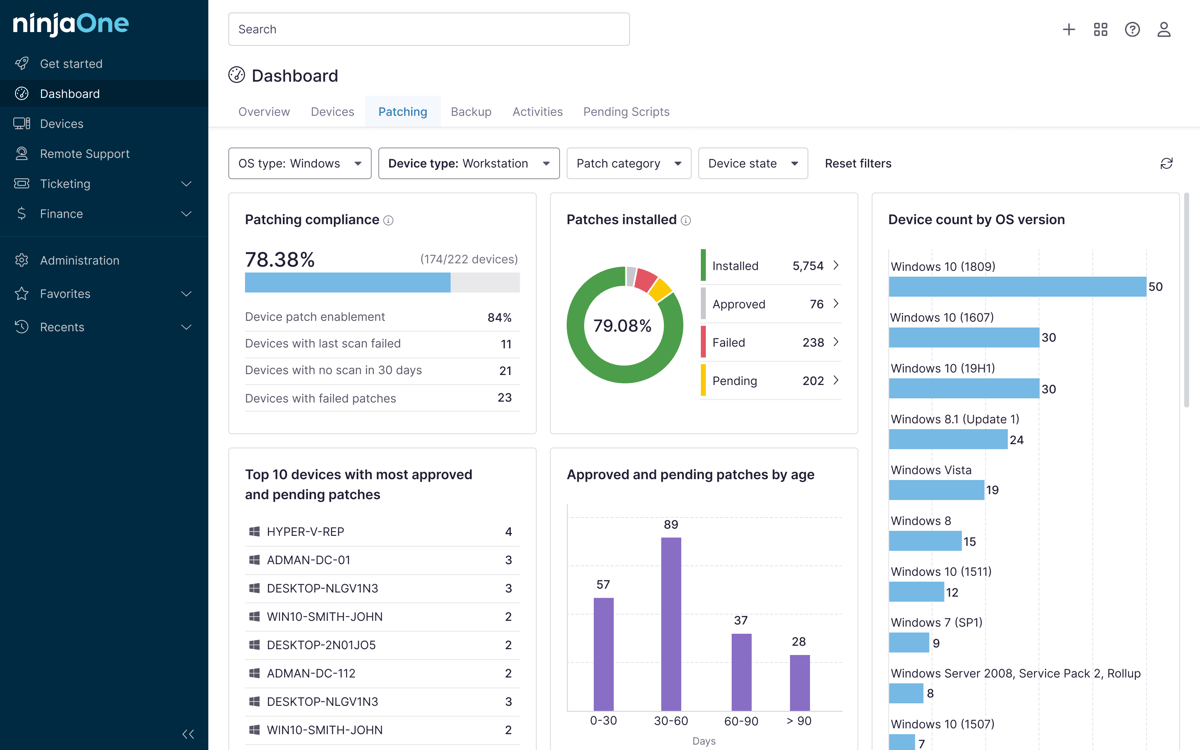
– Patch Management: Automate OS and software patching to keep all remote devices up-to-date with the latest security fixes.
– Endpoint Monitoring: Continuous monitoring of device health, performance, and security posture helps identify and address issues before they impact productivity.
– Remote Access Control: Secure remote access tools allow you to support users or investigate issues without compromising security.
Proof of Results
– Activity Logs: Detailed logs track all automation activities, providing clear evidence of what was executed and when.
– Reporting: Built-in reporting tools let you generate compliance reports, audit trails, and performance metrics to demonstrate the effectiveness of your automation and security measures.
– Custom Alerts: Set up alerts for critical events (like failed patches or security violations), ensuring you can quickly address issues and maintain compliance.
Scalability
– Policy-Based Management: Apply consistent policies across all devices, ensuring uniform security and configuration settings for your entire remote workforce.
– Integration: NinjaOne integrates with existing tools (like PSA platforms), allowing you to automate workflows and prove compliance across your entire IT ecosystem.
By leveraging these features, you can effectively automate remote work processes while maintaining strict security standards and providing verifiable proof of compliance and performance.
Safeguard your organization with robust guardrails for remote work automation setups.
Remote work automation succeeds when it is targeted, safe, and measurable. Start with high-impact tasks, deploy with guardrails, secure the pipeline, and publish evidence every month so stakeholders see the gains.
Related topics: