Key Points
- Anchoring monitoring on user experience means measuring latency and error rates that map to business outcomes.
- Collecting telemetry from the app, server, network, and client layers gives triage full context.
- Clear SLOs and error budgets define target latency and availability before alerting or automating rollbacks.
- Routing alerts by ownership with runbooks attached and visualizing golden signals by service speed up response.
- A monthly performance packet MTTR, and resolved root causes demonstrates outcomes to stakeholders.
Client systems consist of a complex web of applications that support their operations. Instead of maintaining apps separately, IT teams can prioritize a holistic approach that manages infrastructure from a zoomed-out perspective and follow application performance monitoring (APM) best practices.
This article explains how to develop a layered APM data model that enhances visibility, improves threat detection, and drives growth.
Why application performance best practices matter
Implementing APM best practices lets you satisfy user expectations and speed up triage.
Prerequisites:
- Defined user journeys and key business transactions (login, checkout, ticket creation, etc.)
- Access to telemetry across app, infrastructure, and network layers
- Established on-call rotations and escalation paths
- A repository for dashboards, alerts, and monthly evidence packets
Step 1: Start with user-centric SLOs
Define Service Level Objectives (SLOs) that reflect real user experience. SLOs focus on consistency but can vary by industry. For example, an e-commerce SLO could require that 99.5% of checkout page loads complete in under one second over a 30-day window. Moreover, calculate your error budget (100% minus your SLO target) and configure alerts for your burn rate, which shows how quickly you are using up that budget. This cuts false positives and shows how quickly the budget is running down.
Moreover, calculate your error budget (100% – SLO target), and configure automated alerts for frequent errors. This helps eliminate false positives and measure how quickly you “burn” through your error budget, allowing you to monitor application performance efficiently.
🥷🏻| Implement continuous monitoring with real-time alerts.
Read how NinjaOne’s platform tailors visibility across your fleet.
Step 2: Instrument the golden signals
The four golden signals: latency, traffic, errors, and saturation form the cornerstone of Google’s Site Reliability Engineering (SRE) principles. To implement application performance monitoring best practices, track these signals on each layer of your stack:
- Application layer (APM)
- API gateway
- Database and queuing systems
- Infrastructure saturation metrics
Step 3: Optimize observability and telemetry flow
Don’t wait until something breaks to add monitoring measures and apply observability principles across your APM architecture. This means integrating logs, metrics, and distributed tracing into your development process so you can spot problems early and eliminate guesswork.
From a practical standpoint, optimizing observability looks like:
- Using endpoint management tools for enhanced logging.
- Correlating client-side performance and backend telemetry for context.
- Keeping data centralized for easier handling.
- Automating data analysis for reduced overhead.
- Limiting unnecessary logs for faster monitoring.
Step 4: Make alerting actionable
Your alerts need to find the right technician and provide clear steps (AKA “runbooks”) for the situation at hand. Here’s how to make application performance alerts useful:
- Send alerts to the right team: This ensures quick responses from qualified staff.
- Include concrete instructions: Linking documented fixes speeds up
- Prevent alert fatigue: Grouped alerts speed up troubleshooting.
- Provide context: A recent change or deployment may have had something to do with an error.
Step 5: Correlate signals for faster diagnosis
Connecting metrics data from different parts of your system enables you to identify the root cause quickly. High CPU usage on an authentication container or a spike in database queries might be what’s slowing down your login API.
Correlating signals helps you see the chain of events that produce the problem, saving time in troubleshooting. This highlights the importance of adhering to application performance monitoring best practices.
While they don’t come with APM-focused capabilities, Unified Endpoint Management (UEM) tools offer network scans, device health checks, and alerting in a single platform, eliminating the need to manage multiple tools simultaneously.
Step 6: Strengthen post-incident learning
When things don’t go as planned, it’s more important to focus on the lessons than on the culprit. After every incident, review closure metrics, update your runbooks, and document your findings.
Blameless postmortems help your teams focus on improvement while ensuring that they stay prepared for the next time. Rather than focusing on the negative, plan for faster recovery times and fewer alerts to get it right next time.
Fixing a problem is good, but learning from it is just as important.
Step 7: Prove performance with evidence
Lastly, prepare monthly evidence packets to keep stakeholders up to date. This keeps everyone on the same page in between quarterly business reviews (QBRs), and fosters a culture of transparency and confidence.
Keep it client-friendly, and include the following:
- SLO success rate
- How quickly you remediated problems across applications
- Improvements you made to monitoring workflows
Best practices summary table
Practice | Purpose | Value delivered |
| SLOs and error budgets | Match user expectations | User-centric alerts and priorities |
| Golden signals across layers | Added visibility | Fast and efficient problem-solving |
| Observability by design | Operational resilience | Lower Mean Time to Remediate (MTTR) |
| Actionable alerting | Refined remediation workflow | Focused alerts and concrete steps towards resolution |
| Monthly evidence packet | Transparency | Build trust with stakeholders |
Automation touchpoint example for implementing APM
Correlating APM traces with server/network metrics, tagging alerts with runbooks, and compiling error budgets are vital to best practices in application performance monitoring. Automation eliminates human error and reduces overhead, especially for SMBs.
Here are a few examples of how you can automate tasks across your APM architecture:
- Use APIs (New Relic/Datadog/AWS) to fetch traces and infrastructure metrics, and enrich monitors with runbook URLs off-hours.
- Export SLO progress documentation and incident lists from your monitoring platforms weekly.
- In limited user tests, gradually deliver app changes and configure auto-rollbacks when you exceed your error budget.
NinjaOne integration supports application performance monitoring
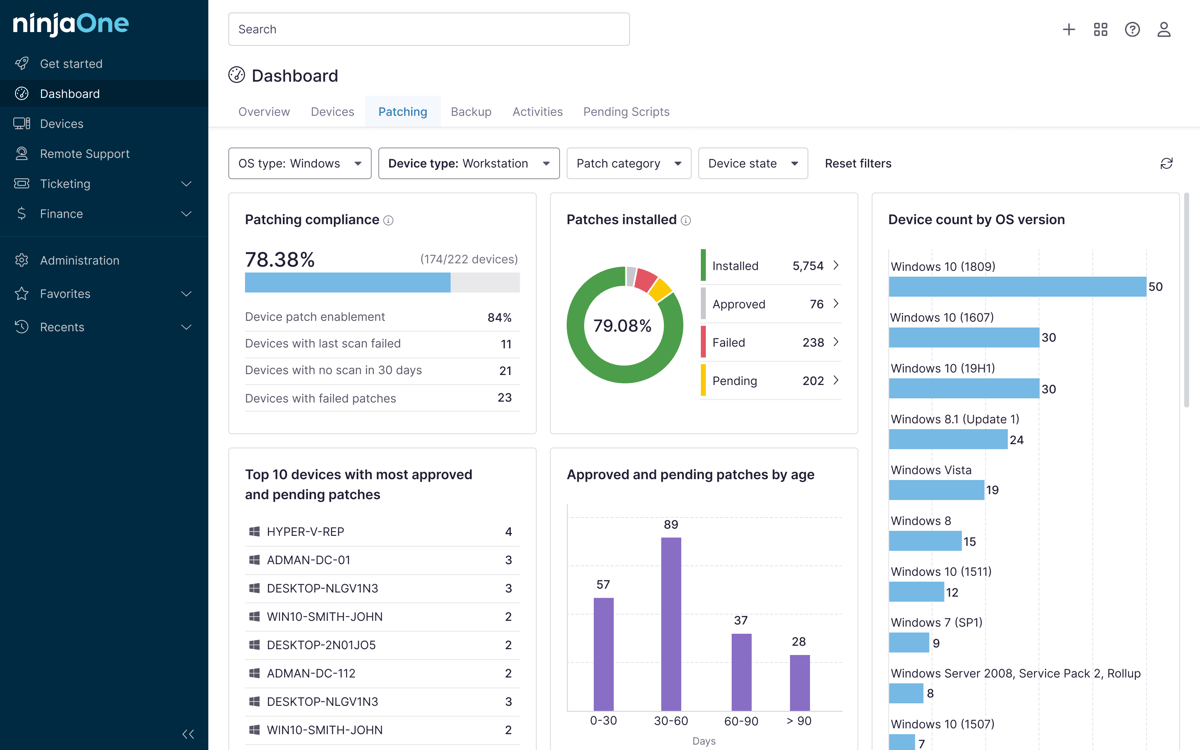
Centralized management platforms can feed telemetry data into existing APM dashboards to simplify app performance tracking. Here’s how NinjaOne supports application performance monitoring best practices:
Step | With NinjaOne |
| User-centric SLOs | Endpoint uptime and performance are tracked to meet user-centric goals. |
| Instrument the golden signals. | CPU, memory, disk, and network usage are tracked to complement app performance monitoring. |
| Optimize observability and telemetry flow. | Device-level data and logs help provide context with app telemetry. |
| Make alerting actionable. | The ticketing system helps route customized alerts to the right team. |
| Correlate signals for faster diagnosis. | Integrates endpoint health data for a top-down view. |
| Strengthen post-incident learning. | Stores incident reports, step-by-step guides, and resolution times in a single repository. |
| Prove performance with evidence. | Generates reports and visuals on uptime, patch compliance, and remediation rates for business counterparts. |
Manage application performance monitoring with centralized solutions
Reflecting user needs and creating comprehensive measures to track performance ensures success across all layers of development and implementation. And with the right tools, IT teams can deliver faster recovery times without compromising quality.
Related topics: