

Key Points
- Unpatched or misconfigured endpoints are now top breach drivers, with vulnerability exploitation hitting 20% of incidents and edge-device attacks surging eightfold.
- Attackers outpace patching, exploiting flaws within days, while IT teams take a 32-day median to remediate.
- One unmanaged device can trigger organization-wide compromise, enabling lateral movement, privilege escalation, and persistent access.
- IT discipline breaks under workload pressure, as teams face too many endpoints, nonstop patches, and overwhelming alerts.
- Automated, integrated endpoint management is critical for continuous monitoring, cross-OS patching, and prioritized vulnerability remediation.
When a single device slips through IT’s defenses — left unpatched, misconfigured, or simply forgotten — it doesn’t stay isolated. It becomes the weak link; the foothold an attacker needs to turn one small gap into a company-wide crisis. For IT teams and the MSPs who support them, this is a real day-to-day risk inherent in modern infrastructure.
The risk is real and rising
The 2025 Verizon Data Breach Investigations Report (DBIR) makes the risk of a compromised device plain. The exploitation of vulnerabilities has surged to 20% of breaches, representing a 34% increase from last year. The weak point is often at the edge: VPNs, firewalls, and internet-facing devices. In fact, attacks on edge devices and VPNs ballooned nearly eightfold in a single year.
While organizations scramble to patch, remediation timelines often fail to keep pace with attackers. The DBIR found that it takes a median of 32 days to fully remediate endpoint vulnerabilities, and adversaries are mass-exploiting some flaws in as little as five days, sometimes the same day a CVE is published.
Outdated or misconfigured endpoints quietly weaken your security stance.
Identify and patch IT vulnerabilities at scale with NinjaOne
How one device becomes everyone’s problem
A breach rarely starts with an exotic zero-day. It usually begins with something mundane: a server running unpatched software, a laptop with misconfigured remote access, or a firewall that has been turned off for troubleshooting and never re-enabled.
From that foothold, attackers move quickly. They escalate privileges, harvest credentials, and spread laterally across the network. A single endpoint shifts from being “just one device” to the launchpad for a much larger compromise. Once attackers establish persistence, recovery stops being a patching exercise and becomes a full-scale incident response.
Why discipline breaks down
MSPs and internal IT teams know all of this. The challenge isn’t awareness — it’s bandwidth. You’re managing an extensive number of endpoints across distributed workforces, hybrid cloud environments, and a mix of operating systems and third-party applications.
Discipline slips because:
- There are too many devices and not enough technicians
- Patches arrive in a constant, unrelenting flow
- Vulnerability alerts pile up faster than they can be triaged.
As a result, teams fall into reactive mode, chasing fires instead of systematically closing gaps. Attackers thrive in those gaps.
The 2025 DBIR reveals that attackers exploit vulnerabilities faster than most teams can patch them. The only viable response is to make patching and monitoring automatic, structured, and visible. That means:
- Automating patch deployments while limiting disruptions
- Monitoring endpoints continuously, so failures or missed patches don’t stay hidden
- Integrating security into endpoint management, so vulnerabilities aren’t handled in a silo
Discipline doesn’t come from effort alone; it comes from having the right systems to enforce it consistently.
Explore the NinjaOne Endpoint Management FAQ to learn how we simplify patching and device security.
Manual security checks don’t scale with emerging IT landscapes and threats.
Don’t wait for “the one”
NinjaOne’s endpoint management platform solves this problem: too many devices, too little time, too much risk. With the right tools, MSP and IT teams can easily:
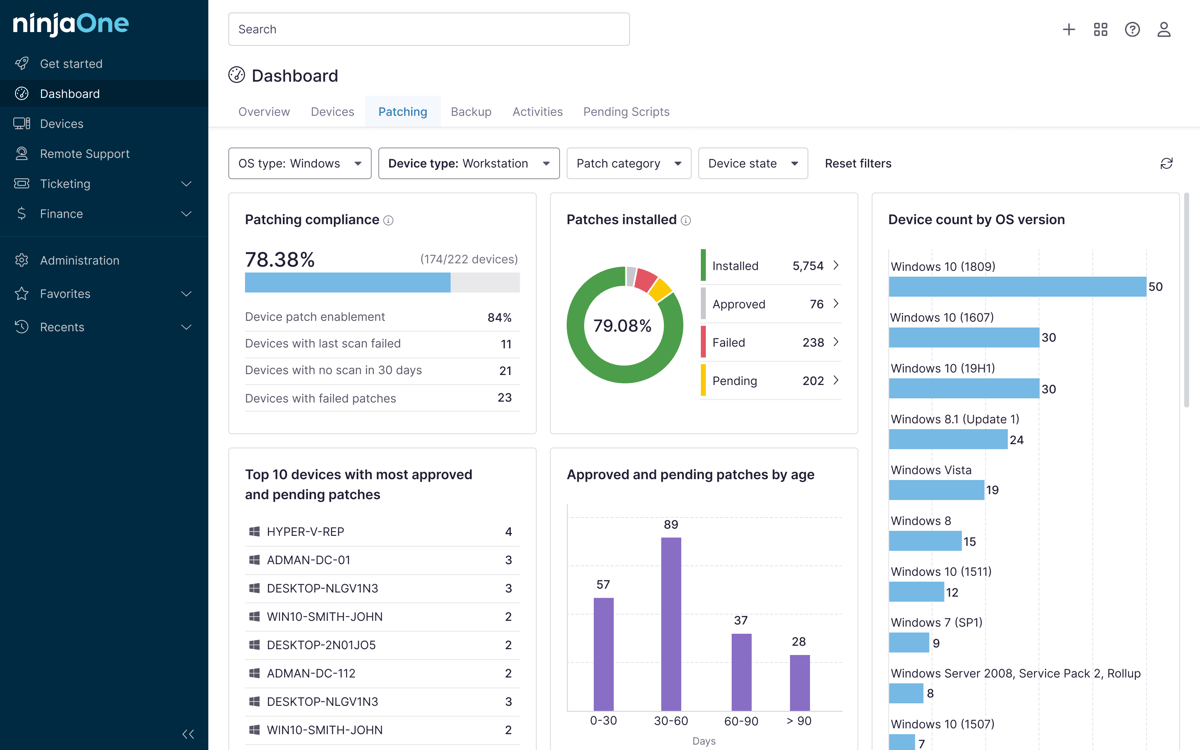
- Automate patching across Windows, macOS, and third-party apps
- Centralize monitoring with real-time visibility into every device
- Cut workload with patching automation and intelligence
- Act faster with prioritized vulnerability and insights