Ratings
Cisco Meraki MDM
Device42

Overall
4.8
Meets Requirements
9.2
905 responses
Ease of Use
9.3
912 responses
Ease of Setup
9.4
804 responses
Ease of Admin
9.5
80 responses
Quality of Support
9.4
876 responses
Ease of Doing Business with
9.6
808 responses
Product Direction (% positive)
Based on G2 Winter 2026
Competitors
Cisco Meraki MDM
Product Summary
Cisco Meraki is a cloud-managed networking platform within Cisco that provides visibility and control across networking, security, and endpoint environments. Its mobile device management (MDM) feature, offered through Meraki Systems Manager, enables organizations to manage and secure mobile devices from a single dashboard.
Systems Manager integrates with the broader Cisco security ecosystem as well as adjusts and enforces network access policies based on device compliance.
It should be noted that Cisco announced the end-of-sale (EOS) for Meraki Systems Manager on December 2, 2025. New purchases will be available until June 3, 2026, and support will continue through June 3, 2029. With that said, organizations evaluating long-term MDM strategies should consider alternative solutions for future deployments.
Use Cases
- Security:
Meraki Systems Manager enables administrators to enforce security policies to protect device data, restrict device features, and control passcode requirements. - Content management:
The platform’s on-device content management feature lets technicians deploy and manage apps, images, documents, and other files on Android, Apple, and Windows devices. - Geolocation:
Cisco Meraki’s geolocation capabilities allow users to locate managed devices and enforce security policies such as lost-mode or location-based restrictions.
Shortcomings
- Product lifecycle status:
With Systems Manager now in EOS, organizations may need to transition to alternative platforms before support ends. - Limited customization:
Meraki’s UI and branding customization options are relatively limited compared to those of other standalone MDM solutions. - Log information:
The customer portal lacks some necessary log information, making it challenging for technicians to swiftly analyze and troubleshoot issues.
Device42
Product Summary
Device42 is a full-stack agentless discovery and dependency mapping platform for hybrid IT. It is also an IT asset management platform built for complex IT environments, unifying IT visibility across data centers and clouds.
Use Cases
- Customer support:
Device42 users acknowledge the platform’s customer support. Their support team responds to issues and listens to feedback. - Installation:
Users pointed out that Device42 is simple to install and deploy. Device42’s installation offers minimal complexity, streamlining the whole deployment process. - RESTful API:
Device42 features a RESTful API, which promotes extensive and flexible integration capabilities. This API enables Device42 to integrate seamlessly with internal systems and other platforms, enhancing its utility.
Shortcomings
- User interface:
Some users have raised issues with Device42’s user interface, which they say is complex and a bit cumbersome when manually editing switch ports. It can affect the overall user experience and sometimes hinder workflow efficiency for IT administrators. - Documentation:
Device42’s documentation could use some improvement and updating. Users specifically pointed out the need for improvements to the documentation of the user interface, reporting, and the software’s main uses. - Limited Large-Scale Visualization:
Some platform users desire better visualization and holistic views of physical interconnections on a larger scale. This limitation affects users who need broader overviews of their network infrastructure.
NinjaOne
Why your peers choose us over Cisco Meraki MDM and Device42
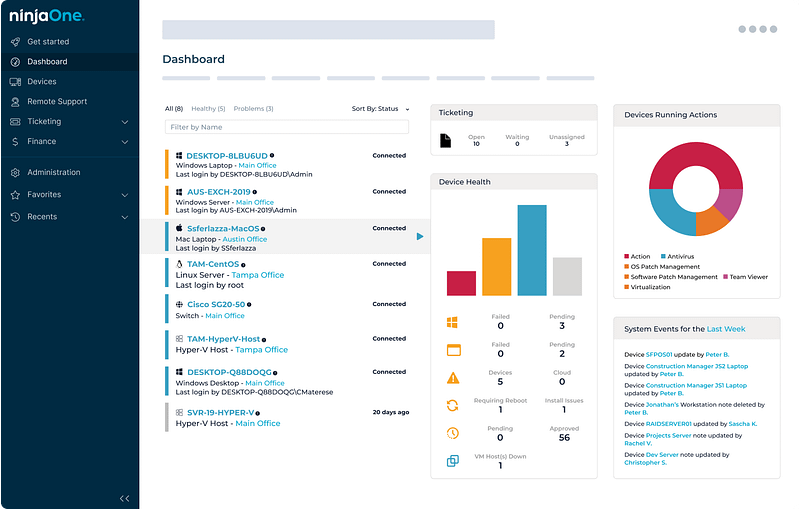
For enterprise IT organizations managing complex, distributed environments, NinjaOne delivers where others fall short. Recognized as a Leader in the 2026 Gartner® Magic Quadrant™ for Endpoint Management Tools, NinjaOne is purpose-built to meet the demands of large-scale operations, combining deep visibility, governance-grade control, and the industry’s highest customer satisfaction scores.Enterprise teams choose NinjaOne for its ability to scale without compromise. Whether managing thousands of endpoints across global locations or enforcing consistent security and compliance policies across heterogeneous infrastructure, NinjaOne provides the reliability and operational consistency that enterprise environments require. Unlike many competing solutions that carry steep learning curves and high system resource overhead, NinjaOne delivers enterprise-grade power without the implementation burden.
NinjaOne’s integration ecosystem is built for enterprise breadth, offering pre-built compatibility with leading security and ITSM platforms, enabling organizations to consolidate their toolset rather than work around it. Advanced, role-based reporting and audit-ready dashboards give IT leadership the real-time intelligence needed to drive strategic decisions and demonstrate compliance. For enterprises seeking a proven, scalable endpoint management platform backed by best-in-class support, NinjaOne is the clear choice.
What they're saying



Watch a Demo of the #1 IT Management Software on G2
Related resources
Cisco Meraki MDM
Device42
Device42 vs LogicMonitor
Bravura Optitune vs Device42
Device42 vs PRTG Network Monitor
Connectwise Automate vs Device42
Device42 vs Kaseya VSA
Device42 vs Syncro
Atera vs Device42
Automox vs Device42
Auvik vs Device42
Device42 vs Veeam
Datto vs Device42
Device42 vs N-able N-sight
Device42 vs N-able N-central
Device42 vs LogMeIn
Device42 vs ManageEngine Endpoint Central
Device42 vs Microsoft Intune
Arcserve vs Device42
BigFix vs Device42
Device42 vs Lansweeper
Device42 vs Tanium
Device42 vs SolarWinds Dameware
Device42 vs Naverisk
Device42 vs Panorama9
Bacon Unlimited vs Device42
Device42 vs Level
Device42 vs GoTo Resolve
Acronis vs Device42
Device42 vs IT Glue
Device42 vs Ivanti
Device42 vs Pulseway
Device42 vs Kace
Device42 vs VMware Workspace One
Device42 vs SysAid
Device42 vs Scalefusion
Device42 vs Matrix42
Baramundi vs Device42
Device42 vs Hexnode
Device42 vs ITarian
Device42 vs Pandora FMS
Device42 vs SOTI MobiControl
Device42 vs IBM Security MaaS360
BMC Helix Client Management vs Device42
Device42 vs SuperOps
Action1 vs Device42
Device42 vs Syxsense
Cisco Meraki vs Device42
Device42 vs Kandji
Device42 vs Sophos Mobile
Device42 vs GFI Languard
Device42 vs Mosyle
Device42 vs Esper
Addigy vs Device42
Device42 vs JumpCloud
Device42 vs Miradore
Device42 vs Jamf
Device42 vs Moki Total Control
Device42 vs SureMDM
