Endpoint patching for Windows, macOS, and Linux with NinjaOne RMM
NinjaOne RMM automates OS patching across Windows, macOS, and Linux endpoints, with policy-based approvals, scheduled deployments, and centralized patch reporting.
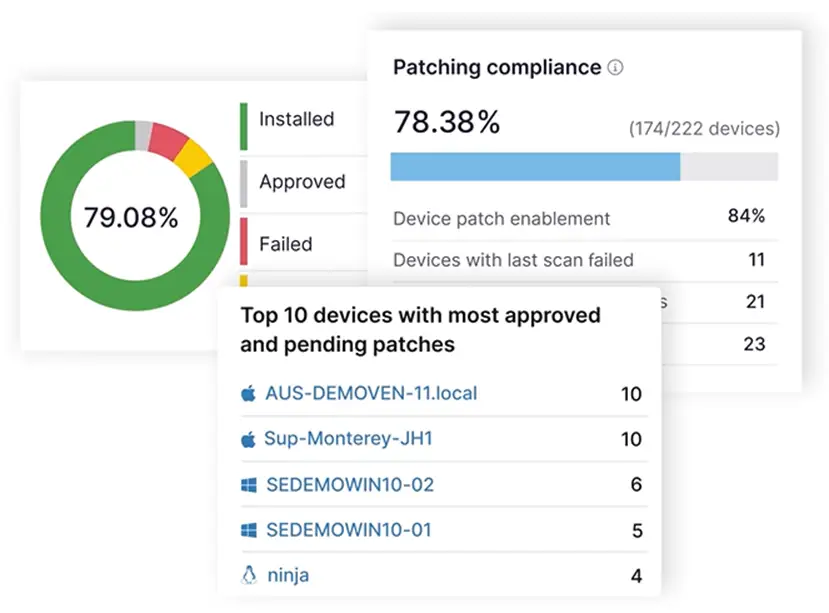
NinjaOne RMM automates OS patching across Windows, macOS, and Linux endpoints, with policy-based approvals, scheduled deployments, and centralized patch reporting.






Managing patches across different operating systems, applications, and device locations presents several challenges. The following scenarios show how NinjaOne RMM helps IT teams address them through centralized patch management.
| Problem | How NinjaOne RMM addresses it |
Managing OS updates across Windows, macOS, and Linux requires different patching workflows. | NinjaOne RMM provides centralized patch management with OS-specific policies for scanning, approving, and deploying updates across supported Windows, macOS, and Linux devices. |
Remote and hybrid endpoints can miss updates when they are disconnected or unavailable during scheduled patching. | NinjaOne RMM supports patch management for remote and on-premises endpoints, from one console. Patch policies can be configured to run missed scans or updates when devices reconnect, helping endpoints catch up on scheduled patching. |
Outdated third-party applications can expose endpoints to known vulnerabilities. | NinjaOne RMM supports third-party application patching on Windows, Linux and macOS using supported application catalogs. |
Unplanned patch installations and reboots can interrupt business operations. | NinjaOne RMM allows administrators to configure patch approval rules, update schedules, and reboot behavior to better control deployments and reduce disruptions. |
Tracking missing patches and installation failures across multiple devices can be time-consuming. | NinjaOne RMM provides centralized patch dashboards and status views to identify pending, installed, and failed updates across managed endpoints. |
The following benefits highlight how NinjaOne RMM helps IT teams and MSPs improve endpoint patching across their environments.
Automate patch scanning and deployments across Windows, macOS, and Linux to reduce missing updates.
Schedule updates and configure reboot behavior to minimize interruptions during business hours.
Use approval rules to decide which updates are installed and when they are deployed.
Quickly identify devices that require attention by reviewing pending, installed, and failed patches in one dashboard.
Review patch status and deployment records to track update activity and support audit preparation.

NinjaOne RMM allows administrators to automate operating system patch scans and deployments across supported Windows, macOS, and Linux devices. Configurable OS patching settings within device policies help teams manage updates without manually patching individual endpoints.

NinjaOne RMM supports automated patching for third-party applications across Windows, Linux and macOS. Both operating systems support application patch catalogs.

Administrators can approve, reject, or require manual approval for updates through OS patching settings within device policies.

NinjaOne RMM lets administrators configure patch scanning, update schedules, and reboot behavior. These controls help teams plan deployments around maintenance windows and reduce interruptions to end users.

The NinjaOne Patch Management dashboard provides centralized visibility into pending, approved, rejected, installed, and failed patches. Technicians can review patch status and identify devices that require attention.

Patch Intelligence AI analyzes Windows OS updates and highlights known issues, helping administrators make informed patching decisions. An optional approval override feature can also change automatic approvals to Manual or Reject for patches flagged with known issues or cautions.
The following scenarios show how IT teams and MSPs use NinjaOne RMM to manage endpoint patching across different environments.
IT teams use NinjaOne RMM to manage operating system and supported application updates across remote and on-premises endpoints. Centralized patching settings within device policies allow administrators to schedule deployments and monitor patch status without requiring physical access to devices.
Organizations use NinjaOne RMM to identify missing patches and deploy approved updates across supported endpoints. Automated patching helps teams address known vulnerabilities while maintaining control over installation schedules and approval policies.
MSPs use NinjaOne RMM to coordinate patch deployments across different customer environments. Technicians can configure patch policies, track installation results, and identify endpoints that require attention from a centralized console.
100,000
Endpoints managed
“NinjaOne is a scalable solution. It’s built on a modern SaaS architecture and it’s future-proof.”

40%
More Cost Effective
“NinjaOne’s price point is 40% less than any other endpoint management tool on the market, while being more powerful and easy to use.”

10-15
Tools Replaced
“Before, I needed 10-15 different tools to execute what NinjaOne does in its centralized, single pane of glass.”

30%
Less time for patching
“We observed a 30% reduction in the time taken for patch deployments compared to our previous solution.”

2,000
Endpoints managed
“NinjaOne gives me much more flexibility and security in my work”

30%
Annual ROI
“[NinjaOne] has already shown its value in ROI…it’s at least a hundred thousand dollars annually.”

24x
Faster Endpoint Management
“Our processes have become 24x faster with NinjaOne.”

20-40
Hours Saved Each Week
“Leveraging the automations feature within NinjaOne has enabled me to save upwards of what would likely be 20 to 30 to even 40 hours per week.”

Enable OS patching or Software patching in the appropriate agent policies. Configure scan and update schedules, approval settings, and reboot options.
NinjaOne scans managed endpoints for available updates according to the configured scan schedules and identifies patches that require approval or installation.
Use automatic approvals, manual approvals, or Windows patch-specific approval overrides to control patch installations. NinjaOne applies approved patches during the configured update schedules.
Use the Patch Management dashboard to review pending, approved, rejected, installed, and failed patches and identify endpoints requiring attention.
Import vulnerability scan results to identify affected endpoints and support patch prioritization.

Connect vulnerability findings with managed devices to help technicians prioritize updates that address known vulnerabilities.
Import vulnerability data into NinjaOne to identify affected devices and support patch remediation workflows.
Blanchard Valley Health System uses NinjaOne Autonomous Patch Management to automate patch management across its healthcare environment. The organization achieved a 66% faster automated patching and increased patch compliance by more than 50%, reducing manual work and improving update consistency.
“With NinjaOne, you’re patching within a short time frame from when patches are released. We’re no longer months behind.”
Jack Frost, Senior IS Infrastructure Manager, Blanchard Valley Health System
Automate patch deployments, manage approval policies, and track installation status across managed endpoints. Simplify patch management from a centralized console.
RMM for unified IT operations. Monitor, protect, and manage all your endpoints on one platform

Improve IT efficiency with an autonomous patch management solution. Automate updates and secure endpoints across your organization with NinjaOne.
Learn how to activate, configure, and monitor Windows OS patch management for managed endpoints.
NinjaOne Patching allows you to create patching policies that automatically scan for and apply new software patches for your Microsoft Windows endpoints.
Learn how the patch management dashboard centralizes update status, compliance, and patch activity across managed endpoints.
Endpoint patching in NinjaOne RMM allows IT teams to scan, approve, and deploy operating system and supported application updates across managed Windows, macOS, and Linux devices. Administrators can automate patching through configurable policies and monitor installation status from a centralized console.
Administrators enable the appropriate patching settings in the device policy, then set scan and update schedules, approval settings, and reboot options. NinjaOne scans endpoints for available patches, applies the approval rules, and installs approved updates on the assigned schedule.
NinjaOne RMM supports operating system patching across Windows, macOS, and Linux endpoints. It also supports third-party software patching on Windows. Linux and macOS, with application availability varying by operating system.
The Patch Management dashboard provides centralized visibility into patch status across managed endpoints. Technicians can identify missing updates, review installation results, and find devices with failed patches that require attention.
Yes. NinjaOne RMM allows administrators to configure update schedules, patch approval rules, and reboot behavior through device policies. These settings help IT teams coordinate patch deployments around maintenance windows and reduce disruptions to end users.