Autonomous patch management, powered by AI

NinjaOne automates patch deployment across your fleet, continuously correlates vulnerability data in real time, and flags unstable Windows updates for admin review.

IT business logo
Provide logo
Advantage Technologies logo
Dedicated IT logo
Alticap logo
Network Coverage logo

Common patch management challenges

The following problems describe common patch management challenges, and how NinjaOne Autonomous Patch Management addresses them.

ProblemHow NinjaOne resolves it

Unpatched vulnerabilities stay open too long when patching relies on manual review and scheduling.

NinjaOne automates patch identification, approval, and deployment across Windows, macOS, Linux, and 6,000+ third-party applications, so known vulnerabilities get closed faster.

A single unstable update can cause more downtime than the vulnerability it was meant to fix.

For Windows patch policies, Patch Intelligence AI analyzes telemetry, vendor feedback, and deployment signals to flag unstable updates, so administrators can assess the risk and decide whether to approve, delay, or reject a patch before it rolls out broadly.

Waiting for the next scheduled vulnerability scan delays remediation of newly disclosed threats.

NinjaOne’s built-in Vulnerability Management continuously correlates endpoint software state against real-time CVE and Known Exploited Vulnerability (KEV) intelligence, with no scan windows, and maps vulnerabilities directly to the patches that resolve them. Teams can also import data from external scanners, such as Tenable or Qualys, instead.

Patching remote or off-network devices is difficult without VPN or on-premises infrastructure.

NinjaOne’s cloud-native, agent-based patching reaches endpoints anywhere, with optional patch caching for bandwidth-limited sites.

Proving patch compliance for audits or leadership review takes manual effort to piece together.

NinjaOne’s patch activity log and compliance reporting show what’s been approved, deployed, or rejected, and when, from a single dashboard.

NinjaOne Autonomous Patch Management capabilities 

Faster time to remediation

Prioritized, automated patch deployment closes known vulnerabilities faster, shrinking the window of exposure.

Real-time exposure visibility

Continuous, scan-free correlation against CVE and KEV intelligence surfaces newly disclosed vulnerabilities immediately, instead of waiting for the next scheduled scan.

Fewer patch-related outages

Flagging unstable updates for review before broad rollout means fewer unplanned outages and support tickets tied to bad patches.

Less manual patch work

Automation across OS and third-party application patching frees IT teams from manually finding, testing, and applying updates.

Audit-ready compliance reporting

Patch activity logs and compliance reports give IT and compliance teams a clear record for audits, without piecing it together manually.

Patch Management Solutions & Features

Patch automation icon

Patch Intelligence AI

For Windows patch policies, Patch Intelligence AI analyzes telemetry, vendor feedback, and deployment signals to flag unstable updates. Administrators can then apply the flagged patch manually or reject it.

Vulnerability Data icon

Policy-based automation

Set preemptive patch approvals, configure approval overrides, deploy pre- and post-patch scripts, schedule deployments, and automatically wake devices for patch windows.

Patching Management

Reboot management

Automated reboot sequences and custom restart messages help minimize disruption to end users during patch deployment.

Cloud-native, agent-based architecture

Patch endpoints anywhere without requiring a VPN, domain, or on-premises infrastructure.

Log icon

Patch activity log

Review a record of who approved, rejected, or deployed each patch, and when.

Events, Updates, and Resources

This is why customers love us

How autonomous patch management works 

I. Plan and configure

Administrators configure NinjaOne agent policies to enable patch management. Based on organizational requirements, they define patch scanning and installation schedules, pre- and post-patching automations, reboot options, and patch approval settings. Optionally, for Windows policies, they can set up Patch Intelligence AI approval overrides.

II. Enroll

Administrators deploy the NinjaOne agent to enroll devices in NinjaOne and enable centralized patch management.

III. Assess and deploy patches

NinjaOne scans managed devices for available OS and third-party patches according to configured schedules and installs approved patches. Administrators can leverage Patch Intelligence AI to assess patch risks and make informed approval decisions.

IV. Monitor and report

Administrators monitor patch deployment status, identify failed installations, and track patch compliance through NinjaOne dashboards, patch activity logs, and reports.

Why organizations trust NinjaOne Patch Management 

Kansas City, a major U.S. city government managing more than 5,000 endpoints, uses NinjaOne Autonomous Patch Management to replace a patching process that previously took up to 72 hours.

“Previously, it would take up to 72 hours to identify vulnerabilities, test, and deploy patches. With NinjaOne, it's almost instantaneous.”

Cancer and Hematology Centers (CHC), Michigan’s largest physician-owned oncology and hematology practice, uses NinjaOne to keep patches current across servers and PCs while maintaining HIPAA compliance.

“NinjaOne patching is automatic. We can run reports showing what's been patched, and what hasn't been. Patching with NinjaOne has significantly reduced the vulnerabilities in our network.”

Rated #1 on G2

G2’s No.1-Rated Patch Management Software

Simple, reliable patching that works.

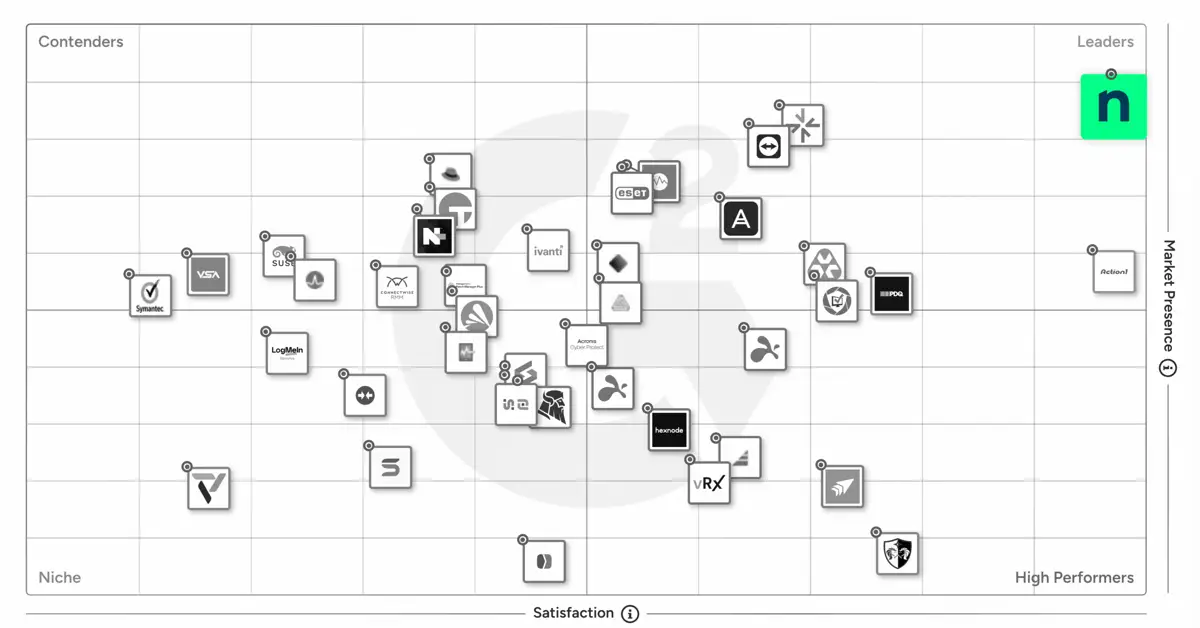
Backed by a G2 score of 98, NinjaOne is the top-rated Patch Management Software in G2’s 2026 Report. With a perfect Satisfaction score of 100, customers know where to turn to simplify patching.
“NinjaOne’s patch management is, without question, the best we’ve used. It’s consistent, reliable, and gives us confidence that our systems are always up to date.”

Madhu Dutta, Vice President IT

G2 Grid for Patch Management Software
G2 Leader - Fall 2026
G2 Leader - Enterprise - Fall 2026
G2 Momentum Leader - Fall 2026
G2 Regional Leader - EMEA - Fall 2026
NinjaOne Average Ratings
Likelihood to Recommend 9.5 9.1
Product Going in the Right Direction? 9.8 9.1
Ease of Admin 9.3 9.0
Ease of Doing Business With 9.6 9.2
Quality of Support 9.3 9.1
Ease of Setup 9.3 8.9
Ease of Use 9.3 9.0
Information as per product capabilities from G2 This comparison represents our assessment of publicly available product capabilities from G2 as of August 2026. If you believe any information here is inaccurate or incomplete, please contact us and we will evaluate and address it as appropriate.
Ready to simplify the hardest parts of IT?

Try autonomous patch management with NinjaOne

See how NinjaOne automates patching and flags unstable Windows updates for review before broad rollout.

NinjaOne Autonomous Patch Management automates patch identification, prioritization, and deployment across Windows, macOS, Linux, and 6,000+ third-party applications. Vulnerabilities are continuously mapped to the patches that resolve them, and for Windows patch policies, Patch Intelligence AI flags unstable updates so administrators can reject or hold them before they disrupt operations, while approving the patches that are safe to deploy.

NinjaOne doesn’t rely on traditional scanning. Its built-in Vulnerability Management continuously correlates software inventory already collected by the NinjaOne agent against real-time CVE and Known Exploited Vulnerability (KEV) intelligence, server-side, with no scan windows or agent performance impact. It can also work alongside external vulnerability scanners, such as Tenable or Qualys, for organizations that want to keep using them.

NinjaOne preserves exposure intelligence by matching newly disclosed CVEs against the device’s last-known software state, so remediation can proceed as soon as it reconnects.

Patch Intelligence AI is an approval-override feature available for Windows policies. During patching, it analyzes telemetry, vendor feedback, and deployment signals to detect patches with known issues or cautions, and can override an automatic approval; administrators can then apply the flagged patch manually or reject it.

NinjaOne patches Windows, macOS, and Linux, plus 6,000+ third-party applications.

No. NinjaOne uses cloud-native, agent-based patching that reaches endpoints anywhere, without requiring a VPN, domain, or on-premises infrastructure.

Automated patch management simplifies and accelerates patch deployment while letting IT teams configure policies, schedules, and approvals. Autonomous patch management builds on this with AI-driven stability analysis that flags risky patches for review, while IT teams still define the rules, assess the risk, and retain approval oversight.

Patch caching is a mechanism that stores downloaded patches on a designated Windows device, allowing other managed devices on the network to retrieve them locally instead of downloading the same patches individually from the internet. This reduces internet bandwidth consumption and improves patch deployment efficiency, particularly in bandwidth-constrained environments.

Unlike a WSUS server, a patch cache server can be any Windows machine running a supported Windows operating system. It only stores and distributes updates; patch approvals and deployment management remain centralized in NinjaOne.

1IDC Business Value White Paper sponsored by NinjaOne, The Business Value of NinjaOne Unified IT Operations Platform, Doc #US54520326, June 2026.