


Key Points
- FedRAMP compliance is a government-wide program that standardizes the security, assessment, authorization, and monitoring of cloud services used by U.S. federal agencies.
- Cloud service offerings must achieve FedRAMP authorization to store, process, or transmit federal data and be eligible for use by federal agencies.
- An independent third-party assessment is required to achieve FedRAMP compliance, enabling the reuse of authorization across federal agencies.
- FedRAMP determines the applicable baseline for cloud services by evaluating their impact on confidentiality, integrity, and availability.
- Achieving FedRAMP authorization involves applicability review, documentation, 3PAO assessment, and vulnerability remediation.
- FedRAMP compliance requires continuous monitoring to maintain authorization and visibility in the FedRAMP Marketplace.
As federal agencies incorporate cloud services, service providers are expected to demonstrate ongoing adherence to federal cybersecurity expectations. FedRAMP compliance outlines the process for assessing, authorizing, and continuously monitoring cloud services before they can be used by federal agencies.
Manage, protect, and document every endpoint from a single, cloud-native console.
What is FedRAMP compliance?
Cloud computing has transformed how organizations deliver services and information by making infrastructure, platforms, and software accessible over the internet. While the cloud enables organizations to scale and centralize processes, its use comes with risks.
The Federal Risk and Authorization Management Program (FedRAMP) standardizes the handling of federal data through cloud services. Understanding and adhering to FedRAMP requirements is essential for organizations entering the federal market or supporting public sector modernization initiatives.
Compliance with FedRAMP means that a cloud service provider (CSP) has met the required security standards and received authorization to provide cloud services to U.S. federal agencies.
Why should organizations comply with FedRAMP requirements?
The U.S. Government launched FedRAMP in 2011, a single, government-wide program that aims to standardize cloud security assessment, providing consistent risk management across agencies.
Complying with FedRAMP requirements enables organizations to deliver secure and eligible cloud-based services to U.S. federal agencies. Aside from this, FedRAMP compliance also delivers broader operational and security benefits for organizations.
Authorization to provide services to federal businesses
FedRAMP compliance is required for any cloud service that stores, processes, or transmits Controlled Unclassified Information (CUI). Without it, CSPs are ineligible to deliver services to federal agencies, preventing them from expanding their services into the government market.
Standardized security requirements
FedRAMP provides organizations with a security baseline based on NIST standards. Aligning to a single, government-wide baseline streamlines the compliance process for CSPs. This eliminate the need to navigate different agency-specific requirements.
Independent security validation and authorization reuse
To demonstrate FedRAMP compliance, organizations must undergo an independent security assessment conducted by an accredited third-party auditor. Once authorized, federal agencies can reuse a FedRAMP authorization, accelerating adoption of authorized cloud services and reducing duplicated security reviews for CSPs.
FedRAMP continuous monitoring
FedRamp compliance doesn’t end after an authorization. Its continuous monitoring requirements help ensure that security controls consistently address vulnerabilities and remain effective over time.
Who needs FedRAMP compliance?
Adherence to FedRAMP requirements is mandatory for CSPs and SaaS providers seeking to offer services to federal agencies. On the procurement side, federal agencies are required to adopt only FedRAMP-authorized cloud services to meet federal security and risk management standards.
Third-party assessment organizations (3PAOs), while not required to be FedRAMP compliant, must meet FedRAMP-defined requirements to assess CSPs.
FedRAMP authorization process: Overview and key steps
To achieve FedRAMP authorization, CSPs should follow a structured process that helps ensure their cloud service offerings meet federal security requirements throughout their lifecycle. The steps below outline how CSPs can evaluate FedRAMP applicability, prepare for an assessment, achieve authorization, and preserve ongoing compliance.
📌 Prerequisites:
- Cloud systems or services intended for federal agency use
- Internal security program aligned with recognized frameworks
- Availability of resources to support assessment and documentation
- Familiarity with NIST-based controls and federal cybersecurity obligations
Step 1: Understanding the applicability and purpose of FedRAMP
The first step in the FedRAMP authorization process is to understand whether a certain service falls within FedRAMP’s scope. CSPs must confirm whether their services qualify as a cloud service supporting federal workloads. This early validation prevents unnecessary authorization and compliance planning.
Step 2: Determining the appropriate impact level and baseline
FedRAMP categorizes cloud offerings across three pillars: confidentiality, integrity, and availability (CIA) as per Federal Information Processing Standard (FIPS) 199. Each pillar is rated Low, Moderate, or High impact.
After rating each pillar, the highest impact level across the three sets the system’s FedRAMP baseline. The selected baseline defines the scope of required security controls for a cloud service, with higher baselines mandating broader and stricter security controls.
Step 3: Prepare the FedRAMP authorization package
CSPs should document how security controls are implemented to protect federal data across their cloud environment through a System Security Plan (SSP). Incorporate supporting documentation to provide evidence that policies, procedures, and safeguards are in place.
Step 4: Complete third-party assessment and security verification
Go to the official FedRAMP Marketplace and engage a certified 3PAO to conduct an independent assessment. This should cover testing, documentation review, and vulnerability validation. Identified risks must be remediated or documented through a formal Risk Acceptance Form (RAF). Additionally, update evidence packets to document infrastructure or control changes.
Step 5: Comply with FedRAMP’s continuous monitoring obligations
Submit regular reports to demonstrate continued control effectiveness and prove ongoing security monitoring after authorization is granted. Ensuring compliance with continuous monitoring obligations helps agencies maintain visibility into potential system risks.
Considerations for maintaining FedRAMP compliance controls
Pursuing FedRAMP compliance requires organizations to consider broader operational, resource, and governance implications. The following considerations should be kept in mind when maintaining ongoing compliance with FedRAMP.
Similarities with NIST standards
FedRAMP is primarily built on NIST standards, specifically NIST SP 800-53, and aligns closely with other federal security programs. If your organization already complies with frameworks such as NIST CSF or ISO 27001, you may find similarities between FedRAMP requirements and your existing controls.
Achieving and maintaining FedRAMP authorization
Attaining and preserving authorization are resource-intensive endeavors. This requires close coordination across multiple teams to ensure existing controls meet federal requirements and prove ongoing compliance.
FedRAMP Marketplace visibility
The FedRAMP Marketplace is an official online database and directory that includes secure cloud service offerings (CSOs) vetted by 3PAOs. To improve your CSO’s visibility on this platform, maintaining an active authorization is a must.
Leverage automation when possible
Continuous monitoring obligations entail repetitive reporting and validation tasks that must be performed over time. That said, automating authorization workflows reduces manual effort and improves consistency in vulnerability management and evidence collection.
⚠️ Things to look out for
|
Risks |
Potential Consequences |
Reversals |
| Unclear impact classification | Unclear impact classifications can lead you to the wrong security baseline, causing rework, delays, or rejection during assessments. | Revisit data types and federal use cases to ensure the impact classification reflects real-world risk. |
| Difficulty preparing documentation | Incomplete documentation can slow down assessments and foster doubt about a CSO’s FedRAMP compliance. | Review sample authorization packages or work with experienced assessors to help clarify expectations and improve documentation quality. |
| Assessment delays | Missing prerequisites can significantly impact the assessors’ ability to complete the required testing procedures. | Confirm readiness before engaging a 3PAO for assessments to ensure testing can proceed smoothly. |
| Continuous monitoring findings | Unresolved findings can weaken trust in a CSO’s security posture, which can impact its authorization standing. | Prioritize remediation and update required artifacts to reflect infrastructure or control changes, demonstrating ongoing risk management. |
| Boundary uncertainty | Unclear system boundaries can confuse assessors about what is included in the authorization. | Refine diagrams and system descriptions to help reviewers better understand the authorized environment. |
NinjaOne integration to support FedRAMP compliance
NinjaOne helps organizations achieve and maintain FedRAMP compliance by enhancing visibility, consistency, and reporting across federal ecosystems. As a FedRAMP Moderate Authorized platform, NinjaOne seamlessly fits into federal IT environments that require robust security controls and ongoing monitoring.
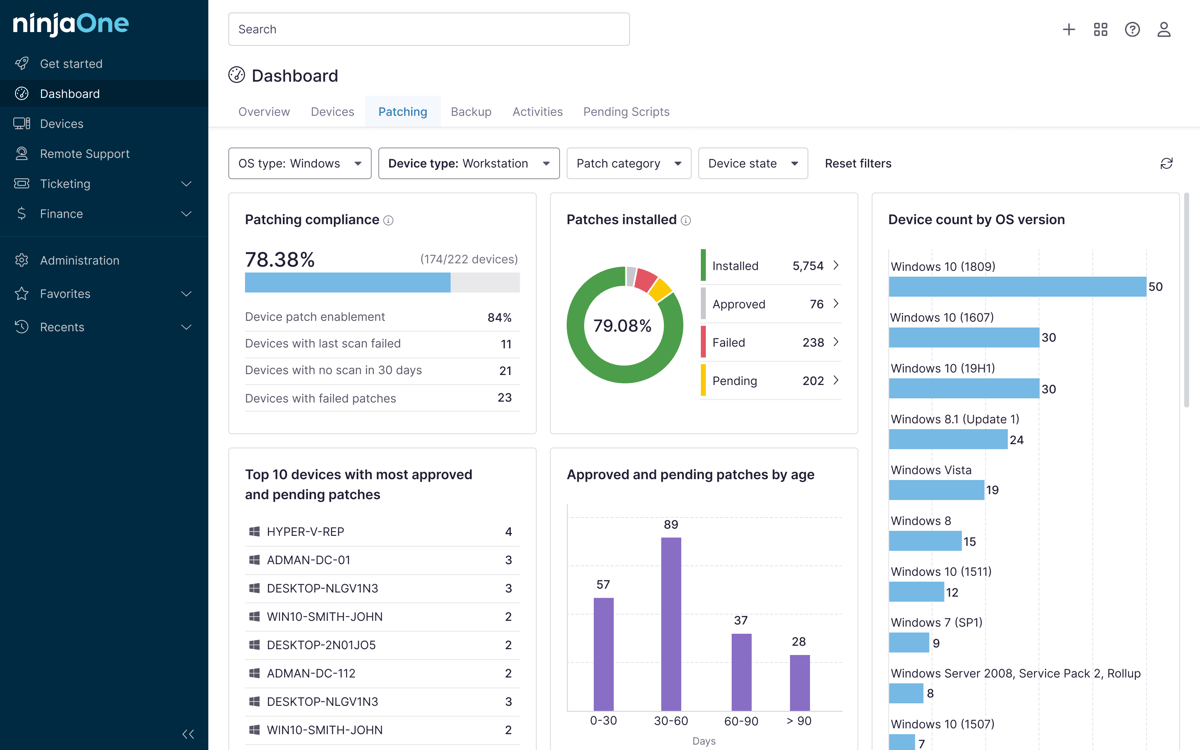
- Endpoint visibility: NinjaOne offers centralized visibility into endpoint configuration, patch compliance monitoring, and vulnerability management, supporting security and compliance activities.
- Automated reporting: Demonstrate ongoing compliance by leveraging NinjaOne’s automated reporting features to assist with continuous monitoring requirements and recurring compliance submissions.
- Compliance support: NinjaOne helps with maintaining system integrity while supporting documentation efforts that align with federal cybersecurity expectations.
- CMMC Level 2 & NIST 800-171 alignment: NinjaOne’s FedRAMP authorized platform delivers visibility, security, and compliance that helps clients meet CMMC requirements.
- Dedicated US-based support: Receive expert guidance and support from dedicated US-based specialists experienced in FedRAMP and federal IT environments.
See exactly how NinjaOne Endpoint Management maps to federal demands.
Maintain FedRAMP compliance to support federal ecosystems
FedRAMP compliance supports the secure adoption of cloud services across federal environments by helping ensure that CSOs adhere to a consistent security standard. Through the FedRAMP marketplace, agencies can identify and reuse authorized CSOs with confidence.
For organizations pursuing compliance with FedRAMP requirements, as well as MSP CMMC support, success depends on following a structured procedure. Confirming compliance applicability, selecting the correct impact level, completing assessments, and sustaining continuous monitoring demonstrate security maturity to support federal agencies.
Related topics: