
Key Points
- Documented workflows, change management, and standardized escalation paths reduce risk and improve predictability.
- Continuous visibility into system health, alerts, and baseline drift ensures resilience and capacity planning.
- Strong access governance protects privileged accounts and supports compliance.
- Staying informed on security threats, reviewing vendor updates, testing tools in controlled environments, and refining automation strategies maintain system resilience.
As IT environments become more and more sophisticated, system administrators face a growing list of responsibilities. One of these is instilling operational discipline in IT, enforcing structured processes such as update cycles and continuous monitoring for resilience and long-term success.
Choose consistent and measurable standards over reactive fixes. This article explains how IT operational maturity is achieved at scale.
How to tailor your modern system administration strategy
Standardized protocols always trump ad-hoc “bandaid” fixes. That said, your best guidelines should always consider your system’s design as well as your technical constraints.
Prioritize structured operational processes
Relying on documented workflows manages risk and improves predictability. This creates effective system administrators and is the first step in building operational resilience in IT.
Define these workplace protocols first:
- Outlined ownership procedures
- Configuration version control
- Incident documentation and review
- Patch windows and update cycles
- Standardized escalation paths
Adopt proactive monitoring and visibility
Visibility should extend beyond endpoint uptime. Your monitoring workflows should also include component usage, baseline drift checks, and proactive alerts for better planning.
This involves checking on CPU and memory status, network health, proactive alerts, and daily certificate management to ensure you’ve planned out long-term capacity needs while strengthening access controls.
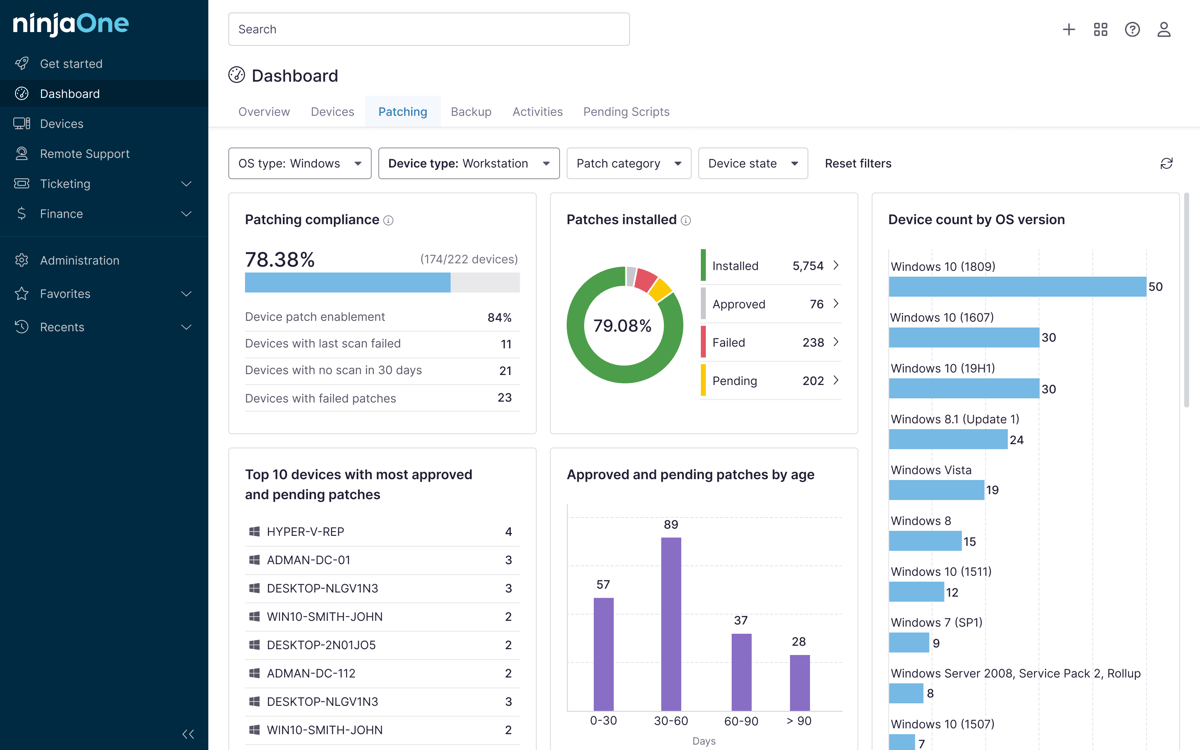
🥷🏻| Enhance visibility with scalable platforms for less overhead.
Find out how NinjaOne’s dashboard can solve IT heartache.
Strengthen access and privilege governance
According to Syteca, system administrator accounts are “prime targets” for cyberattackers, underscoring the need for role-based access control (RBAC), zero-trust environments, and regular credential checks.
Operational discipline in IT supports governance procedures, reducing risk. To improve privilege management, follow these system administrator best practices:
- Avoid shared admin accounts: Give each administrator their own identifiable admin account so audit logs show who did what.
- Restrict elevated permissions: High-level permissions should be rare and limited per role.
- Maintain separation of duties: Divide responsibilities across different roles so no single person can complete a critical workflow end-to-end without oversight
- Conduct periodic access reviews: Regularly audit accounts and privileges to avoid permission sprawl.
- Audit privileged action logs: Track and record all administrative activities for better auditability to support compliance requirements.
Maintain accurate documentation and knowledge sharing
Detailed record-keeping and its continual upkeep improve incident workflows and ensure continuity during staff turnovers. This is a core aspect for businesses that aim to maintain operational discipline in IT, streamlining system recovery while providing indispensable evidence of your infrastructure’s state.
Creating visual diagrams provides a stakeholder-friendly view of your fleet when needed, and noting configuration changes helps reduce blind spots in your security posture. Standardized naming conventions are also a widely-used practice. But your efforts should also align with broader objectives.
Align with organizational governance goals
System administration impacts more than just the health of your physical network. Operational discipline in IT also involves compliance frameworks, security policies, risk management, and even business development.
Keeping your system secure and hardened against ransomware significantly reduces costs and gives you more control over your budget. But proactively coordinating technical endeavors with other departments helps achieve a wider level of success.
Invest in continuous learning and adaptation
Technology is evolving rapidly. And while your systems can be optimized for operational discipline in IT, it’s up to system administrators to research, develop, and implement cost-efficient software upgrades and refine safeguards.
Stay informed on security threats
You can’t risk falling behind on security standards. Administrators should follow trusted security advisories, threat intelligence feeds, and industry reports to anticipate new attack vectors.
Review vendor updates
Hardware and software vendors frequently release patches for their products. Staying current helps close vulnerabilities and bolsters your systems.
Test new tools in controlled environments
Before deploying new solutions, admins should stage their tests from an isolated sandbox to small sample sizes. Doing so before a live push prevents unstable patches from compromising your data.
Refine automation strategies
Automation reduces human error and improves consistency. Administrators should continuously evaluate scripts, workflows, and deployment tools to improve operational efficiency.
Participate in professional development
Training courses, certifications, and international conferences help administrators sharpen skills and adhere to best practices as they evolve.
NinjaOne refines your modern system administration strategy
NinjaOne’s centralized dashboard provides monitoring capabilities and policy enforcement workflows that align with IT discipline goals. Through automated patches and streamlined visuals, admins can conveniently track endpoints from a single platform, strengthening governance and overall consistency for reduced costs.
Quick-Start Guide
NinjaOne Can Support Building Operational Discipline, NinjaOne provides several key capabilities that directly support operational discipline in modern IT environments:
1. Policy-Based Automation
- Create and enforce standardized policies across your entire infrastructure
- Configure automatic patch management and software updates to maintain compliance standards
- Set up device-level policies that automatically apply settings, ensuring consistency across your environment
2. Asset Lifecycle Management
- Track devices from purchase through decommissioning
- Maintain core asset information and custom fields throughout the device lifecycle
- Automatically convert devices between managed and unmanaged states based on their operational status
- Import devices via CSV for bulk management and tracking
3. Compliance & Approval Workflows
- Implement device registration approvals (manual or automatic)
- Enforce approval processes for patches and software installations
- Track all activities and changes on devices for audit purposes
4. Standardized Patch Management
- Automate software patching across 6,000+ supported applications via WinGet
- Configure automatic updates to bypass manual approvals and ensure timely security patching
- Monitor patch status and compliance across your device fleet
5. Mobile Device Management (MDM)
- Enforce zero-touch enrollment for Android devices with standardized configurations
- Ensure consistent device setup and support information across your organization
Foster operational discipline in IT for total security
Building operational resilience in IT involves implementing proactive strategies, increased visibility, strong governance, and cross-departmental goals that improve business continuity as a whole, rather than just a hardened security posture.
Related topics: