

Key Points
- AWS vs Azure vs Google Cloud: Choose based on ecosystem, governance, and long-term strategy, not just features.
- Compare pricing models, Identity and Access Management (IAM) security, compliance coverage, and integration to determine the true total cost of ownership.
- Match provider strengths to workload needs: AWS (global scale), Azure (Microsoft hybrid), Google Cloud (AI and analytics).
AWS vs. Microsoft Azure vs. Google Cloud has been a debate for a while, as these three are considered the best cloud providers. They shape the modern enterprise infrastructure landscape, so it’s natural that people will ask which one provides the best services.
While feature comparisons are common, choosing a cloud provider is a strategic decision. Organizations should consider integration requirements, cost modeling, compliance frameworks, operational maturity, and long-term scalability before committing to a platform.
Market position and core strengths
It’s best to understand each provider’s market position to clarify strategic fit.
AWS has the largest global market share and offers the broadest service catalog. It’s recognized for infrastructure maturity and availability zones, as well as a large third-party ecosystem. AWS often appeals to companies that prioritize flexibility and service control.
Meanwhile, Microsoft Azure leverages Microsoft’s enterprise footprint. Its strengths are its hybrid cloud capabilities and integration with Microsoft products like Windows Server and Microsoft 365. Azure is often the choice for enterprises with existing Microsoft licensing agreements.
Lastly, Google Cloud Platform differentiates itself through data analytics. Organizations focused on modern application development or analytics frequently evaluate Google Cloud Platform versus AWS with innovation velocity in mind.
Ecosystem and identity integration
A strategic cloud decision affects identity, productivity, and operational workflows.
Azure integrates natively with Windows environments and Microsoft 365. Organizations invested in Microsoft ecosystems can leverage existing identity and policy frameworks, which may reduce integration effort if properly configured.
AWS has flexible identity and access management structures and integrates with third-party directory services. It’s often the choice for organizations looking for cross-platform compatibility and tooling flexibility.
Lastly, Google Cloud emphasizes cloud-native identity models and integrates with Google Workspace. It also offers Kubernetes and DevOps ecosystem alignment.
The easiest platform depends on existing tooling. The more aligned the cloud provider is with your ecosystem, the lower the operational friction.
Cost modeling and financial governance
Each provider uses consumption-based pricing but applies different models for compute, storage, and data transfer.
AWS gives Reserved Instances, Savings Plans, and granular billing visibility. Meanwhile, Azure offers Reserved VM Instances and hybrid benefits, reducing costs for companies with Microsoft licenses. Lastly, Google Cloud emphasizes sustained-use discounts and committed-use contracts that optimize long-running workloads.
Data egress charges and inter-region transfer costs vary across providers. Governance teams must also assess cost monitoring tools and reporting transparency.
Long-term cost evaluation should include operational overhead and support plans. Effective financial governance ensures short-term discounts don’t undermine sustainability.
Security and compliance considerations
All three providers maintain strong security foundations, but governance tooling and compliance alignment differ.
AWS is known for granular IAM controls and a shared responsibility model. Azure emphasizes enterprise identity governance and integrates with Microsoft security ecosystem, such as Defender. Lastly, Google Cloud focuses on zero-trust architecture principles and secure-by-design infrastructure.
Companies should evaluate encryption standards and regulatory certifications, among others. While there is overlap in compliance coverage, specific frameworks and regional certifications may vary.
So how does AWS compare to Azure and Google Cloud? The answer lies in the depth and alignment of governance tooling with internal risk management processes. Security posture must align with regulatory obligations and data residency policies.
Scalability, performance, and innovation roadmaps
Long-term viability depends on global reach, scalability, and innovation trajectory.
AWS offers one of the biggest global infrastructure footprints, with nearly 20 million kilometers of terrestrial and subsea fiber optic cabling, ensuring faster data transfers. On the other hand, Azure provides strong hybrid and edge computing capabilities. Lastly, Google Cloud differentiates through high-performance networking and advanced AI services.
Performance benchmarking varies by workload type. Compute-intensive, analytics-heavy, and latency-sensitive applications should be evaluated through workload-specific testing instead of assumptions based on brand positioning.
Innovation roadmaps also matter. Organizations comparing cloud providers should assess AI capabilities, automation tooling, and modernization options across AWS, Azure, and Google Cloud. Cloud strategy must align with current workloads and projected digital transformation goals.
How NinjaOne services support AWS, Azure, and Google Cloud
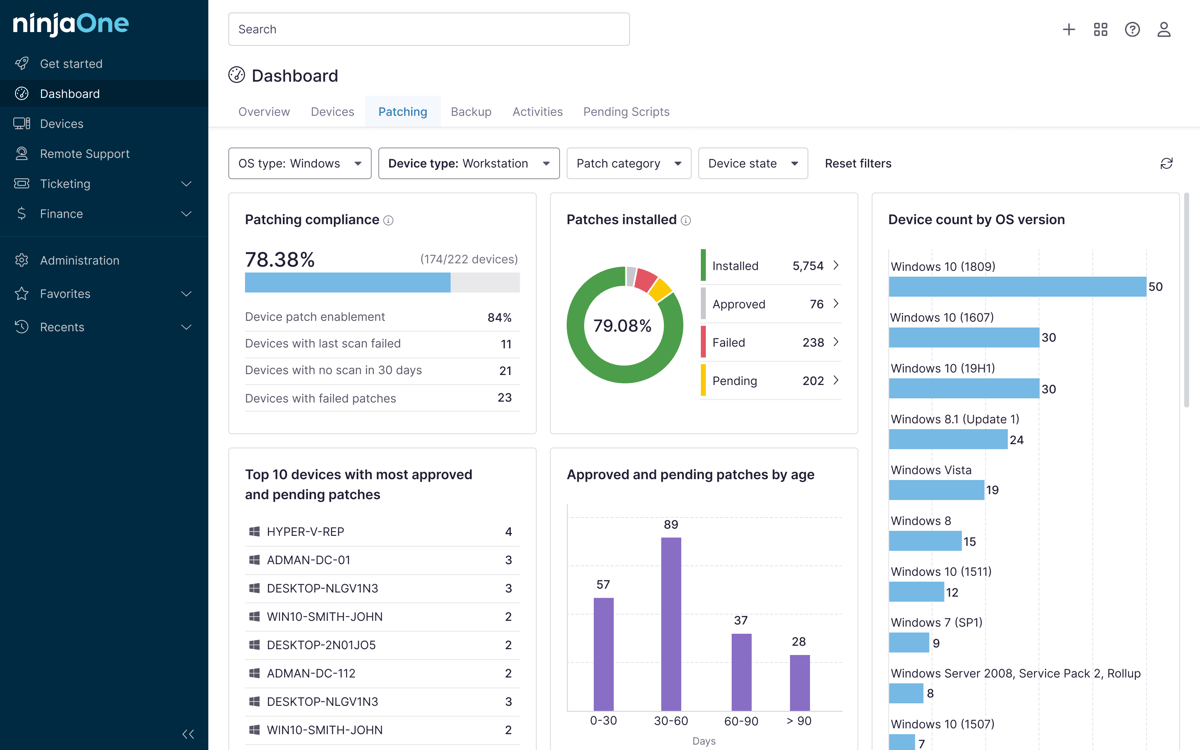
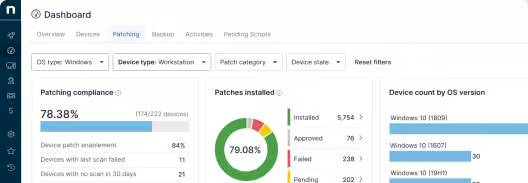
NinjaOne provides endpoint management capabilities and operational visibility across distributed environments, including cloud-connected systems. Organizations can use features such as endpoint visibility and device-level monitoring as inputs to broader cloud strategy decisions.
Conclusion
Choosing between AWS, Azure, and Google Cloud requires feature comparison and strategic alignment. The platform of your choice should align with governance models, cost structures, and security frameworks, among others, to ensure long-term success.
Organizations that evaluate provider differences with a structured governance lens are better positioned to support cloud transformation.
Related topics: