Key points
- Impacts of Delayed Patching: This increases cybersecurity risks and leaves organizations vulnerable to ransomware, phishing, and SQL injection.
- Unpatched Vulnerabilities Real-World Examples:
- Equifax (2017),
- WannaCry (2017),
- Target (2013),
- Marriott (2014–2018),
- MOVEit (2023), and
- Rackspace (2023).
- Consequences of Delayed Patching:
- Increased vulnerabilities,
- compliance and regulatory risks,
- operational and business risks, and
- hidden costs.
- Best Practices for Timely Patching:
- Prioritize critical patches,
- follow patch benchmarks,
- automate patch deployment,
- schedule system audits and patching routines, and
- test patches in controlled environments.
- Proactive Patch Management: Organizations should invest in this to safeguard sensitive data, maintain compliance, and protect long-term business resilience.
Cyber threats have become more sophisticated and pervasive, targeting organizations of all sizes and industries. This reality underscores the need for robust cybersecurity measures, including regular software updates, with concerns regarding the risks of delayed patching. Ignoring these updates not only exposes systems to known vulnerabilities but also signals a broader disregard for the foundational aspects of digital security.
Regularly applied patches fix vulnerabilities, enhance functionality, and protect sensitive data from unauthorized access. Neglecting this maintenance task can have dire consequences, including compromised system integrity, loss of data, and tarnished reputation. Therefore, understanding the importance of timely patching is essential for anyone responsible for the health and security of IT systems.
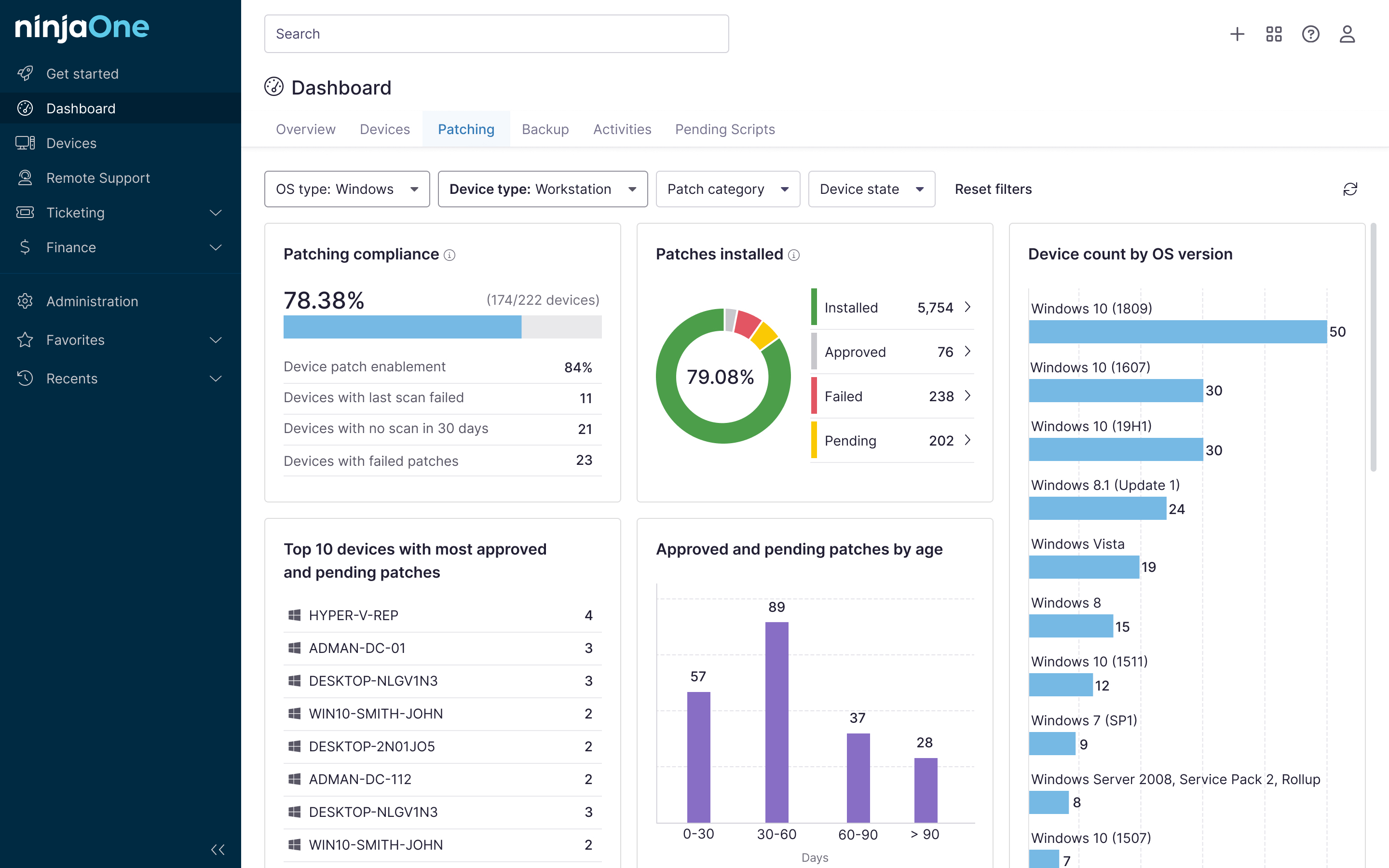
Never miss a critical update by automating patch deployment the moment they’re available with NinjaOne.
What are the risks of delayed patching?
Software patching refers to the process of applying updates from software developers to existing applications, operating systems, or software packages. These patches address vulnerabilities, fix bugs, and sometimes add new features. In the cybersecurity ecosystem, patching plays a pivotal role by closing security gaps that could be exploited by attackers, making it a non-negotiable aspect of maintaining system integrity and security.
Key reasons for delayed patching in organizations
Organizations often face hurdles in maintaining a timely patching schedule due to the following:
- Resource constraints, including lack of time, manpower, or financial resources
- Compatibility concerns, with the fear that new patches might disrupt existing system operations
- Oversight due to inadequate patch management policies or simple human error
Such delays, irrespective of the cause, significantly compromise the security and functionality of IT systems. Delayed patching introduces several risks, including the following:
- Increased susceptibility to cyberattacks
- System inefficiencies and instability
- Exposure of sensitive information
- Legal and compliance violations
The pathway from unpatched vulnerabilities to system compromise is alarmingly straightforward. Attackers continuously scan for systems running outdated software to exploit known vulnerabilities. Once they find a way in, they can steal data, install malware, or gain unauthorized access, leading to data breaches and cyberattacks.
The risks of delayed patching: A closer look
Increased vulnerabilities
Vulnerabilities in software are akin to unlocked doors for cybercriminals and hackers. They use sophisticated tools and techniques to find and exploit these weaknesses, gaining unauthorized access to systems. When software updates are ignored, these doors remain open, providing cybercriminals with a clear path for intrusion.
Real-world examples of massive breaches due to unpatched systems
Historical incidents show the devastating impact of delayed patching. These breaches often result from attackers exploiting well-known vulnerabilities that had patches available but weren’t applied. The following is a relatively short list of some of the major known breaches of the last decade or so:
- Equifax(2017): An exploited Apache Struts vulnerability led to 147 million records being compromised. Legal and financial repercussions followed, but Equifax remains operational with significant revenue.
- NotPetya (2017): Attributed to Russian state-sponsored actors, this destructive wiper—disguised as ransomware—caused an estimated $10 billion in global damages, making it the costliest cyberattack ever recorded.
- WannaCry (2017): This attack exploited an unpatched Windows SMB vulnerability using the EternalBlue exploit despite a patch having been available for nearly two months; the attack infected over 200,000 systems across more than 150 countries—including the NHS, FedEx, Deutsche Bahn, and Telefónica—and caused an estimated $4 billion in damages globally.
- Target (2013): Unpatched third-party vendor systems compromised 110 million people’s data, which remains a significant PR crisis for Target.
- Marriott (2014–2018): Unpatched software in a system acquired by Marriott resulted in 383 million records being compromised. Despite initial struggles, Marriott’s valuation remained strong, with ongoing investigations.
- U.S. voter registry (2017): An unpatched server compromised the records of 198 million voters, sparking widespread speculation and concern around voting security.
- MOVEit (2023): The Cl0p ransomware gang exploited a zero-day SQL injection vulnerability in Progress Software’s MOVEit Transfer, exfiltrating data in May 27–31, 2023, before a patch was even available. By mid-2024, confirmed victims had grown to at least 2,773 organizations and nearly 96 million individuals, including the BBC, British Airways, and multiple U.S. federal agencies. Critically, many victims weren’t direct MOVEit users but were exposed through third-party vendors, illustrating how unpatched software in one part of a supply chain can cascade across hundreds of downstream organizations.
- Rackspace (2023): Rackspace Technology was hit by a ransomware attack that exploited a zero-day in Microsoft Exchange Server (CVE-2022-41080). Although a patch existed, Rackspace hadn’t updated, resulting in significant service disruptions.
The AI-driven compression of the patching window
The urgency of timely patching has intensified dramatically in recent years, driven by attackers’ increasing use of artificial intelligence to identify and weaponize vulnerabilities at unprecedented speed. According to IBM’s 2026 X-Force Threat Intelligence Index, vulnerability exploitation was the leading cause of cyberattacks in 2025, accounting for 40% of all observed incidents, with AI tools enabling attackers to move from scanning to active exploitation faster than ever before.
The window organizations once had to respond is also rapidly closing; average time-to-exploit has collapsed from around 30 days in 2022 to just five days in 2025, and Mandiant’s M-Trends 2026 report found that 28.3% of CVEs are now exploited within 24 hours of public disclosure. With around 40,000 vulnerabilities disclosed in 2024 alone, the combination of AI-accelerated attacks and mounting vulnerability volume means that delayed patching, even by days, now carries substantially greater risk than it did just a few years ago.
Compliance and regulatory risks
Failure to patch within a “reasonable time” can lead to noncompliance with HIPAA, PCI DSS, GDPR, ISO-27001, NIS2, DORA, SEC’s cybersecurity disclosure rules, and FedRAMP. Moreover, these compliance and regulatory violations may translate to hefty fines, piling up on existing burdens brought up by the consequences of delayed patching.
Operational and business risks
Unpatched bugs may seem minor, but they can escalate when they’re already causing system downtime. This disruption can impact earnings through productivity loss. Additionally, if the event becomes public, it may lead to reputational harm that can make some customers lose their trust in the organization.
Hidden costs
Another topic not discussed much is the cumulative costs of the consequences caused by delayed patching. These are the costs that impact business finances aside from hefty fines and revenue cuts due to customer loss. Hidden costs include the following:
- Accumulated vulnerabilities: Longer patching cycles are the result of unpatched systems accumulating The more patches pile up, the more complex and time-consuming the eventual update process becomes, often requiring more downtime and staff hours.
- Higher remediation costs: Breach response isn’t cheap, especially for urgent incidents. The cost may include emergency labor, third-party services, overtime pay, and more. In many instances, remediation costs are higher than proactive patching, proving that prevention is still more ideal and viable.
- Technical debt: Over time, unpatched environments may require complete system overhauls or risky workarounds, making future updates more disruptive and expensive. Some of these systems may become obsolete and are accounted for as legacy tools, leaving businesses with additional replacement costs and migration challenges.
Ransomware, phishing, and SQL injection attacks are types of cyberattacks that exploit unpatched systems. These attacks disrupt operations, steal information, and even hold data for ransom. The financial and reputational repercussions of these attacks can be catastrophic. Businesses may face direct financial losses, regulatory fines, and a loss of customer trust, which can take years to rebuild.
Get a visual breakdown of the dangers behind delayed patching by watching this short video: “The Risks of Delayed Patching: A Guide to Fix Slow Patching.”
Patch management: A path toward mitigating cyberattacks
Patch management is a systematic approach to managing software updates on a computer system. It involves acquiring, testing, and installing multiple patches to a computer system under one’s administration. Its importance can’t be overstated as it plays a crucial role in closing security gaps and ensuring the smooth operation of IT systems.
Effective patch management significantly reduces the window of vulnerability, thereby minimizing the risk of cyberattacks. By ensuring patches are applied in a timely manner, organizations can protect themselves against the exploitation of known vulnerabilities.
Implementing a robust patch management system involves the following:
- Regularly monitoring for new patches released by software vendors
- Assessing the relevance and urgency of applying each patch
- Testing patches before widespread deployment
- Documenting the patching process for audit and compliance purposes
This systematic approach helps prevent data breaches by ensuring that vulnerabilities are promptly addressed.
What are best practices to prevent delayed patching?
1. Prioritizing patches based on threat severity
Organizations should assess and categorize vulnerabilities based on their severity, potential impact, and likelihood of exploitation. This prioritization helps in allocating resources to patch critical vulnerabilities first.
2. Following patch benchmarks
Each patch has a different urgency level. In addition to prioritizing severity, you should consider the “window of exposure.” This pertains to the period during which attackers can exploit a known vulnerability.
Here’s the timeline on how fast a patch should be applied that most security teams follow:
- Critical patches: ideally within 24–72 hours. These patches typically address vulnerabilities with known exploits or those rated high impact to confidentiality, integrity, or availability. Applying them immediately is essential as attackers often weaponize these vulnerabilities within hours of public disclosure. CISA’s Known Exploited Vulnerabilities catalog now serves as a key reference point, requiring federal agencies to remediate listed vulnerabilities within 14 days.
- High severity: within a week. While not as urgent as critical vulnerabilities, high-severity flaws can still lead to significant attacks if left unpatched. A seven-day window balances the need for quick remediation with time for limited testing.
- Medium/low severity: scheduled with normal update cycles. Patches that address less exploitable issues can usually be bundled into routine monthly or quarterly updates, provided they’re monitored to ensure they don’t escalate in risk over time.
3. An automated patch deployment system
Automated patch management tools can streamline the patching process by doing the following:
- Automatically downloading and installing patches
- Scheduling patch deployment during off-peak hours to minimize disruption
- Providing reports on patching status and compliance
4. Regularly scheduled system audits and patching routines
Establishing a regular schedule for system audits and patching ensures that systems remain up to date and vulnerabilities are promptly addressed. This routine should include
- regular vulnerability assessments,
- scheduled patch deployments, and
- the continuous monitoring for new vulnerabilities.
Awareness and training programs can significantly enhance the security posture of an organization by doing the following:
- Informing employees about the risks of delayed patching
- Training staff on recognizing and responding to security threats
- Encouraging a culture of security mindfulness throughout the organization
5. Testing patches in controlled environments before broad deployment
Before deploying patches widely, they should be tested in a controlled environment to
- ensure compatibility with existing systems,
- identify any issues that could arise from the patch, and
- minimize the risk of disrupting business operations.
Never miss a critical update by automating patch deployment the moment they’re available with NinjaOne.
Streamline your patch management process
The risks associated with delayed patching are significant and multifaceted, impacting not only the security but also the efficiency and reliability of IT systems. By implementing best practices for patch management, businesses can significantly mitigate these risks and maintain the integrity and security of their digital assets.
Maintaining up-to-date systems through effective patch management becomes as vital as building resilience in your teams to protect against cyber threats, preserve customer trust, and ensure the long-term success of any organization.
Don’t leave your organization vulnerable—streamline your patch management process with NinjaOne’s automated patch management software to ensure a safe and resilient digital environment. Start your 14-day free trial or watch a free demo of the software.