
Key Points
- Establish Least Privilege: Build access with AGDLP group design and permission inheritance for a predictable, auditablemodel.
- Encrypt Data Everywhere: Enable SMB encryption per share and BitLocker (or EFS for narrow, user-specific cases) at rest.
- Harden the OS and Authentication: Disable unused roles and legacy protocols;audit NTLM usage and migrate to Kerberos.
- Audit with Purpose: Track permission changes and deletions rather than broad read activity; forward logs to a SIEM for centralized visibility.
- Back Up Data and ACLs:Preserve SDDL during backups and test restores regularly; this keeps ransomware or accidental deletion from breaking access control.
- Prove It Monthly: Publish an evidence packet covering ACL drift, encryption status, patch compliance, and access exceptions.
- Stay Within Support: Confirm the OS is inside Microsoft’s support lifecycle; reference ISO/IEC 27001:2022 in compliance documentation.
File servers don’t stay secure on their own. Access expands, data grows, and visibility fades, allowing minor issues to escalate into risks. Most hardening checklists overlook daily management tasks, such as access reviews, ACL backups, and documenting changes. This guide turns Windows file server security into a managed program with clear controls, consistent monitoring, and verifiable results.
Methods to build Windows File Server security through least privilege and encryption
Ensure your environment meets the following basic requirements before applying the methods in this guide.
General prerequisites:
- Active Directory domain with organizational units (OUs) and naming conventions already defined
- Data owners assigned per share and per top-level folder
- Group design standard for AGDLP or AGUDLP with clear naming conventions
- Baseline build checklist for the server OS and a defined patching window
- Evidence workspace for Access Control List (ACL) exports, audit logs, and monthly packets
- Confirmation that the file server OS is within Microsoft’s support lifecycle (Windows Server 2012/2012 R2 ESU ends October 13, 2026, while 2016 extended support ends January 12, 2027)
Method 1: Design least privilege with AGDLP
Start by implementing NTFS least-privilege access using the AGDLP model: Accounts > Global Groups > Domain Local Groups > Permissions. This creates a role-based access control (RBAC) structure in Active Directory (AD) that cleanly separates users, roles, and permissions. It defines who should have access and how permissions flow logically.
Use Case: Streamline user management during onboarding or offboarding.
Steps:
- Create role-based global groups in AD for readers and contributors per department and access level (for example, HR_Readers or Finance_Contributors).
- Create domain local groups that represent access levels on each data root or folder, such as HR_Data_Read or Finance_Data_Write, to define who can read or modify data in the shared folder.
- Nest each global group within the corresponding domain local groups to link users to permissions indirectly, allowing access to be managed through group relationships rather than direct ACL changes.
- Assign NTFS permissions to the domain local groups on the appropriate folders using the Security tab in File Explorer or PowerShell.
- Add users only to global groups. Avoid assigning individual users or global groups directly to ACLs to maintain clean and auditable access control.
- Document the data owner, who is responsible for approving access and regularly reviewing permissions, for each folder root.
Method 2: Build a canonical folder tree and keep inheritance
Once your access design is defined with AGDLP, build a canonical folder tree that supports your least-privilege model. This keeps your file structure predictable, simplifies permission assignment, and makes access reviews and audits easier to manage.
Use Case: Organizing departmental data with predictable access patterns.
Steps:
- Define a predictable and logical folder structure that reflects your organization’s departments, roles, and data types.
- Keep permission inheritance enabled by default to maintain consistent access control throughout subfolders.
- Break inheritance only for planned confidential areas where access must be tightly restricted and explicitly managed.
- Avoid using deny permissions unless they’re narrowly scoped and fully documented to prevent access issues.
- Set share-level permissions to Authenticated Users: Change, Read or Everyone: Read and enforce least privilege using NTFS ACLs instead to prevent mismatched configurations.
- Remove redundant folders, verify that inheritance remains intact, and make sure new departmental or project folders follow the same naming and permission model.
Method 3: Encrypt data in transit and at rest
The next layer of protection is encryption. It keeps data unreadable to unauthorized users even if intercepted or stolen. Encryption prevents data leaks and helps meet compliance requirements such as GDPR, HIPAA, and ISO/IEC 27001:2022.
Keep in mind that the three-year transition window from the 2013 edition closed on October 31, 2025, so ISO/IEC 27001:2013 certificates are no longer valid. Reference the 2022 edition and its restructured Annex A controls in any compliance-facing documentation.
Use Case: Protecting sensitive files shared across the network between departments.
Steps:
- Enable SMB encryption on each sensitive share or server. Use File Server Manager or PowerShell to turn on SMB encryption where clients support it. For example:
Set-SmbShare -Name "Finance" -EncryptData $true
Note: SMB encryption requires client support for SMB 3.x. Modern Windows clients (Windows 8, Windows Server 2012, and later) support SMB 3.x and automatically negotiate encrypted sessions when accessing encrypted shares. Linux and macOS clients must use SMB implementations that support SMB 3.x encryption (for example, recent versions of cifs-utils on Linux and modern macOS releases). Clients limited to older SMB versions (SMB 1.x or 2.x) can’t connect to shares where encryption is enforced.
Starting with Windows 11, version 24H2, and Windows Server 2025, SMB signing defaults are stricter than in earlier versions, where signing was only required by default for SYSVOL, NETLOGON, and domain controller traffic. Windows Server 2025 now requires outbound SMB signing by default; Windows 11, version 24H2 (Enterprise, Pro, and Education), requires both outbound and inbound signing by default. Guest fallback access is also disabled by default on Windows Server 2025 and Windows 11, version 24H2 (Enterprise, Pro, and Education), but Windows 11 24H2 Home still ships with it enabled.SMB encryption still isn’t required by default on any version, so continue to enable it explicitly per share as described above. If your file server or its clients run an older OS, don’t assume signing is already enforced; verify it directly with Get-SmbServerConfiguration and Get-SmbClientConfiguration.
- Use Encrypting File System (EFS) only for limited, user-centric scenarios where files must be encrypted with user-specific keys.
💡 EFS relies on user encryption certificates; without proper certificate backup or a configured Data Recovery Agent (DRA), encrypted files may become permanently inaccessible. For shared file servers or departmental data, prefer BitLocker for encryption at rest and SMB encryption for data in transit, which scale more reliably and avoid per-user certificate management.
- Turn on BitLocker on server drives that store shared folders or backups to encrypt entire drives and protect data at rest with centralized key management.
- Document which folders or shares require encryption based on sensitivity and compliance needs.
- Define and test verification steps to confirm that encryption is active. Use PowerShell commands such as Get-SmbShare and BitLocker management tools to verify encryption across protected paths.
Method 4: Harden the OS and services
A weak or unpatched operating system can undermine your entire Windows server security posture. Hardening the OS and its services reduces the attack surface and strengthens your defense against malware and privilege escalation.
Use Case: Preparing servers for production in secure environments.
Steps:
- Disable unused roles and features to reduce potential entry points. Use Server Manager or PowerShell to remove services not required for file serving, such as IIS, Telnet, or SMBv1.
- Restrict interactive logon to administrators only and block unnecessary access to the server console.
- Apply endpoint protection and antivirus software with proper exclusions for NTFS operations and backup tools.
- Audit NTLM authentication and migrate to Kerberos where possible since Microsoft is phasing NTLM toward disabled-by-default in upcoming Windows Server releases. Use the built-in NTLM auditing in Windows Server 2025 and Windows 11 24H2 to find remaining dependencies before they break.
- Require secure channel protocols such as SMB signing and TLS to enforce authenticated and protected communications. Also, use SMB encryption where encryption of file data in transit is required.
- Maintain a consistent monthly patch window to apply security updates and system fixes.
- Record successful patch installations and keep logs for audit and troubleshooting.
Method 5: Enable auditing that answers real questions
Effective Windows file server auditing focuses on providing actionable insights. Instead of logging everything, focus on events that answer key operational and security questions, such as who changed permissions, who deleted files, or who tried to access restricted data.
Use Case: Monitoring critical or confidential folders for unauthorized access or modification.
Steps:
- Configure auditing using Advanced Audit Policy Configuration through the Group Policy Management Console (GPMC) or the local policy editor. Avoid legacy audit policy settings, which may be ignored when advanced policies are in use.
- In GPMC, navigate to: Computer Configuration > Policies > Windows Settings > Security Settings > Advanced Audit Policy Configuration > Object Access > Audit File System.
- Enable Audit File System for both success and failure events.
- Apply NTFS auditing by adding System Access Control Lists (SACLs) to sensitive folder roots. Log permission changes, delete operations, and failed access attempts rather than broad read activity to reduce noise.
- Forward audit logs to your Security Information and Event Management (SIEM) or log management system to centralize visibility and correlation with other security events.
- Tag audit events with the responsible data owner to simplify investigations and accountability. Use consistent naming or metadata in your SIEM.
- Measure log parsing success and latency to confirm that your SIEM is ingesting and processing data reliably.
- Maintain at least 90–180 days of detailed logs or longer if required by compliance. Confirm that log rotation, backup, and integrity checks work properly.
Method 6: Protect against ransomware and mass change
Ransomware and mass file modifications can cause irreversible damage to your file server. In this method, you apply controls that detect and contain unauthorized changes while keeping recovery options available.
Use Case: Preventing ransomware from encrypting or deleting large volumes of files.
Steps:
- Use file screening through File Server Resource Manager (FSRM) to block or alert on risky file extensions (such as .exe, .js, or .bat) in shared folders where they’re not required. Install FSRM on the file server and apply file screening rules to specific folders or shares.
- Enforce least privilege on service accounts by granting only the permissions required and removing write access to sensitive data.
- Configure alerts for bursty modify or delete patterns that may indicate ransomware or bulk operations. Use FSRM or SIEM rules to detect this behavior.
💡 FSRM can provide basic, rule-based alerts, but it doesn’t perform behavioral or rate-based analysis and may miss bursty modification patterns. For reliable detection, use SIEM rules or dedicated ransomware or behavioral analytics tools that analyze file activity patterns and distinguish malicious behavior from legitimate bulk operations.
- Maintain offline or immutable backups that ransomware can’t alter and test them regularly to confirm that they restore correctly.
- Document the recovery cutover steps, including who initiates the restore, how data is validated, and how access is re-established.
Method 7: Back up data and ACLs together
Backing up files without their permissions can lead to broken access control after a restore. This method keeps both data and ACLs intact to preserve security and usability.
Use Case: Restoring files with correct access controls after accidental deletion or ransomware attacks.
Steps:
- Use backup tools that preserve Security Descriptor Definition Language (SDDL) to keep ACLs during backup and restore.
- Export ACLs from critical data roots nightly for added protection. Use PowerShell or icacls to export permissions and store the output securely alongside data backups. The general syntax is as follows:
icacls “<RootFolderPath>“ /save “<BackupFilePath>.txt“ /t /c
For example:
icacls “D:\DataRoot“ /save “D:\Backups\ACL_Backup\DataRoot_ACLs.txt“ /t /c
- Include a quick test in your backup routine to restore a small folder path and confirm that both data and permissions are restored correctly.
- Record each backup run, its completion status, and test results. Keep these logs for audits and operational checks.
- Adjust schedules, ACL export paths, and retention settings as your folder structure or data roots change.
Method 8: Operate access reviews and exceptions
Access permissions often drift over time due to ad hoc requests, role changes, and temporary needs. Regular reviews and a clear exception process maintain least privilege, ensure accountability, and support compliance.
Use Case: Preventing privilege creep in departmental folders.
Steps:
- Run quarterly access reviews with data owners to confirm that current permissions match business needs.
- Remove or escalate permissions that can’t be verified as business-required or approved by the data owner.
- Require each ad hoc permission request to include an owner, a reason, compensating controls if needed, and an expiry date.
- Configure AD or file server groups so temporary members are automatically removed after their approved access period ends.
- Track all temporary permissions in a simple tracker and confirm that expired access is revoked on schedule.
- Record data owner sign-offs in the evidence workspace to support audits and maintain accountability.
Method 9: Detect drift with ACL diffs and configuration checks
Over time, permissions and system configurations can change through manual edits or automation errors. This method helps you detect and correct drift early by comparing current ACLs and configurations to a known baseline.
Use Case: Detecting unauthorized permission changes or inheritance breaks on shared folders.
Steps:
- Compare nightly ACL exports from critical folders to a known baseline to detect unauthorized changes. Use PowerShell or text diff tools to identify added, removed, or modified entries.
- Generate alerts if a user account appears directly on an ACL. This indicates a policy violation that bypasses the AGDLP structure.
- Review changes where inheritance has been disabled unexpectedly, which can isolate folders or create access gaps.
- Monitor group scope changes, such as a Global Group becoming a Universal Group, or Domain Local Groups gaining new members from unexpected sources.
- Maintain a configuration checklist that includes SMB settings, audit policies, and encryption status.
- Verify the checklist monthly to confirm that critical configurations remain accurate and compliant.
Method 10: Publish a monthly evidence packet
Security work must be documented to prove that controls are operating as intended. This method formalizes the process of compiling and delivering monthly evidence that shows your file server’s security posture.
Use Case: Supporting internal and external audits with clear documentation.
Steps:
- Create one page per data owner summarizing ACL drift findings from the past month. Include the department’s folder paths, owners, and key security metrics.
- Add a section listing high-value audit events such as permission changes, failed access attempts, and investigation outcomes.
- Report encryption status for folders and volumes under each data owner. Confirm that BitLocker, EFS, and SMB encryption remain active and note any discrepancies.
- Document results from backup and restore drills, including success rates and any issues or improvements.
- List all access exceptions granted during the month with owners, reasons, expiry dates, and current status.
- Include two short timelines from recent investigations or incidents showing how they were detected, handled, and resolved.
Best practices summary table
A strong security posture depends on consistent practices that deliver measurable value. This table summarizes the core techniques discussed in this guide, their purpose, and the benefits they provide.
| Practice | Purpose | Value delivered |
| AGDLP with inheritance | Predictable access | Faster changes and fewer errors |
| SMB plus at-rest encryption | Confidentiality | Safer data in motion and at rest |
| Focused auditing | Visibility | Faster investigations and audits |
| ACL backup with data | Accurate restores | Less downtime and rework |
| Monthly evidence packet | Accountability | Executive clarity and trust |
Automation touchpoint example
Automation ensures your controls remain consistent and minimizes manual oversight. Here’s an example workflow showing how scheduled jobs can streamline security operations for a Windows File Server.
- A nightly job exports ACLs using icacls for all protected folder roots, normalizes the data into CSV format, compares it against the baseline, and opens tasks for any anomalies detected.
- Another scheduled job verifies that SMB encryption is enabled on required shares, checks the success of SIEM parsing and log age, and appends performance metrics to a central dashboard.
- A monthly script assembles charts, tracks exception aging, and includes two investigation timelines and then compiles everything into a one-page evidence packet for compliance reporting.
NinjaOne integration
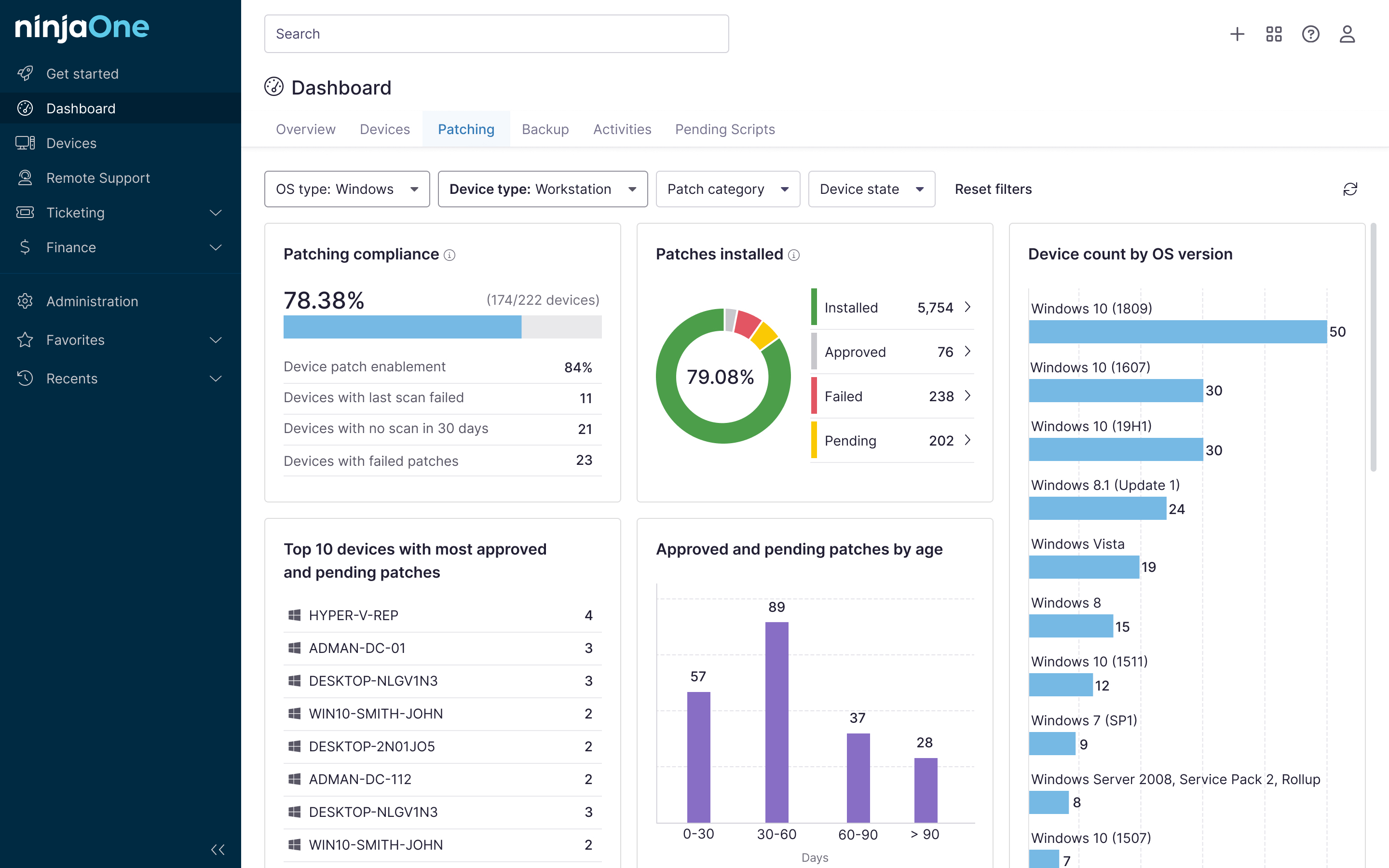
Minimal automation through NinjaOne helps maintain security hygiene without adding unnecessary complexity. Here’s how:
| NinjaOne feature | Function |
| Scheduled tasks | Run nightly ACL export scripts and compare permissions on protected roots. |
| Patch management | Verify that required services are running and that monthly patches are installed successfully. |
| Monitoring policies | Monitor file server health and service availability to confirm that logging agents and required services are running. |
See how NinjaOne Patch Management keeps file servers on a consistent patch cadence by starting a free trial of the software today.
Building long-term resilience in Windows file server security
File server security is most effective when roles control access, encryption is consistently enabled, auditing has a clear purpose, and recovery procedures are regularly tested. Pairing least privilege and system hardening with drift checks and evidence tracking reduces risk and keeps operations steady.
Related topics: