

Key Points
- Defined the Onboarding Scope: Clearly outline ticket submission, escalation paths, and self-service workflows so clients know how to engage with support from day one.
- Simplify Client Training: Use low-touch onboarding programs to help new MSP clients adopt services quickly without heavy technician support.
- Standardize Training Resources: Create consistent, repeatable materials (videos, guides, FAQs) that enable clients to learn independently and reduce onboarding friction.
- Automate Training Delivery: Use automated workflows (e.g., role-based onboarding, behavior-triggered training) to ensure every client receives the right training at the right time.
- Track and Optimize Performance: Monitor KPIs like ticket accuracy, CSAT, and engagement to continuously improve onboarding effectiveness.
- Leveraging MSP Tools for Scale: Use platforms like NinjaOne to centralize automation, knowledge management, and reporting for efficient, data-driven onboarding.
For many SMBs new to managed services, the first few weeks after signing an SLA can feel overwhelming and confusing. New systems, unfamiliar support processes, and different modes of communication can slow adoption, leaving issues unsolved and managed services unutilized.
A standard client onboarding training program guides first-time MSP clients on properly using self-service resources. This helps clients understand where to go for support and what to expect at each step without overwhelming technicians.
For a quick visual overview, watch our video guide on How to Offer Low-Touch Training for New MSP Clients.
5 strategies to build a scalable low-touch MSP onboarding program
New clients are left in the dark without properly structured onboarding strategies, often leading to confusion, misaligned expectations, and increased ticket volume. Low-touch onboarding strategies help MSPs empower clients to effectively utilize services, reducing the need for live training sessions.
📌 Prerequisites:
- Documented onboarding workflow (e.g., ticket creation and escalation)
- Defined onboarding roles to oversee training delivery to clients
- Centralized knowledge base or documentation
- Capacity to produce reusable training assets
Strategy #1: Define the scope of your MSP client onboarding process
Proper information dissemination is the key to mutual success for first-time clients. MSPs should consider which competencies clients should learn to minimize friction and smooth out escalation processes.
Standardize MSP ticketing workflows for new clients
Provide an overview of existing ticketing systems, including the required information clients should provide to generate clear, complete submissions. Onboarding new clients regarding ticket monitoring workflows keeps clients in the loop, reducing repeat inquiries.
When submissions are complete and their status is visible, noise drops, letting technicians focus on critical services to shorten MTTR.
Set clear support expectations and ticket priorities
The definition of “urgent” may vary per client, leading to higher ticket volumes and the potential emergence of false emergencies. Prevent this by defining critical incidents and routine issues, alongside simple guidelines for assessing impact and urgency.
Setting this distinction early aligns clients and MSPs, ensuring critical issues get prioritized over small fixes while providing clients with predictable response expectations.
Define escalation paths and response expectations
Break down escalation paths to help clients understand how support processes work and who handles them. This ensures that clients understand how escalations are structured and that their issues reach the right expert.
Transparency raises awareness regarding typical response times while routing points of contact for service issues, feedback, and emergencies. Additionally, it reduces premature re-escalation, allowing technicians to focus on the right remediation at the right level.
Enable self-service support with clear client guidance
Show clients where to find self-service guides and what they can safely try before opening a ticket. This helps clients discern which issues to fix on their own and which to escalate.
Simply put, self-service can resolve minor issues quickly, cutting ticket volume so techs can prioritize critical issues.
Nowadays, modern self-service goes beyond static knowledge bases. AI-powered self-service portals can guide users interactively, suggest solutions in real time, and reduce dependency on manual support.
Strategy #2: Create scalable low-touch training resources for MSP clients
Low-touch training tools allow MSPs to scale their client onboarding training programs with minimal manual intervention. Through them, new clients can navigate MSP workflows at their own pace, freeing technicians to focus on critical service issues.
In addition, providing unified resources across clients reinforces consistent communication. This standardizes the onboarding process across an MSP’s client base, ensuring consistent and smoother client interactions in every ticket submission.
Essential training materials for MSP client onboarding
The sample resources below work together to form an updatable, standardized training library that can be reused across clients:
- Short video walkthroughs: Quick demos of submitting tickets, checking statuses, or escalating issues.
- One-page process guides: Visual references for MSP workflows like ticketing, escalation, and points of contact.
- Knowledge base or FAQs repository: A searchable library that answers common client questions to help them resolve minor issues.
Strategy #3: Automate and enhance MSP onboarding with AI-driven workflows
Automating onboarding delivery ensures every client starts from the same baseline of knowledge. This saves time by eliminating repetitive explanations, ensuring users know how to leverage services correctly.
It also scales client training while preserving the same professional experience across every onboarding session. This provides MSPs with predictability and smoother communication as clients already know what to do from day one.
Beyond basic automation, MSPs can integrate AI-driven workflows to improve onboarding quality. AI can analyze user behavior, recommend next steps, and dynamically deliver training content based on client needs, reducing friction and accelerating adoption.
Best practices for automating MSP onboarding workflows
The following automated workflows ensure that new clients are trained consistently without requiring extensive technician supervision:
- Role-based onboarding automation: Deliver tailored training content based on user roles (e.g., end user vs. admin vs. finance stakeholder).
- Behavior-triggered training delivery: Trigger specific onboarding resources when users take actions (e.g., first ticket submitted → send “how to submit better tickets” guide).
- Ticket quality automation: Use smart forms or validation rules to ensure tickets include required details before submission.
- Cross-platform onboarding workflows: Deliver onboarding through email, service portals, Slack/Teams, and mobile notifications for better engagement.
- Auto-tagging and routing workflows: Automatically categorize and route tickets during onboarding to reduce delays and improve response times.
Strategy #4: Reinforce client knowledge with ongoing training and refreshers
Training strategies should also evolve as clients expand or recalibrate their processes and workflows. Employing periodic refreshers enables MSPs to guide clients in preventing outdated habits, reinforcing new workflows, and sustaining efficiency post-onboarding.
Craft recurring refreshers to keep client knowledge active and up to date rather than solely relying on one-time onboarding strategies. Support this strategy by crafting quarterly update emails that highlight new tips and service capabilities, among other key developments.
Distribute refresher videos for QBRs or periodic client check-ins to revisit key workflows, such as ticket submission and escalation paths. Consider incorporating automation strategies to ensure clients are informed when internal processes, SLAs, or tools change.
Strategy #5: Measure and optimize MSP client onboarding performance
Continuously monitor the impact of onboarding strategies on clients to detect potential gaps that can hinder client satisfaction. Incorporating this practice within client training strategies allows MSPs to refine training materials, improving future onboarding and periodic refresh strategies.
For example, fewer misrouted or incomplete tickets can indicate that clients understand how to submit tickets and escalate issues correctly. Additionally, reduced onboarding questions and strong KPI scores (e.g., ticket accuracy and CSAT) show clear materials, accessible self-service, and streamlined support workflows.
Other metrics to track onboarding performance include your self-service deflection rate, time to first value (TTFV), and end-user adoption rate. Remember to compile your findings and present them in QBRs to highlight the effectiveness of onboarding and refresher strategies to clients.
Example: Automated low-touch MSP client onboarding workflow
The following sample workflow combines all recommended onboarding strategies to create a structured and scalable training program workflow for new clients. It also spotlights how leveraging automation in client onboarding helps maintain training quality even with limited technician effort.
- After adding a new client, the PSA automatically triggers the onboarding sequence by sending a welcome email to target end users.
- Users receive short, low-touch resources, such as video walkthroughs for escalations and workflow guides, to help them get started quickly.
- After a week, an automated reminder reinforces learning without the need for manual follow-up.
- Optionally, MSPs can use email marketing platforms to gain insight into client participation and strategy effectiveness.
- During QBRs, insights regarding client operational impact are presented to highlight the success of training campaigns or formulate better strategies.
How NinjaOne automates MSP client onboarding and training
As MSP tools evolve, platforms increasingly incorporate AI-driven automation, intelligent ticketing, and predictive insights to further streamline onboarding and support workflows.
NinjaOne supports centralized onboarding workflows for new clients while providing MSPs with an overview of metrics that support impact analysis and trend assessments.
- Remote script deployment: Through the use of custom scripts, NinjaOne supports centralized onboarding of new MSP clients by automatically checking each device and delivering secure role-based training links.
- End user portal: NinjaOne’s self-service portal allows MSPs to guide user-initiated ticket creation through customizable ticket templates, streamlining client support interactions.
- NinjaOne Ticketing: This feature allows ticket trend analysis, allowing technicians to gather performance insights by filtering, analyzing, and tracking ticket submission trends.
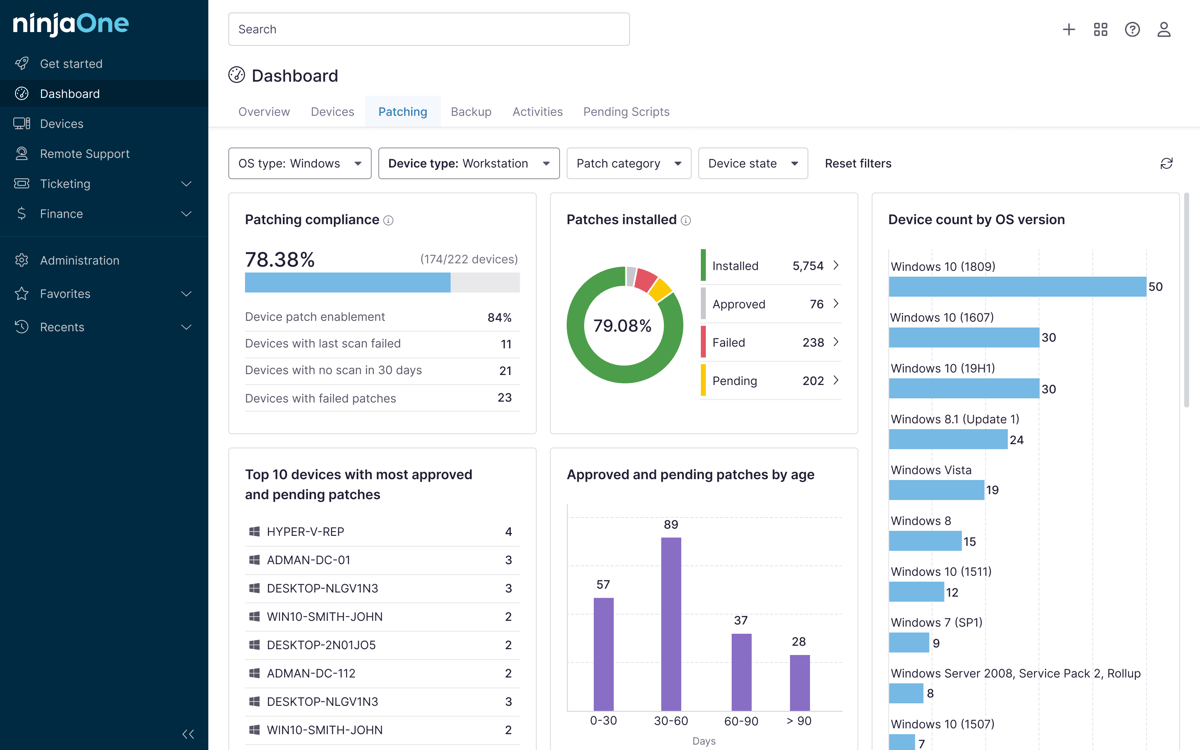
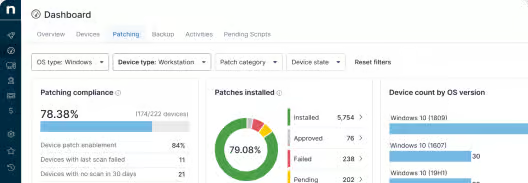
- Comprehensive reporting: Leverage NinjaOne’s reporting and analytics to review ticket trends, endpoint health, and service performance, helping you create context-rich client-facing summaries for QBRs.
How low-touch MSP onboarding improves efficiency and client adoption
Low-touch training helps first-time MSP clients learn the ropes of support and ticketing workflows effectively, with minimal technician intervention. This lowers ticket volume, allowing technicians to focus on maintaining critical services without risking end-user downtime.
Furthermore, low-touch training strategies reduce onboarding friction through definite scopes, scalable resources, and automated delivery of essential training materials. To improve long-term client satisfaction, leverage periodic refreshes and transparent communication when internal processes, tools, or strategies change.
Related topics:
- Selling Managed IT Services: 7 Steps to Scaling Your MSP to Support More Clients
- IT Client Onboarding Checklist for MSPs
- How to Establish a Client-Agnostic Cybersecurity Awareness Training Framework for MSP
- How to Re-Engage and Manage Unresponsive MSP Clients
- How to Re-Engage and Manage Unresponsive MSP Clients (Video)