
Key Points
- Enterprise organizations opt to outsource vulnerability scanning to MSPs and MSSPs to reduce the operational burden of managing complex, distributed IT environments.
- Building a scalable vulnerability scanning service requires defining the scope of service, standardizing client onboarding, and establishing recurring scanning workflows.
- Capabilities such as multi-tenant governance, centralized visibility, and strict segmentation are critical for providers managing multiple enterprise environments.
- A reliable VMaaS system integrates tools for remediation coordination, automation, ticketing, and compliance reporting. This strengthens long-term service value and client trust.
Enterprise organizations need to stay ahead of security weaknesses across increasingly complex environments. Cyberattacks present a recurring threat to enterprises and organizations, making it a good opportunity for Managed Service Providers (MSPs) and Managed Security Service Providers (MSSPs) to offer a high-value solution: vulnerability scanning as a service.
In this article, we will look deeper into how Vulnerability Management as a Service (VMaaS) can serve as a good selling point for IT service providers and how it delivers value when it is built on a structured service delivery framework rather than ad hoc assessments.
Explore NinjaOne Endpoint Management
Unify visibility and control across all devices to reduce complexity, improve efficiency, and strengthen security all from a single console.
Learn more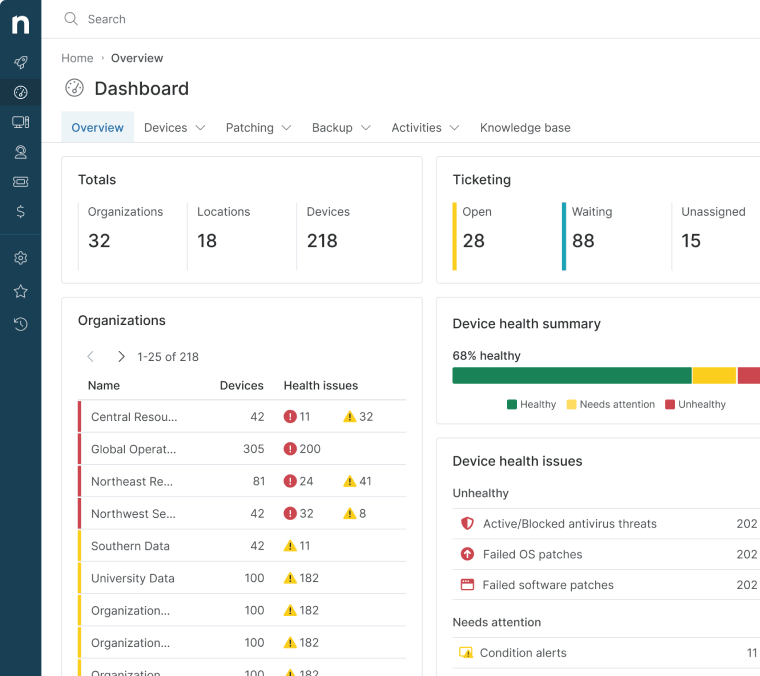
Why enterprise organizations outsource vulnerability scanning
Vulnerability scanning can be operationally demanding, especially for enterprise-level IT environments. Complex IT infrastructure often deals with:
- Hybrid on-premises, remote, and cloud infrastructure
- Remote and distributed endpoints
- SaaS applications and third-party integrations
- Multi-site operations and business-critical systems
Looking at these intricate setups, it is logical for enterprises to outsource vulnerability scanning to an external provider. Doing this can help address gaps by delivering dedicated expertise, structured workflows, and ongoing visibility without requiring clients to build that capability themselves.
Building a vulnerability scanning service
A VMaaS platform is built with a structured approach, ensuring that it delivers effective threat prevention and defense. Here’s what it typically encompasses:
Defining service scope
Building a vulnerability scanning service begins with defining coverage that helps prevent gaps in scope and sets accurate expectations. This can also make the service easier to price and expand as client environments evolve. Providers are expected to establish visibility into:
- Endpoints and workstations
- On-premises servers and network devices
- Cloud infrastructure and hosted workloads
- Internet-facing assets and web applications
- Third-party software dependencies
- Business-critical systems with elevated exposure
Standardizing client onboarding
Service providers need to be consistent with the onboarding process to reduce setup errors and strengthen client confidence. Doing this can establish a strong foundation for long-term service scalability. Every new engagement should follow the same steps, which are:
- Asset discovery and initial inventory
- Scan authorization and environment access setup
- Environment segmentation and risk categorization
- Agreement on reporting formats and escalation contacts
Establishing recurring scanning workflows
Ongoing visibility for enterprise IT environments warrants a recurring workflow, not just regular assessments. This includes:
- Continuous and scheduled scan cadences
- Endpoint validation and coverage verification
- Vulnerability reassessment after remediation
- Reporting aligned to agreed delivery timelines
- Remediation status tracking between cycles
Operationalizing multi-tenant vulnerability visibility
Providers managing enterprise IT environments need centralized oversight without compromising client separation. This requires a well-planned architecture at both the operational and platform levels. Here’s how to operationalize multi-tenant vulnerability visibility:
Centralizing security visibility
A “single pane of glass” approach to environment visibility across all clients enables providers to manage a growing client base without losing operational control by tracking:
- Vulnerability severity across accounts
- Endpoint exposure and coverage status
- Remediation progress per client
- Compliance alignment and risk summaries
Maintaining tenant segmentation
To effectively enforce strict client separation in multi-tenant service delivery, providers must have:
- Data isolation between client environments
- Role-based access for both provider staff and client users
- Segmented dashboards with client-specific views
- Tenant-specific remediation tracking and accountability
Supporting enterprise reporting requirements
Enterprise clients require detailed reporting that serves their internal governance needs and aligns with client expectations, so it will be easier for stakeholders and auditors to act based on the data the report reflects. Providers should be able to deliver:
- Executive-level summaries with business risk context
- Compliance-aligned reports for frameworks like PCI DSS, HIPAA, or ISO 27001
- Remediation progress tracking over time
- SLA performance documentation
Coordinating vulnerability remediation
A clearly defined remediation path strengthens scan result delivery. Providers that connect discovery to resolution offer a defensible approach in vulnerability scanning to enterprise clients.
Aligning scanning and patch operations
Patch deployment should follow vulnerability discovery. Providers should coordinate:
- Handoffs between identified vulnerabilities and remediation tasks
- Patch deployment tracking by endpoint
- Validation scans to confirm resolution
- Compliance reporting tied to remediation outcomes
Defining escalation and SLA workflows
Vulnerabilities present different levels of urgency, so structured escalation workflows should define:
- Severity classifications and escalation triggers
- Remediation timelines by severity level
- Exception handling and risk acceptance procedures
- Ownership and accountability at each stage
Maintaining continuous validation
Continuous validation reinforces accountability and strengthens client confidence by running follow-up scans that verify if:
- Patches have been successfully deployed
- Exposure has been measurably reduced
- Endpoints meet compliance baselines
These factors should confirm whether a vulnerability is gone or ultimately resolved.
What providers should prioritize in vulnerability platforms
Operational scalability plays a big role when choosing a VMaaS platform. Here are some features to consider:
Multi-tenant visibility
An ideal VMaaS platform should offer tools and capabilities such as cross-client dashboards, tenant segmentation, and centralized management without separate logins per client.
Automation
Automation has reduced errors that manual workflows are susceptible to. It also helps with:
- Continuous and scheduled scanning
- Automated risk prioritization and alerting
- Report generation and distribution
- Workflow triggers connected to remediation tasks
Cloud and hybrid visibility
Modern IT environments have shifted to cloud platforms and services to carry out operations. This evolution involves enterprise IT infrastructures that span cloud providers, hybrid infrastructure, and distributed applications. A prospective VMaaS platform should have native visibility across all of them without requiring disparate tools for each environment.
Remediation coordination
Enterprises should prefer VMaaS platforms that efficiently integrate patch management and ticketing solutions into their workflow. This helps enforce accountability, simplify client reporting, and expedite issue resolution.
Common vulnerability scanning service mistakes
MSPs and MSSPs may encounter bottlenecks due to common mistakes, which include operational and structural failures. Here are some of them:
Treating vulnerability scanning as a one-time engagement
A single assessment captures only a snapshot of an enterprise environment’s status. This doesn’t cater to an ever-changing enterprise environment, which can be exposed to the introduction of new vulnerabilities.
Delivering reports without remediation guidance
Providers should offer effective workflows and action plans when findings reflect issues within the environment.
Maintaining fragmented reporting workflows
Fragmented reporting may present inconsistency in data, creating confusion and making it harder to demonstrate service value or meet compliance requirements.
Failing to prioritize vulnerabilities operationally
Context is needed along with severity scores to reflect true business risk. Neglecting to tailor the scanning frequency and scope to the specific risk profile of each client can lead to inefficient resource allocation and a failure to address the most critical threats in real time.
Overlooking client segmentation
VMaaS providers are expected to enforce strict tenant isolation to mitigate operational errors, prevent risky data exposure, and loss of client trust.
Scaling vulnerability scanning services
Scaling a vulnerability scanning service requires operational maturity across every stage of delivery. Providers should invest in:
- Centralized governance frameworks that apply consistently across all clients
- Automation across scanning, reporting, and remediation workflows
- Documented onboarding, escalation, and exception procedures
- Regular service reviews to track progress and adjust scope
These structures reduce the per-client overhead that would otherwise limit how far the service can grow.
Start a free trial of the #1 endpoint management software on G2
No credit card required, full access to all features.
Conclusion
Offering vulnerability scanning as a service (VMaaS) to organizations with enterprise-level environments requires a service delivery framework that supports continuous visibility, structured remediation, multi-tenant governance, and scalable operations. Providers should be capable of providing continuous visibility, multi-tenant governance, remediation integrations, automation tools, and operational maturity.
Related topics: