With the flood of security buzzwords over the years, many non-technical stakeholders often mistake Zero Trust as just another one. The truth is, Zero Trust isn’t just another fancy term; it’s a strategic security model that only needs to be explained in terms leaders already understand. That’s how MSPs can get leaders on board and encourage smarter security investments.
This guide answers the question “What is Zero Trust architecture?” and explains how to communicate it to business leaders in a way that aligns with their priorities.
Prefer video? Watch “How to Explain Zero Trust Architecture to Business Leaders Without Getting Technical” for a visual breakdown of the topic.
Fragmented tools create blind spots and inefficiencies.
Business-aligned definitions and analogies
Start by introducing business leaders to the core principles of Zero Trust architecture using plain definitions and relatable analogies:
| Concept | Business-friendly definitions | Analogy |
| Zero Trust | A security model that assumes no user, device, or application is safe until verified inside or outside the network. In simple terms: “Never trust, always verify.” | Even if you’re inside the building, you still need your badge to open every door. |
| Least privilege | Users and systems are granted only the minimum access rights required to do their job, and nothing more. | Like giving one officer the key to one room they need, not the entire office |
| Continuous verification | Identity, device, and behavior are rechecked throughout the session. | Similar to airport security checking your boarding pass at multiple checkpoints |
| Assume breaches | Operates under the mindset that a breach may have already occurred. | Like installing motion sensors inside a vault in case someone slips past the front door |
Communicating benefits in business terms
Business leaders are focused on running and growing the company. They may not be concerned with the complexities of Zero Trust architecture, but they are concerned with how it protects their business, reduces risks, and supports growth. That’s why the conversation should center on benefits.
Here are key benefits to highlight:
- Risk containment: Zero Trust architecture limits the blast radius of attacks, preventing threats from spreading across the organization.
- Compliance confidence: It supports audit, regulatory, and insurance requirements, easing compliance pressures.
- Remote work readiness: Policies follow users wherever they work, not just within office boundaries.
- Operational continuity: Minimized disruption from compromised accounts or devices.
- Client reputation: Protects brand trust by reducing the chances of public breaches.
The focus should always go back to business continuity, cost control, and resilience, which business leaders value most.
Visual and storytelling techniques
One of the best ways to simplify Zero Trust architecture is through visuals and storytelling. Both translate technical concepts into something business leaders can see and relate to.
Visual suggestions:
- Before/After diagram: Contrast a flat network with segmented Zero Trust access to highlight the added security benefits at a glance.
- Access Decision Flow: Show how device, identity, and behavior checks work together in real time.
- Dashboard-style example: Display who accessed what, when, and why, making the control and visibility tangible.
These visuals make it easier to understand deeper concepts of Zero Trust while keeping the explanation simple and relatable.
Narrative use-case:
“An accounting firm gives remote access to contractors. With Zero Trust, those users can only reach the invoicing system, not customer PII or admin portals. If one account is compromised, the risk is isolated.”
A phased explanation framework for clients
Knowing where to begin and how to wrap up a conversation with clients is crucial. A phased approach works best by moving the discussion from concepts to practical outcomes. Here’s a suggested flow when explaining ZTA to business leaders:
Start with a familiar problem
Always begin with a pain point the client recognizes and you can solve (e.g., “We trust the network too much”). Framing it this way makes the issue relatable and sets the stage for your solution.
Explain the Zero Trust shift
Show how Zero Trust replaces implicit trust with dynamic controls. Access is continuously verified instead of being granted all at once, strengthening security and reducing blind spots.
Use real-world analogies
Analogies make the concept easy to digest, especially for non-technical decision-makers. For example: “It’s like needing card swipes for every room.”
Offer a small pilot project
Suggest a quick, low-friction starting point (e.g., MFA + restricted app access).
Highlight the long-term gains
Close by pointing to long-term gains: better audit logs, safer remote access, and reduced lateral movement if attackers get inside.
Optional automation insight
You can use this Entra ID script to prove to business owners that there are still risky accounts in the tenant. The script queries Microsoft Graph and highlights enabled accounts without MFA registered, as well as disabled accounts that still have MFA tied to them. This makes inconsistencies visible and actionable, showing that you’re addressing them directly.
📌 Prerequisites:
- Microsoft Entra ID (Azure AD) tenant (not applicable to on-premises Active Directory).
- PowerShell 7 or later.
- Microsoft.Graph PowerShell module installed.
- Permissions: Authentication Administrator, Privileged Authentication Administrator, or Global Administrator.
- Delegated scopes: User.Read.All, Directory.Read.All, UserAuthenticationMethod.Read.All.
- Internet access to graph.microsoft.com.
Step-by-step:
- Press Win + S, type PowerShell, right-click Windows PowerShell, and select Run as administrator.
- Run the following command to identify high-risk accounts without MFA enabled:
Connect-MgGraph -Scopes "User.Read.All","Directory.Read.All","UserAuthenticationMethod.Read.All"
Get-MgUser -All -Property Id,AccountEnabled,DisplayName,UserPrincipalName |ForEach-Object {$methods = Get-MgUserAuthenticationMethod -UserId $_.Id$mfaTypes = $methods.'@odata.type' -replace '#microsoft.graph.',''[pscustomobject]@{DisplayName = $_.DisplayNameUserPrincipalName = $_.UserPrincipalNameEnabled = $_.AccountEnabledMFAEnabled = ($mfaTypes.Count -gt 0)MfaMethodTypes = ($mfaTypes -join ', ')}} |Where-Object { ($_.Enabled -and -not $_.MFAEnabled) -or (-not $_.Enabled -and $_.MFAEnabled) } |Select DisplayName, UserPrincipalName, Enabled, MFAEnabled, MfaMethodTypes
NinjaOne platform integration ideas
NinjaOne gives you tools to put Zero Trust architecture (ZTA) into action. Here are a few integration ideas that bring it down to operations:
Automated configuration enforcement
Set up NinjaOne so that when a device strays from security baselines, it fixes itself automatically. This helps ensure devices always stay trustworthy.
Security posture reporting
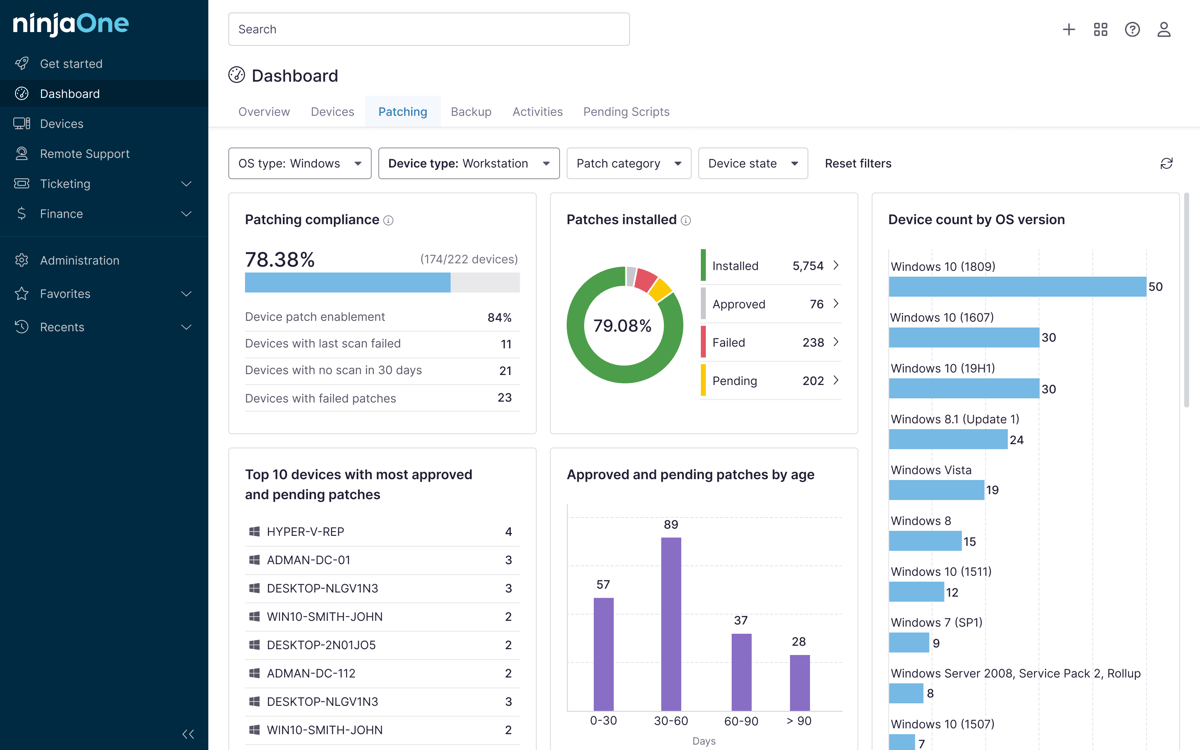
Use NinjaOne reports to show leaders how many devices are up to date, secure, or non-compliant. These reports act as proof that you’re enforcing trust controls.
AD user control from console
Manage user accounts and group memberships directly via NinjaOne (enable/disable, change privileges) so you can instantly enforce least privilege in a Zero Trust model.
Endpoint alerting for risky behavior
Set NinjaOne alerts for unusual device performance (CPU spikes, disk issues, service failures). These can act as signals to reconsider that device’s trust level.
Deploy proactive scripts
Deploy scripts via NinjaOne to disable dormant accounts or flag shadow admin accounts as part of a Zero Trust pilot.
Static security policies undermine Zero Trust environments.
What is Zero Trust architecture: Aligning security with business goals
Zero Trust is about securing access in smarter, more adaptive ways, where nothing is trusted by default. When MSPs frame it in business terms, use real-world examples, and explain it through a phased approach, clients will understand the “why” behind the strategy and are more likely to support it. This approach improves client buy-in for layered security strategies, showing how Zero Trust directly reduces risk and positions MSPs as strategic partners.
Related topics: